
Add every device’s wattage, convert to amps (amps = watts ÷ volts), then add 20 to 25% headroom and apply the 80% continuous-load rule. That figure tells you whether a standard domestic socket will do or you need a dedicated 16 A, 32 A or 63 A supply, or a generator. Before you switch anything on, check the installation against BS 7909 and get it tested.
TL;DR:
- Most AV devices draw less power in practice than their nameplates suggest, but sizing circuits should rely on the rated maximum unless measured otherwise.
- A typical wedding rig with speakers, lighting, and a mixer often exceeds a 13 A domestic socket, requiring a dedicated 16 A or higher circuit.
- Proper planning must account for power factor, the 80% continuous load rule, and safety margins when sizing generators and circuits.
- Earthing, RCD protection, and testing according to BS 7909 are crucial for safe temporary electrical setups at events.
- Using reliable load calculations and on-site measurement tools minimizes the risk of power failures caused by undersized supplies or overlooked devices.
Table of Contents
- How do you calculate AV power requirements?
- What do common AV devices actually draw?
- What mains voltage and sockets should you plan for?
- How do you size circuits and choose protection safely?
- How do you size a generator for AV loads?
- What earthing and testing does BS 7909 require?
- What’s the practical checklist for planning distribution?
- Which calculators and meters should you trust?
- What field experience actually teaches you about AV power
- How Jaks Party Power supports your AV power planning
- Primary standards and guidance
- Sources
- FAQ
How do you calculate AV power requirements?
Start with an inventory. Every projector, amplifier, mixer, switcher and lighting fixture has a nameplate rating printed on its rear panel or PSU, usually in watts. Where the plate only gives volts and amps, multiply them to get watts.
- List every device and its wattage. Use nameplate figures where you have them; use the typical ranges in the next section where you don’t.
- Sum the watts. Add a working allowance for anything you might plug in later, such as a phone charger or a laptop.
- Convert to kVA if you’re sizing a generator. Electronic AV loads rarely run at a power factor of 1, so divide your kW total by an estimated power factor (commonly 0.8 to 0.9 for mixed AV loads) to get kVA.
- Convert to amps. Amps = watts ÷ volts. On a 230 V UK supply, 3,000 W works out to roughly 13 amps.
- Apply the 80% continuous-load rule, then add 20 to 25% planning headroom on top for safety margin and future additions.
Here’s a worked example. A wedding band setup with speakers, a mixing amp, lighting rig and monitor system totals a few thousand watts. Dividing by 230 V gives a current that suggests a dedicated 16 A circuit rather than sharing a venue’s existing 13 A domestic ring.
What do common AV devices actually draw?
Nameplate figures are a starting point, not gospel. Real running power for electronics regularly sits well below the printed maximum, but you should always size for the plate figure unless you have measured the actual load.
- Projectors: small portable units draw 150 to 300 W; large venue or laser projectors can peak at 500 to 1,200 W, particularly at startup.
- Displays and TVs: a 43-inch panel typically draws 60 to 100 W; a 65-inch commercial display can pull 150 to 250 W.
- Power amplifiers and AV receivers: idle draw is often under 50 W, but a receiver driving multiple channels at reference volume can spike towards its rated maximum, sometimes 300 to 900 W for larger home theatre units.
- Lighting: an LED wash panel might use 150 to 300 W, while a single tungsten Fresnel or followspot can draw 500 to 2,000 W. That gap is the single biggest variable in most event power budgets.
- Small items: laptops (45 to 90 W), network switches (15 to 40 W), wireless microphone receivers (5 to 15 W each) and media servers (150 to 400 W) all add up faster than people expect once you’re running eight or ten of them.
Pro Tip: A rack of six wireless mic receivers and a media server can add nearly 200 W you never wrote down. Always budget a “small items” line, not just the headline kit.
What mains voltage and sockets should you plan for?
UK mains runs at a nominal 230 V, with a permitted statutory variation of +10% to −6%, so anywhere from roughly 216 V to 253 V, at 50 Hz ±1%, under the Electricity Safety, Quality and Continuity Regulations 2002. That tolerance matters when you’re close to a circuit’s limit, because a low-voltage moment draws slightly more current for the same wattage.
- A standard 13 A domestic socket suits small rigs: a couple of speakers, a mixer, modest lighting.
- Anything above a certain sustained wattage should move to a dedicated industrial socket, typically BS EN 60309 rated at 16 A, 32 A or 63 A.
- Equipment designed for 110 V or 120 V markets needs a proper step-down transformer, not a travel adaptor. Running it directly on 230 V risks immediate failure.
How do you size circuits and choose protection safely?
The 80% continuous-load guideline exists because breakers and cables are rated for intermittent peaks, not hours of steady draw. A circuit rated at 16 A should be treated as good for about 12.8 A of continuous AV load, not the full 16.
- Calculate your continuous load, then check it sits at or under 80% of the breaker or socket rating.
- Choose the right protective device. An MCB alone protects the cable; an RCBO adds personal protection against earth faults; an RCD does the same but needs pairing with overcurrent protection.
- Follow BS 7909’s grouping guidance, which recommends limiting the number of final circuits on a single 30 mA RCD to avoid one fault tripping everything downstream.
- Balance loads across phases on any three-phase supply, so lighting doesn’t sit entirely on one leg while sound sits on another, which causes uneven neutral loading and nuisance trips.
Pro Tip: Modern electronic loads, particularly switch-mode PSUs and LED drivers, generate residual currents that older Type AC RCDs weren’t designed for. Specify Type A or Type F protection for mixed AV and lighting circuits.
How do you size a generator for AV loads?
Generators are rated in kVA, not kW, and the gap between the two is power factor. Divide your summed kW total by an expected power factor, commonly 0.8, to arrive at the kVA figure a generator supplier’s load calculation would use as a starting point.
- Add planning headroom on top of your calculated kVA to absorb inrush current from motors and switch-mode supplies, which can briefly draw several times their running current at startup.
- Harmonic-rich loads, lighting dimmers and large LED rigs especially, distort the waveform and can confuse a generator’s automatic voltage regulation if the set is undersized.
- Check fuel consumption against your planned run time, and ask about parallel-set options if you need built-in redundancy rather than a single larger unit.
- For anything beyond a modest single-room setup, a proper load study from a generator supplier beats a rough estimate every time.
What earthing and testing does BS 7909 require?
BS 7909:2023 is the UK code of practice specifically written for temporary electrical systems at entertainment and event venues, and it sits alongside BS 7671 rather than replacing it. It covers design, installation, operation and inspection of exactly the kind of short-term AV and power rigs this article is about.
- Outdoor and temporary setups commonly use TT earthing rather than relying on the mains PME earth, because losing the PEN conductor on a PME system creates a genuinely hazardous fault condition.
- HSE Guidance Note GS50 recommends RCD protection on all portable equipment circuits and adequate provision of industrial sockets for higher-power items.
- Every temporary installation needs continuity, insulation resistance, earth fault loop impedance and RCD trip testing before it’s energised, in line with BS 7671 and BS 7909 practice.
- A failed RCD trip test isn’t a nuisance to bypass. It usually points to a genuine earth fault, and running the show on that circuit anyway is how people get hurt.
What’s the practical checklist for planning distribution?
Work through this in order, and don’t skip steps just because a booking is close.
- Finalise the equipment inventory, including anything a band, caterer or client might add on the day.
- Assign devices to circuits, keeping continuous load under 80% of each circuit’s rating.
- Choose your distribution board layout and confirm socket types match your equipment’s plugs.
- Plan cable routes, protecting anything crossing a walkway and keeping runs as short as sensible to limit voltage drop.
- Label every circuit and distro outlet clearly, so anyone troubleshooting mid-event isn’t guessing.
- Confirm isolation points so the whole rig, or just one section, can be shut down safely if needed.
Lead times matter more than people expect: dedicated supplies, generator hire and qualified electricians all get booked up around peak wedding and festival season, so confirm these weeks ahead, not days. If your load calculation pushes past a single domestic circuit, or the venue has no suitable outdoor supply, that’s the point to bring in a hired contractor rather than improvise. Real examples of venue distribution setups show how quickly a “simple” wedding can need a proper distro board.
Which calculators and meters should you trust?
Online calculators are useful for a first pass, but they have real limits. A basic event power calculator will sum your kW and estimate kVA and phase balance, but it won’t model inrush current, harmonics, neutral current or actual cable ampacity.
- Use a plug-in watt meter on individual devices to check real running power against the nameplate figure, since actual draw is often lower than stated.
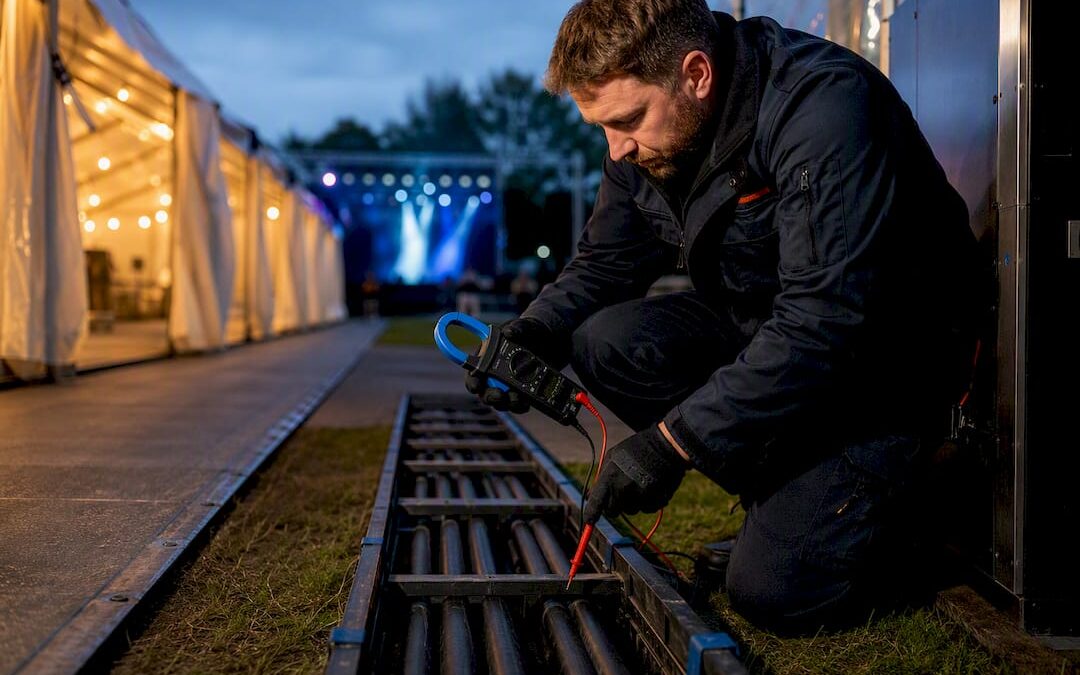
- Use a clamp meter on live circuits during a rehearsal or soundcheck to confirm your calculated load matches reality before doors open.
- If your total pushes past 32 A single phase, or you’re running a three-phase distro, treat any calculator output as a starting point for a proper load study, not a final answer.
What field experience actually teaches you about AV power
Most power failures at events trace back to two things: an underspecified supply and someone ignoring an RCD trip because the show had to go on. Neither is a design problem. Both are planning failures.
Three rules hold up on every job: never trust a nameplate figure for lighting without checking peak draw, never share a single RCD across sound and lighting on a big rig, and never treat a generator’s headroom as optional. Templates and staged planning guides, like Jaks Party Power’s planning stages resource, save more last-minute panic than any last-minute recalculation ever does.
— Rob
How Jaks Party Power supports your AV power planning
Once you’ve run the numbers, the practical part starts: sourcing the right generator, distribution board and someone qualified to sign it off. Suppliers offer generators, distribution boards, cabling and standby electricians for events in the Sussex area, backed by extensive electrical contracting experience.

If your calculation lands you above a single domestic circuit, or you’re running lighting and sound off separate supplies, that’s when a site survey earns its cost. It catches the earthing and phase-balance issues a spreadsheet can’t. For a checklist to bring to the survey, the event equipment hire checklist covers what to have ready, and corporate AV planners running fixed installations may also find the meeting room tech checklist useful for permanent setups. When you’re ready to size the actual kit, hire a generator sized to your calculated kVA, complete with the headroom your loads need, or get in touch for a site visit and a proper load study before you commit to a date.
Primary standards and guidance
- ESQCR 2002, regulation 27 sets the statutory voltage and frequency tolerance behind every watts to amps conversion.
- BS 7909:2023 governs temporary event electrical design and RCD grouping.
- HSE GS50 covers organiser responsibilities, RCD protection and socket provision.
- HSE’s event electrical safety pages outline testing and inspection duties before energising.
Sources
- The Electricity Safety, Quality and Continuity Regulations 2002 (regulation 27)
- BS 7909:2023 – Temporary electrical systems for entertainment and related purposes — code of practice
- Electrical safety at places of entertainment: Guidance Note GS50 (HSE)
- Event power distribution calculator (Toolgrit)
FAQ
How many watts does an AV receiver use?
Most home AV receivers idle under 50 W but can draw 300 to 900 W when driving multiple channels near reference volume, so size the circuit for the higher figure.
What does AV mean in electrical planning?
AV stands for audio-visual, covering the sound, video and lighting equipment whose combined power draw you sum and convert to amps or kVA when sizing a circuit or generator.
Can I use 100 W speakers with a 150 W amp or higher?
Yes, an amplifier rated higher than the speakers is generally safer than an underpowered one, since clipping from an overdriven low-power amp causes more speaker damage than headroom from a stronger unit.
Is it okay to leave an AV receiver on all the time?
Continuous idle draw is usually modest, but leaving high-power AV equipment permanently live on a circuit that’s already near its 80% continuous-load limit isn’t good practice; switch off what you don’t need running.