
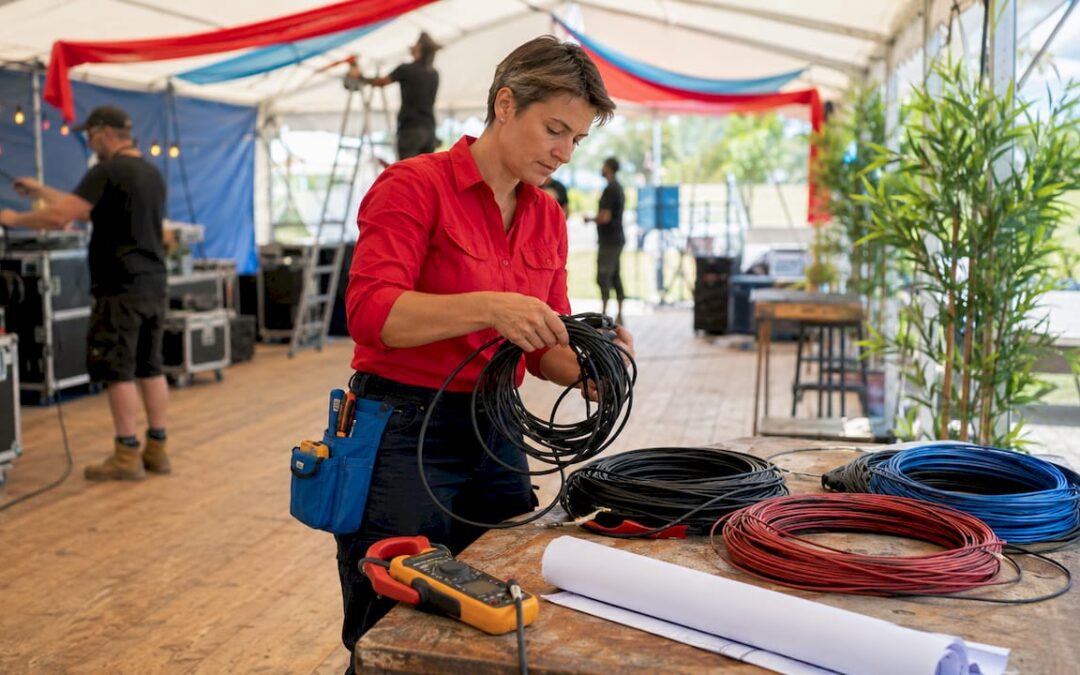
A networking event electrical setup is the process of planning and distributing power across every device, circuit, and system that keeps your event running safely. Get it wrong and you face tripped breakers, failed presentations, and a room full of frustrated attendees. Get it right and the entire event feels effortless. The industry standard governing all temporary electrical installations in the UK is BS 7671, the IET Wiring Regulations. Any compliant setup must meet its requirements before the first guest arrives. Jakspartypower, with over 40 years of electrical contracting experience in Sussex, builds every event power plan around this standard.
What are the essential electrical requirements for networking events?
Power infrastructure planning must start weeks before the event, not the morning of load-in. The first task is a full inventory of every device that draws power: projectors, screens, PA systems, LED lighting rigs, laptop charging stations, catering equipment, and any interactive displays. Each device has a wattage rating. Add them all up to find your total load, then group them by circuit type.
Load grouping is the practice of separating devices by their power characteristics. Audio visual equipment draws relatively stable, low-noise power. Catering equipment draws large, spiky loads when motors start. Lighting rigs, particularly dimmer-controlled fixtures, generate electrical noise. Mixing these on a single circuit causes interference, voltage fluctuations, and unexpected trips.
Once you have your total wattage, add a safety headroom of at least 20–25% above your calculated peak load. This buffer protects against simultaneous start-up surges, which are the moments when multiple devices power on at once and briefly draw far more current than their running wattage suggests.
- List every powered device with its wattage rating
- Group devices into categories: AV, lighting, catering, and general use
- Calculate peak load per group, not just total load
- Add 20–25% headroom above your peak figure
- Identify which circuits are mission-critical and must never be interrupted
Pro Tip: Collect technical riders from every vendor before you finalise your power plan. AV companies and caterers often have specific power requirements that are not obvious until you ask directly.
Outdoor events carry an additional layer of obligation. UK BS 7671 compliance requires weatherproof enclosures, elevated connections, and ground fault circuit interrupter (GFCI) protection on all circuits used in wet conditions. This is not optional. A formal test and inspection certificate must be issued before the event opens to the public.
How to select and configure generators and distribution boxes
Choosing the right generator is the single most consequential equipment decision in your power plan. Two generator types suit most networking events: standard diesel generators and inverter generators. The choice depends on what you are powering.
Inverter generators are the correct choice for sensitive audio visual equipment. They produce clean, stable sine-wave power with very low total harmonic distortion. Standard diesel generators produce power with more electrical noise, which can cause hum in PA systems, flicker in video displays, and unexpected resets in digital equipment. For a networking event where presentations and microphones are central, inverter output is worth the additional cost.
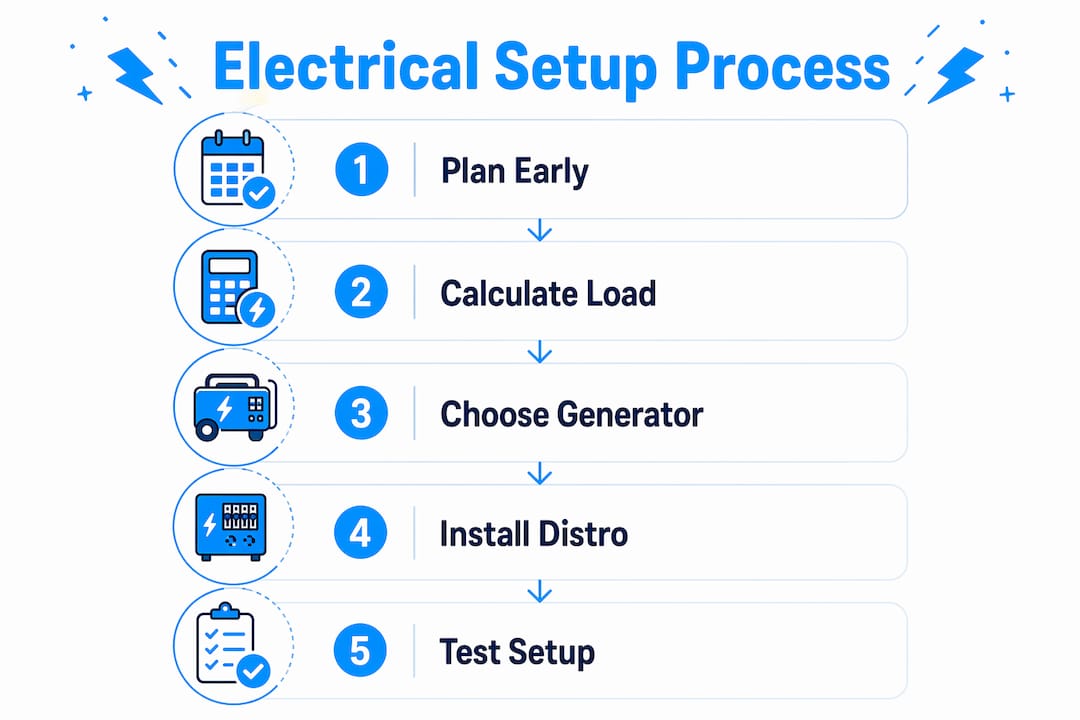
Generator placement matters as much as generator type. Generators placed 75–150 feet from the performance or presentation area keep noise levels manageable. Longer feeder cable runs do introduce voltage drop risk, so cable gauge must increase proportionally with distance.
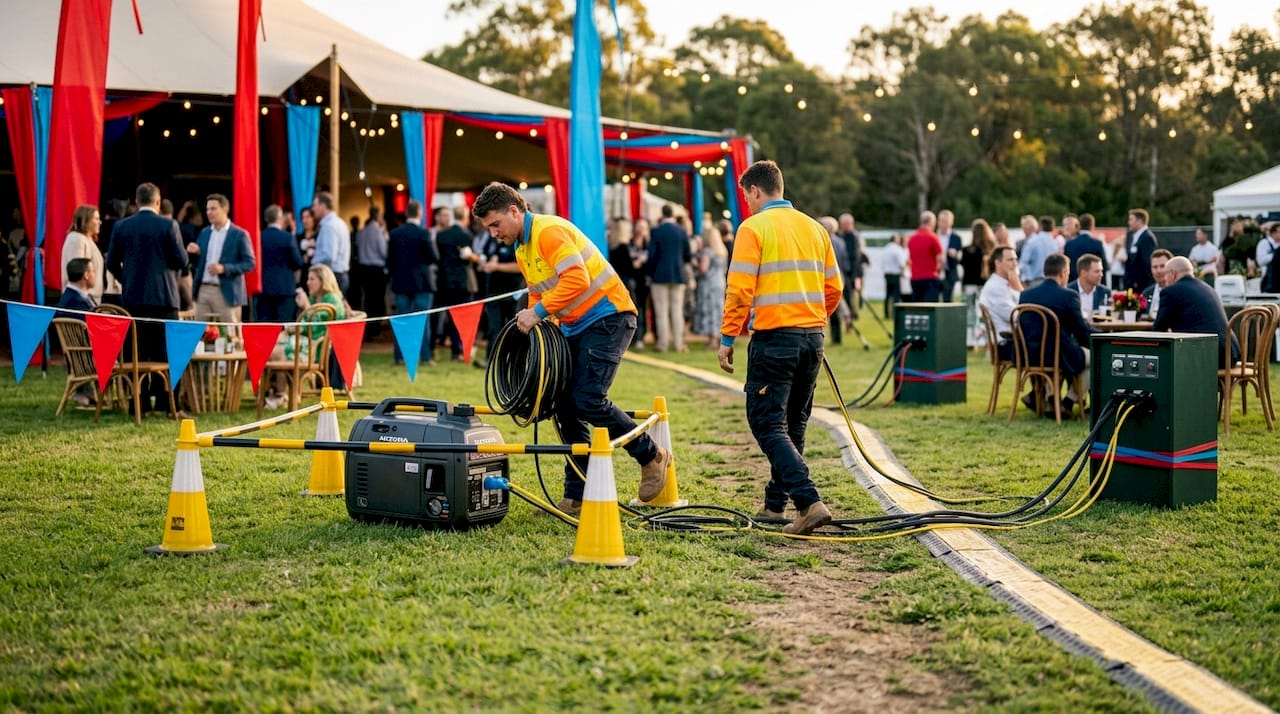
Once you have your generator, the distribution box (distro box) is the next critical component. A distro box takes the high-amperage input from the generator and splits it into multiple isolated circuits, each protected by its own breaker. Typical distro boxes provide 12–24 individual 20A outlets, plus 30A and 50A outputs for heavier loads such as large catering equipment or high-powered lighting rigs.
The configuration strategy that prevents the most failures is circuit isolation by system type. Here is the recommended approach:
- Assign a dedicated distro box or sub-distro to audio systems
- Assign a separate distro to lighting and dimmer packs
- Assign a third distro to catering and general power
- Run a dedicated circuit for any video or projection equipment
- Label every circuit clearly at the distro box and at the point of use
Separating distro boxes for audio, lighting, and video eliminates ground-loop hum and colour inconsistencies in video feeds. A fault on the catering circuit will not kill the PA. A dimmer pack causing interference will not affect the projector. Each system stands independently.
Pro Tip: Hire a generator with at least 20% more capacity than your calculated peak load. A 50 KVA road tow generator suits most mid-size networking events, but always confirm your load calculations first.
What are the best cabling and safety practices for event electrical setups?
Cable choice is where many event organisers cut costs and later pay for it. Undersized cables cause voltage drop and heat build-up, leading to equipment failures and, in worst cases, fire risk. Household extension leads are not rated for the sustained loads that event equipment draws. Professional-grade, heavy-gauge cables are the only appropriate choice.
For runs exceeding 100 feet, voltage drop becomes a measurable problem. The solution is to use local distribution points closer to the load, fed by larger-gauge feeder cables from the main distro. This keeps the final run to each device short and within safe voltage tolerance.
“Voltage drop silently causes equipment malfunction. Thin cables over long runs can cause flickering or resets in sensitive electronics. Use step-up cable gauge or local distribution points to maintain power quality.” — Power distribution for events
Cable management at a networking event serves two purposes: safety and professionalism. Cables crossing pedestrian routes must be covered with rubber cable ramps or run overhead. Cables near catering areas must be protected from moisture and heat. Any cable that could be tripped over or driven over by a vehicle needs physical protection rated for that load.
- Use only professional-grade, heavy-gauge event cables rated for sustained load
- Cover all floor-level cable runs with rubber cable ramps
- Elevate connections in outdoor or wet areas above ground level
- Use weatherproof enclosures for all outdoor distribution points
- Label every cable at both ends with the circuit it belongs to
- Test every circuit with a load before the event opens
Outdoor events require GFCI protection on every circuit in wet conditions. This is a BS 7671 requirement, not a recommendation. GFCI devices detect current leakage to earth and cut the circuit within milliseconds, preventing electrocution. Install them at the distro box level, not just at individual outlets.
How to coordinate with vendors and conduct pre-event testing
Vendor coordination is the step that most event organisers underestimate. Most system failures on event load-in days happen because a vendor plugs into a circuit they were not assigned to. A caterer borrows a socket from the AV distro. A lighting technician taps into a circuit already at capacity. The result is a tripped breaker at the worst possible moment.
The solution is early, structured communication. Contact every vendor at least two weeks before the event. Collect their power requirements in writing. Assign each vendor to specific circuits on your power plan. Share the plan with all parties so everyone knows what is allocated where.
- Send a power requirements questionnaire to all vendors at least two weeks out
- Conduct a site visit to identify available venue circuits and dedicated lines
- Map your full power plan against the venue’s existing infrastructure
- Assign each vendor to named circuits and confirm in writing
- Label all distro boxes and circuits as “Mission Critical. Do Not Unplug” where appropriate
- Physically cordon off distribution areas to prevent unauthorised access
Site visits are critical for identifying what the venue already provides and where its limitations lie. A venue may advertise “full AV facilities” but have only two dedicated circuits available. Discovering this on the day of the event leaves no time to bring in supplementary power.
Pre-event testing is the final safeguard. Testing venue power before event day takes approximately 20 minutes and prevents several hours of emergency troubleshooting during setup. Run every circuit under load. Check for voltage drop, tripped breakers, and any signs of overheating at connection points.
Pro Tip: Bring a clamp meter to the site visit. Measuring actual current draw on existing venue circuits tells you far more than any venue specification sheet.
Reliable event power plans classify circuits clearly and employ load management to avoid blackouts caused by last-minute equipment additions. Build a written circuit schedule and give a copy to your site manager, your AV technician, and your catering lead. When everyone knows the plan, unauthorised taps become far less likely.
Key takeaways
A compliant, well-planned networking event electrical setup requires load calculation, circuit isolation, professional cabling, and structured vendor coordination before a single cable is plugged in.
| Point | Details |
|---|---|
| Start planning early | Inventory all powered devices and calculate total load weeks before the event. |
| Isolate circuits by system | Assign separate distro boxes to audio, lighting, catering, and video to prevent faults spreading. |
| Use professional-grade cable | Heavy-gauge cables prevent voltage drop and overheating on runs over 50–75 feet. |
| Test before the event opens | A 20-minute pre-event test prevents hours of emergency troubleshooting during setup. |
| Coordinate vendors in writing | Assign every vendor to named circuits and physically protect mission-critical distro boxes. |
What I have learned from 40 years of event power setups
The most common mistake I see is treating electrical planning as an afterthought. An event organiser books the venue, confirms the caterer, signs off the AV company, and then calls a power specialist two days before the event. By that point, the layout is fixed, the vendor assignments are done, and there is no room to design a proper distribution system. Late involvement of power specialists leads directly to load balancing mistakes, audio noise, and system instability.
The second thing I have learned is that lighting and AV power are interdependent. Event organisers often treat them as separate problems for separate vendors. They are not. Dimmer packs generate electrical noise that travels back through shared infrastructure and corrupts audio signals. A lighting rig and a PA system on the same circuit will fight each other. The only fix is proper isolation, and that requires a coordinated plan from the start.
The third lesson is about tamper-proofing. I have watched a perfectly designed power system fail because a catering staff member unplugged a feeder cable to charge a phone. Labelling alone is not enough. Physical barriers, locked distro boxes, and a briefed site manager are the only reliable deterrents.
If you are planning a networking event and you are not certain your venue can handle the load, bring in a specialist before you commit to a layout. The cost of a proper assessment is a fraction of the cost of a failed event.
— Rob
How Jakspartypower supports event organisers with reliable power
Event organisers across Sussex trust Jakspartypower for generator hire, distribution boards, professional cabling, and event lighting products that meet BS 7671 requirements. The team brings over 40 years of electrical contracting experience to every booking, from small networking evenings to large-scale shows.

Jakspartypower’s standby service means a qualified engineer is on site throughout your event, ready to respond if anything needs attention. Every hire comes with equipment that is tested, maintained, and matched to your specific load requirements. Visit the Jakspartypower hire page to see the full range of equipment available, or contact the team directly for a tailored power plan built around your event’s needs.
FAQ
What is a distro box and why does a networking event need one?
A distro box splits a high-amperage generator or mains supply into multiple isolated circuits, each with its own breaker. This prevents a single fault from cutting power to the entire event.
How far should a generator be placed from the event area?
Generators should be placed 75–150 feet from presentation or performance areas to manage noise levels. Longer cable runs require heavier-gauge feeder cables to prevent voltage drop.
Does a temporary electrical setup need to comply with BS 7671?
Yes. All temporary electrical installations at UK events must comply with BS 7671 wiring regulations and require a formal test and inspection certificate before the event opens.
How do I prevent vendors from overloading circuits during setup?
Assign every vendor to named circuits in writing before the event, label all distro boxes clearly, and physically cordon off distribution areas to prevent unauthorised connections.
What is the difference between an inverter generator and a standard generator for events?
Inverter generators produce clean, stable power with low harmonic distortion, making them the correct choice for sensitive audio visual equipment. Standard diesel generators produce more electrical noise, which can cause hum and interference in PA systems and video displays.