
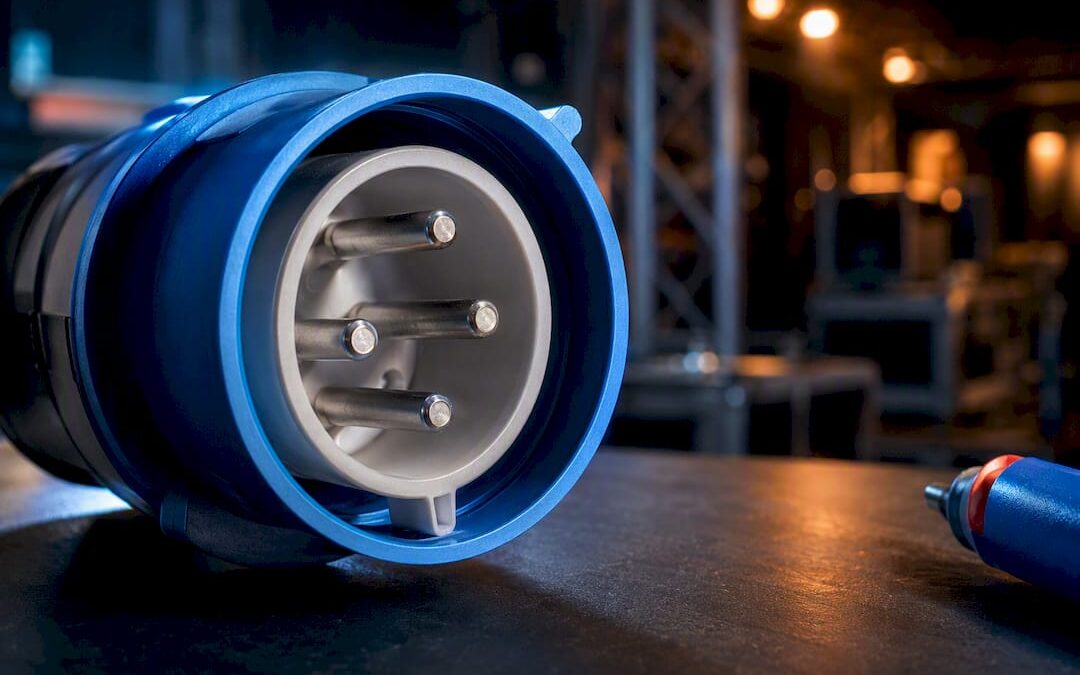
Ceeform connectors are the industrial pin-and-sleeve plugs, sockets and couplers standardised under IEC 60309, covering rated voltages up to 1,000 V and currents up to 800 A. The name endures from entertainment and events wiring, but the specification you actually order from is IEC 60309. Get the colour, pole count, clock position and IP rating right, and mismatches or failed inspections stop being a risk.
TL;DR:
- Properly matching the IP rating (IP44 or IP67) depends on whether the connector is fully mated or left uncapped, affecting outdoor reliability.
- Ceeform connectors typically come in configurations like 2P+E, 3P+N+E, or 3P+E, with pin count and configuration matching the supply voltage and load type.
- Colour coding and clock position are essential to prevent mismating, especially on generators, since a mismatch can cause connection failures despite identical colours.
- Matching the connector’s rated current, cable size, and upstream breaker is critical to avoid overload, with caution around optional pilot contacts that ensure interlock safety.
- Site inspections should include verifying terminal torque, seal integrity, and that IP ratings apply in the connected state to prevent water ingress and connector failure.
Table of Contents
- What is a Ceeform connector under IEC 60309?
- What pin configurations do Ceeform connectors use?
- How do colour coding and clock positions prevent mismating?
- Which IP rating do you need for outdoor event power?
- What current rating and cable size does a Ceeform connector need?
- How do you choose the right Ceeform connector for your job?
- What pre-use checks reduce Ceeform connector failures on site?
- Where do Ceeform connectors actually get used?
- What field experience teaches about Ceeform connector mistakes
- How Jakspartypower gets your event power connections right
- Sources
- FAQ
What is a Ceeform connector under IEC 60309?
“Ceeform” is trade jargon, not a formal standard name. The connectors trace back to CEE 17, a specification from the International Commission on the Rules for the Approval of Electrical Equipment, which was absorbed into IEC 309 and later revised as IEC 60309. Electricians on event sites still call the plugs “CEE” or “Ceeform” out of habit, even though every datasheet, tender document and inspection certificate references IEC 60309.
The standard sets the numeric envelope, including rated voltage, current, frequency and ambient operating range as specified in IEC 60309. Most event and construction gear sits well inside that, typically 16 to 125 A at 230 V or 400 V.
For procurement, cite the exact part: IEC 60309-1:2021 covers general requirements for plugs, socket-outlets and appliance inlets, while IEC 60309-2 handles dimensional interchangeability. The 2021 edition is the fifth, replacing the 1999 text and its amendments, and it added clarified classification and marking requirements. Quote the edition year in a spec sheet; older stock built to the 1999 rules can still turn up on hire shelves.
What pin configurations do Ceeform connectors use?
Pole notation follows the conductors carried: P for phase, N for neutral, E for earth. A 3P+N+E connector carries three phases, a neutral and an earth, five pins in total. Matching the pole count to the supply is the first filter, before you even look at current rating.
Common configurations you will encounter on site:
- 2P+E — single-phase, live and neutral plus earth, typically 16 A or 32 A for small tools and task lighting.
- 3P+E — three-phase without neutral, used for motors and some industrial loads.
- 3P+N+E — three-phase with neutral, five pins, the standard configuration for distribution boards feeding mixed single and three-phase loads.
- 4-pin and 5-pin variants — the practical shorthand for 3P+E and 3P+N+E respectively.
Cable-mounted plugs and connectors terminate flexible leads; panel-mounted sockets and appliance inlets fix to distribution boards, generators or fixed equipment. Couplers join two cables. Every moulded body carries a nameplate stamped with rated current, rated voltage, IP rating and the clock position, all four figures you need before ordering a replacement or matching an existing lead.
How do colour coding and clock positions prevent mismating?
Colour tells you the voltage band at a glance; clock position stops you plugging into the wrong one even if the colour looks close under site lighting. Both come from IEC 60309, and both matter more on a generator-fed temporary supply than almost anywhere else in electrical work.
The conventional colour bands:
- Yellow — 100 to 130 V (commonly 110 V site transformers)
- Blue — 200 to 250 V (standard single-phase mains)
- Red — 380 to 480 V (three-phase supplies)
- Black — 500 to 690 V (heavy industrial three-phase)
- Grey — 277 V (less common, mainly North American voltage bands)
Clock position, expressed in hours, indicates where the earth pin sits relative to a fixed keyway. The major keyway is set at 6 o’clock and the earth pin rotates in 30-degree steps, according to technical notes on the standard. A 6h blue 32 A plug will not mate with a 9h blue 32 A socket, even though the colour matches. Before connecting anything, check colour, pole count and clock position together. Any one of the three being wrong means the connector will not mate, which is the system working as designed rather than a fault.
Which IP rating do you need for outdoor event power?
IP44 covers splashing and small solid ingress, suitable for connectors under a marquee roof or inside a weatherproof distribution cabinet. IP67 covers temporary submersion and heavy dust, and it is the rating you want for anything exposed on open ground, near a generator, or standing in a puddle after three hours of rain.
Suppliers will often confirm the rating only applies when the connector is fully mated, a distinction worth confirming because an unmated connector left uncapped can drop several IP grades until it is capped or connected. A socket rated IP67 mated does not stay IP67 with the cap off.
Checks worth making on site or before hire:
- Confirm the rating on the datasheet applies mated, unmated, or both.
- Inspect gland seals and cable entry points for cracking or perishing rubber.
- Check the hinged cover or shutter closes fully and the seal gasket is intact.
- Look for correct IP marking stamped or moulded into the housing, not just printed on a sticker.
Pro Tip: Carry a handful of IP44 blanking caps in the site box. A connector left open and unmated overnight in the rain is the single most common cause of a “faulty” plug that is actually just full of water.
For anything outdoors, exposed to weather, or near a generator hire unit, specify IP67 as the minimum. Covered indoor runs from a distribution board to a bar or ticket booth can usually run on IP44 without issue.
What current rating and cable size does a Ceeform connector need?
Rated current classes run 16 A, 32 A, 63 A and 125 A as the common event and industrial bands, with larger installations sometimes running to 200 A and beyond. The connector rating has to match both the cable csa feeding it and the breaker protecting that circuit upstream. Fit a 63 A connector to a cable and breaker rated for 32 A, and the connector becomes the least of your problems.
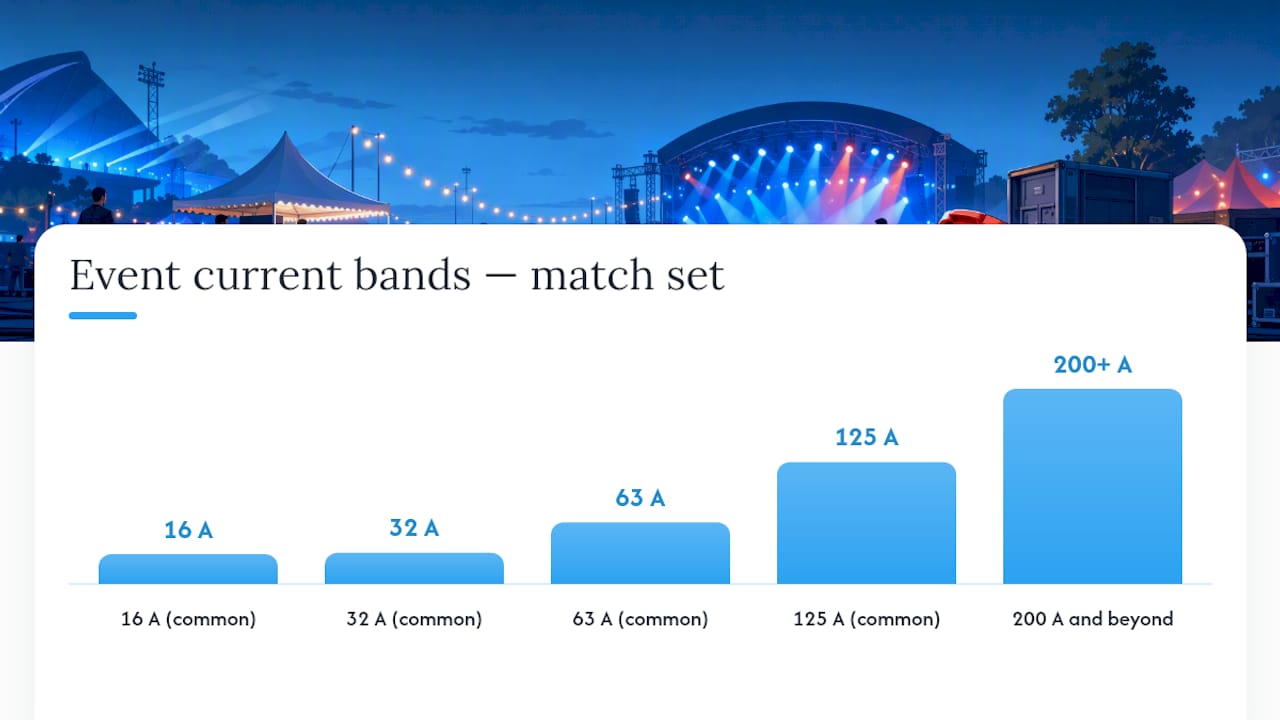
Match the plug, cable and protective device as a set rather than picking the connector in isolation, and get a qualified electrician to confirm conductor sizing against cable length and ambient conditions, since voltage drop over a long run can call for a heavier cable than the rated current alone suggests.
On 63 A and 125 A connectors you will often find a pilot contact, a smaller auxiliary pin that closes after the main power pins engage and opens before they separate. It is wired into an interlock so the breaker cannot be closed on an unmated connector and cannot be opened while still live, sequencing that matters most on generator changeovers.
Practical points to check before energising:
- Confirm the upstream breaker or RCD trip rating matches the connector’s rated current, not just the cable size.
- Test earthing continuity through the full run before loading the circuit.
- Where a pilot contact is fitted, confirm the interlock actually prevents mating under load rather than just looking present.
How do you choose the right Ceeform connector for your job?
Specifying “a red 32 A CEE plug” leaves out four details a supplier needs, and vague requests like this are the most common cause of the wrong part turning up on site. Work through the specification in order:
- Confirm supply voltage and frequency — 230 V single-phase, 400 V three-phase, or a generator’s own output.
- Count the poles required — 2P+E, 3P+E or 3P+N+E, based on the load.
- Set the rated current — 16, 32, 63 or 125 A, matched to cable and breaker.
- Pick the IP rating — IP44 for covered, IP67 for exposed.
- Choose mounting type — cable-mounted plug, panel socket, or inline coupler.
- Check the clock position — matches the equipment it will mate with.
- Confirm cable type and length — armoured, flexible, and long enough without unnecessary joints.
Ask the venue or supplier directly about breaker trip ratings, whether the generator can actually sustain the load, and whether neutral switching is present on the incoming supply. A part that turns up with the wrong clock position or the wrong IP rating should go straight back. Do not force a mismatch by filing or modifying the housing; that voids the protection the standard was built to guarantee.
Pro Tip: Photograph the nameplate of every connector you hire before it leaves the depot. When a query comes in three weeks later about a mismatched plug, that photo settles it in seconds.
What pre-use checks reduce Ceeform connector failures on site?
Visual inspection catches most problems before they become failures. Check the housing for cracks, confirm terminal screws are torqued rather than finger-tight, and run a continuity test on the earth conductor before anything gets loaded. A practical equipment inspection routine covering these steps takes minutes and catches most of what fails inspection later.
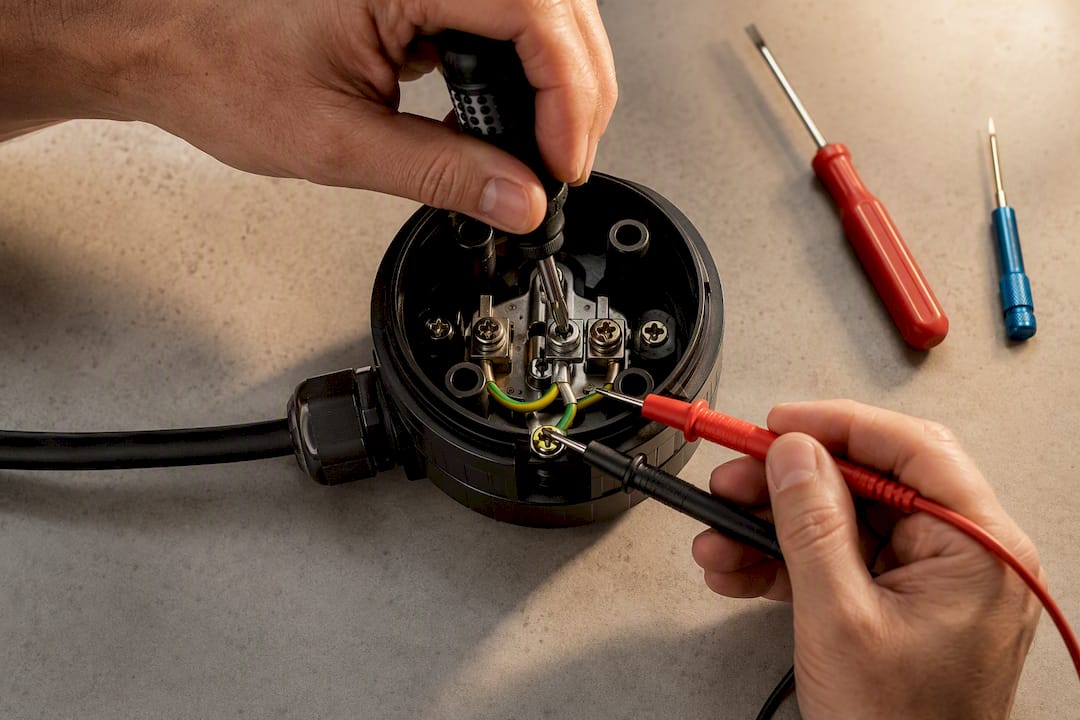
Operationally, plug generator to distribution first, distribution to load second, and always isolate before disconnecting anything without a pilot contact. Where a pilot contact is fitted, let the interlock do its job rather than forcing a connector apart under load.
Field checks worth building into a routine:
- Torque-check accessible terminals at the start of a hire period, not just at manufacture.
- Confirm gland seals are seated correctly on every cable entry.
- Test earth continuity through the whole run, not just at the first joint.
- Keep spare blanking caps and gaskets in the site kit.
Where do Ceeform connectors actually get used?
Generator output leads almost always terminate in a Ceeform plug, feeding into a distribution board that splits load across multiple circuits. From there, connectors feed catering equipment, marquee lighting, PDUs for AV and production gear, and smaller splitter units for task power.
A typical chain runs generator to distro board to PDU to equipment, each joint using the correctly rated connector for that stage’s current draw. Marquee feeds usually run IP67 outdoors and step down to IP44 once inside a covered event venue. Get one link in that chain wrong on rating or IP class, and the whole run inherits the weakest point.
What field experience teaches about Ceeform connector mistakes
Most on-site failures trace back to a connector left uncapped in the wet, or a mismatched clock position forced together by someone in a hurry. Neither is a manufacturing fault. Specify connector type, IP rating and clock position explicitly in the venue brief rather than leaving it to guesswork on the day, and get standby electrical support in place for anything with a generator changeover, because that is where sequencing errors happen fastest.
— Rob
How Jakspartypower gets your event power connections right
Getting the wrong connector delivered halfway through a build is the sort of problem that costs hours you do not have. An experienced electrical contracting team ensures the generators, distribution boards and cabling that arrive on site are specified and matched correctly the first time, not sorted out with adapters after the fact.

The service can include generator hire, distribution equipment, standby electricians and power packages built around your event’s actual load, not a generic package. Tell the team your venue, expected load and outdoor exposure, and they can specify the right connector ratings and IP classes before anything leaves the depot. Book a generator for your event or get in touch through the Jaks Party Power site for a site assessment and quote.
Sources
For procurement wording, cite IEC 60309-1:2021 directly rather than a paraphrase, since edition numbers matter when specifying replacement stock. The Wikipedia entry on IEC 60309 gives a reliable overview of colour codes and ratings, and SCAME’s technical explainer covers clock positions with clear diagrams worth checking against a supplier’s datasheet.
- IEC 60309-1:2021 | IEC webstore
- IEC 60309
- Industrial connector FAQ — WEIPU
- IEC 60309 technical notes (Plugsocketmuseum)
FAQ
What is a Ceeform plug?
A Ceeform plug is an industrial pin-and-sleeve connector built to IEC 60309, identified by its colour, pole count and clock position, and rated for voltages up to 1,000 V and currents up to 800 A.
What are the three types of connectors?
In IEC 60309 terms, the three physical forms are cable-mounted plugs and connectors, panel-mounted sockets and inlets, and inline couplers, distinguished by whether they terminate a flexible cable or fix to equipment.
What is a CEE form?
“CEE form” refers to the same connector family, tracing back to the CEE 17 specification that was later folded into IEC 309 and revised into today’s IEC 60309.
What does CEE mean in electrical work?
CEE stood for the International Commission on the Rules for the Approval of Electrical Equipment, the body whose CEE 17 specification became the basis for IEC 60309.
How do I know if a connector rating applies mated or unmated?
Check the supplier’s datasheet explicitly, since IP ratings often apply only once the connector is fully mated and drop significantly when left open or uncapped.