

Load bank testing proves whether a generator can actually deliver its rated kW under real load, and it burns off the carbon deposits that cause wet stacking. If your monthly exercise cycle never pushes past 30% of nameplate capacity, the fix is a stepped resistive load bank test taken up to at least 50 to 75% of rated output, with the full procedure, safety checks and paperwork covered below, following industry best practices.
TL;DR:
- Load bank testing verifies a generator’s true capacity to produce rated power and prevents wet stacking by simulating real load conditions.
- Resistive banks are standard for routine capacity checks, while combined resistive and reactive banks are necessary for full commissioning and regulation testing.
- Testing at 75 to 80% of the generator’s nameplate capacity is the practical minimum for reliable results, with full load validation requiring 100% testing.
- Frequency of load bank testing should increase if monthly exercises stay below 30% of rated capacity, with annual tests as a minimum for critical sites.
- Proper safety measures include correct ventilation, fuel planning, and briefed personnel, while data recording should track voltage, frequency, oil pressure, and exhaust temperature.
Table of Contents
- What is load bank testing and why does it matter?
- What types of load banks should you use?
- What faults does generator load testing reveal?
- What is the step-by-step load bank testing procedure?
- How often should generators be load bank tested?
- How do you size a load bank for a generator?
- What safety measures does load bank testing require?
- What data should you record during testing?
- What should you do when a test parameter fails?
- Practical field notes from running load bank tests at events
- Key reference documents and standards
- Why most maintenance schedules underrate load testing
- Getting your standby or event power tested properly
- Sources
- FAQ
What is load bank testing and why does it matter?
A load bank is a controlled artificial load that converts a generator’s electrical output into heat, dumped through resistive elements, fans or radiators depending on the unit. It exists because most standby generators sit idle or run at a fraction of their rated capacity for years, and there’s no other reliable way to confirm they’ll perform when a real fault load hits them.
Load bank testing verifies nameplate kW delivery under conditions a light monthly exercise run simply cannot replicate. That matters for three reasons:
- Capacity verification — confirms the set can genuinely produce its rated output, not just start and idle.
- Wet stack prevention — sustained high load raises combustion temperatures enough to burn off unburned fuel deposits.
- Control and alternator validation — exposes governor response, voltage regulation and excitation faults that never surface at low load.
You’ll see load bank testing specified at commissioning, on standby power systems protecting critical facilities, and increasingly on UPS and battery installations where a controlled discharge test plays the same diagnostic role.
What types of load banks should you use?
Choosing the wrong load bank type is one of the most common testing mistakes, and it usually means the test looks fine on paper while missing the fault it was meant to catch.
- Resistive banks load at unity power factor and are the standard choice for diesel wet-stack correction and routine capacity checks. They’re simple, robust, and widely available for hire.
- Reactive (inductive) banks replicate motor-driven loads and specifically exercise alternator excitation systems, something a resistive-only test cannot do.
- Combined resistive/inductive banks reproduce non-unity power factor conditions and are essential for full commissioning tests, since combined testing is the only way to fully verify voltage regulator transient response.
- Electronic load banks offer precise, programmable transient steps and are favoured where power quality and dynamic response are under close scrutiny.
Resistive, reactive and combined load bank designs each serve a distinct diagnostic purpose, and picking the right one depends on what you’re actually trying to prove, not just what’s on the hire yard that week.
What faults does generator load testing reveal?
Faults hide at low load. A generator can idle happily for months and still fail the moment it’s asked to carry a real fault current, and that gap is exactly what testing closes.
- Cooling system weaknesses (undersized radiators, failing thermostats) that only show once heat rejection climbs.
- Fuel delivery restrictions that starve the engine under sustained demand.
- Alternator or excitation faults invisible until reactive load is applied.
- Wet stacking, where extended high-load running burns off the unburned fuel and carbon deposits that accumulate during light-load operation.
- Governor hunting or slow voltage recovery under step-load changes, both signs of ageing control components.
A resistive load test alone can miss regulator and excitation faults, which is why critical sites lean on combined banks for anything beyond routine wet-stack correction.
What is the step-by-step load bank testing procedure?
Every load bank test follows roughly the same sequence, though the specifics shift with generator size, site constraints and the standard your authority having jurisdiction (AHJ) applies.
- Pre-test checks. Verify fuel, oil and coolant levels, confirm ventilation paths are clear, size cables and breakers for the target kW, and agree an isolation plan with anyone else on site before energising anything.
- Warm-up. Run the generator unloaded or lightly loaded until coolant temperature and oil pressure stabilise. Loading a cold engine risks thermal shock and skews early readings.
- Progressive step loading. Apply load in stages rather than jumping straight to full output. A common profile runs 25% for 30 minutes, 50% for 30 minutes, 75% for 60 minutes, then 100% if the bank and generator support it. NFPA-style profiles used in the industry often specify 50% for 30 minutes followed by 75% for 60 minutes as a practical minimum for supplemental annual testing.
- Continuous monitoring. Log kW, voltage per phase, frequency, oil pressure, coolant temperature and exhaust gas temperature at every step, not just at the end.
- Step-down and cool-down. Reduce load gradually rather than cutting it abruptly, allow turbocharged engines a proper cool-down period at low load, then disconnect the bank safely.
- Reporting. Record every step’s readings against pass/fail criteria and file the report for the AHJ or facility records.
Pro Tip: Testing at 75 to 80% of nameplate is widely accepted as the practical minimum when a full-capacity bank isn’t available on site, but if you need to prove genuine full-load capacity, nothing substitutes for pushing to 100%.
Modern electronic load banks often log parameters automatically and generate printable reports, which saves technician effort during tests lasting several hours.
How often should generators be load bank tested?
Testing frequency isn’t arbitrary. It’s built around a simple logic: if your normal exercise regime never exposes the generator to meaningful load, you need a separate, deliberate test that does.
- Monthly exercise should ideally reach at least 30% of nameplate kW. When it consistently falls short, an annual supplemental load bank test becomes the standard fallback to compensate for the shortfall.
- Annual testing typically runs the stepped profile described above and is the minimum most critical facilities budget for regardless of monthly performance.
- Triennial full-runtime tests are common for genuinely critical installations, running the generator at high load for extended periods to fully validate long-duration reliability.
On-site time for a standard annual test typically runs four to six hours including setup, testing, cool-down and reporting, and the main cost drivers are load bank rental, technician labour, fuel consumption and transport to site. AHJs may reference different editions of NFPA 110, so it’s worth confirming which edition your local authority enforces before you plan the schedule.
How do you size a load bank for a generator?
Undersizing the bank is the fastest way to produce a test that looks clean but proves nothing. Size the load bank against the generator’s nameplate kW rating, not its kVA figure. The kW rating reflects real power delivered; kVA includes reactive power that a resistive test won’t touch, and confusing the two leads to a test that under-loads the engine without anyone noticing.
Aim for a high proportion of nameplate kW for most routine and supplemental tests, and full capacity when verifying rated output, such as after a major overhaul or at commissioning.
Connection method matters just as much as size. You can connect the bank to a dedicated bus for a clean, isolated test, or run it in parallel with the building’s actual load for a more realistic scenario. If you go the parallel route, configure the switching so a utility failure automatically transfers to emergency building load rather than relying on someone manually swapping the load bank out, since manual switching may not satisfy code requirements on some sites. Cable and breaker sizing should match the full test current, not just the generator’s typical running load.
What safety measures does load bank testing require?
Heat is the dominant hazard. A load bank dumping tens or hundreds of kilowatts as heat needs proper ventilation planning, and recirculating hot exhaust air back into the generator’s own radiator intake will quietly wreck your readings and overheat the engine.
- Position the load bank so exhaust and heated air vent away from the generator’s cooling intake, not back into it.
- Plan a fire watch for extended high-load runs, particularly where fuel storage or dry vegetation sits nearby.
- Confirm fuel supply is adequate for the full test duration plus a safety margin. A wet-stack correction run at high load typically takes multiple hours and consumes more fuel than lower-load testing.
- Only competent, briefed personnel should handle isolation switching and load bank connections.
- Agree clear communication signals between the person monitoring the generator and the person operating the load bank controls before starting.
Positioning discipline matters just as much on a temporary event generator as it does on a fixed standby installation. Field checks event technicians run before paralleling generators apply the same logic: get the airflow and fuel planning wrong, and the test data becomes meaningless before you’ve even started reading gauges.
What data should you record during testing?
A test without proper records is barely worth running, because there’s nothing to compare against next time or hand to an inspector.
- kW output at each load step, compared against nameplate rating.
- Voltage per phase, watching for imbalance or drift as load increases.
- Frequency, which should hold within tight tolerance across every step.
- Oil pressure and coolant temperature, tracked continuously rather than spot-checked.
- Exhaust gas temperature (EGT), a strong early indicator of combustion or turbo issues.
- Battery charge state and any active alarms, logged at the start and end of the test.
Acceptable ranges vary by manufacturer, but voltage typically needs to stay within a few per cent of nominal and frequency within a similarly tight band throughout the test. Where a reading drifts outside the generator manufacturer’s stated envelope, log it as a failure, note the corrective action taken, and schedule a re-test once the fault is addressed rather than quietly accepting a marginal pass.
What should you do when a test parameter fails?
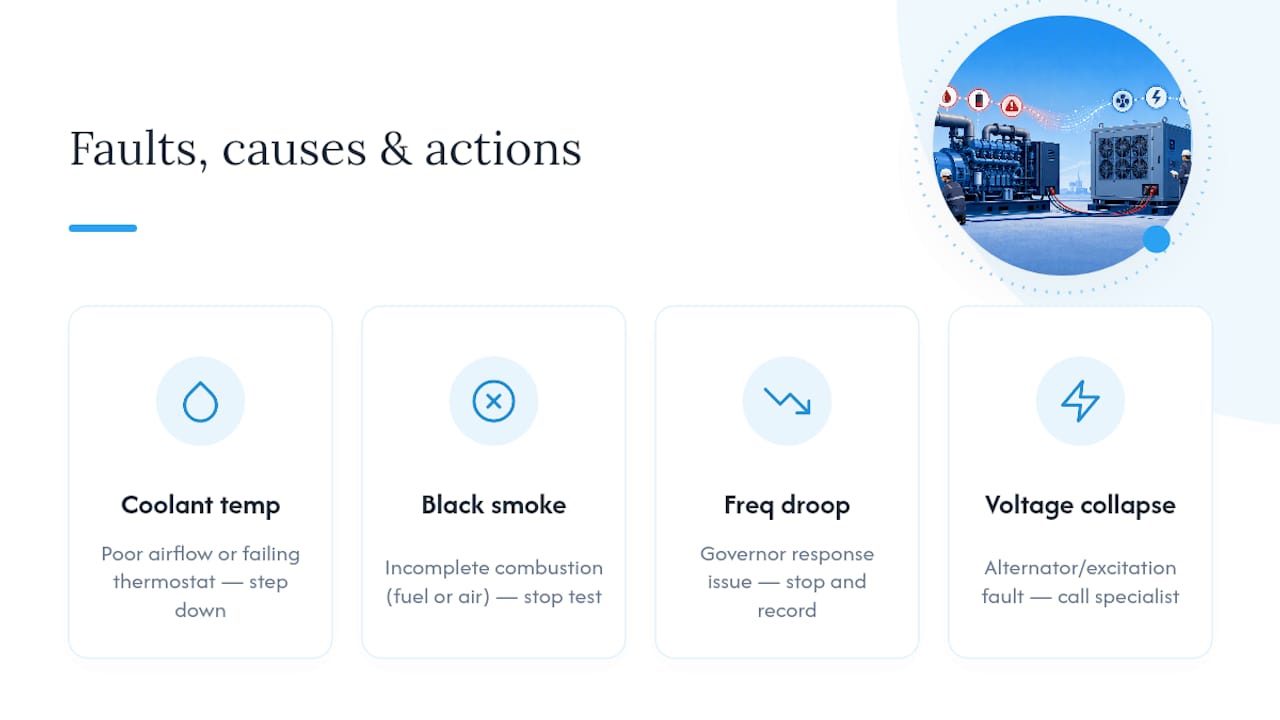
Rising coolant temperature usually points to cooling airflow or a failing thermostat. Black smoke signals incomplete combustion, often a fuel or air supply issue. Frequency droop under load suggests a governor struggling to respond, while voltage collapse points towards alternator or excitation faults. In any of these cases, step load down immediately, stop the test safely, note the exact conditions at failure, and call in the relevant trade (fuel, cooling or alternator specialist) before re-testing.
Practical field notes from running load bank tests at events
Rob has spent years working alongside Jaks Party Power’s electrical contracting team, who bring over 40 years of combined experience to standby and event power setups across Sussex.
On a temporary site, the checks are the same discipline in miniature: correct generator positioning to avoid recirculating hot exhaust, clear space for noise and airflow management, and a fuel reserve sized for the full event duration plus a safety margin. Get those basics right before you connect anything to a load bank, whether it’s a portable trolley generator or a large standby set.
Key reference documents and standards
Check the load bank testing white paper and NFPA 110 guidance for full protocol detail, and always confirm interpretation with your local AHJ.
Why most maintenance schedules underrate load testing
The conventional advice treats load bank testing as a box-ticking annual event, something scheduled once a year because a standard says so. That misses the point. The real judgement call is whether your monthly exercise regime is doing any useful work at all. If it never approaches 30% of nameplate kW, you are not maintaining the generator. You are running an engine that sounds fine and proves nothing.
Where conventional advice falls shortest is on sizing discipline. Too many facilities accept whatever load bank the hire company has available rather than calculating what the test actually needs to prove. A bank sized to 60% of nameplate will pass most sets comfortably and tell you almost nothing about genuine full-load reliability.
Prioritise the monitoring data over the pass certificate. A generator that “passes” with voltage drifting near the edge of tolerance at 75% load is telling you something the certificate won’t. Read the numbers, not just the outcome, and treat every test as a chance to catch a fault before it catches you during a real outage.
— Rob
Getting your standby or event power tested properly
Jakspartypower brings the same standard of technical discipline used across compliance‑grade load bank testing into every generator it supplies for events and standby cover in Sussex. That means the generators you hire have been maintained and checked by contractors who understand wet stacking, cooling faults and load capacity, not just delivered and left running.

Whether you need a portable set for a private party, a full distribution board setup for a corporate event, or standby cover with someone on call throughout, the equipment arrives serviced and the team on site knows how to read the warning signs a badly maintained generator gives off. If continuity planning matters to your event, it’s worth reviewing how emergency response planning fits alongside your power provision, particularly for multi-day bookings.
Check availability and get a quote through the generator hire page, or browse the full hire catalogue to see what fits your event’s power demands.
Sources
- Load bank testing white paper (Generac)
- Generator load bank testing: planning for success (Depco Power Systems)
- Load bank — Wikipedia
- Using load banks to verify engine‑generator performance (Avtron)
FAQ
What is a load bank in a generator?
A load bank is a controlled artificial load, resistive, reactive or a combination of both, that converts a generator’s electrical output into heat to verify it can deliver its rated kW under real conditions.
How much does it cost to load bank test a generator?
Costs depend mainly on load bank rental, technician labour, fuel and transport, with a standard annual compliance test typically taking four to six hours on site including setup, testing and reporting.
Why does load bank testing prevent wet stacking?
Sustained high-load running raises combustion and exhaust temperatures enough to burn off the unburned fuel and carbon deposits that accumulate when a diesel generator runs light for extended periods, with corrective runs typically taking two to four hours.