
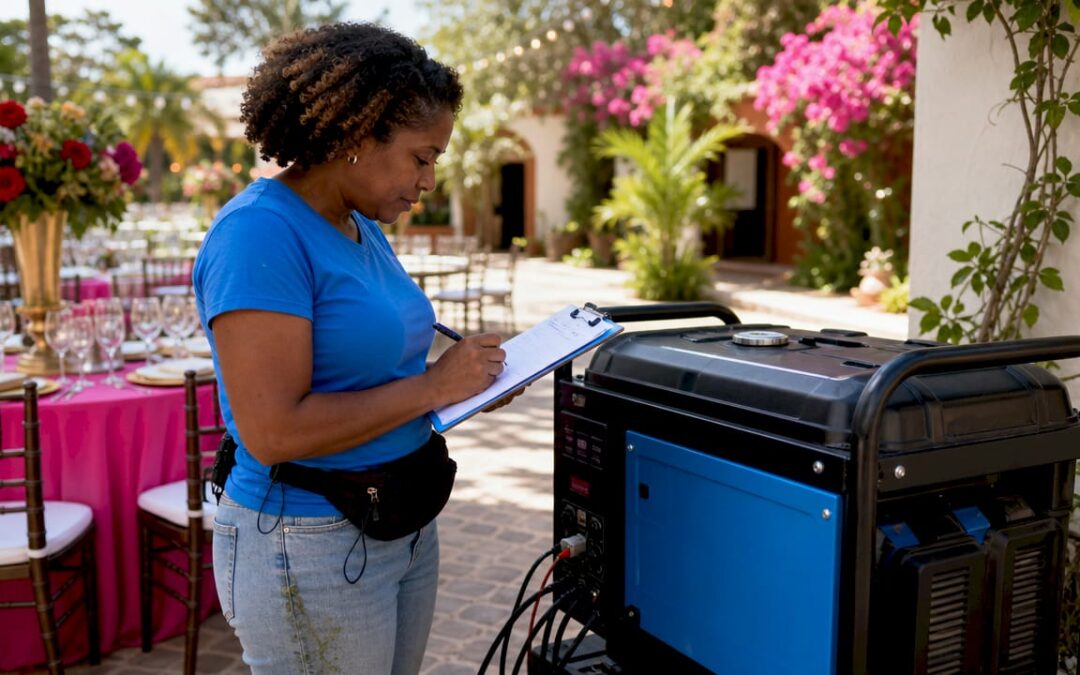
Generator hire for private events is the process of renting a portable or road-tow power unit to supply reliable electricity where no mains connection exists or where mains supply is insufficient. Getting this right is the single most important infrastructure decision you will make for an off-grid event. Choose the wrong unit and you risk blown equipment, noise complaints, or a complete blackout mid-reception. Choose well, and your guests never know the generator exists. Jakspartypower has delivered event power solutions across Sussex for over 40 years, and the lessons from that experience are baked into every section below.
How to assess your private event’s power requirements before hiring a generator
The first step in hiring generator private events services correctly is calculating your total wattage demand before you speak to any supplier. Underestimating this figure is the most common and most costly mistake planners make.
Start by listing every piece of electrical equipment the event will use. Group items into categories: lighting, sound, catering, bar, and ancillaries such as card readers and phone charging stations. For each item, note the running wattage and the start-up surge wattage, which is typically two to three times higher for motors and compressors.
Power is measured in watts (W) or kilowatts (kW), but generator capacity is quoted in kilovolt-amperes (kVA). A rough conversion is: kVA × 0.8 = kW. A 10 kVA generator delivers approximately 8 kW of usable power. Knowing this prevents you from hiring a unit that looks large enough on paper but falls short under real load.
| Equipment | Approximate running wattage |
|---|---|
| PA system (medium) | 500–1,000 W |
| DJ decks and mixer | 200–400 W |
| Catering oven | 2,000–3,000 W |
| Festoon lighting (20 m) | 200–400 W |
| Refrigeration unit | 300–600 W |
| Uplighters (set of 8) | 400–800 W |
Once you have a total, add a safety margin of 20–30% above your calculated peak load. That buffer protects against simultaneous start-up surges and any last-minute equipment additions.
Pro Tip: Ask your caterer for the exact wattage of every appliance they plan to bring. Catering equipment is the most frequent cause of generator overload at private events.
A professional site assessment, offered by full-service providers like Jakspartypower, removes the guesswork entirely. An engineer visits the venue, maps the load, and specifies the correct unit before hire day.
What types of generators are best for private events?
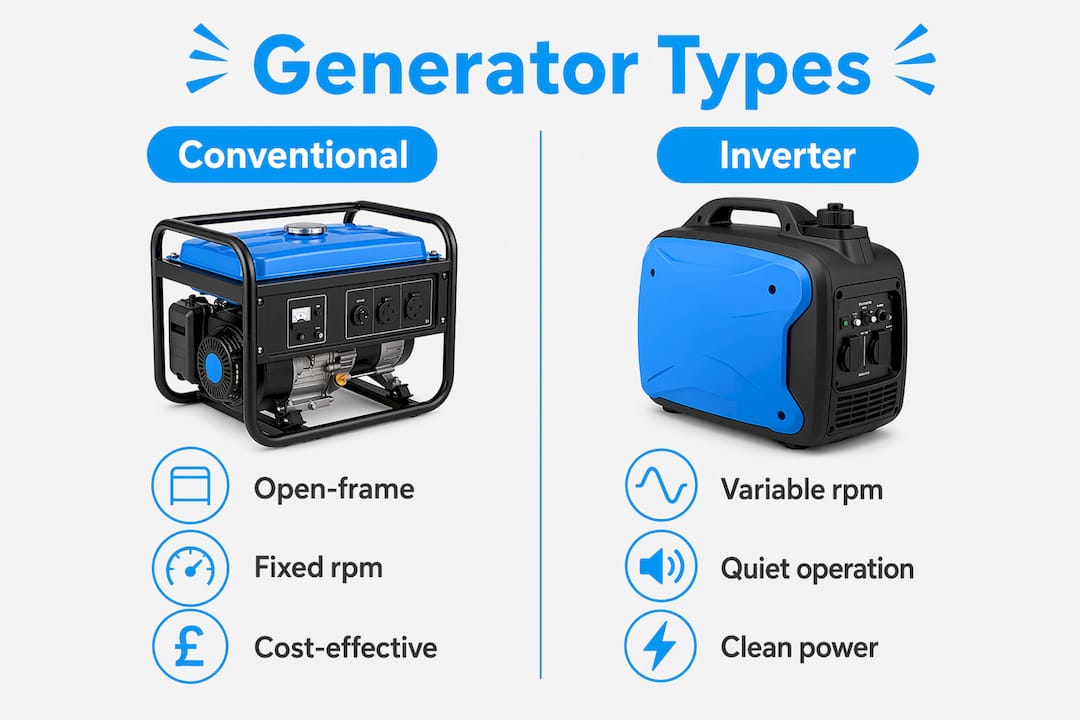
The industry distinguishes two main categories: conventional generators and inverter generators. For most private functions, inverter technology is the correct choice.
Conventional generators produce alternating current at a fixed engine speed, typically 3,000 rpm. They are cost-effective for powering simple loads such as site lighting or water pumps. They are not suitable for sensitive electronics because their output contains voltage fluctuations that can damage equipment.
Inverter generators convert raw AC power to DC and then back to a clean AC sine wave. Sensitive electronics require less than 3% total harmonic distortion (THD) to operate safely. Inverter units consistently achieve this, making them the correct choice for DJ equipment, laptops, smart lighting controllers, and professional sound systems.
Noise is the other critical factor at private gatherings. Modern inverter generators operate as quietly as 52 decibels at partial load. The DuroMax XP2300iH achieves 52 dB and the Erayak 4500PD reaches 60.5 dB at 25% load. For context, 52 dB is roughly equivalent to a quiet conversation. That level of noise is acceptable at a garden party or wedding reception in a way that a conventional open-frame generator, running at 75–85 dB, simply is not.
| Generator category | Noise level | THD | Best suited for |
|---|---|---|---|
| Open-frame conventional | 70–85 dB | High (>5%) | Site power, construction |
| Silenced conventional | 65–75 dB | High (>5%) | Large outdoor shows |
| Portable inverter | 52–65 dB | Low (<3%) | Private parties, weddings |
| Road-tow silenced inverter | 55–68 dB | Low (<3%) | Large private events |
Fuel type is worth considering too. Dual-fuel generators run on petrol or propane. Propane burns cleaner and is preferable for events in enclosed or semi-enclosed marquees where exhaust emissions need careful management. Petrol remains the more practical choice for short-duration events where refuelling logistics are simple.
Noise and emission regulations apply in residential areas and many licensed venues. Choosing a silenced inverter unit and positioning it correctly on site keeps you on the right side of those rules.
Pro Tip: Always ask your hire provider for the generator’s dB rating at 25% load, not at full load. Events rarely run at full capacity, so the partial-load figure reflects real-world noise far more accurately.
How to plan generator delivery, installation, and management on the day
Logistics are where many planners lose control of their power supply. The generator itself may be perfect, but poor cable routing, incorrect load balancing, or a missed refuel can still bring an event to a halt.
Professional rental providers offer tiered services starting from around 8 kVA, covering delivery, installation, fuel management, and breakdown support. Choosing a fully managed service means a qualified engineer handles every technical element, freeing you to focus on the event programme.
Cable distribution is more complex than it appears. A single generator feeds power through a distribution board, which then splits the load across multiple circuits. Proper load balancing and cable management, coordinated with your lighting and sound technicians, prevents tripped circuits and reduces fire risk. Jakspartypower supplies distribution boards and cabling as part of its hire packages, so every element is matched and tested before the event starts.
Key service components to confirm with your provider before signing a hire agreement:
- Delivery and collection included in the quoted price
- On-site installation and connection by a qualified engineer
- Fuel supply and top-up schedule agreed in advance
- Cable distribution boxes sized to your load plan
- Standby cover or a contact number for emergency callout
- Site assessment completed before the event date
Safety regulations require that generators are sited away from public areas, with adequate ventilation and secure cable runs that do not create trip hazards. Your hire provider should supply a risk assessment and method statement for any event where public access is involved.
What mistakes should you avoid when hiring generators for private events?
The most expensive mistakes in renting generators for events are predictable and entirely avoidable with early planning.
Underestimating power demand is the leading cause of generator failure at private functions. Planners often calculate running watts but forget start-up surges. A single catering oven drawing 3,000 W at start-up can trip a generator that appeared adequately sized on paper.
Choosing a noisy unit to save money is a false economy at weddings and intimate gatherings. A conventional open-frame generator positioned 10 metres from a marquee will still be audible during speeches. The cost difference between a conventional and an inverter unit is modest compared with the reputational damage of a disrupted event.
Skipping standby provision is a serious risk at critical events. Synchronised generator pairs, where a primary and a standby unit run in parallel, are the industry standard for weddings and corporate functions where any downtime is unacceptable. If one unit fails, the other carries the full load without interruption. Many professional planners treat a standby unit as non-negotiable for events lasting more than four hours.
Pro Tip: For events in residential areas, check local authority noise guidelines before confirming your generator specification. Some venues have specific decibel limits written into their operating licence.
Additional pitfalls to avoid:
- Ignoring site access constraints that prevent delivery of larger road-tow units
- Failing to brief your caterer and AV team on the power plan before the event
- Booking a generator without confirming fuel type availability at the venue location
- Overlooking the need for permits in some public or licensed outdoor spaces
Early communication with your hire provider resolves most of these issues before they become problems on the day.
Key takeaways
Reliable private event power depends on accurate load calculation, the right generator technology, and a fully managed hire service that covers delivery, cabling, and standby provision.
| Point | Details |
|---|---|
| Calculate load accurately | Add a 20–30% safety margin above your total peak wattage to prevent overload. |
| Choose inverter technology | Inverter generators deliver less than 3% THD, protecting sensitive AV and lighting equipment. |
| Prioritise low noise | Units operating at 52–65 dB are suitable for weddings and intimate private gatherings. |
| Use a managed service | Full-service hire covers delivery, cabling, fuel, and standby support, reducing your workload. |
| Plan for standby power | Synchronised generator pairs eliminate total power loss risk at critical private events. |
What I have learned from 40 years of event power in Sussex
The question I hear most often from event planners is: “Can I just hire the cheapest generator and position it round the back?” The honest answer is no, not if you care about the outcome.
The shift to inverter technology changed everything for private events. Ten years ago, a quiet generator meant a large, expensive silenced diesel unit on a road-tow trailer. Today, a well-specified portable inverter unit can power a 100-person wedding reception with lighting, sound, and catering, and guests will not hear it from five metres away. That is a genuine step forward for event quality.
What I still see planners get wrong is the standby question. They budget for the primary generator and treat a backup as an optional extra. At a wedding or a milestone birthday, there is no optional extra. The standby unit is the insurance policy that makes everything else irrelevant if something goes wrong. I have seen a primary generator develop a fuel fault at 9 pm on a Saturday. Because a standby unit was already running in parallel, the guests noticed nothing. Without it, the event would have ended.
My other consistent observation is that early site assessment pays for itself many times over. Planners who book a generator without a site visit often discover on the day that the access route is too narrow for the specified unit, or that the cable run to the marquee is 40 metres longer than expected. Those surprises are expensive and stressful. A proper assessment, carried out weeks before the event, eliminates them entirely.
The generator hire options that work best for private events are the ones where the provider takes full responsibility for the power infrastructure. Your job is to run a great event. The power should simply work.
— Rob
How Jakspartypower handles generator hire for private events
Jakspartypower provides a complete event generator hire service across Sussex, covering everything from portable inverter units for intimate garden parties to road-tow silenced generators for large weddings and shows.
Every hire package includes delivery, on-site installation by an experienced engineer, cable distribution, fuel management, and standby cover. Jakspartypower’s fleet includes low-noise inverter units suited to quiet private venues, backed by over 40 years of electrical contracting expertise. Packages are tailored to the size and complexity of your event, with flexible hire periods and a dedicated contact for support on the day. Contact Jakspartypower directly for a personalised quote and site assessment.
FAQ
What size generator do I need for a private party?
Calculate the total running wattage of all equipment, then add a 20–30% safety margin above that figure. A medium private party with lighting, sound, and catering typically requires a generator in the 8–20 kVA range.
Are inverter generators worth the extra cost for private events?
Yes. Inverter generators produce less than 3% total harmonic distortion, protecting DJ equipment, laptops, and smart lighting from voltage damage. They also operate significantly more quietly than conventional units, which matters at weddings and garden parties.
How noisy is a hired generator at a private event?
Modern inverter generators operate as quietly as 52 dB at partial load, comparable to a quiet conversation. Conventional open-frame generators run at 70–85 dB and are not suitable for intimate private gatherings.
Do I need a standby generator for my private event?
At critical events such as weddings, synchronised generator pairs are the industry standard. A standby unit running in parallel with the primary generator ensures uninterrupted power if the main unit develops a fault.
What does a full-service generator hire package include?
Full-service providers typically cover delivery, installation, cable distribution, fuel management, and breakdown support. Jakspartypower includes a site assessment and on-site engineer as standard for private event bookings.