
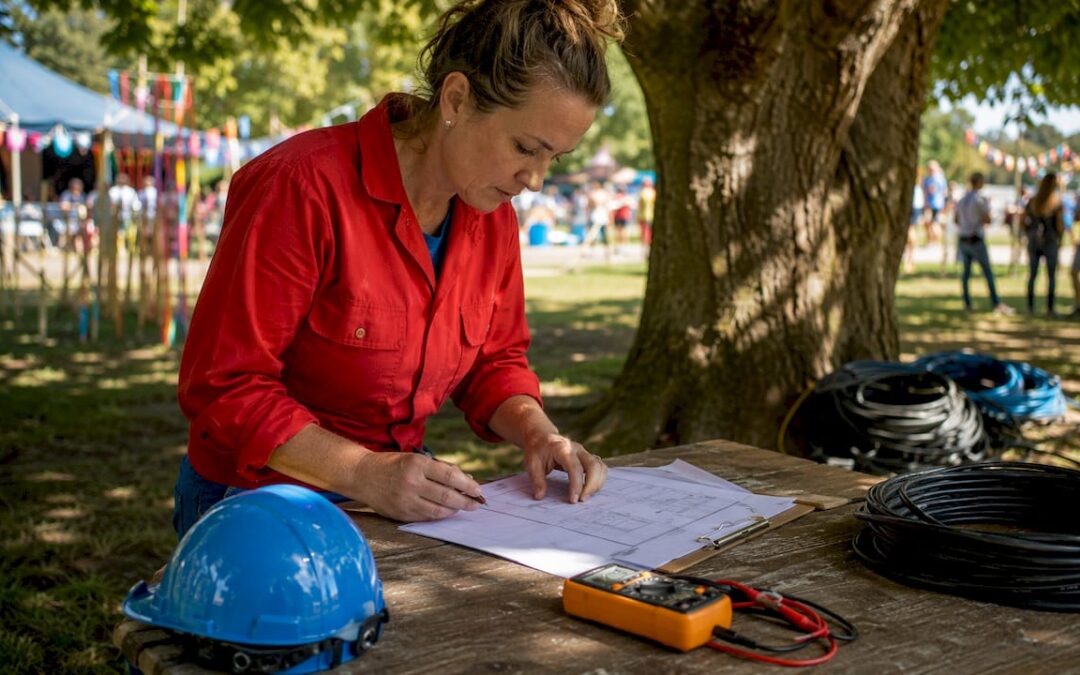
A recurring event electrical support plan is a documented, maintained package of safety policies, test records and standby arrangements that governs every set-up of a temporary electrical installation across multiple event recurrences. At a minimum, it must contain three documents before any recurrence goes live: a site-specific electrical safety policy, an emergency procedure document, and a signed Form G1 handover certificate accompanied by a Schedule of Test Results (Form G2), as required under BS 7909 and the baseline standard BS 7671 / IET Wiring Regulations.
Before each recurrence, check these four operational requirements:
- A named Responsible Person (RP) is appointed and their scope is recorded in writing.
- A pre-energisation check (PEC) has been completed and signed off by a competent person.
- All outdoor equipment carries an appropriate IP rating for the environment.
- Cables are protected by ramps, bridges or overhead routing at the correct clearance.
Jakspartypower has supported recurring events across Sussex for over 40 years, and the framework below reflects what actually keeps events safe and compliant recurrence after recurrence.
Table of Contents
- What must your recurring event electrical support plan contain?
- How do you set a risk-based inspection schedule for recurring events?
- Outdoor events: what equipment and cable controls do you need?
- Who is responsible, and what accreditation should your contractor hold?
- How should you plan for faults and power failures during recurring events?
- A copy-and-paste checklist for your event pack
- Key takeaways
- Why the “one sign-off for the season” approach will cost you
- Jakspartypower: recurring event power, handled end to end
- Useful sources
- FAQ
What must your recurring event electrical support plan contain?
Every event pack should be assembled from the same core documents so nothing is left to memory on the day.
- Site-specific electrical safety policy: Names the RP, defines the scope of the temporary installation, states the applicable standards (BS 7909, BS 7671), and carries the signature of the person accountable for the installation. It is not a generic template — it must reference the specific site, supply type and load.
- Emergency procedure document: Lists isolation points with their physical locations, a contact list (RP, standby engineer, venue safety officer, emergency services), and step-by-step shutdown and evacuation instructions. Every person with a site role should hold a copy.
- Form G1 (handover certificate) and Form G2 (Schedule of Test Results): Form G1 confirms the installation is safe to energise; Form G2 records the actual test results (insulation resistance values, earth continuity readings, RCD trip times). Both must accompany every event set-up. Where the system is altered significantly, a new Completion Certificate is required under BS 7909 G.3.7.
- Single-line diagram and cable schedule: Shows the distribution path from supply to final circuits, including generator output, distribution boards, RCBOs and socket outlets. Store digital copies in the event pack and a printed copy on site with the RP.
- Equipment inventory: Lists every item of hired or owned kit with its IP rating, current rating, connector type and last test date. For distribution boards and generators, include the serial number and rated output.
Each document should carry a reference number, the RP’s name, test instrument serial numbers, and a next re-inspection date.
How do you set a risk-based inspection schedule for recurring events?
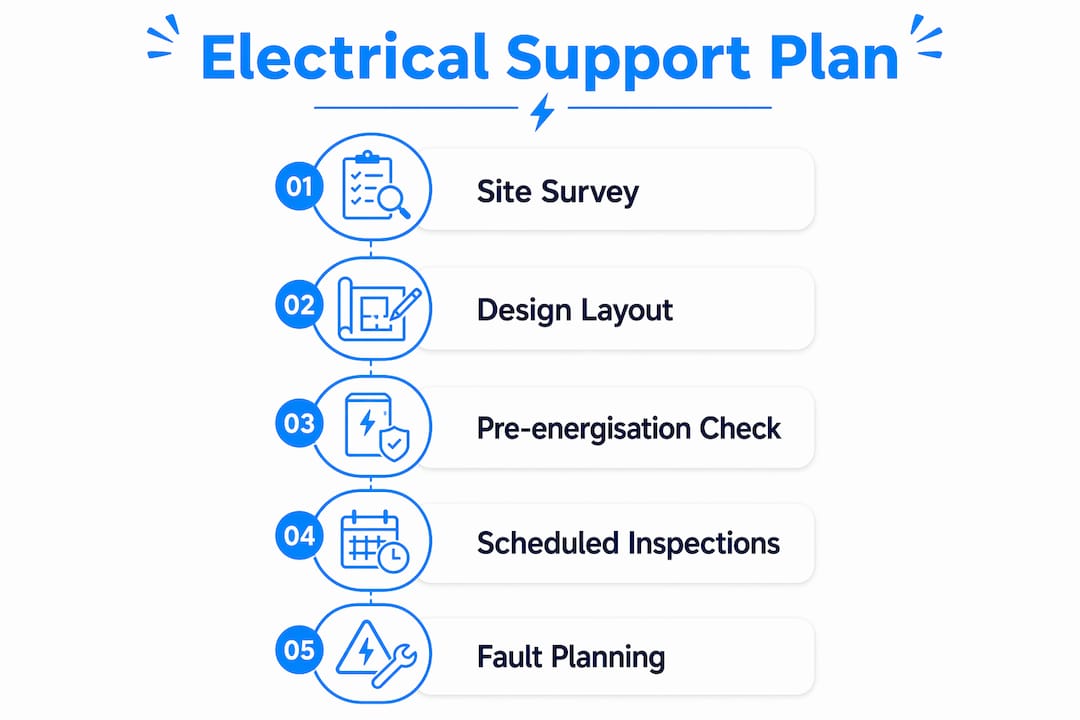
The answer is not “annual only.” Use a risk-based cadence that shortens intervals for outdoor, high-traffic or variable-layout events, driven by environmental exposure and how much the layout or load changes between recurrences. A practical guide to event power risk management sets out the underlying framework in detail.
Before first energisation and at every recurrence:
- Complete a full pre-energisation check: insulation resistance, earth continuity, and RCD functional tests, all with recorded results.
- Carry out a visual inspection of all cables, connectors, distribution boards and generators.
- Confirm the RP has signed the PEC record as a formal go/no-go decision.
Periodic in-service inspections apply where equipment remains in place between recurrences (for example, a three-month outdoor run). In those cases, schedule a formal inspection at intervals the RP sets based on weather exposure and public access density.
Trigger events that force a full re-test: layout change, new or swapped generator, significant load addition, or any incident involving the electrical system.
Statistic callout: Visual inspections identify the vast majority of electrical faults, which is why experienced teams treat the PEC as a non-negotiable go/no-go step rather than a box-ticking exercise.
A sample timeline for a recurring outdoor event:
- Initial design phase: single-line diagram, load schedule, earthing design, RAMS produced.
- First set-up: full initial verification, Form G1 and Form G2 issued.
- Each subsequent recurrence: PEC completed, RCD functional test, visual inspection, RP sign-off.
- Trigger event: full re-verification and new Completion Certificate.
Outdoor events: what equipment and cable controls do you need?
Always specify outdoor-rated equipment. Reusing indoor-rated kit outdoors is one of the most common compliance failures on recurring events, and it voids any protection the original test certificate offered.
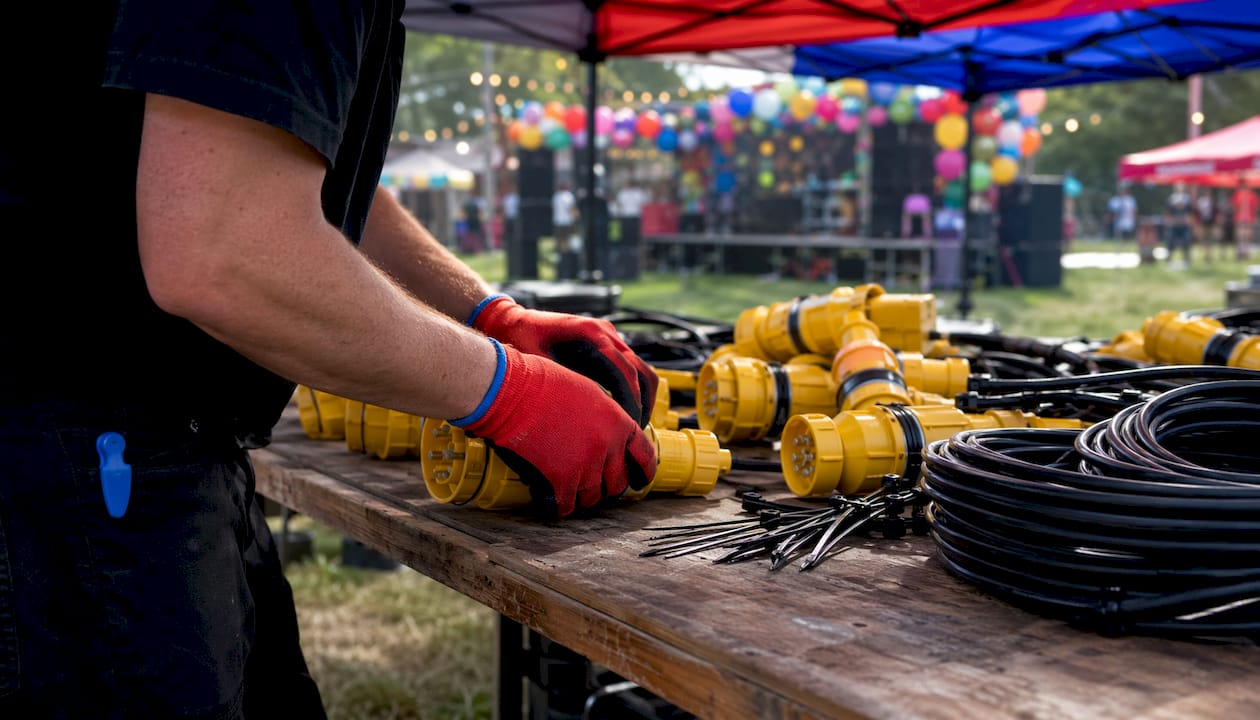
Pro Tip: Standardise your layout between recurrences. The more consistent the cable runs, distribution board positions and generator location, the less re-testing is required at each set-up — saving both time and cost.
Key controls for outdoor recurring events:
- IP ratings: Distribution boards and socket outlets not reserved for exclusive indoor use must meet at least IP44 when connected. For exposed or damp conditions, specify IP55 or higher.
- Cable types: Use H07RN-F rubber-insulated cable for outdoor flexible runs. For buried or mechanically exposed routes, use steel wire armoured (SWA) cable. The role of cabling in event reliability covers selection in detail.
- Cable routing: Cables in public areas must be protected against mechanical damage. Use ramps or bridges across pedestrian routes. Overhead cables on vehicle routes should be at least 5.8 m above ground.
- Generator siting: Position generators behind physical barriers, away from public access. For TT earthing (preferred for outdoor temporary installations), test earth electrode resistance before connecting any load.
- Connectors: Use BS EN 60309-1 connectors with the correct voltage colour code. Single-pole connectors must provide at least IP44 when connected.
HSE guidance GS50 covers siting, segregation and emergency arrangements for temporary supplies at places of entertainment and is worth keeping in the event pack.
Who is responsible, and what accreditation should your contractor hold?
Appoint a named Responsible Person for every temporary installation and record their scope in writing: design oversight, installation supervision, and PEC sign-off. The RP is accountable under BS 7909 and must be competent to carry out or oversee all verification work.
When procuring a contractor, require:
- Demonstrable experience with BS 7671 and BS 7909 temporary installations.
- Listing with a recognised competent person scheme such as NICEIC or NAPIT, or equivalent documented competencies.
- Ability to produce Form G1, Form G2 and a Completion Certificate for each set-up.
- A current RAMS covering the specific site and load.
The role of electrical contractors at events sets out the procurement language and competence checks worth including in your brief.
Required compliance document set:
- Single-line diagram
- Completion Certificate(s) / Electrical Installation Certificate(s)
- PEC records (signed, dated, instrument serial numbers)
- RAMS
- Emergency procedure document
- Form G1 and Form G2 for each set-up
Reference standards to cite in every contractor brief: BS 7909, BS 7671 / IET Wiring Regulations, and HSE guidance GS50.
How should you plan for faults and power failures during recurring events?
Include a staffed standby service, spare critical kit and a clear escalation matrix in the plan. Reactive maintenance costs 3–5 times more than planned work, so the economics of a standby arrangement pay for themselves quickly.
Escalation protocol for each recurrence:
- Fault reported to RP or standby engineer on site.
- RP assesses: isolate affected circuit or full system isolation if required.
- Standby engineer diagnoses and replaces from on-site spares.
- Actions recorded in the site log; Form G1 re-issued if the system is altered.
- Incident report produced before the next recurrence.
Define these service levels in the plan: on-site response time, remote support availability, escalation contacts, and formal handover steps after an incident. For corporate events, a dedicated standby service contract sets these parameters in advance.
On-site spares to keep for recurring events:
- Spare RCBOs (matching the distribution board specification)
- Spare distribution board (one level below the main)
- Connector sets (BS EN 60309-1, matching site voltage)
- Basic cable lengths (H07RN-F, 10 m and 25 m)
- Cable ramps and bridges
For emergency power design principles that translate well to event contingency planning, FutureGen Consulting’s guidance offers a useful external perspective.
A copy-and-paste checklist for your event pack
Pre-event checklist
- [ ] RP appointed and scope documented
- [ ] Site-specific electrical safety policy signed
- [ ] Emergency procedure document distributed to all site roles
- [ ] Single-line diagram and cable schedule current and on site
- [ ] Equipment inventory checked against IP ratings and test dates
- [ ] PEC completed: insulation resistance, earth continuity, RCD functional tests
- [ ] Form G1 signed and Form G2 attached
- [ ] Generator earth electrode tested before loading
- [ ] Cable protection (ramps/bridges) installed on all public routes
- [ ] Overhead cables checked at 5.8 m minimum on vehicle routes
During event
- [ ] Standby engineer contactable and on escalation list
- [ ] Site log open and accessible to RP
- [ ] Any fault or near-miss recorded immediately
Post-event
- [ ] Site log closed and filed with Form G1/G2
- [ ] Equipment condition noted for next recurrence
- [ ] Trigger events (layout change, new load) flagged for re-test
Inspection cadence by risk category
| Risk category | Example | PEC frequency | Periodic inspection |
|---|---|---|---|
| Low | Indoor fixed layout, mains supply | Each set-up | Annually |
| Medium | Outdoor fixed layout, generator | Each set-up | Every 6 months |
| High | Outdoor variable layout, multiple generators | Each set-up | Every 3 months |
When the supply type changes (mains to generator, or venue move), treat the installation as new: produce a fresh single-line diagram, complete full initial verification, and issue a new Form G1.
Key takeaways
A recurring event electrical support plan requires a site-specific safety policy, Form G1 and Form G2 at every set-up, a named Responsible Person, and a risk-based PEC cadence aligned to BS 7909 and BS 7671.
| Point | Details |
|---|---|
| Form G1 at every set-up | A signed Form G1 and Form G2 are required for each recurrence, not just the first. |
| Risk-based PEC cadence | Shorten inspection intervals for outdoor or variable-layout events; trigger a full re-test on any layout or load change. |
| Reactive vs planned cost | Reactive maintenance costs 3–5 times more than planned work; a standby service pays for itself. |
| Outdoor equipment standards | Specify H07RN-F cable, IP44 minimum connectors, and 5.8 m overhead clearance on vehicle routes. |
| Jakspartypower | Jakspartypower provides recurring event packages covering site survey, Form G1 handover, PEC, standby engineers and generator hire across Sussex. |
Why the “one sign-off for the season” approach will cost you
The most persistent mistake recurring-event organisers make is treating a single seasonal sign-off as sufficient for every subsequent set-up. It feels efficient. It is not. Each time a layout shifts, a generator swaps, or a new load is added, the installation is legally a new temporary system under BS 7909 — and the previous Form G1 no longer covers it.
The practical fix is simpler than most organisers expect: standardise the layout as much as possible between recurrences, keep the same generator in the same position, and use the same cable runs. That discipline cuts re-testing time significantly, because a consistent installation genuinely needs only a PEC at each set-up rather than a full re-verification. The cost saving is real, and it comes from good planning, not from skipping compliance.
Bundling electrical checks with fire alarm and emergency lighting inspections on the same site visit is another underused move. It reduces access costs and keeps the whole safety picture current without doubling the diary.
Jakspartypower: recurring event power, handled end to end
Forty years of electrical contracting experience means Jakspartypower has seen every recurring-event power problem worth seeing, and built a service around preventing them. For event organisers who run the same show week after week or season after season, the real value is not just the equipment — it is having a contractor who already knows the site, holds the previous Form G1, and arrives at each set-up ready to complete the PEC and energise on schedule.

Jakspartypower’s recurring event packages cover site survey, single-line design, Form G1 handover, scheduled PEC, standby engineer cover, and generator hire — all coordinated through a single point of contact. That means no chasing multiple suppliers between recurrences, and no gaps in the compliance trail. Get in touch via jakspartypower.com to discuss a package built around your event calendar.
Useful sources
- BS 7909 — Code of practice for temporary electrical systems for entertainment and related purposes; the primary UK standard for event electrical installations, covering Form G1, Form G2 and RP responsibilities.
- BS 7671 / IET Wiring Regulations — The baseline wiring standard referenced by BS 7909; governs initial verification, PEC methodology and Completion Certificates.
- HSE guidance GS50 — Practical guidance on temporary supplies, cable routing, public segregation and emergency arrangements at places of entertainment.
- HSE electrical safety at events — Covers outdoor equipment ratings, cable protection and minimum overhead clearance requirements.
- EADE layman’s guide to electrical safety at events — Accessible overview of BS 7909 G.3.7 Completion Certificate requirements and when new certificates are needed.
- IET Wiring Matters — temporary power distribution — Technical detail on cable types, connector standards and distribution equipment for entertainment installations.
Retain original Forms G1 and G2, single-line diagrams and PEC records as part of the event audit trail. They are your evidence of compliance if a licensing authority or enforcing body requests documentation.
FAQ
What documents are required for every recurring event set-up?
Each set-up requires a site-specific electrical safety policy, an emergency procedure document, a signed Form G1 handover certificate, and a Schedule of Test Results (Form G2) to accompany the safety certificate.
Does a recurring event need a new Form G1 each time?
Yes, when the layout, load or supply source changes between recurrences, a new Form G1 and a Completion Certificate supported by a Schedule of Test Results (Form G2) are required. A PEC must be completed and signed before every energisation regardless of whether the layout has changed.
What is a pre-energisation check (PEC)?
A PEC is a formal inspection and test sequence carried out by a competent person before the temporary installation is energised; it covers insulation resistance, earth continuity and RCD functional tests, and acts as the go/no-go decision point.
How often should outdoor event electrical equipment be inspected?
Use a risk-based cadence: at minimum, a PEC at every set-up, with periodic in-service inspections every 3–6 months for outdoor or variable-layout events, shortening further if weather exposure or public density is high.
Can Jakspartypower manage the electrical support plan for recurring events?
Jakspartypower provides recurring event packages that include site survey, Form G1 handover, scheduled PECs, standby engineer cover and generator hire, coordinated through a single point of contact across Sussex.