
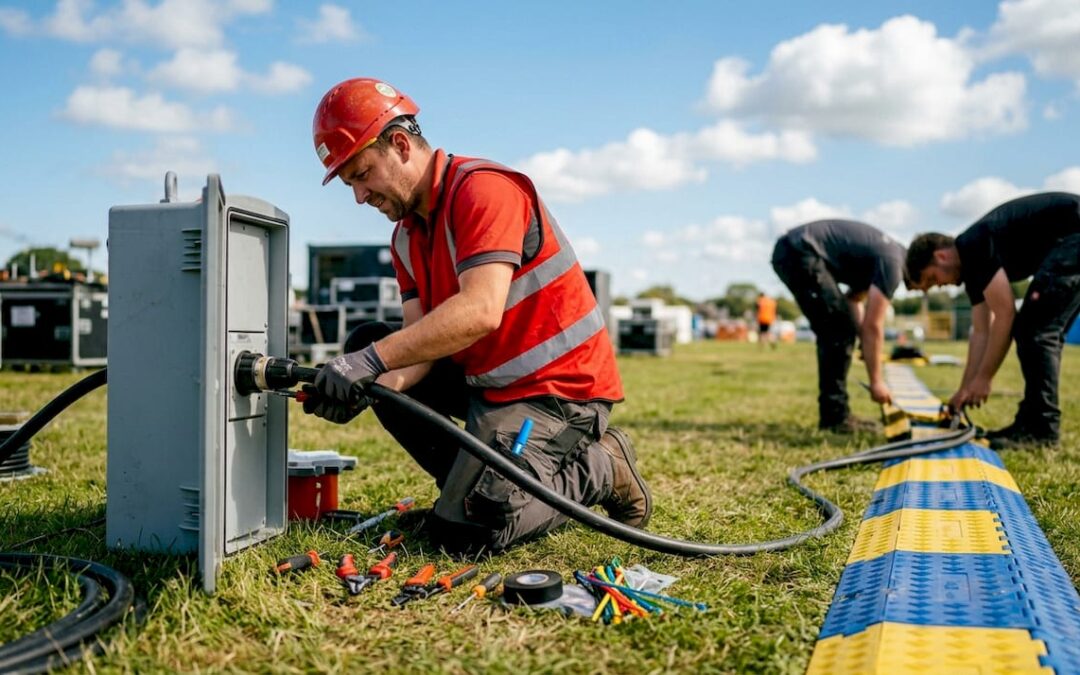
Electrical contractors are the professionals who design, install, and manage temporary power systems that keep events running safely from start to finish. The role of electrical contractors at events extends far beyond plugging in cables. They calculate load requirements, specify protective devices, coordinate with venues, and hold legal responsibility for every circuit they commission. For event organisers, understanding what these professionals do and when to involve them is the difference between a smooth event and a costly shutdown.
What do electrical contractors do during event setup?
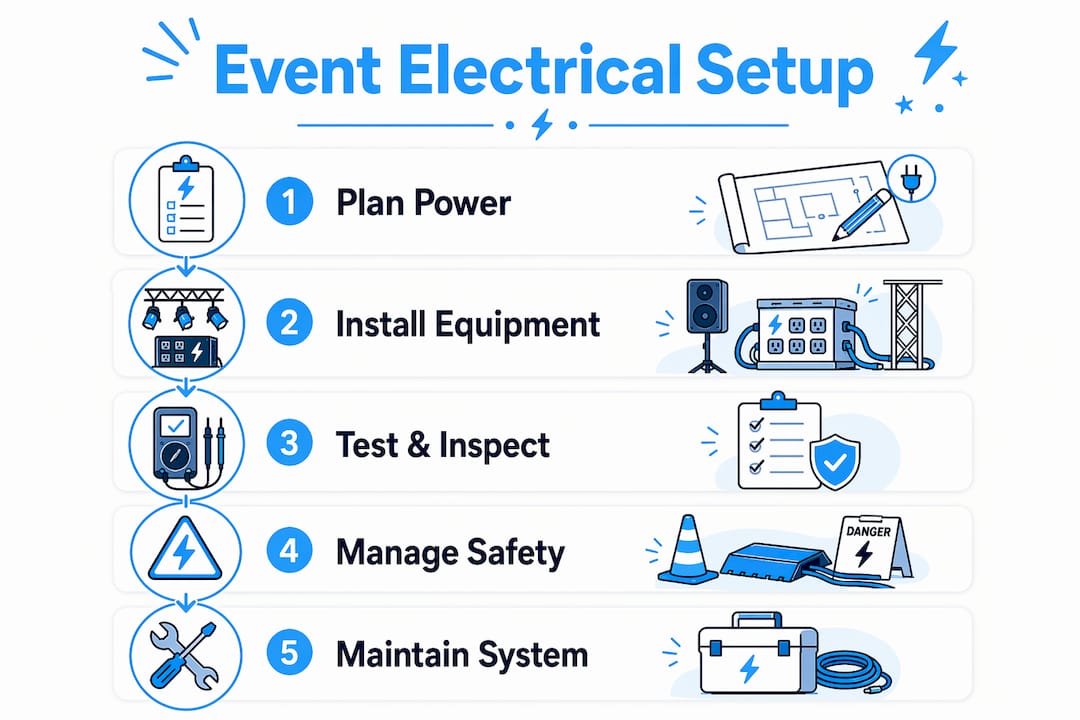
Electrical contractors at events carry out a defined set of technical tasks that most organisers never see but always depend on. Their work begins weeks before the first guest arrives and continues until the final cable is coiled.
The core responsibilities include:
- Load calculation and power design. Contractors map every power demand across the site, from stage lighting rigs to catering equipment, and design a distribution system that prevents overloads.
- Temporary power distribution. They install distribution boards, run feeder cables, and create clearly labelled supply points for each zone or exhibitor.
- Grounding and bonding. Grounding electrodes must be driven at least 8 feet into the ground, and all metallic frames, trussing, and staging must be bonded to prevent electrocution risk.
- GFCI protection. GFCI devices are mandatory on all 125-volt, single-phase 15–30 amp receptacles under NEC Article 590. This single requirement prevents the majority of electrical fatalities at outdoor events.
- Pre-event testing. Every circuit is tested under load before the event opens. Faults found at this stage cost minutes. Faults found during the event cost hours and reputations.
- On-site monitoring. Contractors remain on site to manage faults, respond to tripped circuits, and adapt to last-minute power demands.
The scale of this work is significant. A one-day event can require up to six days of coordinated electrical setup when it involves 200 or more sessions and activations. That figure illustrates why electrical planning cannot begin the week before an event.
Pro Tip: Brief your electrical contractor at the same time you brief your AV and lighting suppliers. Power requirements from those teams directly shape the electrical design, and late changes cause the most expensive problems.

How do electrical contractors protect venue safety and ensure compliance?
Venue safety is the area where electrical contractors carry the most legal weight. Most venues and exhibition halls prohibit exhibitors from performing their own electrical work. Exhibitors cannot perform their own electrical installations due to strict safety and venue liability regulations. This rule exists because shared power infrastructure means one bad connection can affect every stand or zone in the hall.
Contractors fulfil this requirement by providing compliance documentation that venues and local authorities accept. The documentation typically includes:
- Electrical installation drawings showing circuit layouts and load schedules.
- Test certificates confirming all circuits meet the relevant wiring regulations.
- Risk assessments and method statements covering installation and live working procedures.
- A master approval file that consolidates all of the above for inspection on show days.
A master approval file containing drawings, certificates, and safety method statements must be maintained diligently. Discrepancies between approved documentation and installed conditions cause failed inspections and project delays. That is a direct operational risk for organisers who have already sold tickets or confirmed exhibitor bookings.
The technical requirements are equally specific. All trussing, staging, and barriers must be bonded to grounding, and GFCI protection is non-negotiable for temporary circuits under NEC 590.6(A). In the UK context, equivalent protections apply under BS 7671, the IET Wiring Regulations, which govern all temporary electrical installations at public events.
Pro Tip: Request a copy of the master approval file before the event opens. If an inspection fails on show day, you need to know immediately whether the fault lies with the contractor or the venue’s supply.
For a broader view of how lighting and power systems interact within event compliance frameworks, the technical requirements run deeper than most planners expect.
What operational challenges do contractors face on event days?
Event days present a different category of problem from the installation phase. The venue is full, the programme is live, and any power interruption is immediately visible to every attendee.
The most common operational challenges include:
- Tripped circuits under unexpected load. A caterer adding a second oven or a band adding a monitor amplifier can push a circuit beyond its design capacity. Contractors must identify and resolve this without touching the venue’s main panels.
- Fault isolation without disrupting adjacent zones. A fault in one exhibitor’s stand must not take down the neighbouring stands. Proper zoning during the design phase makes this possible; poor design makes it inevitable.
- Communication under pressure. Contractors coordinate simultaneously with venue technicians, AV crews, and event managers. Clear radio protocols and pre-agreed escalation paths prevent confusion from becoming a crisis.
Contractors have limited authority at venues. They work only downstream of approved venue connection points and cannot interfere with mains supply or venue-level panels. Unauthorised access to venue mains risks work stoppages and safety violations. This boundary is non-negotiable, and experienced contractors plan their fault management strategies around it from the outset.
Electrical contractors are the backbone of event power delivery, requiring clear communication, adaptability, and technical expertise to support uninterrupted operations. Their ability to manage digital systems and connections on the fly is critical for event success and minimising delays.
Integrated planning of electrical, lighting, AV, and networking systems from the initial design stage prevents the approval problems and operational restrictions that plague late-change scenarios. Organisers who treat electrical as an afterthought consistently face the most disruption on event days. Reviewing a corporate event setup checklist early in the planning process helps prevent these gaps.
What role do electrical contractors play in industry events and professional development?
The role of electrical contractors in industry events goes beyond the events they power. Contractors also attend sector-specific conferences, training days, and CPD events that shape how they work and what standards they apply.
Events such as NICEIC TechLive provide electrical contractors with CPD opportunities to stay current on wiring regulations and renewable technologies. Participation helps contractors strengthen their businesses and adapt to industry changes by exchanging knowledge and skills. For event organisers, this matters directly. A contractor who attends CPD events brings current knowledge of regulation changes to your project. One who does not may apply outdated standards.
The benefits of electrical industry conferences and workshops for electricians include:
- Regulatory updates. Wiring regulations change. CPD events communicate those changes before they become compliance failures on site.
- Technical seminars. Hands-on sessions covering new equipment, protection devices, and installation methods keep skills current.
- Networking for electrical contractors. Peer exchange between contractors surfaces practical solutions to common problems that no textbook covers.
- Market awareness. Contractors learn which new technologies, from battery storage to EV charging infrastructure, are entering the events sector and how to specify them correctly.
Industry events act as crucial hubs for electrical contractors to stay updated on regulation changes, CPD opportunities, and business best practices. For organisers, the practical implication is straightforward. Ask your contractor which CPD events they have attended in the past 12 months. The answer tells you a great deal about how seriously they take their professional obligations.
Key takeaways
Electrical contractors are the single most critical technical partner an event organiser can appoint, because they hold legal responsibility for every temporary circuit on site.
| Point | Details |
|---|---|
| Appoint contractors early | Electrical design must begin alongside AV and lighting briefings to prevent costly late changes. |
| Compliance documentation is mandatory | Contractors must provide test certificates, drawings, and method statements before any inspection. |
| Venue authority is limited | Contractors work only downstream of venue connection points and cannot access mains panels. |
| GFCI and bonding are non-negotiable | All temporary circuits require GFCI protection and metallic structures must be bonded to ground. |
| CPD attendance signals professionalism | Contractors who attend events like NICEIC TechLive apply current regulations to your project. |
Why I think most organisers underestimate their electrical contractor
After working in and around the events industry for many years, the pattern I see most consistently is this: organisers treat electrical contractors as a logistics item rather than a design partner. They book a contractor the way they book a skip hire company, late, on price, and without a detailed brief.
The consequences are predictable. Circuits get undersized because the load schedule was never shared. Documentation arrives incomplete because nobody asked for it until the morning of the show. Faults on event day take twice as long to resolve because the contractor has never walked the site with the AV team.
The contractors who consistently deliver are the ones brought into the planning conversation early. They attend the site survey with the venue manager. They receive the AV rider before they design the distribution. They know which exhibitors are running high-draw equipment before they specify the feeder cables. That level of integration does not happen by accident. It happens because the organiser treats the electrical contractor as a technical consultant, not a commodity supplier.
Continuous professional development matters here too. A contractor who attends educational events for contractors and workshops for electricians is not just keeping their licence current. They are bringing that knowledge directly to your event. The difference between a contractor who last updated their knowledge five years ago and one who attended a NICEIC TechLive session last month is measurable in the quality of their documentation and the speed of their fault response.
My honest advice: budget for a qualified electrical contractor from the first planning meeting, not the last. The cost of getting it right is always lower than the cost of getting it wrong in front of a full audience.
— Rob
How Jakspartypower powers your event from planning to close

Jakspartypower brings over 40 years of electrical contracting experience to events across Sussex, from intimate weddings to large-scale outdoor shows. The team supplies and installs generators, distribution boards, and full temporary power systems, with every installation tested and certified before your event opens. A dedicated standby service means a qualified engineer is on site throughout your event, ready to respond to any fault without delay. If you are planning an event and need reliable, compliant power from a team that understands both the technical and operational demands of live events, contact Jakspartypower to discuss your requirements.
FAQ
What does an electrical contractor do at an event?
An electrical contractor designs, installs, and manages the temporary power system for an event, including load calculation, distribution boards, grounding, and GFCI protection. They remain on site during the event to monitor circuits and resolve faults.
Why can’t exhibitors do their own electrical work at venues?
Venues prohibit exhibitor electrical work due to safety and liability regulations. Official contractors provide the compliance documentation that venues and local authorities require before any installation is approved.
What documentation should an electrical contractor provide?
A contractor must supply electrical drawings, test certificates, risk assessments, and method statements. These form a master approval file that must match the installed conditions exactly to pass on-site inspections.
How far in advance should I book an electrical contractor for an event?
Large events require months of pre-production planning. A one-day event can need up to six days of coordinated electrical setup, so booking a contractor at the same time as your venue is the safest approach.
How do I know if my electrical contractor is keeping their skills current?
Ask which CPD events they have attended recently. Contractors who participate in events like NICEIC TechLive demonstrate active engagement with current wiring regulations and industry best practices.