
A full house rewire in the UK typically costs between £2,500 and £16,000 in 2026, depending on the size of the property, whether you’re living in it during the work, and where in the country you are. A 1-bed flat sits at the bottom of that range; a 5-bed detached house with an occupied schedule and a London postcode sits at the top.
Before anything else, get an EICR (Electrical Installation Condition Report) and use a registered electrician who can self-certify the work under a competent person scheme such as NICEIC or NAPIT. This single step tells you whether you need a full rewire or just targeted repairs, and it protects you legally.
- Budget a contingency on top of any quote for hidden issues like old cabling behind plaster or an undersized consumer unit.
- Typical timescale: 1–2 weeks for a flat, 2–4 weeks for a 3 or 4-bed house, longer if occupied.
- Always ask for a written Electrical Installation Certificate on completion. You’ll need it when you sell.
Key Takeaways
Full house rewire prices in the UK typically run from £2,500 for a 1-bed flat to £16,000 for a large occupied 5-bed house in London or the South East.
| Point | Details |
|---|---|
| Get an EICR first | An inspection costing £150–£375 tells you whether you need a full rewire or targeted C2 repairs. |
| Budget by property size | Expect £2,500–£4,200 for a flat and £10,000–£16,000 for a 5-bed detached house. |
| Factor in occupied vs empty | Living in the house during work typically adds £800–£1,500 in extra labour time. |
| Check registration and certificates | Only use NICEIC or NAPIT registered electricians who provide a written Electrical Installation Certificate. |
| Consider Jakspartypower’s contracting standards | Jakspartypower applies the same testing and certification discipline from 40 years of electrical contracting to its event power installations across Sussex. |
Table of Contents
- How much does it cost to rewire a house in the UK by property size?
- What factors push a rewire quote up or down?
- What are EICR, Part P, and BS 7671, and why do they matter?
- How long does a rewire take and how disruptive is it?
- How much does a new consumer unit cost?
- Do I need a full rewire, or will repairs do?
- How do I choose the right electrician for a rewire?
- How can I reduce my rewiring costs without cutting corners?
- What contracting experience tells us about getting this right
- Why the standard advice on rewiring costs misses the point
- Get reliable, certified power for your next event
- Sources
- FAQ
How much does it cost to rewire a house in the UK by property size?
Rewiring cost UK prices scale fairly predictably with the number of rooms and circuits, but the gap between an empty and an occupied property is often bigger than people expect. According to MyJobQuote’s 2026 pricing data, here’s what homeowners are typically paying:
- 1-bed flat: £2,500–£4,200
- 2-bed house: £3,200–£5,800
- 3-bed semi: £4,500–£8,500
- 4-bed detached: £6,500–£11,000
- 5-bed detached: £10,000–£16,000
These are mid-market figures for a standard specification, not a premium finish with designer switches or a smart home system layered on top. Working out how much is a full rewire UK homeowners should expect starts with matching your property to the nearest band, then adjusting for the factors below.
A typical quote for house rewiring costs UK-wide includes labour, cable, a new consumer unit, first and second fix accessories (sockets, switches, light fittings), and the final testing and certification. What it usually doesn’t include is plastering, making good around chased walls, or redecorating. Electricians will chase cable runs into walls and lift floorboards, and patching that up is typically a separate job, either done by the electrician’s own plasterer at extra cost or by a decorator you arrange yourself.
Worked example: A 3-bed semi in the Midlands, empty during the work, with a straightforward layout and no structural obstacles, might come in around £5,500 to £6,500 for the electrical work alone. The same house occupied, with furniture to work around and rooms taken one at a time, could add £800 to £1,500 in extra labour time. Add another £150 to £400 for making good afterwards.
Regional variation matters more than most homeowners factor in. London and the South East typically add a significant premium on top of national mid-market figures, largely due to higher labour rates and tighter access in period terraces. If you’re quoting for a house rewire cost UK-wide and comparing tradespeople from different regions, strip out the location premium before you compare like for like.
What factors push a rewire quote up or down?
Two houses of identical size can generate wildly different quotes, and the reasons usually come down to access, age, and specification rather than the electrician simply charging more.
Construction and access:
- Solid brick walls or lath-and-plaster ceilings make cable chasing slower and messier than modern plasterboard stud walls.
- Suspended timber floors are far easier to work under than solid concrete floors, which may need surface trunking instead.
- Multi-storey houses with limited loft access add time for running cables vertically.
Age and hidden hazards:
- Pre-1960s wiring sometimes uses rubber-insulated (VIR) cable or even older fabric-covered wiring, which can be brittle and needs full replacement rather than partial repair.
- Older properties occasionally reveal asbestos in floor tiles, pipe lagging, or ceiling coatings, which needs specialist removal before electrical work continues, adding both cost and time.
Specification choices:
- Extra circuits for a home office, outbuilding, or EV charger point add material and labour cost.
- Smart switches, dimmers, and premium accessories cost more than standard white plastic fittings, sometimes significantly.
- Provision for future EV charging or battery storage means sizing the consumer unit and tails for extra capacity now, which the BS 7671 18th edition guidance increasingly recommends as standard practice.
Pro Tip: Ask your electrician to price the job both with and without EV charger provision. Adding capacity during a rewire is far cheaper than retrofitting it two years later once walls and floors are closed up again.
What are EICR, Part P, and BS 7671, and why do they matter?
Get the inspection sorted before you get quotes for the work itself. An Electrical Installation Condition Report assesses your current wiring against the UK safety standard, BS 7671, and typically costs £150–£375 depending on property size.
The report grades any issues found:
- C1 (danger present): requires immediate action, sometimes disconnection on the spot.
- C2 (potentially dangerous): needs fixing without delay, but isn’t an immediate emergency.
- C3 (improvement recommended): not dangerous now, but worth addressing.
Rewiring and consumer unit replacement are notifiable work under Part P of the Building Regulations in England and Wales. In practice, this means most homeowners hire an electrician registered with a competent person scheme like NICEIC or NAPIT, who can self-certify the completed work rather than involving local authority building control directly. In Scotland, the equivalent requirement is a building warrant, applied for before work starts.
Once finished, insist on a written Electrical Installation Certificate. Conveyancing solicitors and buyers routinely ask for this when a house sells, and its absence can hold up a sale or knock money off an offer.
How long does a rewire take and how disruptive is it?
Rewires happen in two distinct phases, and understanding them helps you plan around the mess.
- First fix: cables are run through walls, floors, and ceilings before plastering. This is the noisy, dusty phase involving chasing walls and lifting floorboards.
- Second fix: sockets, switches, and light fittings are installed once walls are closed up, followed by testing and certification.
- Making good: plastering and decorating around the work, often arranged separately from the electrical contract itself.
Typical durations vary by property size and complexity, generally lasting a few days for a 1-bed flat, one to two weeks for a 3-bed house, and longer for larger detached properties depending on complications.
- Living in the property adds time, since electricians work room by room around furniture and daily routines.
- Set aside one room as a “clean” base for the family while work moves through the rest of the house.
- Budget separately for skip hire, temporary storage, or even a short stay elsewhere if the disruption is severe. If you’re weighing up whether to move out temporarily, the logistics involved often mirror those covered in guides on electricity and gas considerations when moving house.
How much does a new consumer unit cost?
Most rewires include a new consumer unit, and it’s rarely optional in practice even when it isn’t strictly mandatory. Building regulations require that any new work leaves the installation no worse than it was, and an old rewireable fuse board almost never meets that bar once a full rewire is underway.
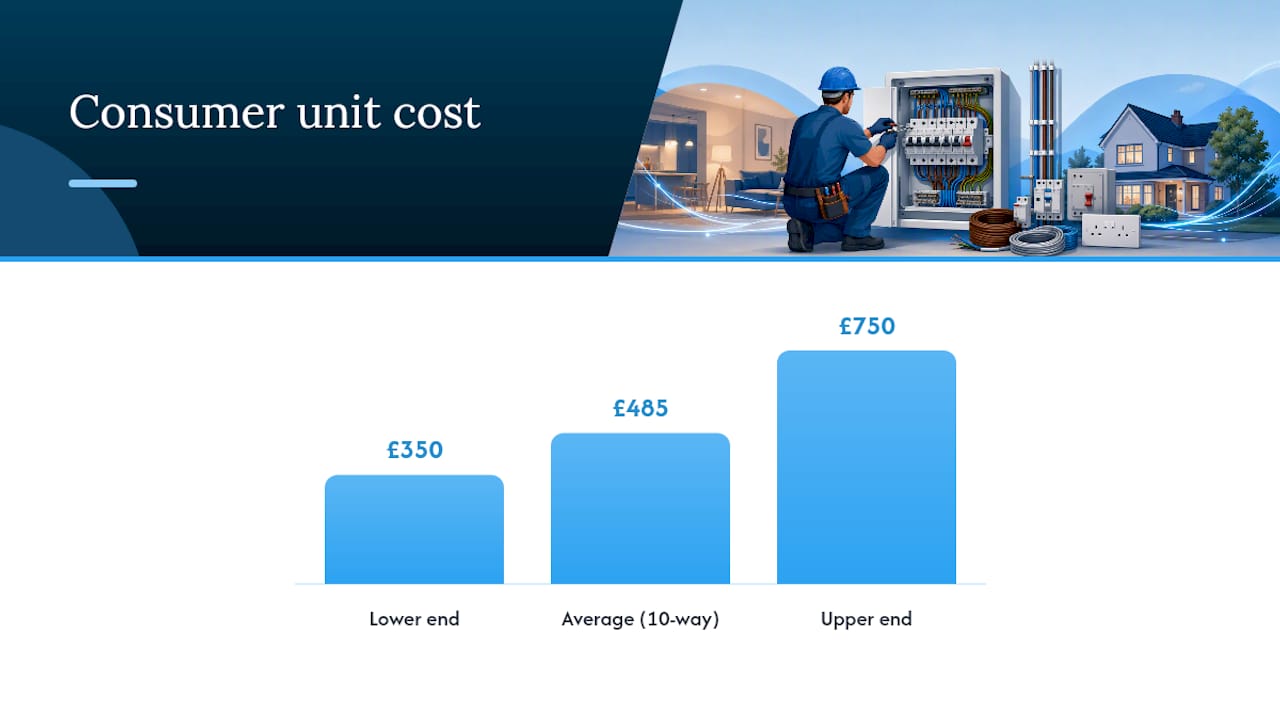
Supply and installation of a modern RCBO consumer unit typically costs £350–£750, with a populated 10-way unit averaging around £485 including fitting. Larger properties needing more circuits, or units with surge protection built in, sit towards the top of that range.
Common extras that add to the bill:
- New meter tails, if the existing ones don’t meet current cross-sectional area requirements.
- Earthing and bonding upgrades, especially in older properties without a modern earthing arrangement.
- Surge protection devices, now commonly specified alongside RCBOs for whole-house protection.
A well-specified consumer unit with spare ways for future circuits costs a little more upfront but saves a second disruptive job later.
Do I need a full rewire, or will repairs do?
Not every EICR points to a full rewire. Many reports come back with a handful of C2 findings, and targeted fixes for those often cost £500 to £1,500, a fraction of a full job.
Phased or partial work makes sense when the overall installation is sound and the issues are isolated. It’s a false economy when you’re about to renovate a kitchen or extension anyway, since opening walls twice costs more than doing it once.
Run through this checklist before deciding:
- Is the installation over 25 years old, or does it still use round-pin sockets or fabric/rubber cable?
- How many C1 or C2 findings did the EICR return, and are they spread across the house or isolated?
- Are you planning any renovation in the next two or three years that would disturb the same walls?
How do I choose the right electrician for a rewire?
Price matters, but registration and paperwork matter more, since a cheap quote from an unregistered installer can cost you far more at the point of sale.
- Check competent person registration with NICEIC or NAPIT and confirm public liability insurance is current.
- Ask for a detailed written quote covering scope, exclusions, who handles making-good, contingency allowances, and a realistic timescale.
- Confirm you’ll receive an Electrical Installation Certificate on completion. Registered electricians should offer this as standard, not as an add-on.
Watch for red flags: no visible registration number, pressure to pay cash with no paperwork, vague verbal quotes with no written schedule, or reluctance to explain what’s excluded.
Pro Tip: Get at least three written quotes and compare them line by line, not just the bottom figure. A quote that’s £500 cheaper but excludes making-good and testing certificates often ends up costing more overall.
How can I reduce my rewiring costs without cutting corners?
Start with an EICR rather than assuming you need everything replaced. Targeting only the circuits and rooms that actually need work, rather than gold-plating the whole house, keeps costs proportionate to the risk.
- Phase work by floor or by circuit if budget is tight, accepting that this may mean two rounds of making-good.
- Choose standard white accessories over premium finishes if budget is the priority; you can upgrade fittings later without re-chasing walls.
- Combine rewiring with a planned renovation, such as a kitchen extension, to avoid opening the same walls twice.
Never skip the certification stage to save money. An uncertified rewire can invalidate insurance and cause serious problems at resale.
What contracting experience tells us about getting this right
Reliable event power depends on the same fundamentals as domestic rewiring: correctly rated equipment, proper distribution, and testing that’s documented, not assumed.
Over 40 years of electrical contracting experience has taught us that reliability comes from getting the fundamentals right before anything else, correct capacity, proper certification, and equipment matched to the job. That principle applies just as much to a domestic consumer unit as it does to a distribution board at a live event.
. Jaks Party Power’s event equipment and setup services across Sussex, including generators, lighting, and distribution boards, are built on the same testing discipline homeowners should expect from any electrician working on their house.
Why the standard advice on rewiring costs misses the point
Most cost guides hand you a price range and leave it there. The range matters less than the sequence you follow to get to it. Homeowners who commission a full rewire without an EICR first often pay for work they didn’t need, because a handful of C2 findings get treated as justification for ripping out an entire system that was largely sound.
The conventional advice also underplays occupied-property costs. Guides quote a headline figure and bury the occupied premium as a footnote, when in reality it can add over a thousand pounds and several extra days to a straightforward 3-bed job.
If there’s one thing worth prioritising above all else, it’s paperwork. A rewire without a proper Electrical Installation Certificate is a liability you won’t discover until you try to sell the house, by which point it’s someone else’s problem to negotiate down from your asking price. Spend the money on registration and certification before you spend it on premium light switches.
— Rob
Get reliable, certified power for your next event
If this article has taught you anything, it’s that electrical work is only worth paying for when it comes with proper testing, registration, and paperwork behind it, the same standard Jakspartypower applies to every event it powers across Sussex.

Jakspartypower brings over 40 years of electrical contracting experience to event power hire, covering generators, lighting, distribution boards, and full temporary electrical installations for weddings, corporate events, and large shows. Where a domestic rewire needs a registered electrician and a written certificate, event power needs the same rigour: correctly rated kit, tested distribution, and a standby service on hand should anything need attention mid-event. Whether you’re planning a wedding marquee or a multi-day show, browse the event equipment hire checklist to see what a properly specified setup looks like, then get in touch for a quote tailored to your event.
Sources
Cross-check any quote or advice against official guidance rather than relying solely on a tradesperson’s word.
- How Much to Rewire a House in the UK? (2026 Prices) – MyJobQuote
- Part P of the Building Regulations — Electrical Safety First
- Cost to replace a fuse box / consumer unit — Checkatrade cost guide
- Why hire a registered electrician and EICR costing practicalities — SkillsTG
Ask your electrician directly which competent person scheme they’re registered with, and ask building control (or check with the electrician) whether a building warrant applies if you’re in Scotland.
FAQ
Does a house need rewiring after 25 years?
Not automatically, but 25 years is a sensible point to get an EICR. Wiring itself can last 30 to 40 years or more, though older cable types, connectors, and consumer units often fail modern safety checks well before that.
How much does a full house rewire cost in the UK?
In 2026, a full rewire typically costs between £2,500 and £16,000, ranging from £2,500–£4,200 for a 1-bed flat up to £10,000–£16,000 for a 5-bed detached house, with London and the South East adding 15–30%.
Can I get a government grant to rewire my house in the UK?
There’s no general grant specifically for rewiring a private home, though some energy efficiency or accessibility schemes occasionally cover related electrical upgrades. Check current gov.uk guidance or your local authority for any scheme you might qualify for.
Why is rewiring a house so expensive?
Costs reflect skilled labour, materials, and the time needed to chase walls, run cables, and test the finished installation to BS 7671 standards, plus certification and making-good afterwards. Older, less accessible properties with solid walls or hidden hazards like asbestos push costs higher still.
Is a consumer unit always replaced during a rewire?
It isn’t always legally mandatory, but it’s standard practice, since building regulations require the finished installation to be no worse than before. A populated 10-way RCBO unit typically costs around £485 including installation.