
Live stream power means the on-site generators, distribution boards, cabling and standby cover that keep an event’s electrics running without a drop, from the lighting rig to the streaming encoder. Get it wrong and you lose the feed, not just the ambience. The single action that matters most before anything else: commission a proper site survey and load calculation from a competent supplier, not a rough estimate scribbled on a floor plan.
Jaks Party Power Limited has been solving exactly this problem for over 40 years, combining electrical contracting experience with a dedicated standby service that keeps a qualified technician on hand throughout the event. That combination, survey first, standby second, is what separates a smooth broadcast from a mid-set blackout.
Before you go further, know this:
- A site survey and load calculation come first, always, before you hire a single generator.
- Standby cover during the event matters as much as the initial installation.
- Compliance paperwork (test certificates, single-line diagrams) protects you legally and operationally.
Key Takeaways
Reliable live stream power depends on a proper site survey, correctly sized generators with safety margin, compliant distribution and protection, and genuine standby cover on the day.
| Point | Details |
|---|---|
| Survey before hire | Commission a site survey and load calculation before booking any generator or distribution equipment. |
| Build in margin | Add a 20 to 25% safety margin to your calculated peak load to absorb surges and additions. |
| Separate critical circuits | Keep streaming, encoding and network equipment on dedicated, protected circuits away from high-draw items. |
| Demand paperwork | Insist on earth testing, RCD results and a signed single-line diagram before doors open. |
| Choose a single supplier | Jaks Party Power provides survey, installation, standby cover and certification through one point of contact. |
Table of Contents
- Site survey and load calculation: capture every load and build a timetable
- Generator selection and safe placement: sizing, earthing and isolation basics
- Distribution, cabling and protection: building a safe temporary distribution system
- What inspection and certification should you insist on before doors open?
- How do you avoid an outage during a live stream?
- What’s a realistic checklist and timeline for event power?
- Power quality management and mitigation of electrical interference during live streaming
- Backup power solutions tailored specifically for uninterrupted live streaming
- Integration of power systems with live stream equipment requirements and recommendations
- Environmental considerations for power setups at live streaming venues
- Why the standard advice on event power misses the point
- Why Jaks Party Power is a practical partner for live-streamed events
- Sources
- FAQ
Site survey and load calculation: capture every load and build a timetable
A proper survey does more than count sockets. It records the site layout, performance areas, existing mains access points, the location of buried cables, and any environmental constraints such as flooding risk or restricted vehicle access. The HSE’s electrical safety guidance for events is explicit that this groundwork, done before equipment arrives, prevents most on-the-day failures.
From there, you build a timetable of loads. Separate audio and lighting circuits from catering and heating circuits wherever possible, since coincidental peak demand is one of the most common causes of nuisance trips and streaming interference. The process looks like this:
- List every piece of equipment drawing power, from encoders and mixers to festoon lighting and coffee urns.
- Calculate running load for each item, then note peak or startup load separately, since motors and some lighting fixtures can draw several times their running current at switch on.
- Add a safety margin of 20 to 25% on top of your calculated peak to absorb surges and future additions.
- Cross-check the total against available supply capacity or generator options.
Tools like the NADJ Power Planner let you enter equipment lists and get a recommended generator size and distribution layout without guesswork. Insist on a single-line diagram and written sign-off from whoever conducts the survey.
Pro Tip: Ask your supplier for the load calculation in writing before the equipment is booked, not after. A verbal estimate is not a document you can hold anyone to if the numbers turn out wrong.
Generator selection and safe placement: sizing, earthing and isolation basics
Sizing is not just about matching kVA to your calculated load. Startup surges from motors, chillers and some lighting control gear can spike well above running current, so headroom matters more than raw capacity on paper. Many planners round up to the next available generator size and, per NADJ’s guidance, effectively double the calculated peak when sensitive or motor-heavy loads are on the circuit. Running a set continuously near its maximum rating shortens its life and increases the risk of trips, so keep continuous load comfortably under full capacity where the application allows it.
Earthing is not optional extra work, it’s the difference between a safe temporary system and a genuine hazard. HSE’s GS50 guidance is clear that generators need competent installation, proper earth testing, and that paralleling a generator with the public mains supply requires written agreement from the electricity distributor beforehand, never assumed.
Placement matters just as much as the electrical spec:
- Keep generators segregated from public areas with barriers and clear signage.
- Allow adequate ventilation around the unit; enclosed spaces cause overheating and carbon monoxide risk.
- Use acoustic enclosures where noise could disrupt filming, dialogue capture, or nearby residents.
- Document fuel storage and refuelling procedures before the event, not during it.
Distribution, cabling and protection: building a safe temporary distribution system
Once power reaches site, how it’s distributed determines whether your rig stays live or trips out at the worst possible moment. Portable distribution boards need RCD protection matched to the load they’re serving. The IET’s guidance on temporary power distribution recommends Type A RCDs as a minimum for entertainment loads, moving to Type F or Type B where modern variable-speed drives, LED dimming or certain streaming equipment can introduce DC or high-frequency leakage currents that a basic RCD won’t detect properly.
Cable selection follows clear rules rather than convenience. Multicore cable suits circuits under 125A; above that, single-core cable becomes the practical choice. Outdoor runs need HO7RN-F rubber-sheathed cable rather than standard PVC flex, and domestic extension leads should never be daisy-chained to extend a run, a habit that causes voltage drop and overheating on longer distances.
Practical points worth insisting on:
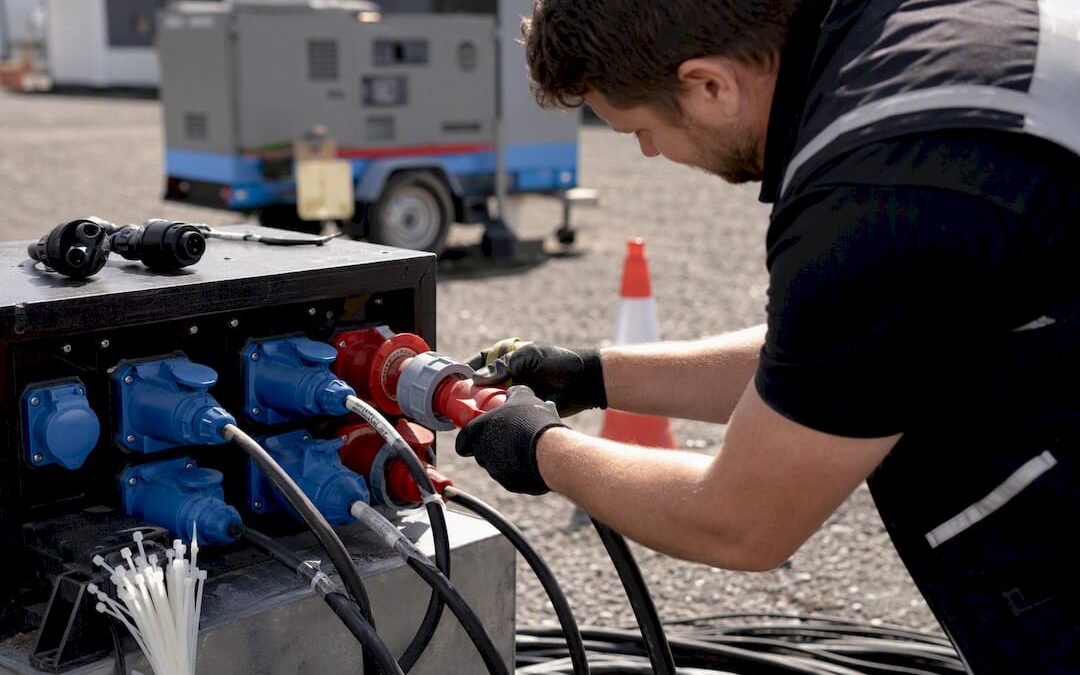
- Connectors should conform to BS EN 60309 (the blue and red round industrial plugs), not domestic sockets adapted for outdoor use.
- Fully unwind cable drums before use; a coiled drum under load can overheat even at moderate current.
- Route cables through ramps, ducts, or overhead rigging away from public footfall, and secure every joint.
- Keep a dedicated map of cable runs so faults can be traced quickly during the event.
Our guide to power cable management for events covers routing and trip-hazard protection in more depth, and the event power distribution explained guide walks through board specification in detail.
What inspection and certification should you insist on before doors open?
Paperwork isn’t bureaucracy here, it’s proof the system won’t fail when it matters. Before the public or crew are admitted, ask your supplier for:
- An earth electrode resistance test result, confirming the earthing system meets the required value for the installation.
- RCD test results showing correct trip times for every protective device fitted.
- Functional tests of any automatic changeover systems and emergency lighting or shutdown circuits.
- A completed single-line diagram matching what’s actually installed on site, not just what was planned.
- Commissioning documentation signed by a competent person, dated for that specific event.
Reference BS 7909 when briefing suppliers, since it’s the recognised code of practice for temporary entertainment electrical systems, alongside BS 7671 (the IET Wiring Regulations) and HSE’s event safety guidance. Keep copies of every certificate for at least the duration of your event insurance claim period, and confirm in writing who the competent person is before the day arrives. Our event electrical equipment inspection guide sets out what a thorough inspection report should contain.
How do you avoid an outage during a live stream?
Redundancy is what separates “the power went out” from “nobody noticed.” For genuinely critical loads, either run multiple generators with automatic changeover or accept that a single point of failure exists somewhere in your chain. UPS units earn their keep bridging the gap for sensitive control desks, mixers and network switches, the handful of seconds between a fault and a generator kicking in, rather than trying to power an entire rig.
- Fuel management needs a named owner: safe storage, scheduled refuelling windows, and a plan that doesn’t involve refuelling a running generator.
- Keep a standby electrician or technician on site with a clear escalation route if something trips.
- Test changeover systems before the event starts, not during the opening act.
Pro Tip: Assign refuelling to a specific person by name on your event brief, not “the crew.” Vague ownership is how tanks run dry mid-broadcast.
Our page on why venues need power contingency plans expands on staffing and fallback options, and Jaks Party Power’s standby service for corporate events covers what a dedicated on-site electrician actually does during a live event.
What’s a realistic checklist and timeline for event power?
A clear sequence keeps suppliers accountable and stops last-minute scrambling:
- Book a site survey and load calculation, ideally 6 to 8 weeks before the event for anything beyond a small private function.
- Confirm generator size, distribution layout and cable routes from the survey findings.
- Schedule equipment delivery and installation, allowing at least a full day before doors open for larger events.
- Run pre-event testing: earthing, RCDs, changeover systems, all signed off.
- Confirm standby staffing and refuelling ownership for the event day itself.
Cost mainly hinges on kVA required, cabling distance, the number of distribution circuits, and whether standby staffing is needed for the full event duration. Discuss all four with your supplier upfront rather than requesting “a generator” and hoping the quote covers everything. Our event power planning stages guide breaks the timeline down further, and the event equipment hire checklist is worth downloading before you brief anyone.
Power quality management and mitigation of electrical interference during live streaming
Clean power matters more for a live stream than it does for a wedding disco. Voltage sags, harmonic distortion and electromagnetic interference can introduce visible flicker on camera, audible hum in audio feeds, or, worse, dropouts on network-connected streaming hardware. Encoders and switchers are often more sensitive to power quality than the lighting and PA equipment sharing the same circuit.
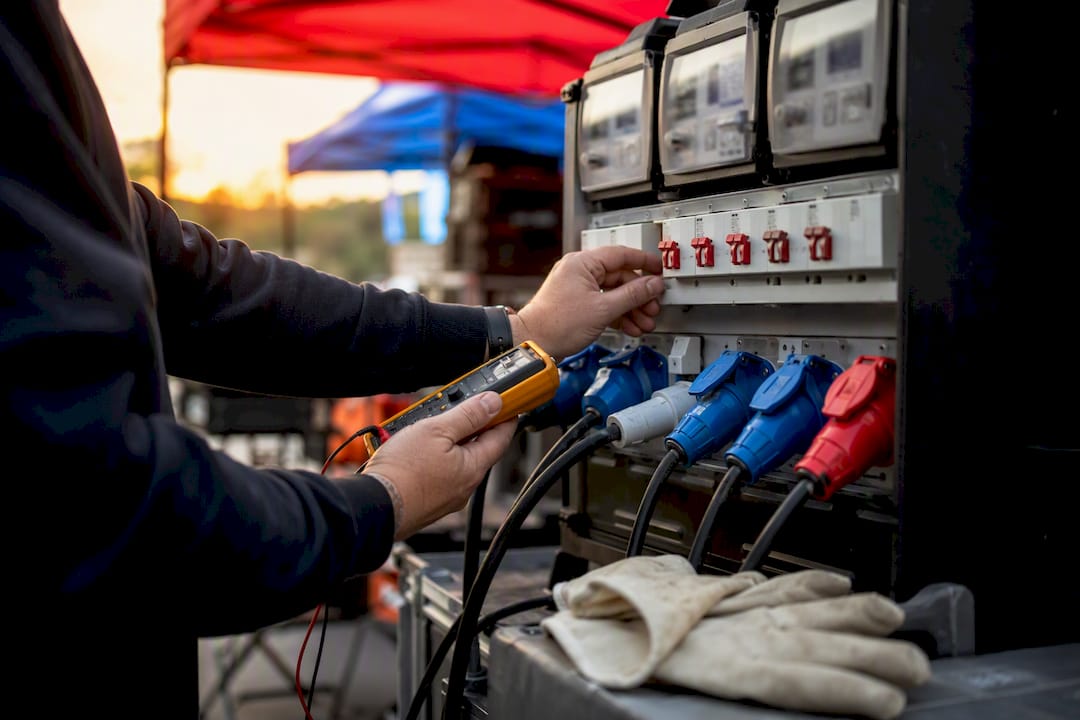
The fix starts at the distribution stage, not with a filter bolted onto the encoder afterwards. Keep streaming and broadcast equipment on a separate, dedicated circuit from high-draw items like dimmers, heaters or catering equipment, since these are the loads most likely to introduce voltage fluctuation and harmonic noise onto a shared supply. Where LED lighting or dimming systems run on the same generator, Type F or Type B RCD protection (as covered in the distribution section above) also helps guard against the leakage currents that variable-frequency drives and dimmer packs can generate.
Cable routing plays a role too. Running power and data or camera cables in parallel over long distances, particularly unshielded runs, can induce interference into signal lines. Cross power and data cables at right angles where they must intersect, and keep parallel runs separated by a reasonable distance where the site allows it.
Generator quality itself varies. Inverter-style generators typically produce a cleaner sine wave than older conventional sets, which matters when encoders, network switches and camera control units are directly plugged into generator-fed circuits rather than protected by a UPS. If the budget allows, request this specification explicitly when discussing generator options with your supplier rather than assuming any set will do.
Backup power solutions tailored specifically for uninterrupted live streaming
Streaming equipment fails differently to stage lighting. A lighting circuit tripping is visible and recoverable; a streaming feed dropping mid-broadcast often can’t be recovered at all, the moment is gone. That difference should shape your backup strategy.
UPS units are the first line of defence, not the generator itself. They bridge the handful of seconds between a fault occurring and a standby generator reaching full output, which is exactly the gap that causes an encoder to reboot or a network switch to drop connection. Size the UPS to your actual critical load, encoders, vision mixers, network switches and control desks, rather than trying to cover the whole production on battery power, which is rarely practical or necessary.
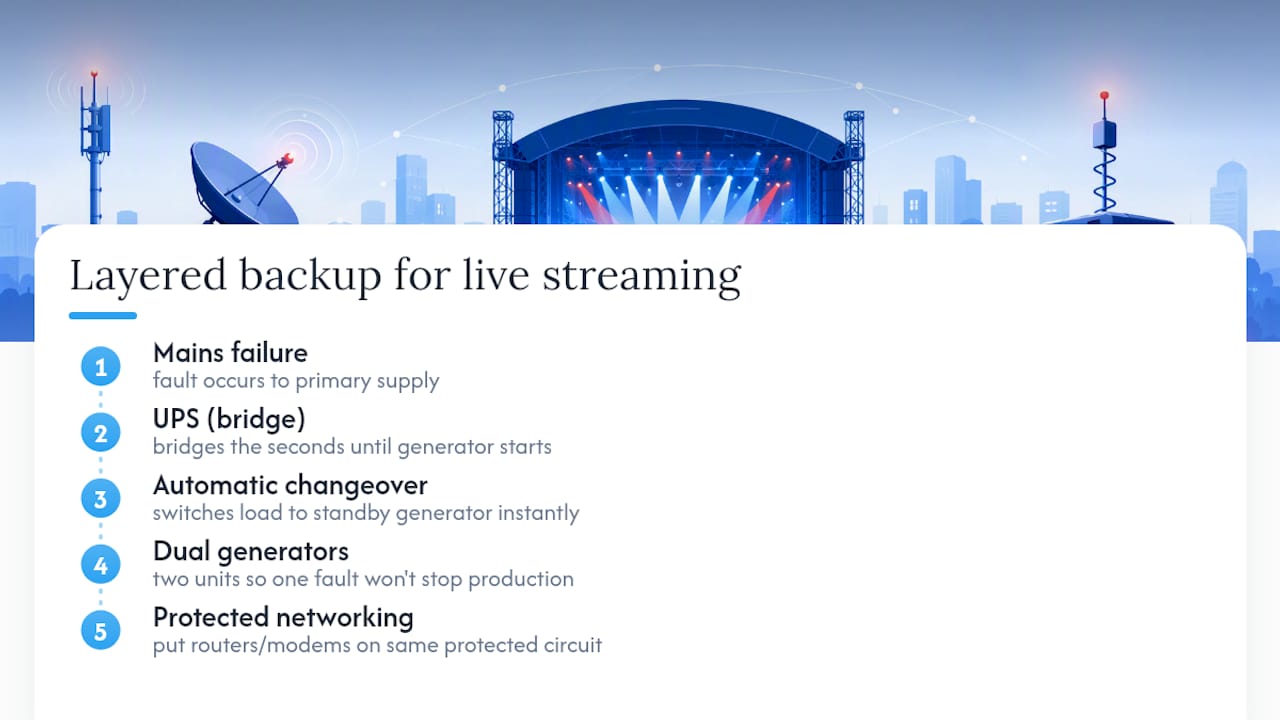
Beyond UPS bridging, redundancy at the generator level matters for anything genuinely mission-critical. Running two generators with automatic changeover, rather than a single larger set, means a fault on one unit doesn’t take the entire production down while it’s addressed. This costs more than a single-generator setup, and it’s worth having that conversation honestly with your supplier about which parts of your production genuinely justify it.
Network connectivity deserves the same backup thinking as power. A generator failure that also takes out your internet router or modem defeats the point of a UPS on the encoder if there’s no connection to stream through. Put networking equipment on the same protected circuit as your other critical broadcast kit, not as an afterthought plugged into whatever socket is nearest.
Integration of power systems with live stream equipment requirements and recommendations
Streaming equipment has power characteristics that differ from typical event kit, and treating it identically to stage lighting during planning is where problems start. Encoders, multi-camera switchers and network infrastructure tend to draw modest, steady current rather than the surging loads typical of motors or dimmer packs, but they’re far less tolerant of voltage fluctuation or brief interruptions.
When building your load calculation (covered earlier in the site survey section), list streaming and broadcast equipment as a distinct category with its own circuit rather than folding it into a general “AV” line item. This makes it straightforward for your electrical contractor to allocate a clean, protected supply and apply appropriate RCD protection without it being buried among higher-draw items.
Cable runs from distribution to the production or streaming desk should be planned with the same rigour as runs to the main stage. Voltage drop over long cable runs can affect sensitive equipment even when the current draw itself is low, so specify cable sized for the actual run length, not just the load, when briefing your supplier.
Coordinate timing between your production crew and electrical contractor early. If encoders and control desks need power live well before doors open, for pre-broadcast checks and stream testing, say so at the survey stage rather than assuming standard event power-up timing will suffice. A supplier who understands live-streamed events specifically, rather than only staged entertainment, will ask these questions unprompted.
Environmental considerations for power setups at live streaming venues
Weather and site conditions affect streaming power setups more than most organisers expect until the first heavy shower arrives. Outdoor or semi-outdoor venues need weatherproof distribution boards and connectors rated for the conditions, not standard indoor equipment sheltered under a gazebo and hoped for the best. IP-rated enclosures matter for anything exposed to rain, and cable joints in particular need proper weatherproof protection rather than simply being kept dry by positioning.
Ventilation is the flip side of weatherproofing. Sealing equipment against rain can trap heat, which is a real problem for generators, UPS units and networking equipment, all of which generate heat under load and need airflow to avoid thermal shutdown at the worst possible moment. Acoustic enclosures used for noise control (mentioned earlier for generator placement) need ventilation designed into them, not just a solid box that muffles sound and cooks the engine.
Temperature extremes affect equipment differently. Streaming hardware, network switches and control desks often have narrower operating temperature ranges than generators or lighting rigs, so positioning this equipment away from direct sun in summer, or providing heating in winter marquee setups, protects reliability as much as the electrical supply itself does.
Site drainage matters for cable routing specifically. Cables running through areas prone to standing water, even briefly during heavy rain, create both a safety hazard and a fault risk. Route cabling with drainage patterns in mind during the site survey, not as an afterthought once the ground is already wet.
Why the standard advice on event power misses the point
Most guidance on this topic treats compliance as the finish line: get your certificates, tick the boxes, done. That’s necessary but nowhere near sufficient. The organisers who actually avoid outages are the ones who treat the site survey as a conversation, not a form to fill in, asking their supplier hard questions about margin, redundancy and who’s accountable if something trips at 8pm on the night.
The gap I keep seeing is between paper compliance and operational readiness. A certificate proves the system passed a test that morning; it says nothing about whether the refuelling plan has a named owner or whether anyone’s checked the UPS runtime against your actual changeover speed. BS 7909 and BS 7671 give you the technical floor, not the whole answer.
If there’s one thing to prioritise above the rest, it’s the safety margin on your load calculation. Undersizing to save on generator hire cost is the single most common false economy in this entire process.
Why Jaks Party Power is a practical partner for live-streamed events
Jaks Party Power brings over 40 years of electrical contracting experience to exactly the problems this article covers: site surveys, generator sizing, distribution boards, cabling and a dedicated standby service that keeps a qualified technician on hand throughout your event. Rather than coordinating separate suppliers for survey, installation and on-site cover, you get one point of contact who provides commissioning documentation and test records as standard, not as an optional extra you have to chase.

That single-supplier approach matters most when something needs fixing fast, there’s no handover delay between the company that installed the system and the person troubleshooting it at 9pm. If catering is also drawing significant power on site, it’s worth coordinating load timing with your catering supplier, such as Pat’s Prime Cuts & Deli, so their equipment doesn’t spike demand during your stream’s peak moment.
Ready to get your load calculation sorted properly? Request a site survey or browse generator hire options to start the conversation before your event date gets closer than you’d like.
Sources
- Electrical safety at events — HSE
- BS 7909: Temporary electrical systems for entertainment — BSI Knowledge
- Temporary power distribution systems for entertainment-related purposes — IET
- NADJ Power Planner
FAQ
What does “live stream power” actually mean for event organisers?
It refers to the on-site generators, distribution boards, cabling and standby electrical support that keep live event and streaming equipment running reliably throughout production.
How much generator capacity do I need for a live stream?
Calculate your running and peak loads, then add a 20 to 25% safety margin; tools like the NADJ Power Planner help you reach an accurate figure before hiring.
Do I need a UPS if I already have a backup generator?
Yes, for sensitive equipment. A UPS bridges the brief gap between a power fault and a generator reaching full output, which a generator alone cannot cover.
What certificates should I ask a power supplier for before an event?
Request earth electrode resistance test results, RCD test results, a single-line diagram, and commissioning documentation signed by a competent person.
Can Jaks Party Power provide standby electrical cover during my event?
Yes, standby service is a core part of their offering, keeping a qualified technician on site throughout the event to handle faults as they arise.