
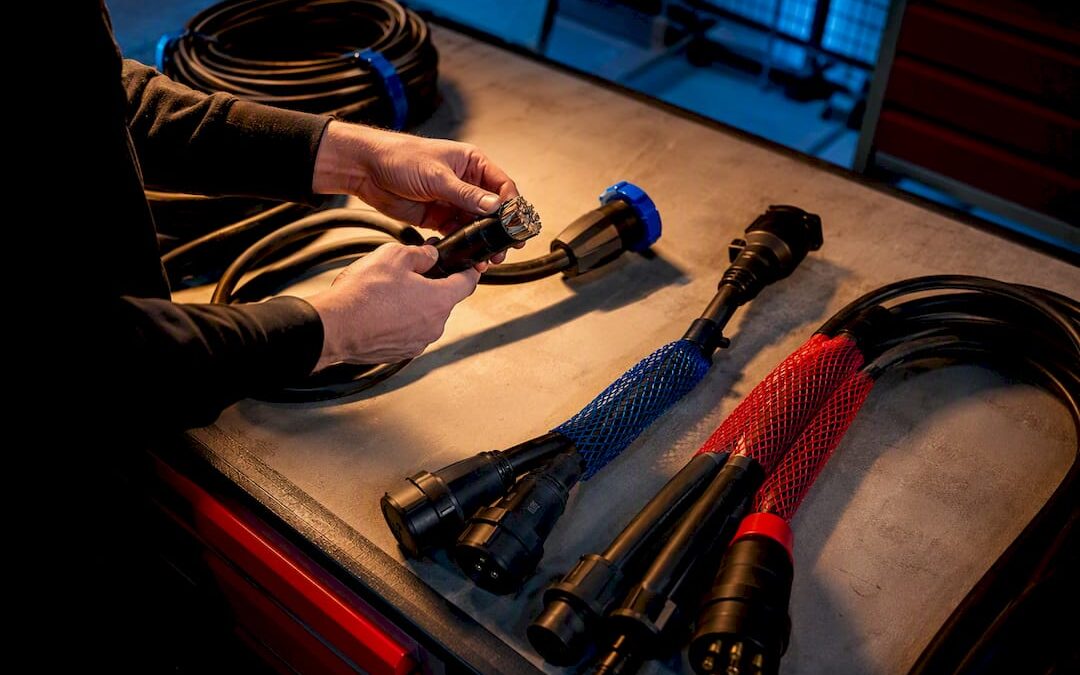
For most temporary supplies, H07RN‑F heavy‑duty rubber‑sheathed cable is the right choice outdoors, H05RN‑F or 300/500 V flexible cable covers indoor and low‑abuse runs, and LSZH‑rated cable is mandatory anywhere it routes through an escape route.
SY cable turns up everywhere on sites but isn’t built for rough outdoor duty. Every choice must trace back to BS 7671 and, for events, BS 7909.
TL;DR:
- H07RN-F rubber-sheathed cable is recommended for outdoor temporary supplies due to its high voltage rating and flexibility in cold weather, according to BS 7909 guidelines.
- LSZH-rated cables are mandatory for routing through escape routes to prevent toxic smoke and halogen gas emission during a fire, enhancing safety.
- Proper cabling depends on adherence to standards like BS 7671 and BS 7909, with detailed checks on voltage, conductor size, fire rating, and weather resistance before installation.
- Buried cables should be at least half a meter deep with physical markings, and overhead spans should not exceed 30 meters, maintaining minimum clearance of six meters over vehicle routes.
- Using the correct cable size (1.5 mm² for 16 A, 4 mm² for 32 A) requires checking load, length, and bundling conditions to avoid overheating and insulation damage.
Table of Contents
- Understanding temporary power cabling types
- What standards govern temporary power cabling?
- How deep should buried temporary cables go, and what overhead clearances apply?
- What cable size do you need for a 16 A or 32 A supply?
- Installation and routing: what does a safe checklist look like?
- Which earthing and RCD arrangements suit temporary supplies?
- Lessons from the field: what 40 years of event power teaches you
- Why competence matters more than the cable you pick
- How Jaks Party Power supports your temporary cabling needs
- Sources
- FAQ
Understanding temporary power cabling types
The cable family you pick decides whether your installation survives a wet weekend or fails at the worst possible moment. Each type differs in sheath material, voltage rating, and how much mechanical abuse it can take before the insulation gives up.
H07RN‑F is the workhorse for outdoor temporary supplies. It’s rated 450/750 V, sheathed in tough polychloroprene rubber rather than PVC, and stays flexible in cold weather where PVC cable stiffens and cracks. BS 7909 specifically recommends it, or an equivalent, for outdoor heavy‑duty runs feeding generators, distribution boards, and stage equipment, according to the IET’s guidance on cables for temporary electrical installations.
H05RN‑F, rated 300/500 V, is the lighter cousin. Use it for indoor leads, exhibition stands, or short runs where the cable won’t get run over, dragged across gravel, or left out in the rain.
LSZH (low smoke zero halogen) cable matters wherever a run crosses a corridor, fire exit, or any escape route. Standard PVC sheathing gives off dense smoke and toxic halogen gas when it burns; LSZH doesn’t, which is why fire‑behaviour standards require it in those locations, as the Voltimum UK guide on temporary installation cables sets out.
SY cable is common on building sites and in workshops, but treat it with caution outdoors. Its PVC sheath isn’t UV‑stable long term, and the internal steel wire braid needs proper earthing through a purpose‑made gland. The IET’s temporary power distribution webinar is direct on this: SY isn’t recommended for rough outdoor use, and H07RN‑F is the safer substitute.
A quick reference for the main families:
-
H07RN‑F: 450/750 V, rubber sheath, outdoor and heavy duty
-
H05RN‑F: 300/500 V, lighter rubber sheath, indoor or low‑abuse use
-
LSZH variants: fire‑safe sheath, mandatory near escape routes
-
SY: PVC sheath with steel braid, workshop use, poor fit for rough outdoor jobs
-
Armoured (SWA): steel wire armour, used for buried or fixed temporary distribution runs
What standards govern temporary power cabling?
Every cable choice needs to trace back to a standard, not a gut feeling. BS 7671 (the IET Wiring Regulations) sets the baseline for all UK electrical installations, temporary or permanent. BS 7909 goes further for events and entertainment, covering generator supplies, distribution, and the cable grades suited to touring and temporary rigs. BS 7375 deals with the distribution of electricity on construction and building sites, which matters if your temporary supply sits within a wider site project.
Before you sign off on a cable, check the datasheet against these points:
- Rated voltage (300/500 V or 450/750 V, marked on the sheath)
- Conductor cross‑sectional area against the expected load
- Sheath material and its UV and abrasion resistance
- Fire behaviour rating (standard PVC vs LSZH vs EN 60332 flame‑propagation compliance)
- Manufacturer’s temperature range for outdoor and cold‑weather use
Pro Tip: Photograph the cable drum label and datasheet before installation and keep it with your commissioning file. It’s the fastest way to prove compliance if a site inspector asks what’s actually in the ground.
Armoured cable (SWA) is required wherever a temporary feed becomes semi‑permanent, buried, or runs through an area where mechanical damage is likely. The HSE’s guidance on electrical safety on construction sites treats temporary distribution with the same rigour as permanent installations, insisting on competent design and retained test records, not ad‑hoc extension leads strung between generators.
How deep should buried temporary cables go, and what overhead clearances apply?
Site conditions dictate cable choice as much as the load does. A few practical rules keep both people and cable safe:
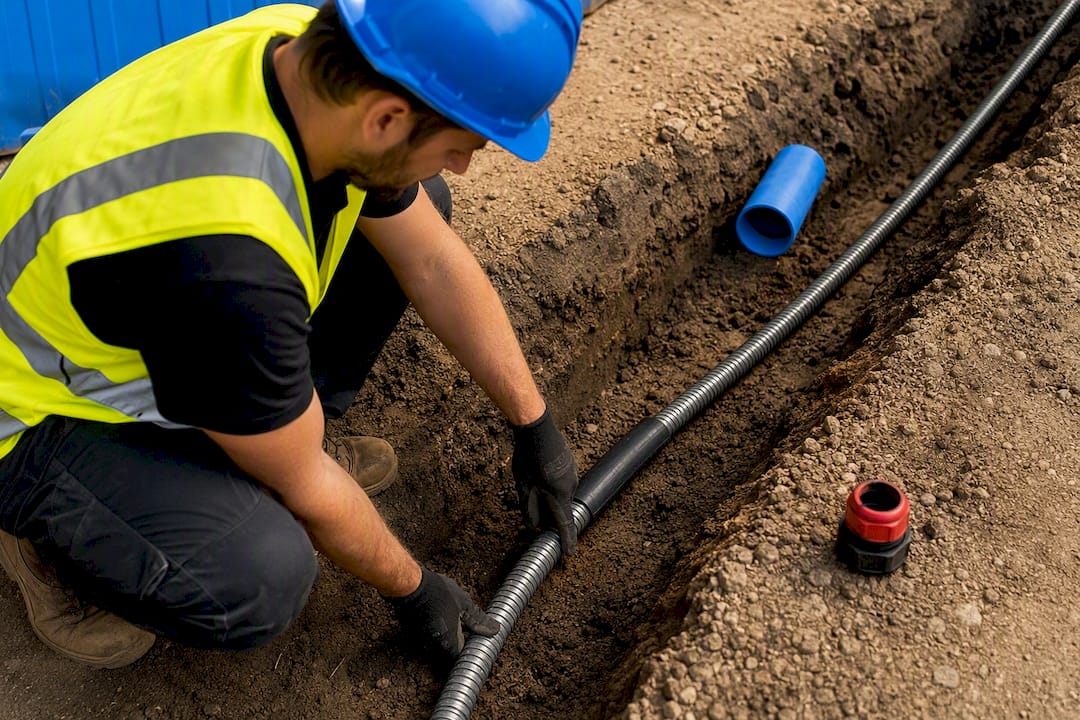
- Bury cables crossing vehicle routes at a minimum depth sufficient to protect the cable from mechanical damage, typically around half a metre, or run them through a duct at that depth, and mark both ends physically so nobody digs through them later.
- Keep overhead spans to around 30 metres maximum before you need intermediate support, since longer unsupported runs sag and risk contact with vehicles or structures.
- Maintain a minimum clearance generally recognized as approximately six metres for vehicles over vehicle routes and 3.5 metres over inaccessible pedestrian areas.
- Use cable ramps at every ground‑level crossing point rather than taping cable to tarmac, and choose SWA or ducted routing for any run that will stay in place beyond a single event day.
- Protect every connector and termination from standing water; IP‑rated enclosures and raised connections are cheap compared to the alternative.
Pro Tip: Keep a simple burial and route record, even for a one‑night event. If a groundworks contractor turns up next week, that record is the difference between a quick conversation and an expensive cable strike.
What cable size do you need for a 16 A or 32 A supply?
Cable sizing questions come up constantly on site, and the short answer is: don’t guess, check the current rating against the run length and grouping, then size up if in doubt. As a working baseline, 16 A flexible leads typically use 1.5 mm² conductors and 32 A leads step up to 4 mm², though the exact minimum depends on cable length, ambient temperature, and how many other cables are bundled alongside it, per the IET’s cable guidance for temporary installations.
The 16 A vs 32 A choice usually comes down to load, not preference: 16 A suits lighting runs and smaller equipment, while 32 A handles larger distribution feeds, catering equipment, and multi‑outlet splitter boxes. Above roughly 125 A, standard practice shifts from multicore flexible cable to single‑core conductors, since a multicore cable that size becomes unwieldy to handle and terminate safely.
Grouping and heat matter more than most people expect. Bundle several loaded cables together, coil them under a stage riser, or run them through a duct with poor ventilation, and the current rating drops because heat can’t escape as easily.
- Never coil a live cable under load; a coiled drum traps heat and accelerates insulation ageing even at rated current
- Keep phase, neutral and CPC conductors bundled together within a multicore run to avoid circulating currents in nearby steel structures
- Always uncoil spare drums fully before energising, even for a short test
Pro Tip: If you’re running cable through a duct or under decking, derate one size up from the “open air” rating. It costs a few extra metres of copper and saves you a nuisance trip on a hot afternoon.
Installation and routing: what does a safe checklist look like?
A temporary system built without a plan on paper tends to fail in ways a permanent installation never would, mostly because nobody remembers where anything actually runs. Get the paperwork right before the first cable goes down.
- Draw a single‑line diagram and a physical route map before installation starts, noting cable type, length, and protective device for every circuit.
- Mark buried ducts at both ends and keep the depth record with the diagram; the HSE’s site safety guidance treats this as standard practice, not an optional extra.
- Terminate outdoor and heavy‑duty circuits with EN 60309 (commonly called CEE‑form) connectors, and where a cable uses a braided screen, earth it properly through the gland rather than leaving it floating.
- Use consistent colour coding and durable labelling at every distribution point, so anyone tracing a fault mid‑event isn’t guessing which drum feeds which load. Our guide to power cable management for events covers labelling conventions in more depth.
- Protect every crossing point with a proper cable ramp, support overhead runs on catenary wire rather than trees or scaffold poles, and lock distribution boards with secure isolators.
- Run a daily visual check on connectors, gland seals, and cable ramps for the duration of a multi‑day event, not just at initial commissioning.
Which earthing and RCD arrangements suit temporary supplies?
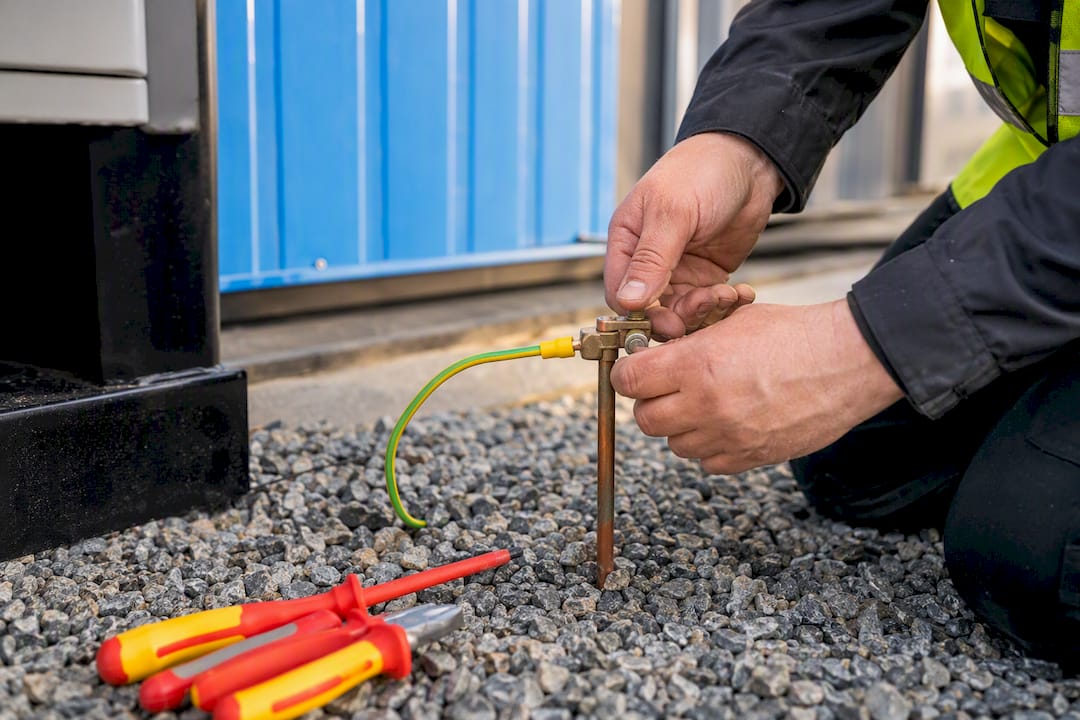
Earthing choice on a temporary job isn’t just a technicality. TT earthing, using a local earth electrode, is often preferred for standalone generator supplies because it avoids relying on a PME (Protective Multiple Earthing) connection that can become dangerous if the incoming neutral fails. TN‑S arrangements work where a solid, verified earth is already available from the supply, and IT systems have a niche role in specific continuous‑process setups, though they’re rare on typical event or construction jobs.
RCD selection has to match the load, not just tick a box. Type A is the practical minimum for most modern socket‑outlet circuits, but stage dimmers, variable‑frequency drives, and rectifying equipment can produce mixed‑frequency or smooth DC residual currents that a Type A device won’t reliably detect. In those cases, BS 7909 guidance on temporary installations calls for Type F or Type B protection instead.
Before energising anything, run and record:
- Continuity testing on every protective conductor
- Insulation resistance testing across all live conductors
- RCD operation testing at rated trip current and time
- Earth loop impedance testing where the arrangement calls for it
Keep every result. Decommissioning and periodic re‑inspection both rely on having a baseline to check against, and an event distribution board installation guide is a useful reference for planning where these tests fit into your board layout.
Lessons from the field: what 40 years of event power teaches you
Forty years of running electrical contracting and event power across Sussex teaches you that the failures are rarely dramatic. They’re a connector left uncapped in the rain, a cable coiled tight under a generator that’s been running for six hours, a distribution board with no spare fuse on site.
One recurring job pattern: a marquee wedding drawing around 32 A total load across catering, lighting, and a band, fed from a single generator through H07RN‑F outdoor runs, distributed via a 63 A board down to individually protected 16 A and 32 A outlets. Every circuit gets RCD protection matched to its load, cable runs get ramped at every walkway crossing, and connectors get checked before doors open, not after a complaint.
The equipment matters less than the discipline behind it. Spare leads, clear labelling, and someone who checks connectors before the first guest arrives will save an event long before any cable specification does.
Practical habits that pay off repeatedly:
- Carry spare H07RN‑F leads in common lengths, already tested
- Label every distribution outlet at both the board and the load end
- Inspect connector pins and gland seals before each hire goes back out
- Keep a standby technician on call for multi‑hour events rather than assuming nothing will trip
Why competence matters more than the cable you pick
Temporary power fails as a management problem far more often than it fails as a materials problem. Choose H07RN‑F, get the earthing right, and the job can still go wrong if nobody’s responsible for the single‑line plan or the test records.
That’s the real argument for nominating a Senior Person Responsible on every job, someone whose job is to hold the diagram, chase the commissioning tests, and know exactly what’s buried where. A competent contractor doesn’t just supply the right cable; they reduce the number of decisions being made improvised, on the day, under time pressure. That’s where risk actually creeps in.
If you’re planning a supply beyond a simple domestic extension lead, get a competent contractor involved at the design stage, not just for the install. It’s cheaper than fixing a fault mid‑event.
— Rob
How Jaks Party Power supports your temporary cabling needs
Getting cable type, sizing, and earthing right is only half the job. The other half is having equipment that’s tested, labelled, and backed by someone who answers the phone if a connector fails at 9pm on a Saturday. That’s the gap Jaks Party Power fills for event organisers and site managers across Sussex who don’t want to manage hire logistics on top of everything else.

We supply H07RN‑F and other correctly rated cable through our cable hire range, alongside generator hire and distribution board packages sized to your load, all backed by over 40 years of electrical contracting experience. Every hire comes with proper commissioning checks, and our standby service means a qualified technician is on call for the duration of your event, not just at setup. If you’re planning a wedding, corporate event, or a multi‑day show, get in touch with Jaks Party Power to talk through your load requirements and get a quote for cabling, generators, and standby cover together.
Sources
- Electrical safety on construction sites (HSE)
- Temporary installations BS 7909 | Elec‑Mate
- Cables for temporary electrical installations (Voltimum UK)
FAQ
What are the three types of power cables?
Temporary power generally uses three broad categories: heavy‑duty outdoor cable like H07RN‑F, ordinary‑duty indoor cable like H05RN‑F, and fire‑rated LSZH cable for escape routes. Armoured cable adds a fourth category for buried or semi‑permanent runs.
What are the seven different types of cable connectors?
Common connectors on temporary power jobs include EN 60309 (CEE‑form) plugs and sockets in 16 A and 32 A ratings, 63 A and 125 A industrial couplers, connectors compliant with relevant British Standards, and specialist multi‑pin connectors for lighting and control circuits. The exact mix depends on load size and whether the circuit is single or three phase.
What are the four basic cable types?
For temporary installations, the four basic types are rubber‑sheathed H07RN‑F for outdoor heavy duty, H05RN‑F for indoor ordinary duty, LSZH variants for fire‑critical routing, and armoured (SWA) cable for buried or fixed temporary runs.
What is a 16 A vs 32 A cable used for?
A 16 A cable, typically 1.5 mm², suits lighting circuits and smaller equipment, while a 32 A cable, typically 4 mm², handles larger distribution feeds and multi‑outlet loads. The right choice depends on total connected load, not just what’s on the hire shelf.
Is SY cable suitable for outdoor temporary power?
SY cable isn’t recommended for rough outdoor temporary use because its PVC sheath isn’t UV‑stable long term and its steel braid needs careful earthing. H07RN‑F is the standard substitute for outdoor and heavy‑duty applications.