
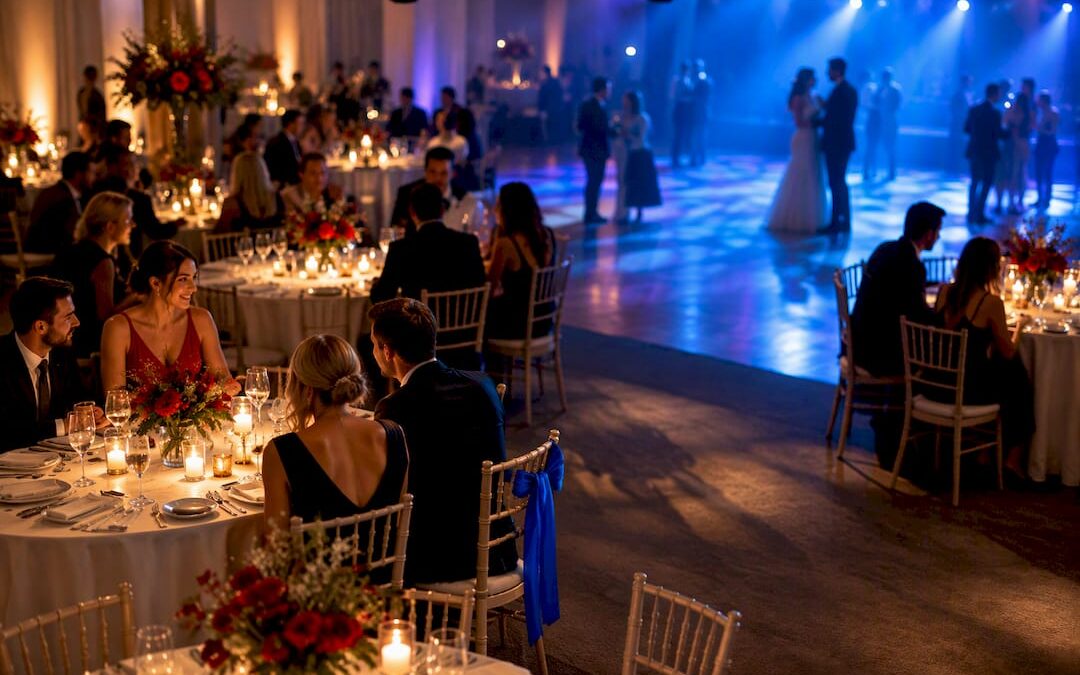
Treat wedding lighting as a temporary electrical installation: hire a supplier who designs, installs and provides on-site standby so the lights stay on and escape routes remain safe. Lighting design for weddings means integrating fixtures, temporary power and technical support into one managed system across the full event timetable, not just dropping off lamps. Jaks Party Power Limited is one provider set up to deliver that as a single service.
TL;DR:
- Temporary wedding lighting systems must comply with BS 7671 and BS 7909 standards, requiring a competent person to oversee design, installation, and testing.
- A detailed brief covering site layout, program phases, load timetable, equipment, and safety measures is essential for accurate quotes and system planning.
- Peak load calculations should consider every fixture and effect phase by phase, with generators used when mains power is unconfirmed or insufficient.
- Outdoor setups require ground and wind assessments, safety zones, appropriate equipment, and weather contingency plans to prevent safety hazards.
- On-site standby support from qualified technicians, including fault response and generator management, is crucial to maintain continuous wedding operations.
Table of Contents
- Why this is a temporary electrical installation, not a lighting delivery
- Mandatory brief checklist for a lighting hire quote
- Sizing power and distribution without the common technical traps
- Outdoor safety, rigging and weather planning to insist on
- Inspection, testing and documentation to request before guests arrive
- Standby and on-site technical support: what good cover looks like
- Types of lighting fixtures suited to a managed wedding rig
- Choosing colour schemes and moods that suit the day
- Lighting control systems and programming for the evening
- Coordinating lighting with music, decor and photography
- Safety considerations for guests in public event spaces
- Cost estimation and budgeting for a lighting and power system
- What experienced event power practitioners actually worry about
- How Jaks Party Power can help with your wedding lighting brief
- Sources
- FAQ
Why this is a temporary electrical installation, not a lighting delivery
Booking lighting for a wedding is fundamentally different from renting a van of fixtures and plugging them in. The moment you connect multiple circuits, a generator or extended cable runs across a venue, you have created a temporary electrical system, and that system falls under BS 7671 wiring rules and the specialist temporary-event standard BS 7909. HSE guidance on electrical safety at events expects organisers to appoint a competent person to oversee design, installation and testing rather than assume the venue’s sockets will cope.
Venue power points and a generator borrowed for the day are rarely enough on their own. Neither comes with the earthing checks, load calculations or documentation a wedding of any real size needs.
- A competent person or Senior Person Responsible should own the design and sign it off.
- BS 7909 governs management and testing of the temporary system once installed.
- Venue sockets alone rarely have the capacity or protection for a full lighting and power rig.
Pro Tip: Ask any lighting supplier who their appointed competent person is before you book. If they can’t name one, they are supplying fixtures, not a system.
Mandatory brief checklist for a lighting hire quote
A comparable quote depends on giving every contractor the same brief. HSE’s event-safety guidance sets out the core topics a temporary lighting brief should cover, and turning these into a numbered checklist keeps your requests to suppliers consistent and easy to compare.
- Site layout and areas: ceremony space, dining, dancefloor, DJ or band position, and any technical or backstage zones.
- Programme phases: what lighting and power each phase needs, from arrival through to last dance.
- Load timetable: when demand rises (band load-in, dinner service, evening effects) and when it drops.
- Equipment list: fixture types, quantities and connector types for every circuit.
- Distribution preference: confirmed mains access, or a stated need for generator hire.
- Socket and connector types: specify BS EN 60309 industrial connectors for higher-power circuits.
- Cable routes: marked routes with protection at every crossing point or trip hazard.
- Main isolation: a clearly accessible isolation point the on-site team can reach in seconds.
- Emergency lighting: coverage for escape routes independent of the main supply.
- Earthing arrangements: confirmation of how the system will be earthed and tested.
Paste this list into an RFQ and any competent contractor should return a proposal that answers every line, not a generic fixture quote.
Sizing power and distribution without the common technical traps
Start with a simple kilowatt load timetable: list every fixture, motor and effect against the phase of the wedding it runs in, then total the peak demand rather than the average. A dancefloor lighting rig running alongside a band and a heated marquee at 9pm draws far more than the same kit idling during the ceremony, and contractors size supply to that peak, not an average across the day.
- Build peak-load figures phase by phase, not one flat total for the day.
- A generator is recommended whenever mains supply is unconfirmed, undersized or shared with catering and heating loads.
- BS EN 60309 connectors are the standard for higher-power lighting circuits, and three-phase distribution is often needed once bands, catering and lighting share one supply.
- Earthing and isolation on a hired generator are the contractor’s responsibility to assess and test, never assumed from the connection alone.
Guidance Note GS50 warns that a single RCD protecting an entire lighting rig can cause nuisance trips with some dimmer types, because dimmer channels often carry higher earth leakage than the RCD expects. A contractor working to GS50 should propose several RCDs or another form of discrimination across circuits, so one dimmer fault does not take out every light in the room. Ask specifically how your supplier separates dimmer circuits from general lighting and power before you sign off the design.
Outdoor safety, rigging and weather planning to insist on
Outdoor ceremonies and marquee receptions bring risks that indoor venues do not. HSE’s guidance on outdoor equipment requires a site-specific assessment of ground strength, slope and wind loading before any lighting tower, truss or suspended fixture goes up, because a rig designed for a flat, firm indoor floor is not automatically safe on grass, gravel or a slope.
- Ground and wind assessment comes first: soft ground, slopes and exposed sites all change what equipment can safely be used.
- Safety chains or wires are required on suspended fixtures, and no fixture should rely on a single suspension point.
- Outdoor-rated IP equipment with appropriately sized ballast or base weights keeps towers and stands stable in wind.
- Exclusion zones around towers are typically set relative to the tower’s height, and forecast wind or rain can be reason enough to modify or pause a rig.
A generic indoor lighting stand moved outside for a marquee wedding is one of the most common shortcuts that turns into a safety problem on the day. If the forecast changes overnight, expect your contractor to revisit the plan rather than proceed as briefed.
Inspection, testing and documentation to request before guests arrive
Ask for paperwork, not just a working rig. The IET’s guidance on temporary electrical systems explains that larger or altered systems need a completion certificate, which records what was installed, how it was tested and who signed it off. Local authority guidance from areas including Dover reinforces that a temporary electrical installation report should exist before any event opens to guests, particularly where a generator is hired in.
- A completion certificate should cover the installation, the tests run and the person responsible.
- Pre-event checks include RCD test-button trials, earthing verification and load-balance checks across circuits.
- Venues and insurers may ask to see third-party verification before allowing access.
- Keep method statements, risk assessments and handover notes on file, not just the certificate itself.
Our guide to event electricians’ roles at weddings covers what these documents should contain in more detail.
Standby and on-site technical support: what good cover looks like
Standby cover is what turns a well-designed system into a resilient one on the night. A competent electrician or technician on call, or physically on site, can reconfigure distribution, respond to a fault or refuel a generator without stopping the wedding.
- Fault response should be immediate: a blown circuit during the first dance is not the moment to wait for a callback.
- Generator refuelling and reconfiguration are standard standby tasks, especially over a long reception.
- Response times should be specified in the contract, along with an escalation path if the on-site technician needs support.
- Spare kit access matters as much as the technician: a fault fixed by a swap-out is far faster than one diagnosed from scratch.
Pro Tip: Ask what happens if a circuit trips during the speeches. The answer should name a person, a response time and a spare part, not “we’ll sort it”.
Types of lighting fixtures suited to a managed wedding rig
The fixture mix on a wedding job is usually built from a small set of proven types rather than anything exotic. Uplighting units wash walls, marquee linings or trees with colour and are among the most requested fixtures for both ceremony and reception spaces. Fairy lights and festoon strings provide ambient fill for dining areas and outdoor walkways, though on a managed system these run from properly protected circuits rather than a domestic extension lead.
Spotlights and profile fixtures pick out speakers, the top table or the first dance, giving the photographer and videographer a clean, controllable source instead of relying on ambient light. LED effect fixtures, including moving heads and wash lights, handle the dancefloor and evening entertainment, where colour and movement need to change through the night without re-rigging.
Choosing between these is less about aesthetics than about circuit planning: uplighting and festoon lighting tend to be lower current and simpler to distribute, while moving-head and effect fixtures draw more and often sit on dedicated dimmer circuits. A partner guide to lighting design for event planners sets out how these fixture types map onto different venue areas, which is useful when you are briefing a contractor on layout. Our own lighting hire range covers each of these categories, including uplighting specifically.
Choosing colour schemes and moods that suit the day
Colour temperature and palette do most of the emotional work in a wedding lighting design, and they need to be agreed early because they affect equipment choice. Warm white uplighting and amber-toned fill light suit a traditional or rustic theme, while cooler whites and controlled colour washes suit a modern or minimalist look. Bold saturated colour, typically reserved for the dancefloor and evening reception, works because it is confined to one zone rather than washed across the whole room.
Matching mood to timetable matters as much as matching it to theme. A ceremony and drinks reception generally call for soft, even, warm light that flatters guests and photographs well, while the shift to bolder colour and movement for the evening reception should feel like a deliberate change, not an accident of the rig running out of settings. Discuss the palette for each phase of the day with your contractor, phase by phase, in the same way you would discuss the load timetable, because the two decisions are linked: richer colour effects often draw more power and sit on separate dimmer circuits from the warm ambient wash.
Photographers and venues both tend to prefer a coordinated palette over a mix of clashing colour temperatures in the same room, so agree the scheme with anyone else lighting the space, including any DJ-supplied effects, before the day.
Lighting control systems and programming for the evening
A wedding with more than a handful of fixtures needs a control system, not a row of dimmer switches. DMX-based control lets one operator programme scene changes for each phase of the day: a warm static look for the ceremony, a brighter scheme for dinner, and programmed colour changes or chases for the dancefloor later on. Pre-programming these scenes in advance, rather than improvising on the night, is what allows a single operator or standby technician to move the room from one mood to the next with one button press.
Wireless DMX and app-based control have made this more accessible, letting a technician adjust levels from anywhere in the room rather than standing at a fixed desk. That flexibility is useful when timings slip, which they usually do, and the lighting needs to hold a look for longer or move on faster than planned.
The control system should be specified in your brief alongside the fixtures themselves, since a rig without proper control is far harder to adjust live. Our guide to the role of lighting control systems in events covers the practical side of specifying and running one of these systems on the day.
Coordinating lighting with music, decor and photography
Lighting rarely works in isolation at a wedding. The DJ or band’s own effects, the venue’s decor and the photographer’s requirements all interact with your lighting plan, and a design that ignores one of them tends to create a problem for another.
Coordinate cue timing with the band or DJ so that lighting changes land with the music rather than against it, particularly around the first dance and any special moments. Decor elements such as drapes, floral installations or a lit backdrop should be checked against the lighting plan so uplighting does not wash out a feature or clash with its colour. Photographers and videographers need enough consistent, flattering light to work with throughout the day, and a sudden shift to saturated colour during speeches can ruin otherwise good photographs, so confirm key moments with them in advance.
The simplest way to manage this is a single point of contact on the day who can adjust lighting on request, which is one of the practical arguments for on-site standby rather than a fixture drop-off with no technician present.
Safety considerations for guests in public event spaces
A wedding is a public event for electrical safety purposes, and guests move through spaces in ways a static rig needs to accommodate. Cable routes must be protected wherever guests walk, particularly across doorways, dancefloors and any transition between marquee and permanent building, in line with HSE’s electrical safety guidance. Isolation points need to be accessible to the on-site technician at all times, not buried behind furniture or decor once the room is dressed.

Emergency lighting covering escape routes should comply with BS 5266-1 and run from an independent source, so a mains failure never leaves an exit route in darkness. Generators must be sited away from public access and guest movement, both for noise and to prevent anyone touching hot surfaces or fuel points. Any temporary structure supporting lighting, such as a truss or tower, needs the same guest-safety thinking as the electrical system itself: exclusion zones, secure bases and secondary suspension on anything overhead.
These are not abstract requirements. A trailing cable across a dancefloor or an unprotected isolator behind a buffet table is exactly the kind of oversight that turns a minor fault into an injury.
Cost estimation and budgeting for a lighting and power system
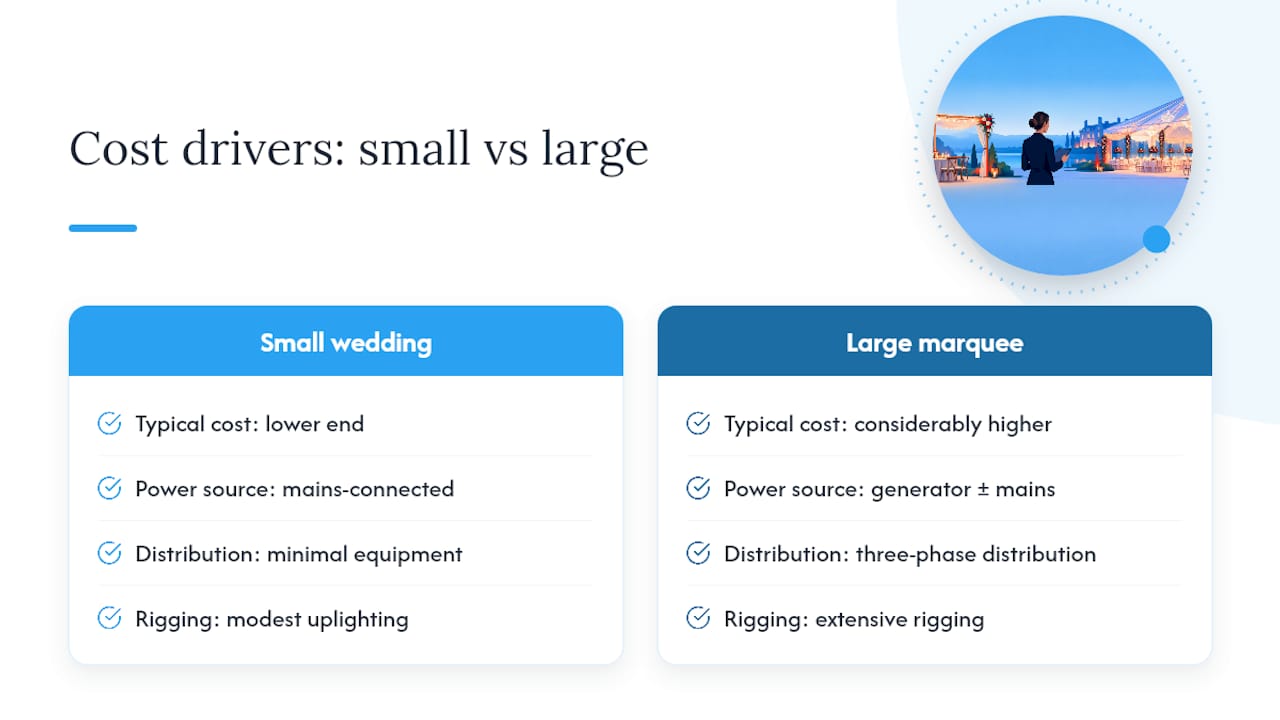
Budgeting for wedding lighting means pricing a system, not a list of fixtures. The main cost drivers are the number and type of fixtures, whether a generator is needed alongside or instead of mains power, the distribution equipment required to run everything safely, and whether standby cover is included for the event.
A small, mains-connected ceremony and reception with a modest uplighting and dancefloor package sits at the lower end of the range. A larger marquee wedding needing full temporary power, three-phase distribution, extensive rigging and an on-site technician for the whole event costs considerably more, largely because of the generator, distribution equipment and labour rather than the fixtures themselves. Jaks Party Power Limited and similar specialists price bespoke packages once they know the venue, guest count and programme, since power requirements vary too much between weddings for a fixed rate card to mean much.
When comparing quotes, check what is actually included: fixture hire alone is the cheapest option on paper, but a quote that also covers design, installation, testing, a completion certificate and standby cover is buying you a managed system rather than a box of lights. Ask each contractor to itemise fixtures, distribution, generator hire if needed, and standby separately, so you can see where the budget is actually going rather than comparing one all-in figure against another.
What experienced event power practitioners actually worry about
Most lighting failures at weddings come from the parts nobody photographs: an unearthed generator, a cable run nobody protected, a rig sized for the ceremony but not the dancefloor later that night. Decades of electrical contracting experience teach you to design for the worst hour of the day, not the easiest, and to test before guests arrive rather than hope. Good standby practice is what stops a fixable fault becoming a stopped reception.
— Rob
How Jaks Party Power can help with your wedding lighting brief

Planning a wedding that needs proper temporary power, not just fixture hire, is exactly the job Jaks Party Power Limited is built around. Drawing on over 40 years of electrical contracting experience, the team designs, installs and tests lighting and distribution as one system, then provides on-site standby so faults get fixed while the reception carries on.
- Product hire covers lighting, distribution, generators, cables and accessories from one supplier.
- Event setup includes design, installation and testing before your guests arrive.
- Standby cover puts a competent technician on call or on site for the event itself.
- Completion certificates and handover documentation are provided as part of the service.
Get in touch through the services page to request a site-specific brief and a quote that covers design, installation and standby together.
Sources
- Electrical safety at events (HSE)
- Temporary electrical systems: a guide to the application of BS 7671 and BS 7909 (IET)
FAQ
Do I need a certificate for temporary wedding lighting?
Yes, larger or altered temporary systems should come with a completion certificate confirming what was installed and tested, as set out in IET guidance on temporary electrical systems. Ask your supplier for this document, along with any risk assessments, before the event opens to guests.
Can I just use the venue’s existing power sockets?
Venue sockets alone are rarely sufficient for a full wedding lighting rig, since HSE guidance expects a proper assessment of power requirements, earthing and distribution rather than reliance on whatever sockets happen to be available. A competent supplier will confirm mains capacity or recommend a generator instead.
Why would a lighting rig need more than one RCD?
A single RCD covering an entire lighting rig can trip unexpectedly because some dimmer types carry higher earth leakage than the device expects, according to Guidance Note GS50. Splitting circuits across several RCDs, or using another form of discrimination, stops one fault taking out every light in the room.
Is a generator always needed for outdoor wedding lighting?
Not always: a generator is recommended whenever mains supply is unconfirmed, undersized or already shared with catering and heating, but a venue with confirmed adequate mains capacity may not need one. Your contractor should assess this as part of the load timetable rather than assume either way.
What should standby cover actually include on the night?
Good standby cover includes a competent technician available for immediate fault response, generator refuelling and distribution reconfiguration if demand changes through the evening. Response times and escalation should be agreed in advance, not left open on the day.