
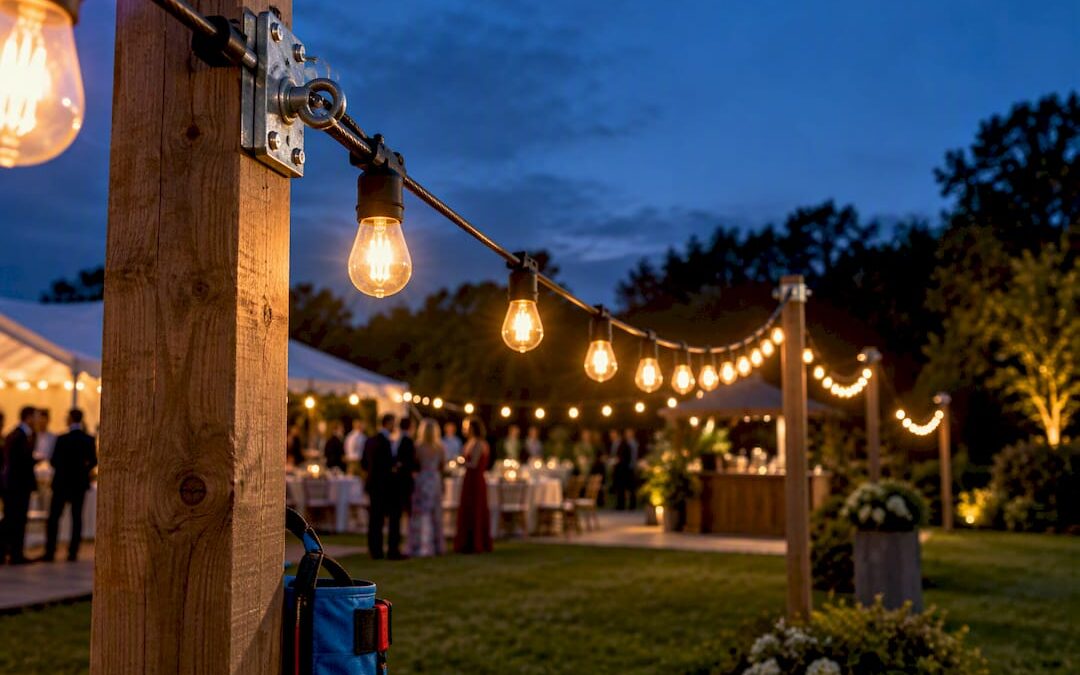
Festoon lighting is a safe, durable choice for outdoor ambience when you use weatherproof cable, a supported catenary and an RCD-protected supply. Get those three things right and everything else, spacing, bulb type, fixing hardware, is a matter of preference. Skip any one of them and you risk sagging cable, blown bulbs or a genuine shock hazard.
TL;DR:
- Using weatherproof IP44 cables with rubber lamp holders and BS EN 60309 connectors ensures safety and compliance for outdoor festoon lighting.
- Tensioning a catenary wire before hanging the cable prevents sagging and protects bulbs from wind damage and strain.
- LED bulbs are recommended for their lower power consumption and cooler operation, especially near fabric or foliage, despite higher upfront costs.
- For larger or public events, professional electrical oversight, testing, and certificates are necessary under BS 7909 standards.
- Proper planning, measuring, and tensioning are critical to achieving an attractive, durable, and safe festoon lighting setup.
Table of Contents
- Tools and materials you need before you start
- Planning your layout, measuring runs and spacing bulbs
- Fixing points, catenary wire and getting the tension right
- Power, protection and the standards you must follow
- Step-by-step installation for a typical garden or small event run
- Creating supports when there are no trees or tall walls
- Maintenance, storage and weatherproofing
- When to bring in a professional and what they provide
- Estimating power consumption and calculating your total load
- Choosing efficient, lower-impact lighting options
- Troubleshooting flickering, outages and wiring faults
- Design and arrangement ideas for better ambience
- An electrician’s view on DIY versus hiring in
- How Jaks Party Power supports your festoon lighting setup
- Sources
- FAQ
Tools and materials you need before you start
Before buying anything, decide whether you want an IP44-rated outdoor festoon set with rubber lamp holders and moulded connectors, or a lighter indoor-style string better suited to a covered patio. LED bulbs cost more upfront but draw a fraction of the power of incandescent equivalents and run cooler, which matters when bulbs sit close to fabric awnings or dry foliage. Incandescent festoon bulbs still appeal for their warm glow and lower unit price, but they generate more heat and need replacing more often.
- Weatherproof festoon cable rated IP44 or higher, with rubber or polymer lamp holders rather than plastic.
- LED filament or LED globe bulbs for lower running costs, or incandescent globes for a warmer traditional look.
- A galvanised steel catenary or support wire, turnbuckles for tensioning, and stainless cable ties or clips.
- Fixings matched to your surface: eyebolts for masonry, coach screws for timber, and beam clamps for metal structures.
- BS EN 60309 (Commando-type) outdoor connectors rather than domestic round-pin plugs.
- A basic tool kit: drill, spirit level, tape measure, ladder or platform, and a cable tester.
Buy slightly more cable and wire than your measured run. Off-cuts of catenary wire are useful for reinforcing awkward spans later.
Planning your layout, measuring runs and spacing bulbs
Sketch the space first, even roughly, marking every fixing point, obstacle and the direction guests will look from. This tells you how many metres of run you actually need before you order anything.
- Walk the space and note every potential anchor point: walls, posts, pergola beams, mature trees.
- Measure the horizontal distance between anchors, then add 10 to 15% for sag if you are not using a catenary.
- Choose a bulb spacing, most festoon sets are supplied at fixed centres of around 0.4 to 0.6 metres, and confirm this suits your visual density.
- Multiply your total run length by the bulb density to estimate how many bulbs you will see lit across the space.
- Decide on a pattern: a single straight run reads as clean and modern, a zigzag between two rows of posts fills a wider area, and criss-crossing overhead creates a canopy effect but needs more fixings and more cable.
As a worked example, say you are lighting a 12-metre by 8 metre garden with four criss-crossed runs at 8 metres each. That is 32 metres of festoon cable, plus roughly 3 metres of allowance for sag and end connections, so budget for about 35 metres. At 0.5 metre bulb spacing, that gives you around 70 lit points across the canopy. Criss-cross patterns roughly double your fixing count compared with a single run of the same footprint, so factor that into your hardware order.
Fixing points, catenary wire and getting the tension right
Festoon cable will sag and stretch over time, so a dedicated catenary or support wire is what actually bears the load, not the festoon flex itself. This keeps lamp holders evenly spaced and stops the cable looking tired within a season.
- Add a catenary wire on any span over about 5 metres, or wherever the cable will be walked or driven under.
- Secure the festoon cable to the catenary roughly every 0.25 to 0.5 metres using cable ties or purpose-made hooks.
- Use turnbuckles to tension the catenary so the curve is gentle and symmetrical rather than tight and straight.
- Match fixings to the surface: expansion eyebolts for brick or stone, coach screws with wall plugs for timber posts, and beam clamps for steel or aluminium structures.
- Check every anchor point can take the combined weight of cable, bulbs and wind load, not just the static weight.
Pro Tip: Tension the catenary before you hang the festoon cable, then attach the lighting last. Pulling a loaded string tight afterwards puts uneven strain on lamp holders and connectors.
Wind is the most common failure point. A loosely tensioned catenary sways and whips in gusts, so anchor into structural elements rather than fascia boards or fence panels alone.
Power, protection and the standards you must follow
Every outdoor festoon circuit needs residual current protection. Under BS 7671 wiring regulations, outdoor circuits and temporary lighting fed from a socket must be protected by an RCD with a rated residual operating current of no more than 30 mA. A single plug-in RCD adaptor on a domestic socket is not the same as a properly designed event RCD circuit, and it is not treated as adequate protection for anything beyond the smallest domestic setup.
30 mA is the maximum RCD trip current permitted for outdoor and temporary lighting circuits, the threshold designed to stop a fault becoming a shock risk before it can cause serious harm.
For anything beyond a small garden run, BS 7909 guidance on temporary electrical systems becomes relevant. It introduces the Senior Person Responsible, someone electrically competent who oversees the installation, and it distinguishes small, simple systems from larger or generator-supplied ones that need fuller design, testing and completion certificates. Systems under roughly 6 kV are usually treated as small and simple; anything above that generally needs proper documentation.
Practical points to check on site:
- HSE guidance on entertainment electrical safety recommends outdoor-rated BS EN 60309 connectors rather than domestic plugs, since they resist damp and knocks far better.
- If you are running dimmers on any part of the rig, be aware they can cause nuisance RCD tripping; check the manufacturer’s guidance before wiring dimmed circuits through the same RCD as everything else.
- For licensed or public events, electrical specifications typically require inspection by a competent person, with completion certificates and inspection records available on the day.
- Earthing must be continuous and verified, particularly where cable runs cross joints, junction boxes or extension leads.
If you are supplying multiple circuits or running anything through a generator, read our guide on temporary event power before you commit to a DIY layout.
Step-by-step installation for a typical garden or small event run
Once your plan and materials are sorted, the physical install follows a fairly fixed order.
- Walk the site again on the install day and note any new hazards: wet ground, overhead branches, uneven paving for ladder placement.
- Mark fixing points at both ends and any intermediate anchors, checking each with a spirit level so the run reads as intentional rather than accidental.
- Install the catenary wire first, tensioning it with turnbuckles until it holds a gentle, even curve.
- Attach the festoon cable to the catenary at regular intervals, working from one end to the other so slack does not bunch up.
- Fit bulbs last, once the cable is fully secured, to avoid breakages while you are still handling the run.
- Connect to the supply via an RCD-protected outlet or distribution board, then test each circuit before fitting the final bulbs.
- Walk the full run in daylight and again after dark to check for flat spots, uneven spacing or any bulb that fails to light.
Pro Tip: Always have a second person holding or footing the ladder for any fixing above head height. Working at height alone with cable in hand is one of the most common causes of avoidable falls on small installations.
If a section fails to light, check connectors for moisture before assuming a bulb fault, loose connections are the more common culprit outdoors. Anything beyond a blown bulb or a loose plug, particularly repeated tripping, is a sign to stop and call an electrician rather than keep resetting the RCD.
Creating supports when there are no trees or tall walls
Gardens and courtyards without mature trees or high walls still work well for festoon lighting, you just need to build the support rather than borrow it.
- Screw-in ground posts suit lawns and soft ground and are quick to remove afterwards, though they offer limited wind resistance on their own.
- Freestanding timber or metal posts, ballasted at the base, work on hard standing such as patios or driveways where you cannot dig or drill.
- Temporary scaffold-style frames or hired lighting towers suit larger spans and give the most reliable wind resistance for bigger events.
- HSE guidance on outdoor equipment recommends sizing the base or ballast to the prevailing conditions on site, not just the equipment’s static weight.
For a single evening in a sheltered garden, screw-in posts are usually enough. For anything exposed, multi-day, or carrying more than a couple of runs, hired frames or scaffold poles are the safer, more permanent-feeling choice.
Maintenance, storage and weatherproofing
A festoon set looked after properly will outlast several seasons of use.
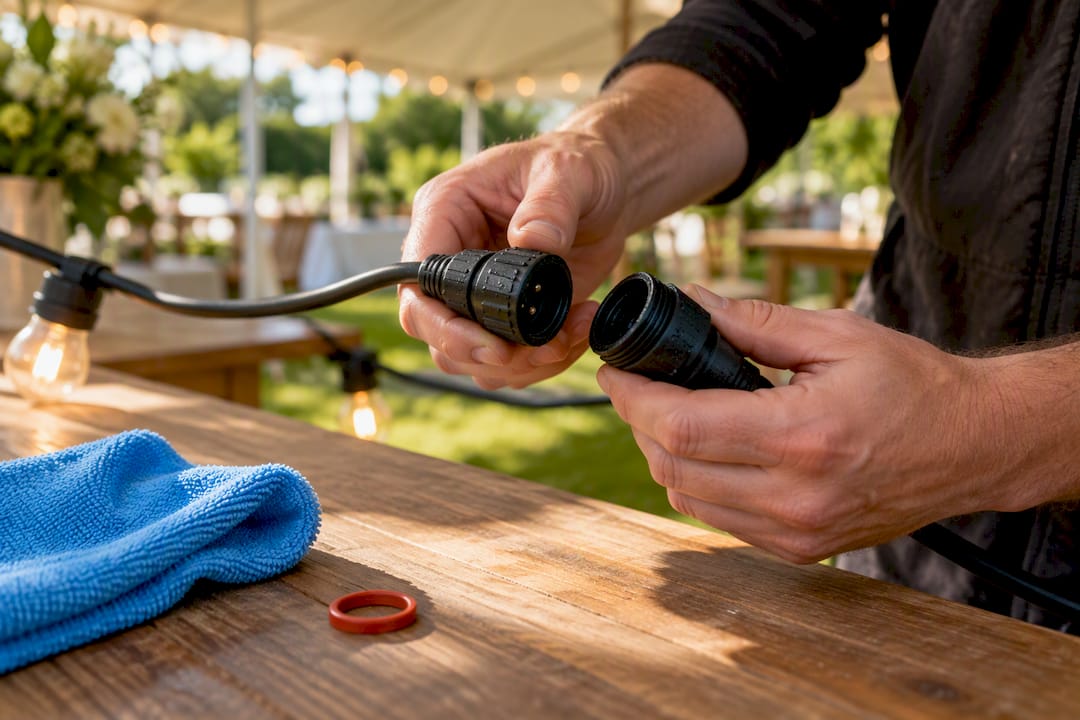
- Inspect cable, connectors and lamp holders for cracking, discolouration or moisture ingress before every use, not just at the start of summer.
- Dry cable fully before coiling it away, damp coiled cable encourages corrosion inside connectors.
- Coil loosely rather than tightly to avoid stressing the cable insulation, and store away from direct sunlight and rodents.
- Replace any lamp holder that shows scorching, and swap incandescent bulbs for LED equivalents as they fail to reduce future running costs.
- After any storm or high wind event, re-check every fixing and the catenary tension before switching the lights back on.
When to bring in a professional and what they provide
Some situations move beyond sensible DIY. Public or ticketed events, anything drawing power from a generator, and multi-circuit rigs covering more than a small garden all sit within BS 7909’s larger or generator-supplied category, which calls for design, testing and completion certificates rather than a confident guess.
- Event electrical contractors typically supply design, installation, testing and standby support for the duration of the event.
- A hire company can provide festoon runs already rated and tested for outdoor use, removing the guesswork around connectors and IP ratings.
- Ask for a completion certificate and the name of the Senior Person Responsible before signing off any hired or contracted installation.
- For anything with multiple distribution points, our inspection and certification guide explains what paperwork to expect on handover.
Estimating power consumption and calculating your total load
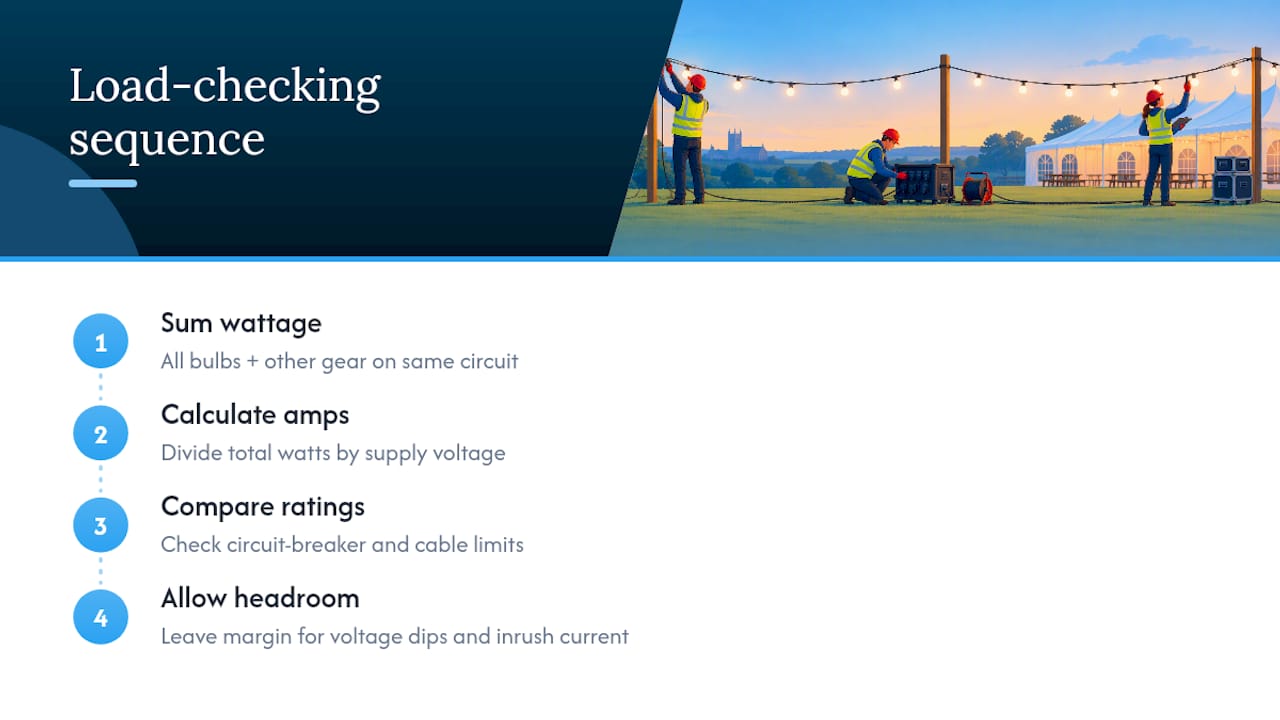
Add up the wattage of every bulb on the run, then add anything else on the same circuit, speakers, a coffee van, a marquee heater, before deciding what supply you need. A typical 10-metre LED festoon set with 20 small LED bulbs might draw well under 100 watts in total, while the equivalent run in incandescent globes can draw several hundred watts because each bulb individually uses far more power.
Once you have a total wattage figure for everything on one circuit, divide by your supply voltage to get the current draw in amps, then check that figure sits comfortably below the rating of the circuit breaker and cable you are using, not just below the socket’s stated maximum. Leave headroom rather than running a circuit at its absolute limit, since voltage dips and inrush current at switch-on both push the momentary draw higher than the steady-state figure suggests.
For anything beyond a single run fed from one domestic-style socket, for instance several festoon circuits, a marquee’s worth of task lighting and a catering unit, a distribution board split across multiple protected circuits is safer than daisy-chaining extension leads. Our guide to outdoor lighting distribution covers how to split loads sensibly across circuits for larger layouts.
Choosing efficient, lower-impact lighting options
LED festoon bulbs are the more efficient choice for almost every outdoor setting, drawing a fraction of the power of incandescent equivalents for a comparable level of brightness, and they run far cooler, which reduces the fire risk where bulbs sit near fabric, foliage or bunting.
Warm white LEDs in the 2200K to 2700K range give the closest match to traditional incandescent festoon glow, while cooler white LEDs above 4000K read as more modern and functional, better suited to workspaces than romantic garden settings. Dimmable LED festoon sets exist, but check compatibility carefully: not every LED driver plays well with every dimmer, and mismatched pairs cause flickering rather than a smooth fade.
Running festoon lighting only for the hours you actually need it, rather than leaving it on overnight, is the simplest efficiency gain available and costs nothing to implement. A basic timer or smart plug on the supply side achieves this without any change to the lighting itself.
Troubleshooting flickering, outages and wiring faults
Flickering usually points to one of three things: a loose connector, an incompatible dimmer, or a voltage drop caused by too many bulbs on too long a run of thin cable. Check connectors first, since moisture and vibration loosen outdoor connections more often than any component actually fails.
A full outage on one section, while the rest of the run stays lit, usually means a break or corrosion at a single connector rather than a fault with every bulb on that section. Work along the run from the last working point and check each joint in turn.
Repeated RCD tripping is different from a simple bulb fault and should not be treated as a nuisance to reset around. It can mean water has reached a connector, a cable has been damaged, or a dimmer is causing genuine leakage current. If resetting the RCD does not hold the circuit for more than a few minutes, stop using that circuit and have it checked before reconnecting.
Design and arrangement ideas for better ambience
A single straight run along a fence line or pergola beam gives a clean, understated look that suits most gardens without overwhelming the space. Criss-crossing overhead between two rows of posts creates more of a canopy effect and reads well over dining areas, though it needs more fixings and roughly double the cable of an equivalent straight run.
Pairing festoon lighting with lower-level lighting, lanterns along a path, or uplights on trees or shutters, adds depth rather than leaving the space lit from one height only. Venues coordinating fixed features such as shutters or screens alongside festoon runs can find useful pointers in this guide to shutter use in hospitality settings, particularly around sightlines and where fixed fittings sit relative to overhead lighting.
Grouping bulbs slightly closer together over a focal point, a bar, a dance floor, a seating area, while leaving wider spacing elsewhere, draws the eye without needing extra fixtures.
An electrician’s view on DIY versus hiring in
Most DIY festoon installs fail on tensioning or protection, not bulb choice. Get the catenary and the RCD right and a weekend install can be genuinely safe.
— Rob
How Jaks Party Power supports your festoon lighting setup
If your event has grown beyond a garden run, hiring in removes the guesswork around ratings, testing and standby cover. Jaks Party Power Limited supplies festoon lighting and full event setup services across Sussex, backed by over 40 years of electrical contracting experience, so the catenary, the RCD protection and the certification are already sorted before you arrive on site.

| Service | What it covers |
|---|---|
| Product Hire | Festoon lighting, generators, distribution and cabling for your event |
| Event Setup | Installation, catenary support and testing handled on site |
| Standby cover | Electrical support present throughout the event itself |
Two of the client’s linkable festoon products, the 20-metre linkable set and the 25-metre linkable set, along with the bolt-on festoon package, are built for exactly this kind of handover: tested, rated and ready to connect rather than assembled from separate parts on the day. Get in touch through the services page to request a quote for your event.
Sources
- Outdoor electrical regulations guide — Total Skills
- Electrical specification for events — Eden District Council
- Electrical safety for entertainers INDG247(rev2) — HSE
- BS 7909 – Temporary electrical systems in the entertainment industry — Richmond local authority guidance
FAQ
How should you position festoon lights?
Position festoon lights along a supported catenary wire rather than letting the cable itself bear the load, anchored to structural points such as walls, posts or pergola beams rather than fences or fascia boards. Keep runs out of reach of guests and away from anywhere vehicles or pedestrians pass underneath at head height.
What is the best spacing for festoon lights?
Most festoon sets come with bulbs fixed at centres of around 0.4 to 0.6 metres, and this spacing works well for most gardens and event spaces. Tighter spacing over a focal point, such as a bar or dance floor, creates a brighter, more concentrated effect without needing extra fixtures.
What is the best festoon lighting for outdoor use?
Weatherproof festoon cable rated IP44 or higher, fitted with LED bulbs and connected via BS EN 60309 outdoor connectors, is the safest and most efficient choice for outdoor use. LED bulbs draw less power and run cooler than incandescent equivalents, reducing both running costs and fire risk near fabric or foliage.
What is the difference between festoon lights and string lights?
Festoon lights use a thicker, more robust cable with larger, evenly spaced bulbs and are designed to be load-bearing on a catenary wire for permanent or semi-permanent outdoor runs. String lights, often called fairy lights, use thinner wire and smaller bulbs, and they suit decorative, lightweight draping rather than tensioned overhead spans.