
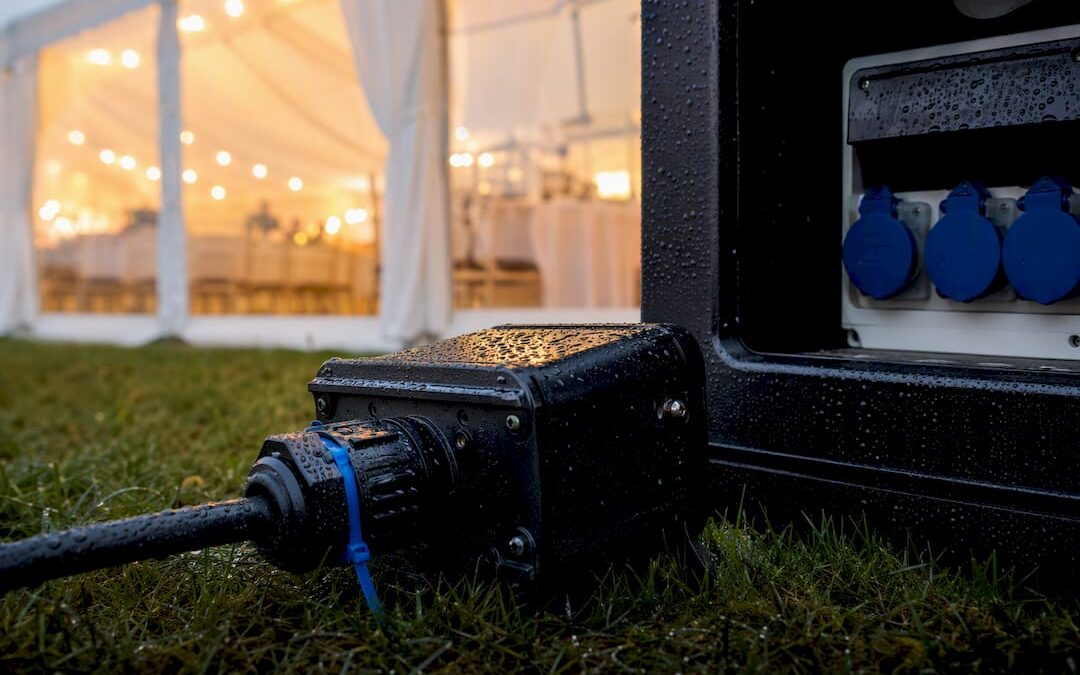
For most outdoor lights and equipment, aim for at least a common recommended IP rating in sheltered spots, a higher rating suitable for direct rain or coastal salt exposure, and an even higher rating for anything submerged. The number on the box only tells you how well the casing keeps out dust and water, though. It says nothing about installation quality or electrical safety, which is why every outdoor job also needs proper siting, drainage, and RCD protection to back it up.
TL;DR:
- IP ratings only indicate ingress protection and do not guarantee durability or resistance to UV, corrosion, or long-term weathering, so material and installation quality matter.
- For exposed coastal or submerged installations, IP66 or higher with corrosion-resistant housings is recommended, but sheltered spots usually only need IP44 or IP65.
- Condensation inside enclosures often causes failures more than ingress from rain, highlighting the need for proper ventilation, drainage, and maintenance.
- Proper safety measures, including RCD protection and suitable socket ratings, are essential alongside IP ratings to ensure electrical safety outdoors.
- Higher IP ratings increase costs and are justified mainly for permanent, coastal, or submerged fittings; proper siting and maintenance often outperform higher IP standards in less exposed environments.
Table of Contents
- What is an IP rating and which standard defines it?
- How do you read the two IP digits?
- Recommended IP ratings by outdoor use case
- How do condensation and materials affect outdoor durability?
- What safety checks matter alongside the IP rating?
- How does an event power specialist actually specify IP-rated kit?
- When should you pay for a higher IP rating, and when is it wasted money?
- How Jakspartypower fits into your outdoor power planning
- Sources
- FAQ
What is an IP rating and which standard defines it?
An IP rating is a two-digit code set out in BS EN 60529 (the UK adoption of IEC 60529), and it tells you exactly one thing: how well an enclosure resists solid objects and liquids getting inside. Nothing more. The standard covers electrical equipment rated up to 1000V AC or 1500V DC, and manufacturers test against it using controlled conditions in a lab, not a British winter.
That distinction trips up a lot of buyers. An IP rating is a classification of ingress protection, not a badge of overall durability or a corrosion guarantee. A fitting can carry an excellent IP number and still fail within a season if the housing is cheap alloy left to react with rainwater, or if UV exposure cracks the seals within a year or two.
The test itself has real limits worth knowing before you specify anything:
- Water ingress tests use fresh water, not the salt spray a coastal fitting will actually face.
- There’s no standardised test for condensation, which is one of the most common causes of outdoor lighting failure.
- The rating says nothing about UV resistance, plastic embrittlement, or long-term corrosion of metal components.
Treat the IP code as a baseline requirement, not the whole specification. Pair it with sensible material choice and correct installation and you get a fitting that lasts; rely on the number alone and you’re gambling on the weather.
How do you read the two IP digits?
The format is always IP followed by two digits, sometimes with a letter tacked on. First digit covers solids, second covers liquids, and each runs on its own scale.
- First digit (0 to 6): protection against solid objects, from no protection at 0 up to complete dust-tight protection at 6.
- Second digit (0 to 9): protection against liquids, from none at 0 up to protection against powerful jets and, at the top end, sustained submersion.
- X in place of a digit means that aspect wasn’t tested, not that it fails. IP X4, for instance, tells you nothing about dust resistance.
- Supplementary letters occasionally appear, such as W for weather-conditioned equipment tested with additional exposure, or D for cable entry protection.
A few real-world decodes make this concrete. IP44 protects against solid objects larger than 1mm and splashing water from any direction, which is fine for a covered porch light. IP54 trades a little dust protection for the same splash resistance, common on switchgear. IP65 is dust-tight and protects against low-pressure water jets, the usual benchmark for exposed garden lighting. IP66 steps up to powerful jets, a common spec for façade and coastal fittings. IP67 withstands temporary immersion up to a metre for around 30 minutes, and IP68 covers continuous submersion at a depth the manufacturer specifies.
Recommended IP ratings by outdoor use case
Matching the number to the actual environment matters more than chasing the highest figure you can find. Here’s how the ratings map to common outdoor scenarios:
- Sheltered patios and porches. A minimum of IP44 is usually enough here, since the fitting is shielded from direct rain by an overhang and only needs to handle splashing or wind-driven moisture. Spending more on IP66 fittings for a covered veranda is money better spent elsewhere.
- Fully exposed wall lights, façades and coastal properties. Push up to a dust-tight IP rating protecting against water jets, and pair the rating with corrosion-resistant housings, marine-grade stainless steel or good-quality anodised aluminium rather than budget alloy. Common industry guidance treats combining these IP levels with better materials as the standard specification for façade lighting near the coast.
- In-ground fittings, ponds and submersible lights. Go for IP67 or IP68 depending on how deep and how long the fitting sits underwater; check the manufacturer’s stated depth and duration rather than assuming IP68 means indefinite submersion at any depth.
- Temporary event sites and exposed festival equipment. Specify IP65 or higher enclosures for distribution gear, and use IP67-rated CEEform connectors for cable joints exposed to standing water or driving rain. This is the same standard applied across portable power distribution on temporary sites, where connectors get dragged through mud and left out overnight far more often than a domestic fitting ever will.
If you’re weighing up lighting types for a wedding marquee or a festival stage, it helps to look at how different outdoor party lighting options are rated before you commit to a supplier, since a fairy-light string and a ground-recessed uplighter have very different exposure profiles even sitting a few feet apart.
How do condensation and materials affect outdoor durability?
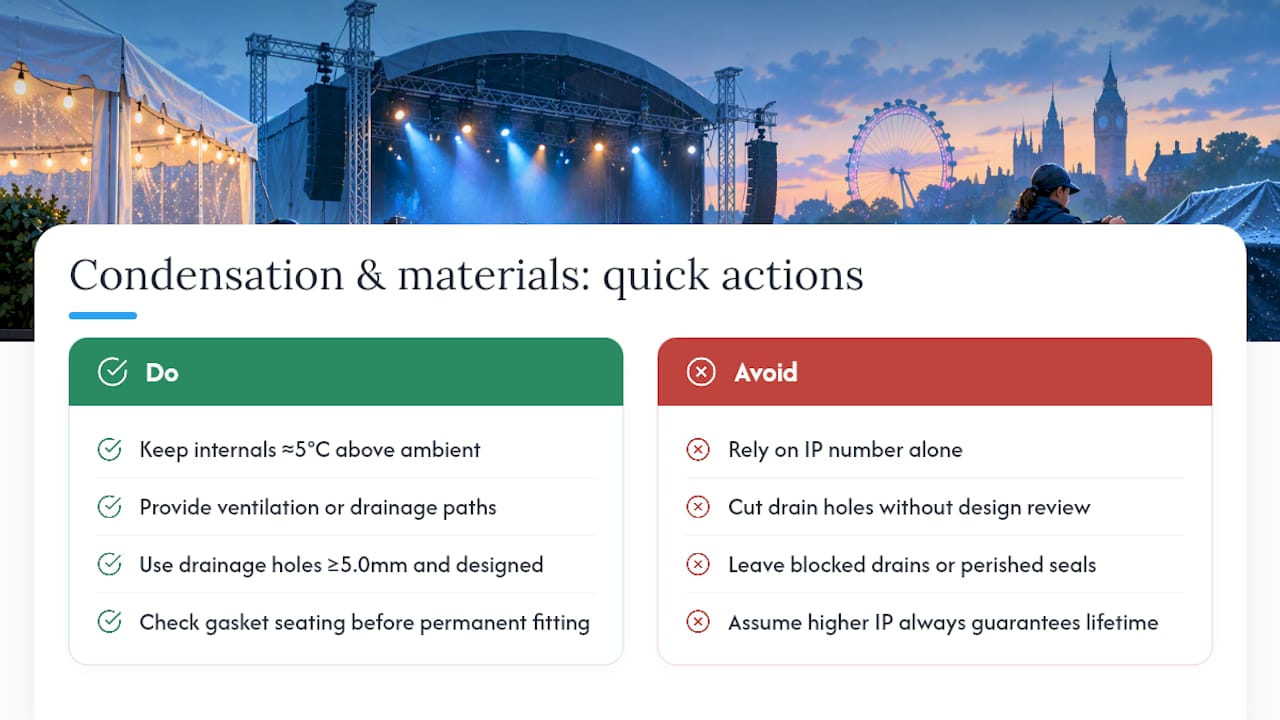
Condensation, not rain, is the failure mode that catches most people out. A sealed enclosure that heats up during the day and cools rapidly overnight can trap moisture inside regardless of its IP rating, because the water was never an ingress problem in the first place. BEAMA’s guidance on enclosures recommends keeping internal temperatures around 5°C above ambient, or building in ventilation and drainage to let moisture escape before it accumulates.
Drainage holes solve one problem and can create another. BEAMA suggests a minimum diameter of around 5.0mm to let condensate drain freely, but any hole cut into a housing has to be designed so it doesn’t become an ingress path that undermines the declared IP classification. This is exactly the sort of detail worth raising with the manufacturer rather than guessing at, especially on a bespoke installation.
Material and finish matter just as much as the IP number itself. Stainless steel grades vary hugely in how well they resist salt corrosion, moulded plastics degrade differently under UV depending on their additive package, and a cheap powder coat will blister years before a marine-grade anodised finish shows any wear. Two fittings with identical IP66 ratings can have wildly different service lives outdoors, and the difference is almost never printed on the box.
Pro Tip: Before fitting anything permanent outdoors, check the gasket seating and any drain holes are clear and undamaged. A perished seal or a blocked drain hole quietly turns a perfectly good IP66 fitting into something closer to IP20 within a season.
Site fittings away from direct spray where possible, check gaskets annually, and when a spec sits on the margin between two IP levels, ask the manufacturer directly rather than assuming the higher number is automatically the safer bet.
What safety checks matter alongside the IP rating?
An IP rating protects the equipment. It does nothing to protect the person plugging it in, which is why Electrical Safety First’s guidance for the garden treats RCD protection as a separate, non-negotiable requirement.
- Fit a 30mA RCD on every outdoor circuit, and Electrical Safety First’s advice on outdoor lighting is explicit that lights with a water-protection digit below 3 shouldn’t be used outdoors at all.
- Outdoor sockets should carry a minimum of IP44, and any socket exposed to direct splashing needs that protection as standard.
- For event or temporary distribution, use CEEform connectors with an IP rating indicating protection suitable for wet conditions, rather than domestic plugs, since they’re built to handle repeated connection cycles in wet conditions.
- Keep cable reels fully unwound during use to avoid heat build-up, fit thermal cut-outs where appropriate, and test RCDs regularly rather than assuming they’ll trip when needed.
None of this is optional extra care. RCD protection is what keeps a failed seal or a nicked cable from becoming a shock hazard, and it matters just as much on a IP68 submersible fitting as it does on a IP44 porch light.
How does an event power specialist actually specify IP-rated kit?
On a live event site, the kit has to survive conditions far rougher than a garden ever sees: cables dragged across wet grass, connectors disconnected and reconnected dozens of times, fittings left out through an entire weekend of British weather. Battery-powered IP-rated uplighters and IP67 CEEform connectors are standard choices for exactly this reason, paired with weatherproof distribution boards that keep the whole circuit protected end to end.
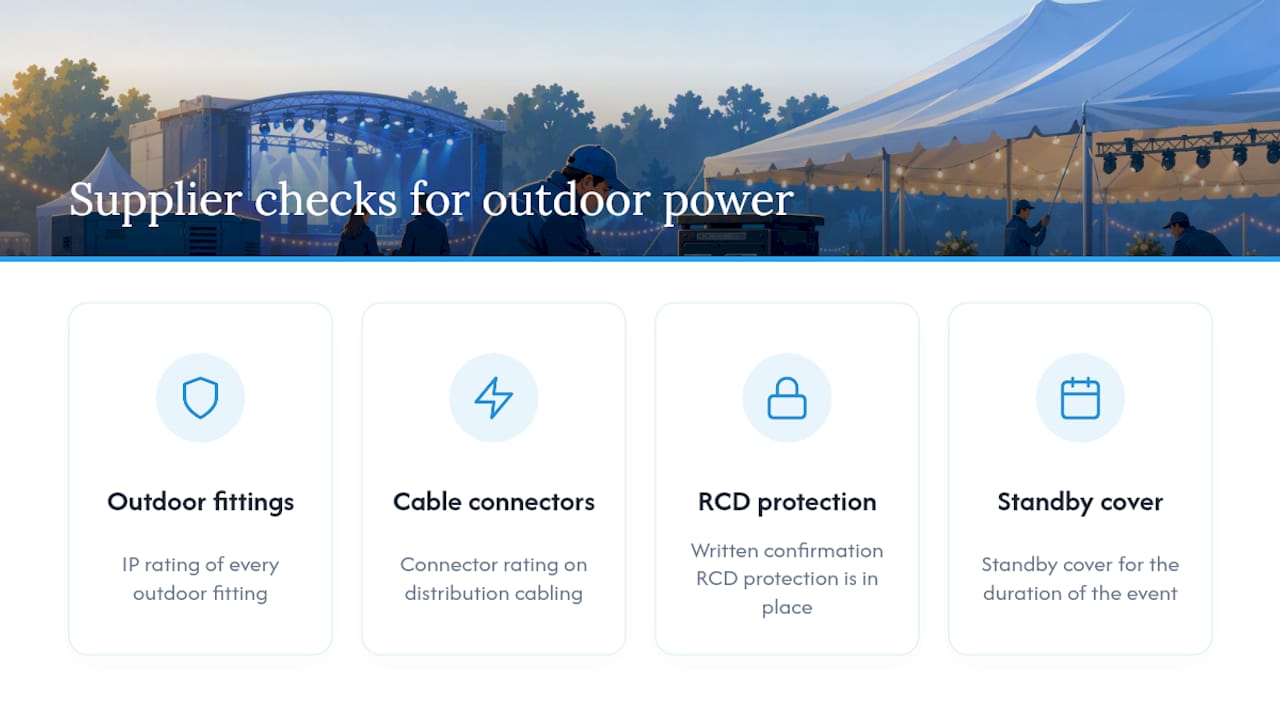
Ask any supplier for specifics before you book: the IP rating of every outdoor fitting, the connector rating on distribution cabling, and written confirmation that RCD protection is in place across the site. A supplier who can answer all three without hesitation, and who offers standby cover for the duration of the event, is one worth trusting with a wedding marquee or a corporate marquee that can’t afford a power failure halfway through the evening.
When should you pay for a higher IP rating, and when is it wasted money?
Higher IP numbers cost more, and they’re not always the right spend. Permanent coastal installations, anything submerged, and fittings that genuinely sit in driving rain all justify IP66 or above, because the failure cost of getting it wrong (corroded housings, water in the electrics, a full replacement within two years) far outweighs the extra spend upfront.
But a sheltered porch light doesn’t need IP68 protection any more than a garden shed needs a bank vault door. Good siting, a properly designed drain hole, and a seal you actually check once a year will often do more for a fitting’s lifespan than chasing a higher number ever will. BEAMA’s own guidance flags that higher IP ratings can introduce their own trade-offs, including reduced ventilation and higher internal temperatures, so the top-tier option isn’t automatically the safer one in every case.
Where the choice is genuinely marginal, the manufacturer’s technical team will give a straighter answer than any spec sheet. That conversation is free, and it beats guessing.
— Rob
How Jakspartypower fits into your outdoor power planning
Getting the IP rating right on paper is one thing. Getting the right fitting, correctly wired into a protected circuit and installed by someone who’s done it hundreds of times before, is another matter entirely. That’s the gap Jakspartypower closes: over 40 years of electrical contracting experience behind every hire, so the kit you get is already matched to the job rather than left for you to work out on site.
For events, that means access to correctly rated lighting, distribution boards fitted with tested IP67 CEEform connectors, and generators sized properly for the load, all backed by RCD-protected supply as standard. Jaks Party Power’s standby cover means a qualified electrician stays on site through the event itself, so a failed seal or a tripped circuit gets sorted in minutes rather than derailing the evening. Whether you’re planning a wedding marquee, a festival stage, or a permanent installation for a venue, the full range of event equipment hire and setup services covers the specification, the kit, and the people to install it correctly. Get in touch to talk through what your site actually needs before you commit to anything.
Sources
- Degrees of protection provided by enclosures (IP code) — BSI Knowledge Centre
- BEAMA guidance on enclosures and environmental testing
- Electrical Safety First — Electrical safety advice for the garden
FAQ
Which is more waterproof, IP44 or IP65?
IP65 offers considerably better water protection than IP44. IP44 only guards against splashing water from any direction, while IP65 withstands low-pressure water jets and adds full dust-tight protection, making it the better choice for fully exposed fittings.
Is IP67 100% waterproof?
No IP rating means completely waterproof under all conditions, but IP67 protects against temporary immersion up to a metre deep for around 30 minutes. For anything permanently submerged or subjected to greater depth or duration, look for IP68 and check the manufacturer’s specific depth rating.
Is IP44 OK for heavy rain?
IP44 is designed for splashing water, not direct or sustained rainfall, so it suits sheltered spots like covered porches rather than fully exposed positions. For a location that takes heavy rain head on, Electrical Safety First recommends stepping up to at least IP65.
Is IP65 OK for outdoor use?
Yes, IP65 is a solid choice for most exposed outdoor fittings, covering full dust protection and resistance to low-pressure water jets. For coastal locations or façades that take a real battering, IP66 with corrosion-resistant materials is worth the extra spend.
What IP rating does event lighting hire typically use?
Jakspartypower specifies IP-rated fittings and IP67 connectors matched to each event site, from covered marquees through to fully exposed outdoor stages. Current availability and pricing for lighting and distribution hire are listed on the site, with details confirmed against your specific event needs.