

Powering a food truck at your event means hiring a properly sized generator, connecting it through RCD-protected portable distribution, and having a competent supplier commission and certify the whole setup before doors open. Your first move is simple: draw up an equipment load list for every vendor, then book a supplier who can produce an electrical completion certificate on the day. Before signing anything, ask two questions: who is the competent person signing off the installation, and can they show proof of insurance and testing?
TL;DR:
- Verify the supplier provides documentation such as a risk assessment, single-line diagram, electrical completion certificate, and proof of a qualified person’s insurance before signing any contract.
- Use proper cables rated for run length, with appropriate protection and clear labeling, and protect all crossings from public or vehicle traffic to prevent hazards.
- Confirm compliance with BS 7671 and BS 7909 standards by ensuring the installation is signed off by a qualified person with test records and a suitable earthing and RCD setup.
- Book a supplier who offers an integrated service including site survey, sizing, certification, and on-site standby support to reduce the risk of common power setup failures.
Table of Contents
- What should you ask suppliers for when hiring food truck power?
- How do you calculate load and size a generator for food vendors?
- What are the BS 7909 and BS 7671 compliance requirements?
- What site logistics matter for cabling, fuel and public safety?
- What should the supplier brief and contract cover?
- Why do temporary power setups usually go wrong?
- Book food truck power hire with a proper completion certificate
- Sources
- FAQ
What should you ask suppliers for when hiring food truck power?
A clear brief prevents the two most common failures on site: an underpowered circuit tripping mid-service, and nobody able to produce paperwork when a licensing officer asks for it.
Ask any prospective supplier to confirm they’ll provide:
- Generator(s) with a stated kVA rating matched to your load, not just “a generator that should do it”
- Portable distribution boards with RCD protection, correctly labelled for each outlet
- Cables rated for the current and run length involved, with visible identification
- A defined earthing arrangement, appropriate cable protection, and clear segregation from public areas
Before the event, request these documents in writing:
- A risk assessment and method statement (RA/MS) for the electrical setup
- A single-line diagram showing how power flows from generator to each vendor
- An electrical completion certificate confirming the installation was tested
- Proof of the competent person’s qualifications, plus current insurance details
On the operational side, insist on dedicated circuits for anything safety-critical, a named standby contact reachable during trading hours, a refuelling schedule, and spare equipment held on site rather than promised “if needed”.
How do you calculate load and size a generator for food vendors?
Start by listing every piece of equipment each vendor plans to run, and note its rated running wattage, not the number printed on the box in bold. Fryers, griddles, and refrigeration units draw a steady load once running, but motors, compressors, and some heating elements pull a startup surge that can hit two to three times their running figure for a few seconds.
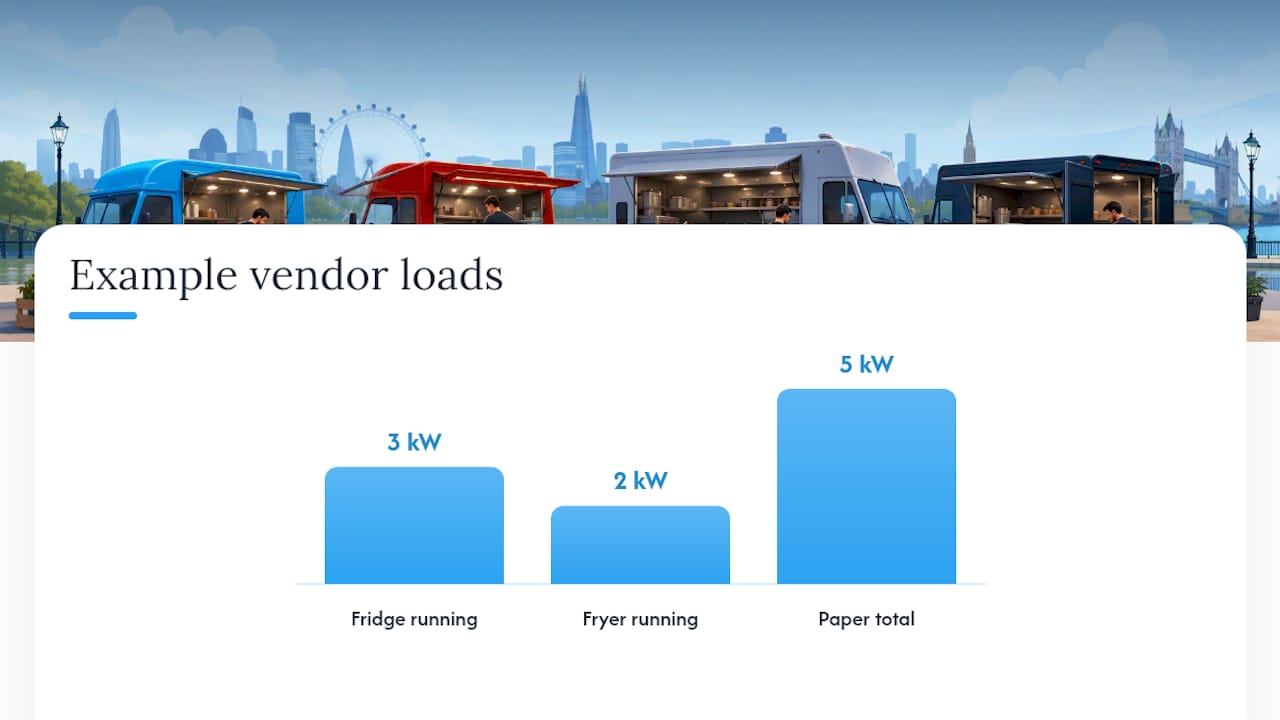
That surge is where undersized generators fail. A vendor running a 3kW fridge compressor alongside a 2kW fryer might look like a 5kW job on paper, until the compressor’s startup spike coincides with the fryer switching on and trips the whole board.
Some practical rules help:
- Keep continuous loading below roughly 80% of the generator’s rated output, a margin industry practice for temporary power distribution recommends to leave headroom for startup surges
- For mixed loads with several motors or compressors, some guidance suggests planning for a generator size significantly above the combined peak demand
- Split heavy heating or compressor loads across separate generators or dedicated circuits rather than combining them on a single supply
- Treat anything safety-critical, refrigeration for allergen-sensitive stock, for instance, as its own circuit with standby backup
Pro Tip: Run your numbers through a dedicated tool before you call a supplier. The NADJ Power Planner calculates running and peak loads, recommends a generator size with headroom built in, and checks voltage drop, producing a sheet you can hand straight to your hire company.
Even with a planner’s output in hand, get a competent person to verify the figures against the actual equipment on site. Nameplates lie more often than you’d think.
What are the BS 7909 and BS 7671 compliance requirements?
BS 7671, the IET Wiring Regulations, sets the baseline rules for electrical installations in Britain. BS 7909:2023 sits alongside it as the code of practice written specifically for temporary systems at entertainment and event sites, covering the planning, earthing, and RCD provisions that BS 7671 alone doesn’t fully address for short-term, outdoor, vehicle-heavy setups.
Both standards point to the same non-negotiable: someone qualified has to own the installation. That’s the competent person, often called the Senior Person Responsible or SPR, and their sign-off should produce an electrical completion certificate along with test records you can actually inspect, not just take on trust.
On the technical side, three checks matter most:
- Earthing strategy: TT arrangements are generally preferred outdoors on generator supplies, given the lack of a reliable earth connection back to the national grid
- RCD type: modern catering equipment often runs switched-mode power supplies that produce non-sinusoidal residual currents, so updated IET guidance recommends Type A as a minimum, with Type F or B where variable-frequency loads are present
- Documentation: a single-line diagram, board labelling, and a record of functional tests carried out before anything is switched on for the public
The HSE’s own guidance on event electrical safety lists layout, power requirements, earthing, cable routing, and emergency power among the items organisers must plan and document, not leave to a supplier’s discretion after the fact. If a supplier can’t answer questions on any of these points, local-authority guidance recommends requiring third-party inspection before public access is permitted.
What site logistics matter for cabling, fuel and public safety?
Cable choice depends on the run. Flexible above-ground runs between vendors typically use H07RN-F, while anything buried should be armoured SWA cable. Either way, voltage drop needs checking against BS 7671’s 5% guidance on longer runs, particularly where a generator sits some distance from the furthest food truck.
- Protect every cable crossing a public or vehicle route with ramps, catenaries, or ducting, and sign overhead crossings clearly, allowing roughly 5.8 metres of clearance where vehicles pass beneath.
- Site generators in a segregated, ventilated area away from food preparation, with fencing or barriers keeping the public at a distance.
- Build a supervised refuelling plan with lockable fuel storage, never an open can beside a running unit.
- Near residential boundaries or overnight events, consider acoustic enclosures or quieter models rather than relying on distance alone to mute noise.
- Lock and label every distribution board so nobody outside the electrical team can open it.
Pro Tip: Walk the cable route yourself before the event, on foot, at the pace a member of the public would walk. Trip hazards that look obvious on a site plan often disappear until you’re actually standing on the ground.
What should the supplier brief and contract cover?
Your written brief should demand delivery of the RA/MS, single-line diagram, completion certificate, test records, and proof of the competent person’s insurance and qualifications, before the day, not on it.
Service levels worth pinning down in writing:
- Confirmed arrival and commissioning times ahead of vendor setup
- On-site standby personnel for the duration of trading, not just a phone number
- A fuel and refuelling schedule with named responsibility
- Fault response times, and confirmation that spare equipment is genuinely on site
On the commercial side, record the exact generator sizes agreed, how fuel is charged, overtime rates if the event runs long, and who carries liability for any client-supplied equipment plugged into the supplier’s distribution.
- Confirm documents in writing before deposit
- Confirm standby cover and response times
- Confirm who owns liability for third-party equipment
Why do temporary power setups usually go wrong?
Three mistakes show up again and again. Organisers underestimate startup load and trip the board mid-service. Cables get laid without protection and become a hazard the moment foot traffic increases. Nobody checks for a completion certificate until an inspector asks for one.
A supplier who runs a proper site survey, labels every board, and offers genuine standby cover catches all three before they become a problem. That’s the difference between a setup that holds and one that doesn’t, and it’s the practical experience behind Jaks Party Power’s standby service.
— Rob
Book food truck power hire with a proper completion certificate
Some suppliers provide an alternative to piecing together generator hire, cabling, and distribution from separate providers: one team handles the survey, the sizing, the distribution boards, and the certification, so you’re not chasing three companies for one signature.

When you get in touch, ask specifically for a site survey, a single-line diagram, an electrical completion certificate, and an on-site standby contact, the same four things this guide has told you to demand from any supplier. Browse the range of generators available by size, or get in touch directly to check availability and request a quote for your event dates.
Sources
- Electrical safety: guidance for events — HSE
- Temporary electrical systems for entertainment and related purposes: code of practice | BSI Knowledge
- Guide to temporary electrical systems, 2nd edition — IET Wiring Matters (May 2025)
- Introducing the NADJ Power Planner — NADJ
FAQ
What size generator does a food truck need?
It depends on the equipment running simultaneously, but a single truck with a fryer, griddle, and fridge often needs headroom well above the sum of running loads to cover startup surges. Use a load planner such as the NADJ Power Planner and verify the result with a competent person before booking.
Do I need a certificate for temporary event power?
Yes. An electrical completion certificate, issued after testing by a competent person or SPR, confirms the installation meets BS 7671 and BS 7909 requirements, and you should request it in writing before the event, not after.
What’s the difference between BS 7909 and BS 7671?
BS 7671 is the general wiring regulation for electrical installations in Britain, while BS 7909:2023 is the code of practice written specifically for temporary systems at events, covering planning, earthing, and RCD provisions that suit short-term outdoor setups.
Can one generator power multiple food trucks?
It can, provided the combined running and peak loads stay within roughly 80% of the generator’s rated output, but heavy compressor or heating loads are often better split across separate generators or dedicated circuits to avoid nuisance trips.
Who should I hire for food truck power at an event?
Look for a supplier who combines generator and distribution hire with documented compliance, such as Jaks Party Power, and always confirm they’ll provide a completion certificate and standby contact before the event.