
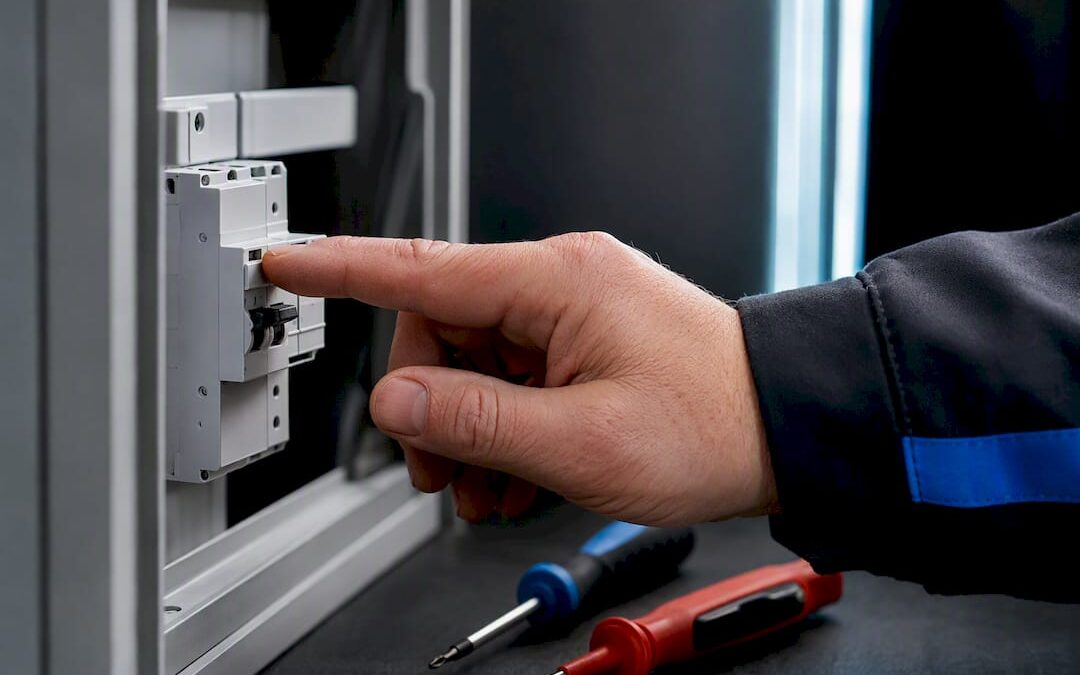
Under BS 7671 A4:2026, AFDDs conforming to BS EN 62606 must be provided on single-phase socket-outlet circuits rated up to 32 A in four named higher-risk residential premises types; elsewhere they remain recommended, not compulsory. Devices sit at the origin of the circuit. On site, that means checking the premises classification, reviewing Condition Report includes item 4.23 on any inspection, and flagging AFDDs the moment a replacement of existing consumer units is scoped.
TL;DR:
- AFDDs are mandatory only in high-rise residential buildings, HMOs, purpose-built student accommodations, and care homes for circuits up to 32 A; outside these, they remain recommended.
- Devices must conform to BS EN 62606 and be installed at the origin of each protected circuit, with compatibility confirmed against manufacturer instructions to avoid nuisance trips.
- Installing or replacing consumer units triggers full AFDD compliance on affected circuits, especially during upgrades or re-energizing after partial rewires.
- Proper testing involves manufacturer-specific procedures, including manual tests and careful insulation resistance checks, with all results documented on the Condition Report.
- Existing installations may need AFDDs added during major work like consumer unit replacements or partial rewires, with inspections and paperwork integral to compliance enforcement.
Table of Contents
- What the regulations actually say: 421.1.7, BS EN 62606 and A4:2026
- Which premises and circuits are mandatory, recommended or exempt
- Installation, device types and coordination on site
- Testing, commissioning and how to record it on the EICR
- When existing installations suddenly fall under the requirement
- Costs, nuisance trips and the conversations clients actually want
- A step-by-step checklist for compliant AFDD projects
- How experienced contractors should approach AFDD projects
- Jakspartypower’s AFDD-ready consumer unit support
- Sources
- FAQ
What the regulations actually say: 421.1.7, BS EN 62606 and A4:2026
The wording change matters more than most electricians realise. Before A4:2026, Regulation 421.1.7 recommended arc fault detection devices as good practice. The redraft under A4:2026 replaces “recommended” with “shall be provided” for a specific set of premises, turning a design suggestion into a legal obligation for those buildings. Everywhere else, the recommendation still stands, so you can specify AFDDs voluntarily without triggering the mandatory clause.
Any device fitted to comply must conform to BS EN 62606, which sets out how the device detects arcing signatures and what markings and test functions it must carry.
The Corrigendum accompanying A4:2026 also updated the Condition Report model form. Key changes electricians need to know:
- Regulation 421.1.7 now uses mandatory language (“shall”) for named premises, not advisory language.
- BS EN 62606 conformity is non-negotiable for any device used to satisfy the requirement.
- Condition Report item 4.23 was added specifically to confirm AFDD operation on inspection.
Which premises and circuits are mandatory, recommended or exempt
Survey work now starts with a classification question: is this a mandatory premises type? The four categories named under A4:2026 are high-rise residential buildings (HRRB), houses in multiple occupation, purpose-built student accommodation, and care homes or supported living. Fall outside those four and AFDDs revert to recommended status, subject to the designer’s risk judgement.
Where the requirement bites, the scope is narrower than people assume:
- It covers single-phase AC final circuits supplying socket-outlets with rated current not exceeding 32 A, plus relevant sleeping-room circuits.
- Three-phase circuits and circuits above 32 A sit outside the mandatory clause.
- Medical locations in Groups 0 to 2 are prohibited from having AFDDs fitted, because arc detection can interfere with critical equipment.
- EV charging circuits conforming to BS EN 61851 meeting BS EN 61851 are exempt, since fault detection is already built into compliant charge point electronics.
Installation, device types and coordination on site
Placement is fixed: the AFDD goes at the origin of the final circuit it protects, not partway along. The only routine exceptions involve busbar or powertrack systems built to their own BS EN standards, where the manufacturer’s declared configuration takes precedence.
You’ll encounter three broad device forms on the market. Understanding which suits a given board saves a return visit:
- Standalone AFDD modules that pair with an existing MCB, useful where board space and existing protection are already correct.
- Combined AFDD/RCBO units, which integrate arc detection with residual current protection and overload/short-circuit protection in one width, easing coordination because the manufacturer has already validated it internally.
- Add-on AFDD modules that clip onto an existing MCB or RCBO, which need the declared protective device coordination checked against the manufacturer’s own compatibility table before fitting.
Coordination with the upstream protective device is not optional guesswork. Manufacturer instructions specify which MCB or RCBO ratings a given AFDD has been tested against, and departing from that list risks nuisance tripping or, worse, a device that fails to coordinate under fault conditions.
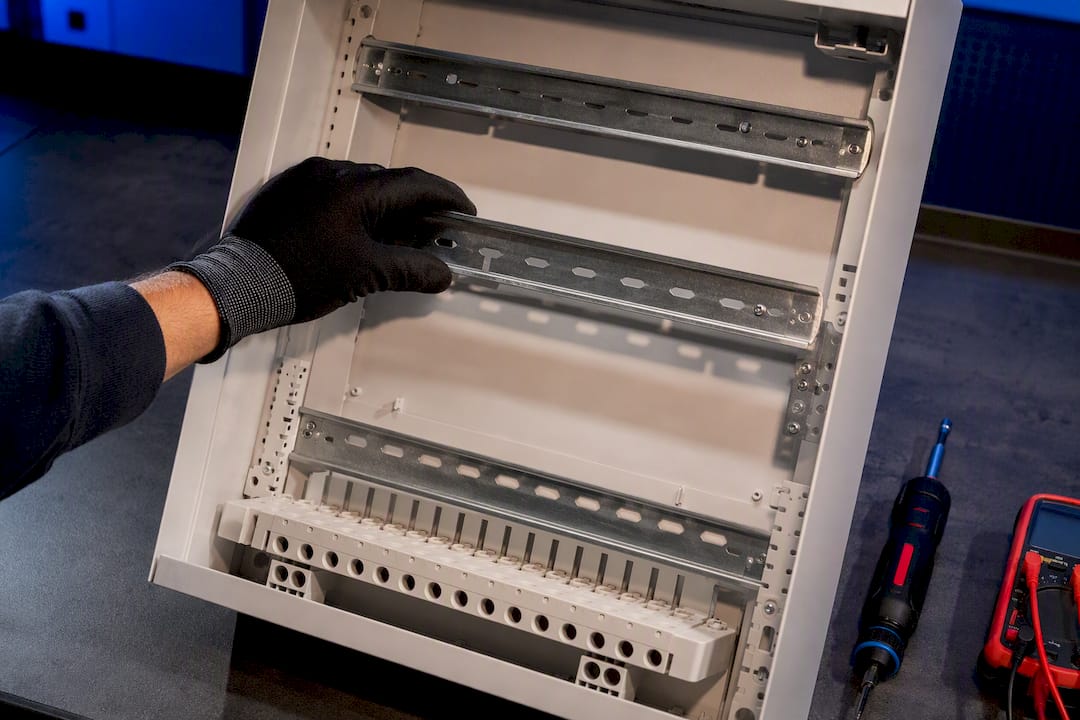
Pro Tip: Check busbar and pole space before you quote. Many existing consumer units simply lack room or a compatible busbar arrangement for retrofit AFDD modules, and a full board replacement often ends up being the more reliable route than trying to shoehorn devices into a tired board.
Testing, commissioning and how to record it on the EICR
Commissioning follows the manufacturer’s own procedure, but the principle is consistent across brands: press the manual test button, confirm the trip, and note whether the device has an automatic self-test function that runs periodically without intervention.
Insulation resistance testing needs care. BEAMA guidance recommends disconnecting AFDDs before running a 500 V DC insulation test, since that voltage can damage the internal electronics. If disconnection genuinely isn’t practical, dropping to 250 V DC is acceptable only where the manufacturer explicitly permits it.
On the Condition Report, item 4.23 asks you to confirm AFDD operation. The recording practice breaks down as follows:
- Acceptable: device fitted, tested, and confirmed operational.
- Unacceptable / C2: AFDD missing where mandatory, or fitted but not functioning; Elec-Mate’s guidance treats this as a typical C2 in mandatory premises.
- Improvement recommended / C3: AFDD absent in a premises where it’s recommended but not mandatory.
- FI: further investigation, where the device’s operation can’t be confirmed on the day.
Always log the device type and model on the schedule of test results, alongside the operational indication observed.
When existing installations suddenly fall under the requirement
A property built years before A4:2026 doesn’t get a free pass forever. Certain project triggers pull an existing installation into scope the moment work starts:
- Consumer unit replacement counts as new work. Any circuit re-energised from that new board in a mandatory premises needs full AFDD compliance, not a partial fix.
- Partial rewires that touch an affected final circuit carry the same obligation at the point that circuit is re-energised, even if the rest of the installation is untouched.
- EICR findings or post-incident remediation frequently surface the gap first, particularly in licensed HMOs, where landlords face licensing enforcement on top of the electrical obligation.
Insurers and licensing authorities are increasingly asking to see the EICR paperwork rather than taking a verbal assurance, so treat the trigger as a documentation exercise as much as an installation one.
Costs, nuisance trips and the conversations clients actually want
Clients rarely argue with the rule itself, they argue with the invoice. Cost drivers worth itemising up front:
- Combined AFDD/RCBO devices installation costs more per way than a standard RCBO, and that adds up across a full board.
- A [replacement of existing consumer units](https://jakspartypower.com/consumer-unit-upgrade-installation costs-uk) is often the real installation costs driver, not the AFDD modules themselves.
- Labelling, schedule of test results updates, and EICR paperwork all add billable time that’s easy to underquote.
Nuisance tripping is the other conversation. Most cases trace back to wiring faults, multiple parallel loads sharing a circuit, or harmonic interference from certain LED drivers and switch-mode supplies interacting badly with the AFDD’s detection algorithm. Correct circuit coordination and following the manufacturer’s compatibility list resolve the majority before they become a callback.
A step-by-step checklist for compliant AFDD projects
Working through jobs in a fixed order stops you missing the paperwork that actually gets checked:
- Survey and classify the premises against the four mandatory categories, then list every affected circuit and note any exemptions.
- Choose the device form (standalone, combined RCBO, or add-on module) and check board space and busbar compatibility before ordering.
- Confirm coordination with the upstream protective device against the manufacturer’s declared compatibility table.
- Install and label each device clearly, recording the model and rating as you go.
- Commission and test, then complete Condition Report includes item 4.23 and the schedule of test results before handover, with maintenance advice given directly to the client.
Pro Tip: Photograph the consumer unit label and the AFDD’s own rating label before you close the board. It takes thirty seconds and saves an awkward return visit when a query comes in six months later.
How experienced contractors should approach AFDD projects
The temptation on a full consumer unit swap is to treat AFDDs as just another line on the parts list. That’s the wrong instinct. Plan the replacement around the venue’s downtime tolerance and, where the property is licensed, its landlord’s renewal timing, because a badly timed board swap causes far more grief than the device installation costs ever will.
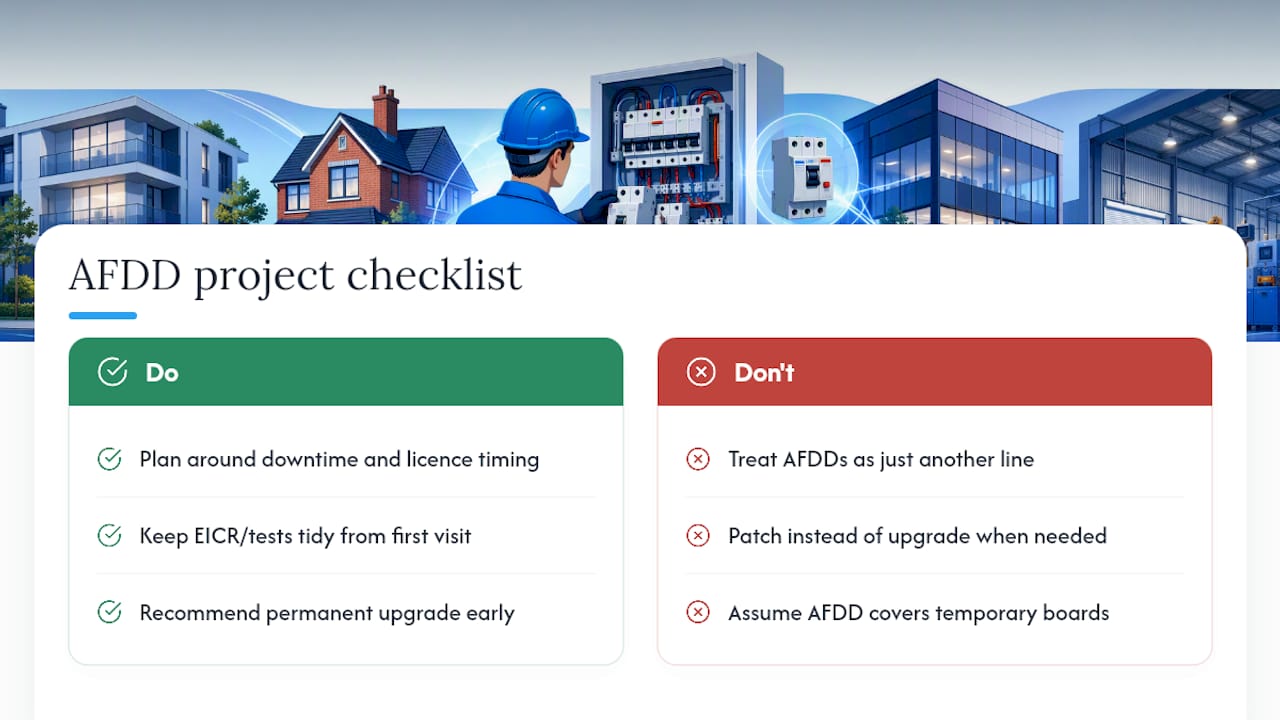
Keep your EICR and test records tidy from the first visit, not tidied up afterwards. Licensing officers and insurers are starting to ask for item 4.23 specifically, and a contractor who can produce a clean schedule of test results looks a different class of operator to one scrambling through a van for a scrap of paper.
Where temporary distribution comes into the picture, such as an event supply feeding a building’s permanent circuits, understand that AFDDs on the fixed installation don’t extend automatically to temporary distribution boards. If a permanent upgrade is genuinely needed, say so early rather than patching around it.
— Rob
Jakspartypower’s AFDD-ready consumer unit support
An experienced electrical contracting service brings extensive experience to consumer unit upgrades, which means an AFDD-ready board replacement comes with a high standard of commissioning discipline used on live event sites where downtime simply isn’t an option. Where alternatives leave you juggling separate survey, supply and test visits, some providers run it as one flow: survey, quote, install, test, certificate, with EICR-ready evidence handed over at the end rather than chased afterwards.

That matters most on a replacement of existing consumer units, since that’s the trigger that pulls an existing installation into full AFDD compliance the moment it’s re-energised. If you’re weighing up board space, busbar compatibility or where AFDD modules fit against your existing protection, get in touch about a [consumer unit upgrade](https://jakspartypower.com/consumer-unit-upgrade-installation costs-uk) and have the survey booked before your next licensing deadline creeps up on you.
Sources
- BS 7671 A4:2026 — AFDD changes explained (Elec‑Mate)
- Arc fault detection devices (AFDD) – IET guidance
FAQ
Are AFDDs mandatory in the UK?
Yes, but only in four premises types under A4:2026: high-rise residential buildings, HMOs, purpose-built student accommodation, and care homes or supported living. Outside those categories, AFDDs remain recommended rather than compulsory.
Do I need an AFDD on every circuit?
No. The mandatory requirement applies to single-phase AC final circuits supplying socket-outlets with rated current not exceeding 32 A, plus relevant sleeping-room circuits, not to every circuit in the installation.
Are AFDDs required in flats?
It depends on the building, not the flat itself. A flat within a high-rise residential building falls under the mandatory requirement, but a flat in a low-rise block outside the four named categories does not, unless the designer recommends one anyway.
Where should an AFDD be installed?
At the origin of the final circuit it’s protecting, conforming to BS EN 62606, with the only common exceptions involving busbar or powertrack systems built to their own device standard.
What happens if an EICR finds a mandatory AFDD missing?
Inspectors typically code this as a C2 on the Condition Report, since item 4.23 specifically asks for confirmation that AFDDs are operational in scope. In premises where AFDDs are only recommended, the same absence is usually coded C3 instead.