
Event lighting power consumption is defined as the total electrical load, measured in Watts or kilowatts, that all lighting fixtures draw during an event. Getting this figure right determines whether your power supply is adequate, your budget is realistic, and your setup meets UK safety law. For the UK’s 230V system, 1kW equals approximately 4.3 Amps, a conversion every event planner should know by heart. Standards such as BS 7671:2018+A2:2022 and BS 7909 govern all temporary electrical installations at events. Choosing LED over traditional incandescent fixtures can cut energy consumption by 50–80%, which changes both your generator size and your running costs.
How to calculate event lighting power consumption
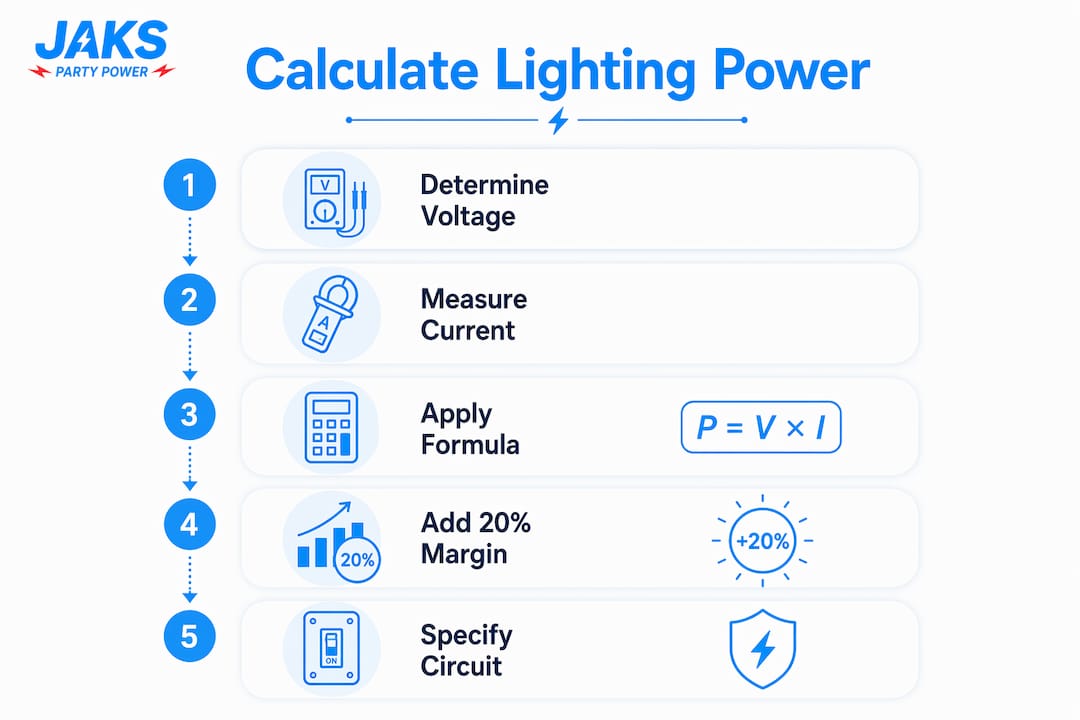
Accurate power calculation starts with one formula: Power (Watts) = Voltage (Volts) × Current (Amps). Rearranged for planning, Amps = Watts ÷ Volts. At UK mains voltage of 230V, a 1,000W lighting rig draws roughly 4.3 Amps. Event planners often round this up to 4.5 Amps to build in a small safety buffer.
Step-by-step calculation method
Follow these steps to calculate the total load for your lighting rig:
- List every fixture and its rated wattage. Include uplighters, festoon strings, spotlights, and any architectural wash lights.
- Sum the wattages to get your total installed load in Watts.
- Convert to Amps using Amps = Total Watts ÷ 230.
- Calculate energy consumption by multiplying total kW by the number of operational hours to get kilowatt-hours (kWh).
- Apply the 80% breaker loading rule. Circuits should not run at 100% capacity; 80% of the breaker rating is the industry standard for continuous operation.
Practical example: 100-guest event
A reliable rule of thumb is 5.5W per guest for combined ambient and task lighting. For 100 guests, that gives 550W, or roughly 2.5 Amps at 230V. Add decorative festoon lighting, a DJ booth spotlight, and entrance uplighters, and the total load can easily reach 2,000W (2kW), drawing around 8.7 Amps. Running that rig for six hours consumes 12kWh.
| Fixture type | Typical wattage | Amps at 230V |
|---|---|---|
| LED uplighter | 10–30W | 0.04–0.13A |
| LED festoon bulb | 1–5W per bulb | Under 0.02A |
| LED PAR can | 30–60W | 0.13–0.26A |
| Incandescent PAR can | 300–500W | 1.3–2.2A |
| Halogen flood | 500–1,000W | 2.2–4.3A |
Pro Tip: Always add 20% to your calculated total load before specifying a circuit or generator. Non-linear LED loads and dimmer packs create harmonic distortion that increases effective current draw beyond the nameplate wattage.
Are LEDs really worth it for event lighting efficiency?
LED fixtures reduce electricity consumption for event production by 50–80% compared to legacy lighting. That figure is not marketing copy. It reflects the difference between a 500W halogen flood and a 60W LED fixture delivering equivalent output. For a large show with 50 fixtures, that gap translates directly into a smaller generator, lower fuel costs, and a reduced carbon footprint.
Power and cost comparison
The table above shows the wattage gap clearly. A single incandescent PAR can draws up to 500W. Its LED equivalent draws 30–60W. Across a full lighting rig, the cumulative saving changes which generator package you need.
LEDs also last significantly longer than incandescent or tungsten alternatives, reducing lamp replacement costs and mid-event failures. Fewer replacements mean less waste and lower maintenance overhead across a season of events.
Smart controls for further savings
Intelligent controls and high-efficacy LEDs together reduce power consumption further and make ESG reporting straightforward. Dimmers, occupancy sensors, and scene-based lighting programmes allow you to drop output during low-activity periods such as dinner service, cutting consumption without affecting atmosphere. The role of lighting control systems in managing live event power draw is often underestimated by planners who focus only on fixture selection.
Pro Tip: Specify dimmable LED drivers from the outset. Retrofitting dimmer compatibility after installation costs more and sometimes introduces flicker or electrical noise.
What UK safety standards apply to event lighting power setups?
UK events must comply with BS 7671:2018+A2:2022 and BS 7909:2011+A1:2020 for all temporary electrical systems. These standards are not optional guidance. They carry legal weight, and non-compliance can invalidate your public liability insurance. A competent person, as defined by the Health and Safety Executive, must design, install, and inspect the temporary electrical installation.
Key requirements for event planners to understand:
- IP-rated equipment is mandatory for all outdoor installations. IP44 is the minimum for equipment exposed to rain or splashing.
- 30mA RCD protection must be fitted on all circuits to protect against electric shock.
- Critical circuits must be segregated. Lighting, sound, and catering should run on separate circuits so a fault in one does not black out the whole event.
- Cable drums must be fully unwound before use. Coiled cables build up heat and can damage insulation, creating a fire risk.
- Domestic extension leads must not be daisy-chained. They are not rated for continuous high-load use at events.
- PAT testing of all portable appliances is required before use.
Generator placement also falls under HSE guidance. Generators must be positioned away from public areas, with exhaust directed clear of enclosed spaces, and with adequate fuel containment. Jakspartypower’s team, with over 40 years of electrical contracting experience, handles these compliance requirements as standard on every job.
Pro Tip: Request a written scheme of work from your electrical contractor before the event. BS 7909 requires one, and it protects you if anything goes wrong on the day.
How to reduce energy consumption in event lighting
Reducing power use starts before any equipment arrives on site. Collecting actual power usage data from previous events allows smarter planning and avoids over-specifying generators. Most planners over-order power because they lack historical data. One season of metered records changes that.
Follow these steps to build a leaner, more efficient lighting setup:
- Audit your previous events. Review metered consumption logs or generator fuel records to establish a realistic baseline.
- Apply a wattage-per-guest or wattage-per-area budget. The 5.5W per guest benchmark is a practical starting point for ambient and task lighting.
- Specify LED fixtures throughout. Replace any remaining halogen or incandescent units. The payback in reduced generator hire costs is rapid.
- Integrate smart controls. Dimmers and scene presets reduce consumption during low-activity periods without requiring manual intervention.
- Right-size your generator. Generators should be sized at minimum double the peak load to handle power factor losses and motor startup surges, but over-sizing beyond that wastes fuel and money.
- Explore battery or hybrid power options. For smaller events, battery power units can eliminate generator noise and emissions entirely.
Collaboration with your power supplier early in the planning process is the single most effective step. Sharing your calculated load schedule allows them to specify the right equipment and identify any gaps before the event day. Jakspartypower offers generator hire options calibrated to calculated lighting loads, removing the guesswork from sizing decisions.
Pro Tip: Standby power draw from AV equipment, often called vampire load, adds measurable consumption. Track standby loads separately in your energy plan, especially if you are producing ESG reports for corporate clients.
Common mistakes in estimating lighting power needs
The most costly planning errors in event lighting power are not dramatic failures. They are quiet miscalculations that compound across an event.
- Planning at 100% circuit capacity. Running circuits at full rated load leaves no margin for surges or additional fixtures added on the day. The 80% loading rule exists precisely because temporary power environments are unpredictable.
- Mixing PA and dimmer circuits. Sharing a circuit between audio systems and lighting dimmer packs introduces electrical noise that causes audible buzzing in speakers. Always keep audio and lighting on separate circuits.
- Ignoring load diversity. Not all fixtures run simultaneously at full power. Failing to account for diversity leads to over-specified, expensive power supplies.
- Using domestic extension leads. These are not designed for continuous high-load use. They overheat, trip breakers, and create fire risks.
- Assuming a competent person is optional. UK law requires a qualified electrician for temporary installations. Skipping this step risks prosecution and voids insurance.
- Forgetting standby loads. AV equipment left in standby draws power continuously. Over a long event, this adds up and can push a circuit beyond its safe operating margin.
Cable safety deserves specific attention. Cables routed across walkways must be covered with cable ramps. Cables run through water or near heat sources must carry the correct IP and temperature ratings. Overheated cables do not always trip a breaker before damage occurs.
Key takeaways
Accurate event lighting power planning requires knowing your total wattage, applying the 80% loading rule, and specifying LED fixtures to keep consumption and generator costs low.
| Point | Details |
|---|---|
| Use the 80% loading rule | Never plan circuits at full rated capacity; cap continuous load at 80% for safe operation. |
| Apply the watt-per-guest benchmark | Budget 5.5W per guest as a starting point for ambient and task lighting calculations. |
| Switch to LED fixtures | LEDs reduce energy consumption by 50–80% compared to incandescent or halogen alternatives. |
| Separate audio and lighting circuits | Shared circuits cause electrical noise and audible buzzing in PA systems. |
| Right-size your generator | Size at minimum double the peak load to handle power factor losses and startup surges. |
What I’ve learned from years of event power planning
After working alongside event planners across Sussex for many years, the pattern I see most often is over-specification driven by anxiety rather than calculation. Planners order a 60kVA generator for a 200-guest wedding because they are worried about running out of power. The actual metered load rarely exceeds 15kVA. That gap represents wasted fuel, unnecessary cost, and a machine running inefficiently at low load, which shortens its service life.
The fix is straightforward. Sit down with your lighting list, apply the formulas in this article, and produce a load schedule before you call a supplier. When you arrive with numbers rather than guesses, the conversation changes. You get a correctly sized generator, a sensible cable layout, and a power plan that holds up on the day.
I have also seen the consequences of skipping the safety standards. A single tripped RCD at the wrong moment can cut power to a dance floor mid-reception. A shared audio and lighting circuit can ruin a ceremony recording with a persistent hum. These are not theoretical risks. They happen at real events, and they are entirely avoidable with proper planning.
The planners who get this right consistently are the ones who treat power as a design element, not an afterthought. They specify their lighting rig, calculate the load, brief their power supplier, and review the setup on arrival. That process takes an hour of preparation and saves hours of troubleshooting on the day.
— Rob
How Jakspartypower supports your event lighting power needs
Jakspartypower brings over 40 years of electrical contracting experience to every event power setup in Sussex, from intimate weddings to large outdoor shows. The team supplies generators sized to your calculated lighting load, distribution boards, cabling, and full compliance with BS 7671 and BS 7909 standards.

Every hire includes expert guidance on load calculations, circuit segregation, and safe cable management. Jakspartypower’s standby service means a qualified engineer is on call throughout your event, ready to respond if anything needs attention. Whether you need a compact unit for a marquee reception or a larger package for a multi-stage festival, the full hire range covers the load. Contact Jakspartypower directly to discuss your lighting schedule and get a generator recommendation based on your actual power figures, not guesswork.
FAQ
What is the basic formula for event lighting power consumption?
Power (Watts) = Voltage (Volts) × Current (Amps). For UK events at 230V, divide your total wattage by 230 to find the Amps your lighting rig draws.
How much power does event lighting typically use per guest?
A practical estimate is 5.5W per guest for combined ambient and task lighting. For 100 guests, that equals 550W, or approximately 2.5 Amps at 230V.
What safety standards apply to temporary event lighting in the UK?
All temporary electrical installations at UK events must comply with BS 7671:2018+A2:2022 and BS 7909:2011+A1:2020, requiring IP-rated equipment, 30mA RCD protection, and installation by a competent person.
How much can switching to LED reduce my event lighting energy costs?
Switching from incandescent or halogen fixtures to LED reduces electricity consumption by 50–80%. That reduction directly lowers the generator capacity you need and cuts fuel costs across the event.
Why should audio and lighting circuits always be kept separate?
Sharing a circuit between PA systems and lighting dimmer packs introduces electrical noise that causes audible buzzing in speakers. Segregating these circuits eliminates the interference entirely.