
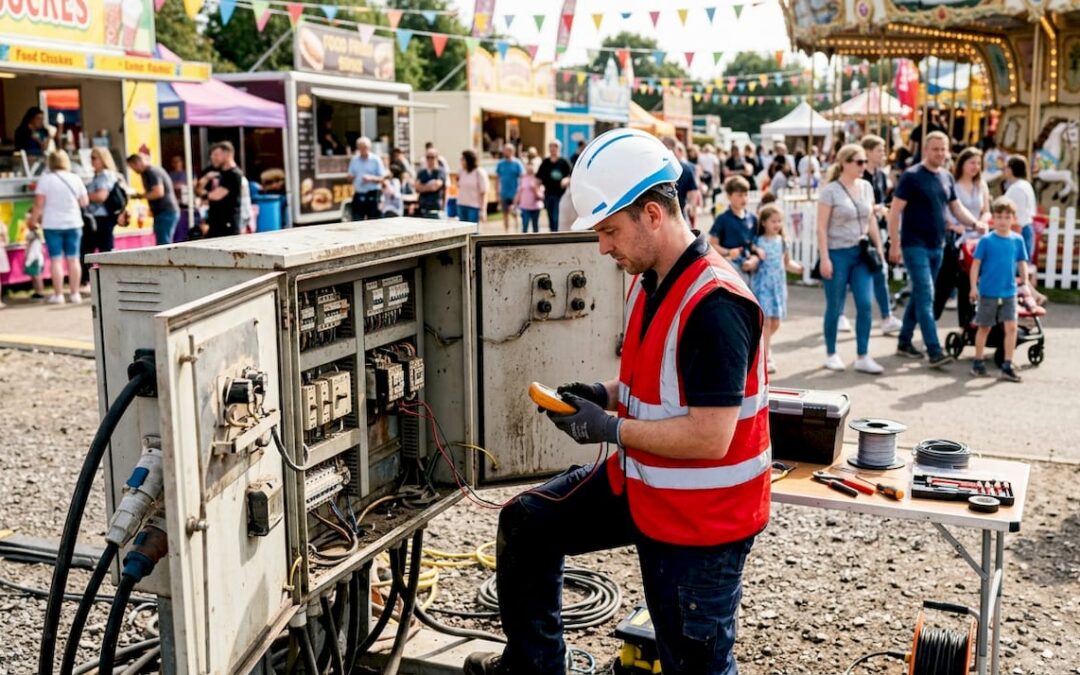
Event power distribution is the organised delivery of electrical power from a source to every piece of equipment across an event site, using a planned network of cables, distribution units, and protective devices. Get it wrong and you risk tripped breakers, equipment failure, or worse. Get it right and your audience never thinks about electricity once. In the UK, all temporary electrical systems at events must comply with BS 7909 and BS 7671, the standards that sit beneath the Electricity at Work Regulations 1989.
The key components you will encounter in any professional event power setup:
- CEE-form connectors and commando sockets rated to BS EN 60309, colour-coded by voltage and current
- Power Distribution Units (PDUs), also called distribution boxes or distro boards, which split one incoming supply into multiple protected circuits
- MCBs (Miniature Circuit Breakers) that cut power automatically when a circuit is overloaded
- RCDs (Residual Current Devices) rated at 30mA on all final circuits, protecting against electric shock from earth faults
- Cables, cable ramps, and connectors sized and rated for the environment and load
These components work together as a system. A generator or mains supply feeds a main PDU, which distributes power through protected circuits to local distro boxes, and finally to individual equipment. Every link in that chain carries safety and compliance obligations.
What are the core components of event power distribution?
Cables are the backbone of any temporary power system, and the type you choose depends entirely on where and how they will be used. For outdoor events, rubber-insulated and sheathed cables conforming to BS 6007 (commonly known as HO7RN-F) are the standard choice, rated to a minimum of 450V/750V. Indoor cables can be PVC or rubber sheathed to BS 6500, with a minimum 300V/500V rating. For circuits above 125A, single-core cables are used; multicore cables handle distribution circuits below that threshold. Where cables cross walkways or vehicle routes, armoured cable or proper mechanical protection is required.
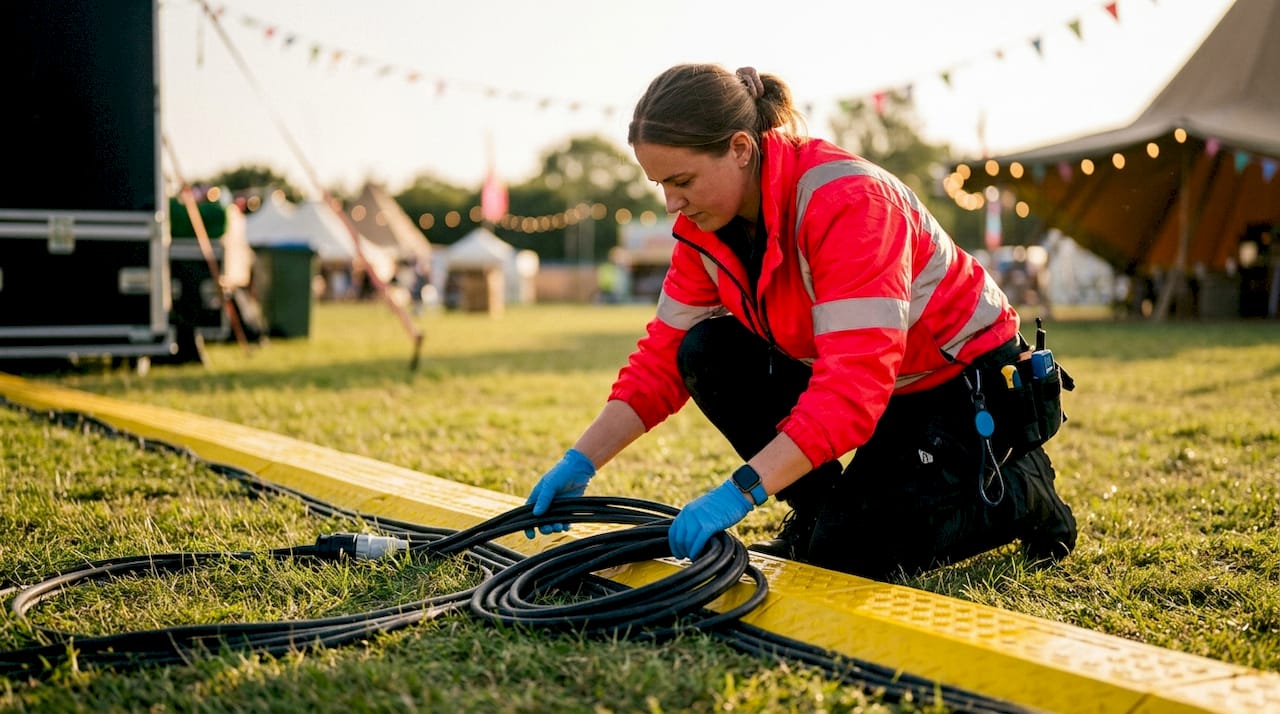
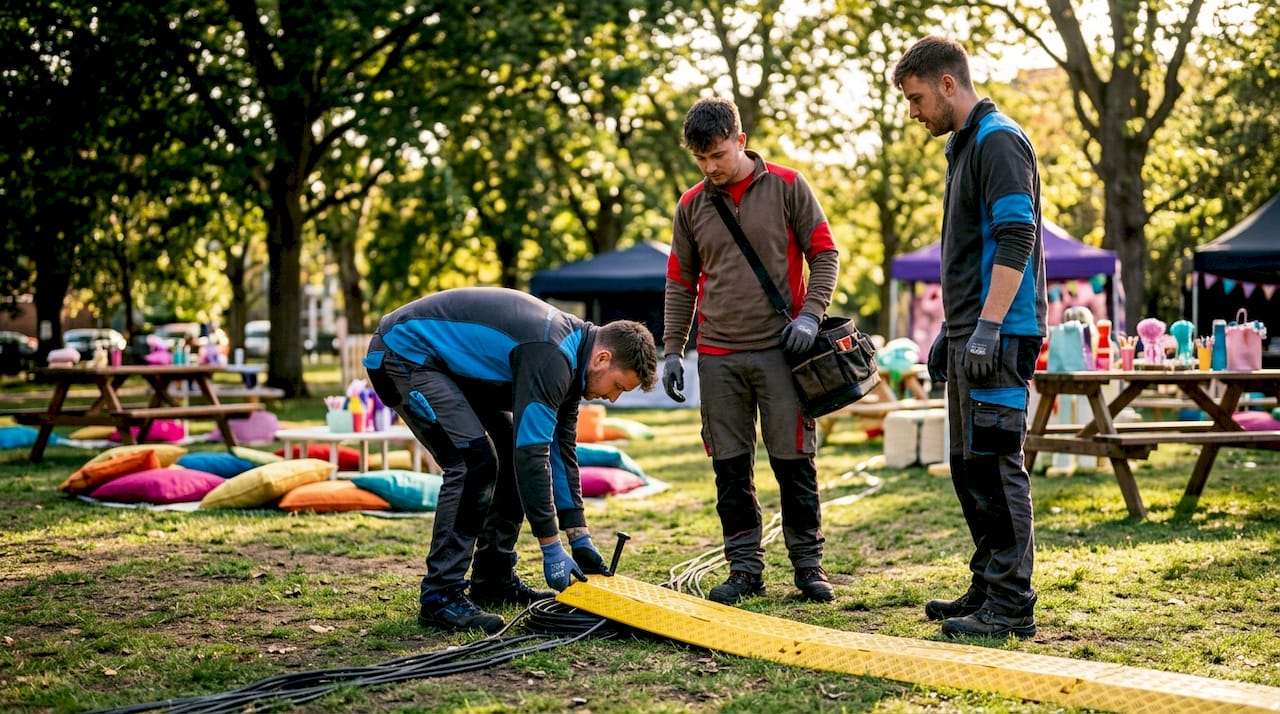
Cable ramps do more than reduce trip hazards. They protect the cable itself from foot traffic and vehicle wheels, and they signal to the public that a cable is present. Rubber mats are not a substitute; they only cushion the trip risk without providing mechanical protection. Cables routed across access and egress routes must go through proper cable ramps, not under matting.
Distribution boxes and PDUs
A Power Distribution Unit receives power from a generator or mains supply and breaks it into protected circuits using MCBs and RCDs. This is fundamentally different from plugging a consumer extension lead into a wall socket. A PDU gives you overcurrent protection on every outgoing circuit, earth fault protection via RCDs, and a clear, labelled layout that makes fault-finding fast. For more on how these units are installed safely, the distribution board installation guide covers the process in detail.
Common connectors used in UK event power:
- 16A CEE (blue): single-phase, the workhorse for lighting rigs, small audio, and catering equipment
- 32A CEE (blue): single-phase, for higher-demand single-phase loads
- 32A CEE (red): three-phase, used for larger stage equipment and motor loads
- 63A and 125A CEE (red): three-phase, for main distribution feeds between PDUs
- Commando sockets: the same BS EN 60309 family, widely found on venue walls and lighting columns
Industrial-grade plugs rated to BS EN 60309 are mandatory for professional event power. Consumer-grade extensions are a genuine fire and trip hazard in this context, not just a technicality.
Pro Tip: Label every PDU output clearly before the event starts. A strip of coloured tape and a marker pen takes two minutes and saves twenty when a breaker trips at midnight and you need to isolate one circuit without cutting power to everything else.
What power sources and supply types work best for events?
Mains supply, mobile generators, and battery or UPS systems each have a place in event power, and most large events use a combination of all three.
Mains supply is the cheapest option when available, but it requires permission from the venue or local authority, a check on the existing installation’s condition report (EICR), and confirmation that the supply capacity matches your load. Many venues have 16A or 32A commando sockets on lighting columns, but these are often reserved for festive decorations and cannot be used for event power without a specific licence.
Mobile generators give you independence from the venue’s infrastructure. Sizing matters: a generator running consistently above 80% of its rated capacity risks overheating and reduced reliability. The practical rule is to calculate your total connected load, add a margin for inrush currents (motor starts and transformer-coupled equipment can draw three to six times their running current for a fraction of a second), and then select a generator rated comfortably above that figure. Jakspartypower’s generator hire covers a range of sizes suited to events from small weddings to large outdoor shows.
Battery and UPS systems are not typically primary power sources for large events, but they are standard for protecting critical equipment. A UPS on a front-of-house audio console or a lighting desk means a brief generator switchover does not crash the system.
Single phase versus three phase
Single-phase supply (230V in the UK) suits most lighting, audio, and catering loads. Three-phase supply (400V line-to-line) is used where large motors, professional stage lighting dimmer racks, or high-power audio amplifiers are involved. Three-phase distribution also allows load balancing across three legs, which improves generator efficiency and reduces the risk of a single circuit becoming the weak point. Understanding power requirements for events before you specify your supply type prevents expensive last-minute changes on site.
What are the electrical safety rules for UK events?
BS 7909 applies to all temporary electrical systems at events in the UK, from a small press launch to a multi-stage festival. It sits alongside BS 7671 (the IET Wiring Regulations) and both are referenced in the Electricity at Work Regulations 1989. Compliance is not optional; local authorities and venue owners have a legal duty to ensure the public and staff are protected from electrical hazards, and event permissions routinely depend on documented compliance.
The standard requires every event to appoint a Senior Person Responsible (SPR). This is a legally designated role under BS 7909. The SPR must be electrically competent, cannot be a general contractor without documented qualifications, and is personally responsible for identifying electrical risks, overseeing design and testing, and signing completion certificates. Those certificates must be available before the public is admitted. Designating the SPR early, well before event day, is the single most effective way to avoid last-minute compliance problems.
Key safety requirements at a glance:
- All final circuits up to 32A must be protected by a 30mA RCD
- Distribution circuits feeding temporary structures need RCD protection not exceeding 300mA, using a time-delayed or S-type device to allow discrimination with downstream 30mA RCDs
- Generators must be earthed correctly with RCD protection on outputs; earth spikes placed under wheels or on grass are not acceptable
- All outdoor equipment must meet appropriate IP ratings; socket-outlets and connectors not reserved for indoor use must be at least splash-proof
- Emergency isolation must be possible quickly; all staff should know where the main isolator is located
- Signage must clearly identify distribution boards, isolation points, and any restricted electrical areas
- Completion certificates must be signed and submitted to the event organiser and venue owner
“In the event of an emergency, it should be possible to easily isolate all electrical supplies. Be aware of the location of local isolating breaker switches and safety arrangements.” — BBC Safety guidance on temporary electrical systems
Inspection and testing before the event opens is not a box-ticking exercise. The SPR must verify that protective measures will work for the supplies in use, that earth fault loop impedance on final circuits is within limits, and that all portable equipment has current PAT records. A periodic inspection report for any fixed host installation should be obtained from the venue before work begins.
How do you plan and manage event power distribution effectively?
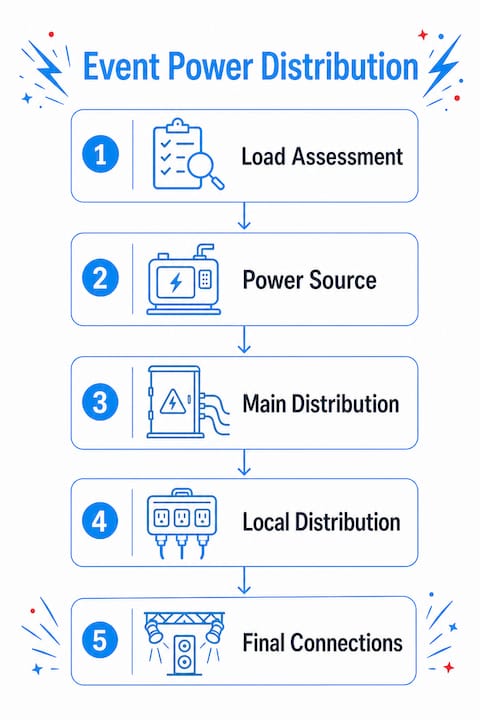
Start with a load assessment. List every piece of equipment, its rated wattage, and whether it has a motor or transformer (both create inrush currents). Add those figures up by zone, apply a demand factor where not everything runs simultaneously, then add a safety margin. Inrush currents can cause immediate breaker trips even when the steady-state load is within limits, so this step is not optional.
Organise the distribution in four layers: power source, main distribution, local distribution, and final connections. Each layer feeds the next through a PDU with appropriate overcurrent and earth fault protection. This structure makes fault-finding logical and limits the impact of any single failure to one zone rather than the whole site.
For larger sites, a microgrid approach divides the event into self-sufficient power zones, each with its own generator and distribution. A fault at a catering area does not then affect the main stage. Life-safety circuits, including emergency lighting and PA systems, should always be on isolated supplies independent of the main stage power.
Best practice checklist for event power planning:
- Conduct a full load assessment before specifying generator size or supply capacity
- Design for four distribution layers: source, main distro, local distro, final connections
- Use dedicated zone supplies for stages, catering, and life-safety systems
- Label every PDU, circuit, and cable run clearly with durable, weatherproof labels
- Stock spare RCDs and MCBs on site for rapid replacement if a device fails
- Place UPS units on critical equipment: audio consoles, lighting desks, communication systems
- Monitor generator loads using clamp meters or digital displays throughout the event
- Carry out visual checks on cables, connectors, and distribution equipment at regular intervals during the event
- Brief all crew on emergency isolation procedures before the event opens
Pro Tip: Nuisance tripping is the most common complaint on event sites. Before blaming the RCD, check whether the connected equipment has high earth leakage current. Some LED drivers and variable-speed motor controllers leak enough to trip a 30mA device even without a fault. Identify these loads during your pre-event test and either isolate them on a dedicated circuit or fit a UPS.
The event power risk management process ties all of this together: assess the risks, design to mitigate them, test before opening, and monitor throughout. That cycle, repeated for every event, is what separates professional power management from guesswork.
Why Jakspartypower’s expertise makes a difference
Jakspartypower brings over 40 years of electrical contracting experience to event power, which means the team has seen the failure modes that catch newer operators out: undersized generators, domestic extension leads daisy-chained through a marquee, generators earthed with a spike in the grass. That experience shapes every hire and every site visit.
The approach at Jakspartypower is bespoke rather than off-the-shelf. A wedding in a Sussex barn has different power requirements from an outdoor agricultural show or a corporate product launch, and the equipment selection, distribution layout, and standby support reflect that. The standby service means a qualified electrician is available throughout the event, not just during setup, which is the kind of cover that matters when a breaker trips during the first dance or a catering unit draws more than its rated load.
What clients get in practice:
- Site-specific load assessment and distribution design before equipment is specified
- Fully compliant equipment: generators, PDUs, CEE-form cabling, and protective devices all meeting BS 7909 and BS 7671 requirements
- SPR coordination and completion certificate support, so local authority submissions are handled correctly
- On-site standby support throughout the event, not just at setup
- Equipment that is tested, labelled, and ready to deploy, reducing installation time and the risk of wiring errors
The value of working with a specialist is not just the equipment. It is the judgement call at 11PM when a load imbalance is developing across three phases and you need someone who has seen it before. For event planners comparing venue types and their power implications, understanding what your venue can supply versus what a specialist brings in is a critical early decision.
Jakspartypower’s full range of generators, distribution boards, lighting, and cabling is available at jakspartypower.com. For events where power cannot be left to chance, that is the starting point.

Key takeaways
Safe, compliant event power distribution requires a planned four-layer system, BS 7909-designated SPR, and industrial-grade components rated to BS EN 60309, all verified by signed completion certificates before the public arrives.
| Point | Details |
|---|---|
| Compliance is mandatory | BS 7909 and BS 7671 apply to all UK temporary event electrical systems, with no exceptions for small events. |
| SPR designation is legally required | The Senior Person Responsible must be electrically competent and must sign completion certificates before public access. |
| Industrial connectors only | CEE-form and commando sockets rated to BS EN 60309 are required; consumer extension leads are a fire and safety risk. |
| Plan for inrush currents | Load assessments must account for motor and transformer start-up currents, which can trip breakers even within steady-state limits. |
| Microgrid zoning limits failures | Dividing large sites into dedicated power zones means a fault in one area does not cascade across the whole event. |
FAQ
What is event power distribution?
Event power distribution is the planned network of cables, distribution units, and protective devices that delivers electrical power from a source to equipment across an event site. In the UK, all temporary systems must comply with BS 7909 and BS 7671.
What is a PDU and how does it work?
A Power Distribution Unit (PDU) receives power from a generator or mains supply and splits it into multiple protected circuits, each with MCB overcurrent protection and RCD earth fault protection. It replaces makeshift extension leads with a safe, labelled, and compliant distribution point.
What are the three types of power distribution at events?
Event power is typically organised as mains supply, mobile generator supply, or battery and UPS backup. Most large events combine all three: mains or generators as the primary source, with UPS units protecting critical equipment during switchovers.
How does single-phase differ from three-phase at events?
Single-phase (230V) suits most lighting, audio, and catering loads. Three-phase (400V line-to-line) is used for high-power stage equipment, dimmer racks, and large motors, and allows load balancing across three legs to improve generator efficiency.
Who is responsible for electrical safety at a UK event?
The Senior Person Responsible (SPR), designated under BS 7909, oversees all electrical safety. The SPR must be electrically competent, sign completion certificates, and be appointed well before the event to coordinate testing and local authority submissions.