
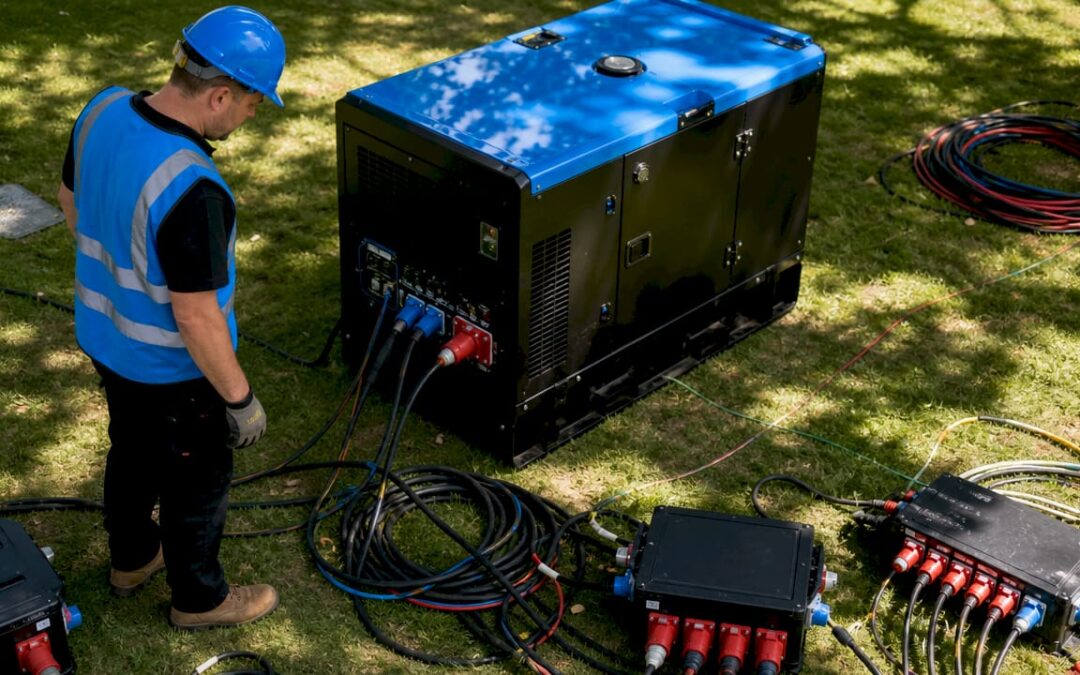
Types of event power equipment is the collective term for the generators, distribution units, cabling, and connectors that deliver safe, reliable electrical supply at any event. In professional practice, this falls under temporary electrical systems, governed in the UK by BS 7909 and BS 7671:2018+A2:2022. Getting the equipment mix right determines whether your event runs without interruption or grinds to a halt mid-performance. This guide covers every major category, from portable generators to uninterruptible power supplies, so you can match the right kit to your event’s specific demands.
1. Types of event power equipment: the core categories
Event power supply covers five distinct equipment categories. Each plays a different role, and none is optional once you move beyond a basic domestic setup.
- Generators produce the electrical power from fuel.
- Power distribution units (PDUs) split and manage that power across circuits.
- Cabling and connectors carry current safely from source to load.
- Transformers adjust voltage for specialist equipment or isolation.
- Uninterruptible power supplies (UPS) protect critical systems from sudden outages.
Every event, from a Sussex wedding to a large corporate conference, requires at least the first three. The final two become necessary as scale and complexity increase. Understanding which category you need, and why, is the foundation of sound event power planning.
2. Portable generators for events
Portable generators are the primary power source for any event without a mains connection. They convert diesel or petrol into electricity, and the choice of fuel type matters considerably.
Diesel generators are the standard for medium to large events. They are fuel-efficient, long-running, and well-suited to sustained high loads such as stage lighting rigs and catering equipment. Petrol generators suit smaller, shorter events where portability is the priority. Inverter generators produce clean, stable power with low harmonic distortion, making them the correct choice for sensitive AV equipment and corporate conference technology.
Sizing is where most planners go wrong. A 9kW load typically requires 15–20 kVA of generator capacity once power factor is applied. That gap exists because electrical loads do not draw power at 100% efficiency. Catering compressors and heavy audio systems also produce startup surges that can overload an undersized generator within seconds.
Key sizing considerations:
- Calculate total wattage for all connected equipment.
- Convert to kVA by dividing by the power factor (typically 0.8).
- Add a 25% safety buffer on top of the kVA figure.
- Account for startup surges from motors and compressors separately.
Pro Tip: Never size a generator to run at full capacity. A generator operating at 70–80% of its rated output runs more efficiently, produces less heat, and lasts longer across a full event day.
For detailed guidance on generator sizing for events, the process differs meaningfully between private parties and corporate setups.
3. Power distribution units and distribution boards
A generator produces raw power. A power distribution unit (PDU) makes that power usable across multiple circuits safely. Without proper distribution, a single fault can cut power to the entire event.
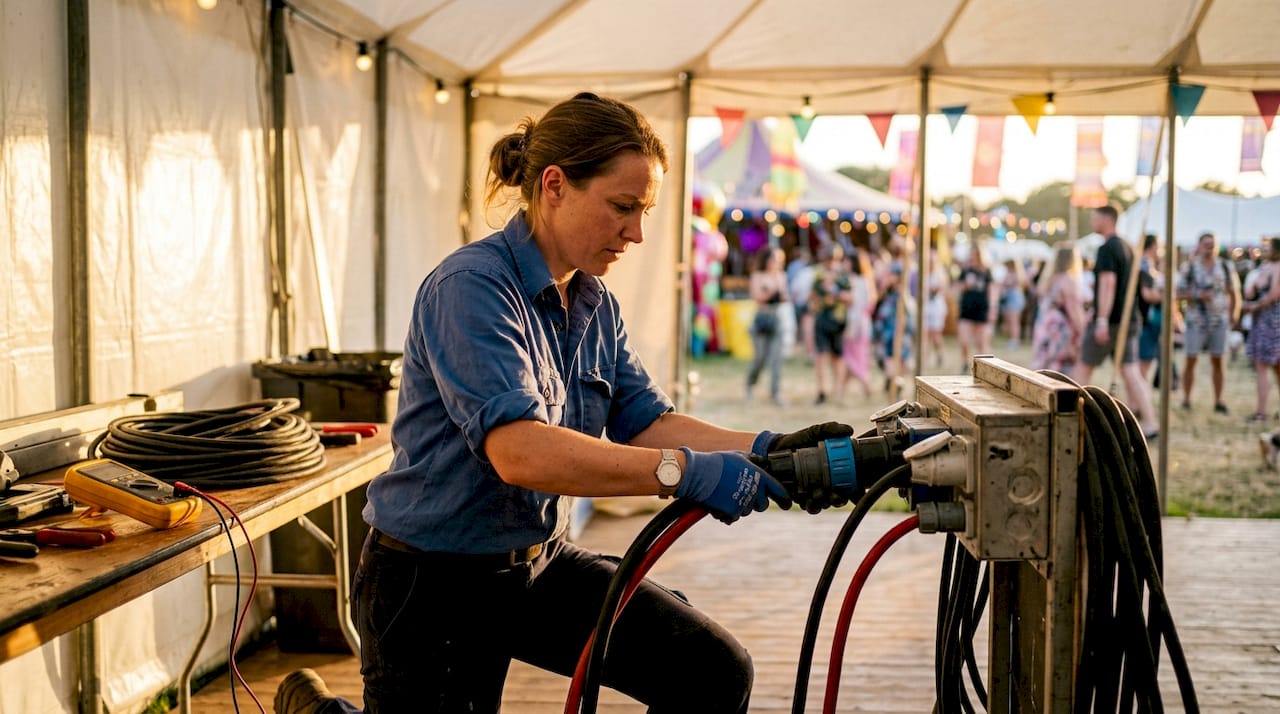
PDUs, distribution boards, and Event Distribution Panels (EDPs) all serve the same core function: they receive incoming supply and split it into separate, protected circuits. The critical difference between categories is capacity and protection level.
| Distribution unit type | Typical capacity | Key protection features |
|---|---|---|
| Single-phase distribution box | 16A–63A | RCD, MCB, IP44 rating |
| Three-phase distribution panel | 63A–125A | RCD per circuit, IP65 rating |
| Event Distribution Panel (EDP) | 125A+ | Metering, modular outputs, IP65 |
RCD protection at 30mA minimum is a legal requirement under BS 7671:2018+A2:2022 for all outdoor supplies. An RCD trips the circuit within milliseconds of detecting a fault current, preventing electrocution. IP ratings indicate resistance to moisture and dust. Outdoor events require a minimum of IP44; wet conditions demand IP65.
Key features to specify in any distribution unit:
- Individual RCDs per output circuit, not a single master RCD.
- Clearly labelled circuit breakers for rapid fault identification.
- Robust housing rated for the environmental conditions on site.
- Sufficient output sockets to avoid improvised extensions.
Separate circuits for critical infrastructure, such as PA systems and emergency lighting, prevent a full event blackout when a single fault occurs. This is one of the most practical steps a planner can take to protect the event programme.
For outdoor festival setups, distribution unit selection involves additional considerations around cable routing and environmental exposure.
4. Cabling and connectors for safe power delivery
Cabling is the most frequently mismanaged element of event power. The wrong cable creates a fire risk, a compliance failure, and a liability.
Daisy-chaining domestic 13A extension leads violates BS 7909 and creates a serious fire hazard. Domestic leads are not rated for the sustained loads, outdoor conditions, or cable lengths typical of events. They overheat, their insulation degrades under foot traffic, and they are not IP-rated for moisture exposure.
Industrial-grade cables with the correct cross-sectional area (CSA) are the only compliant option. CSA determines how much current a cable can carry without overheating. A cable that is too thin for its load will heat up, degrade, and potentially ignite. Cables must also be fully unwound during use. A coiled cable generates heat that it cannot dissipate, which accelerates insulation failure.
CEE connectors (the blue or red industrial plugs and sockets) are the standard for temporary event power systems. They lock securely, are IP-rated, and are available in 16A, 32A, 63A, and 125A ratings. Matching the connector rating to the circuit capacity is non-negotiable.
Cable safety checklist:
- Inspect all cables visually before each event for cuts, abrasions, or damaged connectors.
- Confirm PAT testing is current for all portable electrical equipment.
- Route cables to avoid pedestrian areas or protect them with cable ramps.
- Never join cables with domestic adaptors or non-rated connectors.
Pro Tip: Label every cable run at both ends before the event starts. During a fault at 10PM in a dark marquee, a labelled cable system saves significant time and prevents dangerous improvisation.
The role of cabling in event reliability is often underestimated until something goes wrong.
5. Specialist power equipment for complex events
Large-scale events and those with sensitive technical requirements need equipment beyond generators and distribution boards. Three categories become relevant as complexity increases.
Transformers serve two purposes in event power. Isolation transformers separate the event supply from the mains earth, reducing the risk of electric shock in wet outdoor environments. Step-down transformers reduce voltage for equipment rated at 110V, which is common on construction-adjacent event sites where tool safety standards apply.
Uninterruptible power supplies (UPS) protect equipment that cannot tolerate even a brief power interruption. Live broadcast feeds, medical equipment at public events, and financial transaction systems at corporate events all fall into this category. A UPS bridges the gap between a generator fault and either restoration or controlled shutdown. The bridge time varies by unit, but even a 10-second buffer prevents data loss and equipment damage.
Lighting control systems interface directly with the power distribution network. Dimmer racks, DMX controllers, and LED driver units all draw power from the distribution system and require stable, clean supply. The role of lighting control systems in event power planning is significant because lighting is frequently the largest single load on the distribution network.
When to specify specialist equipment:
- Use isolation transformers at any outdoor event with wet ground conditions.
- Specify a UPS for any live broadcast, medical, or financial system.
- Confirm lighting control equipment compatibility with your generator’s output quality before the event.
6. Matching equipment to event type and scale
Different events have fundamentally different power profiles. A corporate conference and an outdoor music festival share almost no equipment requirements beyond the basic categories.
Compliance with BS 7909 is mandatory for all temporary electrical systems in the UK. The standard requires a designated competent person to manage design, installation, and verification. That person signs off the system before energisation. Without that sign-off, the event organiser carries full liability for any electrical incident.
| Event type | Typical power demand | Recommended equipment |
|---|---|---|
| Corporate conference (indoor) | Low to medium | Inverter generator, single-phase PDU, CEE cabling |
| Wedding (marquee) | Medium | Diesel generator, single-phase distribution board, IP44 cabling |
| Outdoor festival | High | Large diesel generator, three-phase EDP, IP65 cabling, UPS for stage |
| Large show or exhibition | Very high | Multiple generators, 125A three-phase distribution, isolation transformers |
Risk assessments are not optional for any event using temporary electrical systems. The HSE’s HSG107 guidance specifically covers outdoor supplies and requires IP-rated equipment and proper cable routing. For top power equipment at corporate conferences, the inverter generator is the preferred choice because it produces stable power with low harmonic distortion, protecting AV and IT equipment.
Event power risk management covers the full process of identifying and mitigating electrical hazards before and during an event.
Key takeaways
Selecting the right event power equipment requires matching generator capacity, distribution protection, and cable ratings to the specific demands of each event while meeting BS 7909 compliance requirements.
| Point | Details |
|---|---|
| Generator sizing | Add a 25% buffer to your kVA calculation and account for startup surges from motors. |
| Distribution protection | Specify individual RCDs per circuit and IP65-rated units for outdoor use. |
| Cable compliance | Use industrial-grade CEE cables; domestic extension leads violate BS 7909. |
| Specialist equipment | Specify UPS units for critical systems and isolation transformers for wet outdoor sites. |
| Competent person | A certified competent person must verify and hand over all temporary electrical systems. |
What I have learned from 40 years of event power
The single most common mistake I see is planners treating event power like a domestic supply. It is not. Every temporary electrical system requires a responsible person to manage design, installation, and verification. That is not a bureaucratic formality. It is the difference between a safe event and a serious incident.
The second mistake is leaving cabling decisions until the day. Cable runs need to be planned on paper before a single metre of cable is laid. You need to know the load at each end, the distance, the environmental conditions, and the routing. Improvised cabling on the day, under time pressure, produces exactly the kind of dangerous installations that BS 7909 certification is designed to prevent.
Separate circuits for critical systems is a principle I advocate without exception. Your PA system, emergency lighting, and catering refrigeration should never share a circuit. When a fault trips one, the others keep running. That single design decision has saved more events than any other.
Finally, brief your power equipment supplier early and in detail. Give them your full load schedule, your site plan, and your event timeline. A good supplier will identify problems before they become failures on the night.
— Rob
Jakspartypower: event power hire and expert support
Planning an event and need reliable power equipment from a team that understands compliance as well as kit? Jakspartypower brings over 40 years of electrical contracting experience to every hire, covering generators, distribution boards, and industrial cabling for events across Sussex.
Whether you need a generator for a corporate event or a full power package for a marquee wedding, Jakspartypower provides equipment that meets BS 7909 requirements and backs it with a standby service on the day. Browse the full event power hire range to find the right solution for your event scale and budget.
FAQ
What does BS 7909 require for event power?
BS 7909 requires a designated competent person to design, install, and certify all temporary electrical systems before energisation. The standard also limits voltage drop to 5% of the nominal 230V supply.
What size generator do I need for an event?
Calculate your total wattage, convert to kVA using your power factor, then add a 25% overhead to cover startup surges and inefficiencies. A 9kW load typically requires a 15–20 kVA generator.
Can I use domestic extension leads at an event?
No. Domestic 13A extension leads violate BS 7909 and create a fire hazard. Industrial-grade IP-rated cables with CEE connectors are required for all temporary event power systems.
When do I need a UPS at an event?
Specify a UPS for any system that cannot tolerate a power interruption, including live broadcast feeds, medical equipment, and financial transaction terminals. A UPS bridges the gap during a generator fault or transfer.
Who is responsible for event electrical safety?
A competent and responsible person must manage the design, installation, and formal handover of all temporary electrical systems. Without certified handover, the event organiser carries full legal liability for any electrical incident.