
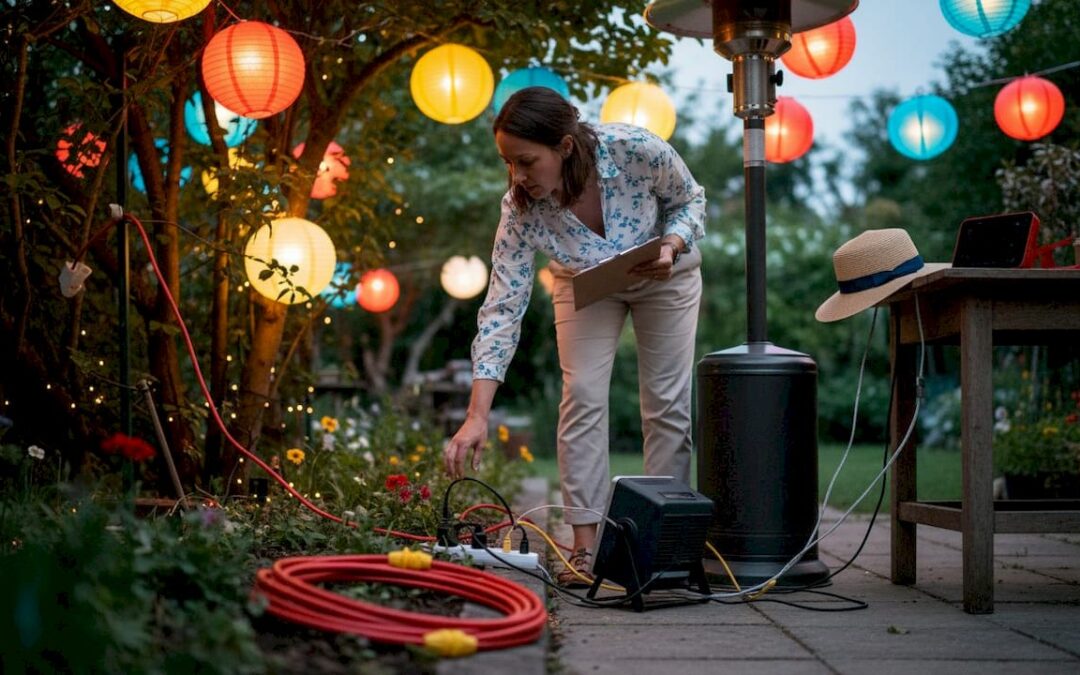
Garden party power planning is the process of estimating, sourcing, and safely distributing electricity to meet the specific demands of your outdoor event. Get it wrong and you risk tripped circuits, damaged equipment, or worse, a fire. Get it right and your guests notice nothing except the music, the food, and the fairy lights. This guide covers the full picture: load calculation, power source selection, UK safety standards including BS 7671 and BS 7909, cable management, and supplier coordination. Jakspartypower, with over 40 years of electrical contracting experience in Sussex, applies exactly these principles to every event it supports.
What does garden party power planning actually involve?
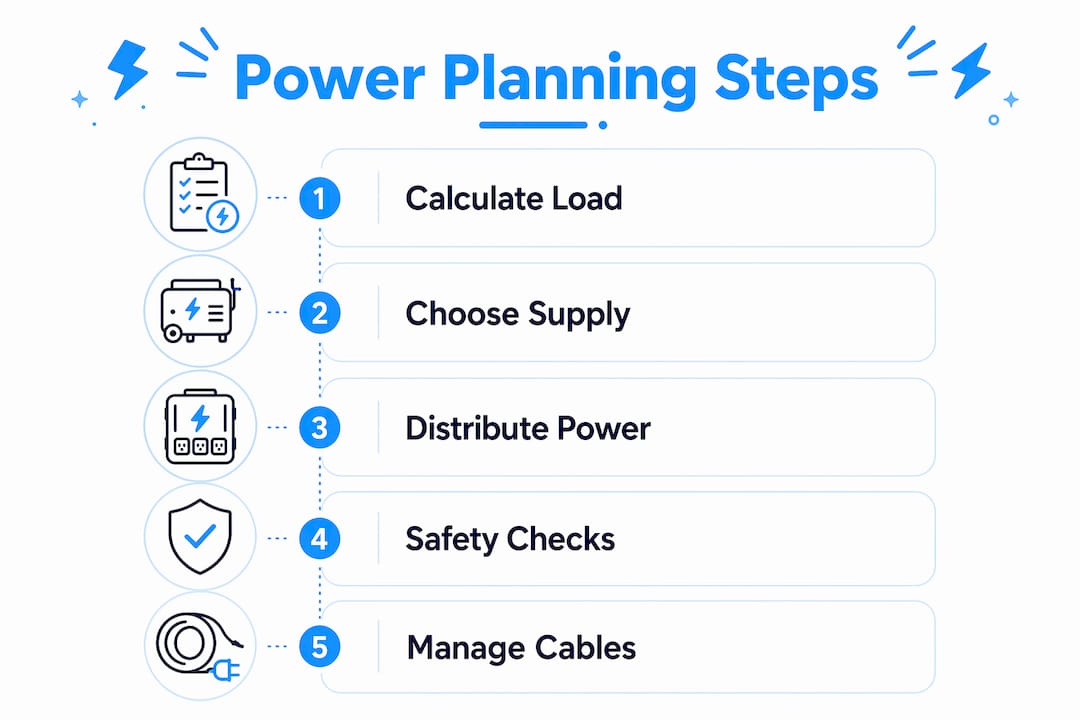
Garden party power planning is the industry term for temporary event power design applied to domestic outdoor settings. It covers four core tasks: calculating your total electrical load, choosing the right power source, specifying compliant equipment, and laying out cables safely. Most hosts skip straight to hiring a generator without doing the first step. That shortcut causes most of the problems seen at garden events.
The governing standards in the UK are BS 7671:2018 (the IET Wiring Regulations) and BS 7909 (the code of practice for temporary electrical systems at events). Both apply to garden parties the moment you move beyond a single domestic socket. Understanding them does not require an electrical qualification. It requires knowing which questions to ask your supplier.
How do you calculate power requirements for a garden party?
Every piece of electrical equipment has a wattage rating. Add those ratings together and you have your total load. For UK 230V systems, 1kW equals approximately 4.3 Amps, which event planners round up to 4.5 Amps to account for inefficiencies and startup surges. That rounding matters because motors and heating elements draw significantly more current at startup than during steady operation.
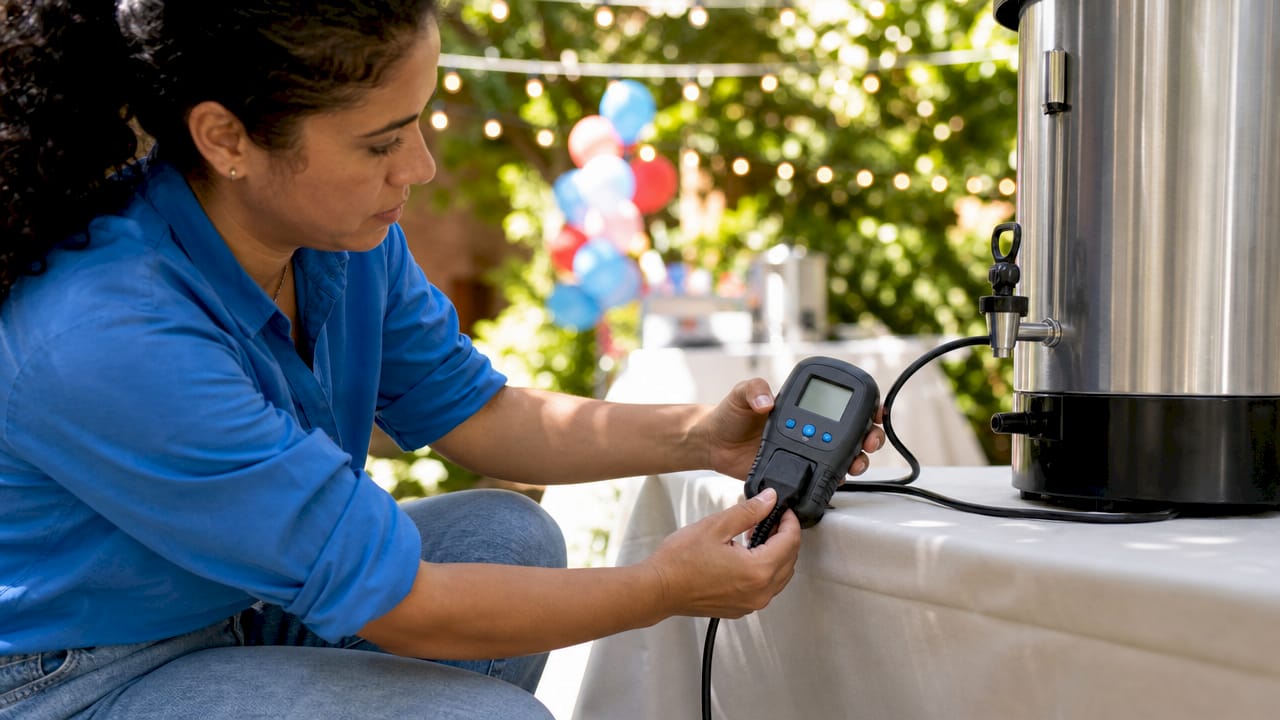
Here is a practical breakdown of typical garden party power consumers:
| Equipment category | Typical wattage | Approximate amps (at 230V) |
|---|---|---|
| Catering urn (10 litre) | 3,000W | 13A |
| Commercial catering oven | 3,000–6,000W | 13–26A |
| PA sound system (medium) | 500–1,000W | 2–4.5A |
| String/festoon lighting (LED) | 200–500W | 1–2A |
| Patio heater (electric) | 2,000–3,000W | 9–13A |
| Refrigeration unit | 300–600W | 1.5–3A |
| Bouncy castle blower | 1,500W | 6.5A |
For a typical birthday party with a catering urn, a PA system, festoon lighting, and two patio heaters, your total load sits around 9,000–11,000W, or roughly 40–48 Amps. That figure immediately tells you that a domestic ring main will not cope.
Pro Tip: Ask every supplier for their equipment’s peak wattage, not just the running wattage. Catering equipment in particular draws two to three times its rated load during the heating phase.
What power supply options are available for garden parties?
The choice comes down to three options: domestic house circuits, a hired generator, or a hybrid of both.
Using domestic house circuits
Small events under 30 Amps total can run off household circuits distributed across independent ring mains. A standard UK ring main is protected by a 32A breaker, but you should never load it beyond 80% of that figure in practice. Two independent ring mains can theoretically supply around 50 Amps combined, but cable runs from the house become the limiting factor. Events exceeding 30 Amps or located more than 50 metres from the building require a generator.
Hiring a generator
Generator hire is the reliable choice for most garden parties with catering, sound, and lighting running simultaneously. Event-spec silent generators are the correct choice for private parties. Construction tool-hire generators are significantly louder and often fail to meet local noise restrictions. Silent road-tow models operate at noise levels that do not intrude on conversation or music.
Size your generator with a 20%–30% safety buffer above your calculated maximum load. If your total load is 10kW, hire a 12–13kVA generator at minimum. That buffer prevents voltage drops under peak load and protects sensitive equipment like sound systems and lighting controllers. Jakspartypower’s generator hire options include silent event-spec models sized for exactly this kind of calculation.
Pro Tip: Always confirm fuel runtime with your hire company. A generator running dry mid-party is far more disruptive than any planning conversation beforehand.
Hybrid and backup options
A hybrid approach uses house circuits for low-draw items like LED lighting and charges a generator for high-draw catering and heating. This reduces generator fuel consumption and noise. Always plan a backup circuit for critical equipment such as refrigeration, particularly at summer events where food safety is a concern.
What safety standards apply to outdoor garden party power?
Outdoor electrical safety is not optional. BS 7671:2018 requires 30mA RCD protection on all outdoor and temporary circuits under Regulation 411.3.3. An RCD at 30mA trips fast enough to prevent a fatal electric shock. Every circuit feeding outdoor equipment must have one, without exception.
IP ratings govern which equipment is safe to use outdoors. IP44 is the minimum for covered outdoor areas such as marquees, and IP65 is required for fully exposed locations. Using indoor-rated equipment outside invalidates your event insurance and creates a genuine safety risk. This applies to connectors, sockets, and junction boxes, not just the main equipment.
BS 7909 requires that temporary electrical systems for events be designed, installed, inspected, and tested by a competent person, with full documentation and certification. For a garden party, this means your electrical contractor must provide a signed test certificate. The Purple Guide, the UK’s primary safety reference for events, places legal responsibility on the event organiser to verify that competency. If something goes wrong and your contractor was unqualified, your insurance claim fails.
The most common compliance failures at garden parties are:
- Using domestic extension leads outdoors without RCD protection
- Connecting equipment rated for indoor use only to outdoor circuits
- Failing to obtain a test certificate from the electrical contractor
- Running circuits without IP-rated connectors in wet conditions
- Overloading a single circuit by daisy-chaining multiple appliances
Professional verification under BS 7909 is not bureaucracy. It is the document that protects you legally and financially if an incident occurs. Jakspartypower provides full compliance documentation as standard on every installation.
How should you manage cables and power distribution at a garden party?
Cable management is where most DIY setups fail. Never daisy-chain domestic 13A extension leads across long distances. They overheat, they are not rated for outdoor use, and they create trip hazards. Industrial-rated cables with the correct cross-sectional area (CSA) and IP-rated connectors are the only safe option for outdoor event use.
Voltage drop is the hidden problem in long cable runs. Industry standards limit voltage drop to a maximum of 5% between the supply point and the load. Beyond that, equipment runs inefficiently, motors overheat, and lighting dims noticeably. The solution is correct cable sizing: a heavier CSA cable over a longer run maintains voltage within the acceptable limit. Your electrical contractor calculates this during the design phase.
Cable drums must be fully unwound before use. A coiled cable drum carrying current builds heat in the centre of the coil. That heat has nowhere to go and can melt insulation or start a fire. This is one of the most frequently ignored rules at informal events.
Pro Tip: Run cables along fence lines and under matting rather than across open grass. Guests trip on cables they cannot see, and a disconnected supply mid-event is both dangerous and embarrassing.
An event distribution board splits your generator or mains supply into separate protected circuits. Each circuit feeds a different zone: catering, lighting, entertainment. If one circuit trips, the others stay live. Without a distribution board, a single fault takes down your entire event. Jakspartypower installs distribution boards as part of its standard garden party setup service.
For cable hire, rated outdoor cables are available directly from Jakspartypower, ensuring the correct CSA and IP rating for your specific run lengths and loads.
How do you plan generator hire and coordinate with suppliers?
Supplier coordination is the step most hosts leave too late. Contact every supplier, including caterers, entertainers, and lighting companies, at least four weeks before the event. Request the following from each:
- Peak wattage draw (not just running wattage)
- Plug type and phase requirement (single phase or three phase)
- Whether equipment contains heating elements, which draw high startup current
- Cable length they will bring and whether they need power at a specific location
Compile those figures into a single power schedule. That document becomes the basis for your generator specification and distribution board layout. Jakspartypower’s event power supplier briefing guide provides a ready-made framework for this process.
When hiring a generator, confirm silent operation, fuel type, runtime at full load, and whether the hire company provides a competent person for connection. A generator delivered without a qualified operative to connect it is only half a solution. Verify that the hire company holds current public liability insurance and can provide a test certificate on the day. For a detailed walkthrough of the hiring process, Jakspartypower’s private event generator guide covers every step.
Schedule generator delivery at least two hours before guests arrive. That window allows for positioning, connection, load testing, and any adjustments before the event begins.
Key takeaways
Correct garden party power planning requires accurate load calculation, a correctly sized generator with a safety buffer, and full compliance with BS 7671 and BS 7909 before a single cable is laid.
| Point | Details |
|---|---|
| Calculate load first | Add peak wattages for all equipment and convert using 4.5A per 1kW for UK 230V systems. |
| Size the generator with a buffer | Choose a generator rated 20%–30% above your calculated maximum load to prevent voltage drops. |
| Mandate RCD protection | Every outdoor circuit requires 30mA RCD protection under BS 7671:2018 Regulation 411.3.3. |
| Use IP-rated equipment outdoors | IP44 minimum for covered areas, IP65 for exposed locations; indoor-rated equipment invalidates insurance. |
| Get a test certificate | BS 7909 requires a competent person to sign off all temporary event electrical systems. |
What I have learned from planning garden party power
The single biggest mistake I see hosts make is treating power as an afterthought. They book the caterer, the band, and the marquee, then call about power two weeks before the event. By that point, the best silent generators are already hired out, and there is no time to properly survey the site.
Early power mapping changes everything. Walk the site, mark where each supplier will set up, measure the cable runs, and identify where the distribution board will sit. Do that in the first week of planning and every subsequent decision becomes easier. You know what size generator you need, you know which cables to hire, and you know what to ask each supplier.
The other lesson is that the safety buffer in generator sizing is not a nice-to-have. Catering equipment in particular is brutal on generators at startup. I have watched a correctly calculated but unbuffered generator trip repeatedly during the first hour of a party because the caterer’s urn and oven both started heating at the same time. A 20%–30% buffer on the generator rating eliminates that problem entirely.
Silent generators also matter more than most hosts expect. Guests standing near a noisy construction generator cannot hold a conversation. The event atmosphere suffers immediately. Event-spec silent models cost slightly more to hire, but the difference in guest experience is significant. For outdoor gatherings where ambience is part of the point, that cost is always justified.
— Rob
How Jakspartypower supports your garden party power setup
Planning the electrical side of a garden party is straightforward when you have the right partner from the start.

Jakspartypower provides event-spec generator hire with silent models sized to your exact load calculation, including the safety buffer built in. The team installs fully compliant distribution boards, supplies IP-rated cables in the correct CSA for your run lengths, and provides BS 7909 test certification as standard. With over 40 years of electrical contracting experience, Jakspartypower handles the technical side so you can focus on the event itself. Contact the team early in your planning process at jakspartypower.com to get a power schedule built around your specific suppliers and site.
FAQ
How many amps does a typical garden party need?
A garden party with catering, sound, and lighting typically requires 40–50 Amps or more. Events exceeding 30 Amps need a generator rather than domestic house circuits.
What size generator do I need for a garden party?
Add the peak wattages of all equipment, convert to kilowatts, then add a 20%–30% safety buffer. A party drawing 10kW at peak load needs a generator rated at 12–13kVA minimum.
Is RCD protection legally required for outdoor garden party power?
Yes. BS 7671:2018 Regulation 411.3.3 mandates 30mA RCD protection on all outdoor and temporary electrical circuits. Omitting it invalidates event insurance and creates a serious safety risk.
What is the difference between IP44 and IP65 equipment?
IP44 equipment is rated for covered outdoor areas such as marquees. IP65 equipment is rated for fully exposed outdoor locations. Using indoor-rated equipment outside is both unsafe and non-compliant.
Do I need a test certificate for a garden party electrical setup?
Yes. BS 7909 requires that all temporary event electrical systems be installed and verified by a competent person, with signed documentation provided before the event begins.