

A power contingency plan is a pre-planned protocol that venues activate when their primary power supply fails, covering backup generation, failover switching, and team communication. Without one, a single outage can cancel an event entirely, triggering refunds, vendor compensation, and lasting reputational damage. UK standards BS 7671:2018+A2:2022 and BS 7909:2011+A1:2020 set the legal baseline for temporary electrical systems, and the Health and Safety Executive (HSE) enforces compliance. Jakspartypower, with over 40 years of electrical contracting experience in Sussex, builds these plans into every event power setup they deliver.
Why venues need power contingency plans: risks and real costs
Power failure is the single biggest operational threat to a live event. A 2-hour outage can force a full cancellation, leaving venues liable for hundreds of thousands of pounds in ticket refunds and vendor credits. That figure does not include the longer-term cost of a damaged reputation.
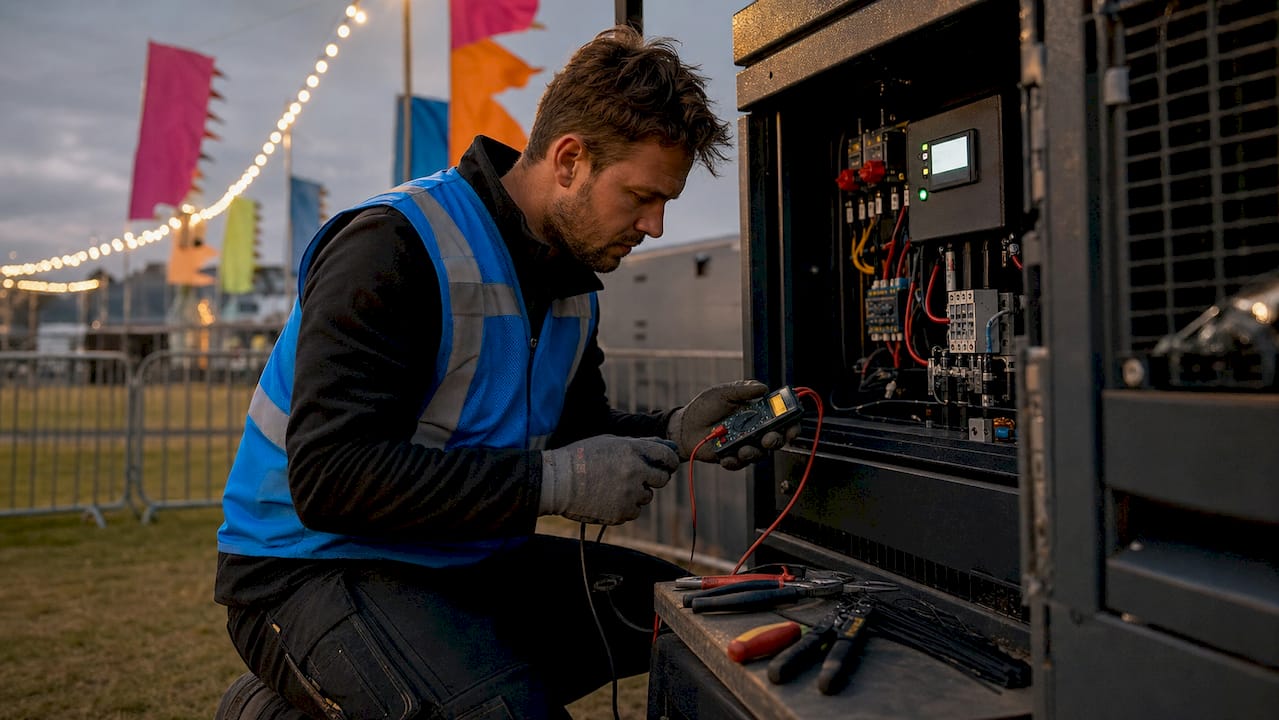
The financial exposure goes beyond the immediate event. Sponsors withdraw, insurers raise premiums, and repeat bookings dry up. Venues that cannot demonstrate power resilience lose business to those that can.
Safety risks compound the financial ones. Power loss interrupts emergency lighting, fire alarm systems, and PA announcements. These are not inconveniences. They are life-safety systems, and their failure puts attendees at direct risk.
Cascading failures are a particular hazard at food-led events. Refrigeration loss creates a public health risk within hours. Vendors without temperature logging or cool-box contingencies can expose the venue to enforcement action.
“Power failures in urban settings produce cascading effects. Refrigeration failure alone can compromise food safety across an entire event site, requiring temperature logging and contingency equipment as standard practice.”
The legal exposure is equally serious. Significant electrical incidents must be reported to the HSE within 10 days, or immediately if serious injury or death occurs. Venues without documented contingency plans have little defence when enforcement follows.
Key risks of operating without a power contingency plan:
- Full event cancellation and mass refund liability
- Vendor compensation claims and contract penalties
- Failure of emergency lighting and fire alarm systems
- Food safety breaches from refrigeration loss
- HSE enforcement and potential prosecution
- Long-term reputational damage affecting future bookings
Which UK regulations govern temporary power at events?
Temporary power installations carry the same legal weight as permanent ones. Temporary systems must be professionally designed, installed, inspected, and maintained to the same standards as fixed electrical infrastructure. This surprises many organisers who assume a generator and a few cables sit outside the regulatory framework.
Two standards define the compliance baseline for event power in the UK.
- BS 7671:2018+A2:2022 covers the wiring regulations for all electrical installations. All outdoor and temporary circuits must be protected by a minimum 30mA RCD, and the maximum permitted voltage drop across any circuit is 5%. These are not guidelines. They are mandatory requirements.
- BS 7909:2011+A1:2020 applies specifically to temporary electrical systems for entertainment events. All systems under BS 7909 must be designed and signed off by a competent person, with full documentation of inspections and tests retained on site.
The table below summarises the key compliance requirements venues must meet.
| Requirement | Standard / Body | Detail |
|---|---|---|
| RCD protection on all circuits | BS 7671:2018+A2:2022 | Minimum 30mA sensitivity on every outdoor circuit |
| Maximum voltage drop | BS 7671:2018+A2:2022 | No more than 5% across any circuit |
| Competent person sign-off | BS 7909:2011+A1:2020 | Design, installation, and inspection must be documented |
| Incident reporting | HSE | Serious incidents reported immediately; others within 10 days |
| Risk assessment | Health and Safety at Work Act 1974 | Written assessment required for all temporary power setups |
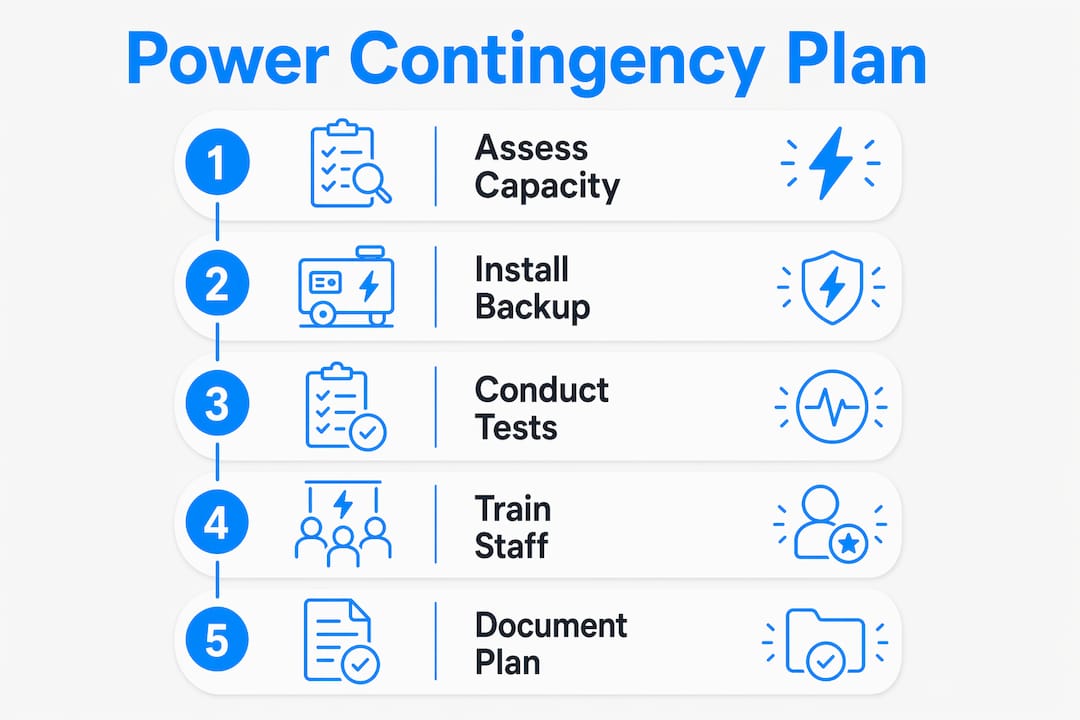
Compliance protects venues legally and operationally. A signed-off installation with full documentation gives insurers, local authorities, and event licencing bodies the evidence they need. Without it, venues carry uninsured risk.
Pro Tip: Ask your power supplier for the BS 7909 sign-off documentation before the event day. If they cannot produce it, the installation is not compliant.
How should venues design an effective power contingency plan?
A venue power capacity assessment is the starting point for every contingency plan. You cannot size backup generation without knowing the total load. Work through each power zone: stage, catering, lighting, AV, and welfare facilities. Add a safety margin of at least 20% above peak calculated demand.
Once load is established, the plan must address redundancy. A single generator with no backup is not a contingency plan. It is a single point of failure. The standard approach pairs a primary generator with a standby unit sized to carry the full critical load, connected through an automatic transfer switch (ATS). An ATS detects a supply failure and switches to the backup source within seconds, without manual intervention.
Follow these steps when building the plan:
- Conduct a load calculation. List every electrical load by zone, note peak draw, and total the site demand. Factor in event lighting power consumption as a significant variable.
- Size generators correctly. Undersized generators overheat and trip under load. Oversized ones waste fuel and run inefficiently. Match generator capacity to calculated peak demand plus the 20% margin.
- Install an automatic transfer switch. Manual switching introduces delay and human error. An ATS removes both risks.
- Segment power zones. Separate critical systems (emergency lighting, PA, fire alarms) from non-critical loads (decorative lighting, secondary catering). A fault in one zone should not take down another.
- Plan fuel logistics. Calculate runtime at expected load. Arrange a confirmed fuel delivery schedule with a named contact and a backup supplier. Contract clauses specifying delivery times and fuel availability reduce the risk of supply failure on the day.
- Specify cabling and distribution correctly. Correct cable sizing, RCD protection on every circuit, weatherproof enclosures, and clear labelling are non-negotiable for safe fault response.
- Brief all vendors on the plan. Every supplier with an electrical load must know the contingency protocol, their circuit allocation, and the escalation contact.
Pro Tip: Build a one-page contingency activation sheet for your site manager. It should list the ATS location, the backup generator start procedure, the fuel contact number, and the HSE reporting threshold. Laminate it and attach it to the distribution board.
Vendor contracts should specify liquidated damages for power failures. Contracts with penalty clauses for supply interruption give suppliers a direct financial incentive to maintain continuous service. This single clause changes supplier behaviour more reliably than any verbal agreement.
What safety challenges come with managing temporary event power?
Generator positioning is a life-safety decision, not a logistics one. Generator exhaust contains carbon monoxide and must be located away from public access areas and food preparation zones. Wind direction changes throughout the day, so the positioning assessment must be repeated as conditions shift. A generator placed correctly at 8:00 AM may become a hazard by midday if the wind turns.
Weatherproofing is equally critical. Outdoor events in the UK face rain, humidity, and temperature swings that degrade unprotected electrical equipment. All distribution boards, connectors, and cable joints must use IP-rated weatherproof enclosures. Exposed connections are a fault waiting to happen.
“Temporary power setups must be treated with the same rigour as permanent electrical installations. The fact that equipment is hired and temporary does not reduce the duty of care owed to attendees and staff.”
Load management prevents equipment failure during the event. Overloaded circuits overheat before they trip. Assign maximum load limits to each zone and brief vendors on their allocation before they connect equipment. Unannounced load additions are a common cause of mid-event failures.
Urban venues face additional logistical pressure. Generator delivery in a congested city centre requires coordinated access windows, often with local authority permits. Logistical coordination for generator delivery must be tightly planned alongside other event services to allow sufficient testing time before doors open. A generator that arrives two hours late leaves no time for a proper load test, and an untested system is an unreliable one.
Operational safety checklist for temporary power:
- Confirm generator exhaust clearance from public and catering areas
- Reassess generator position if wind direction changes
- Verify all enclosures carry appropriate IP weatherproof ratings
- Assign and enforce load limits per zone before vendor connection
- Schedule a full load test at least two hours before the event opens
- Confirm the site manager holds the contingency activation sheet
- Check fuel level and delivery schedule the morning of the event
The role of electrical contractors on site goes beyond installation. A qualified contractor present during the event can respond to faults, manage load issues, and activate the contingency plan without delay. That on-site presence is what separates a plan on paper from a plan that actually works.
Key takeaways
A venue without a tested power contingency plan carries uninsured financial, legal, and safety risk that a single event failure will expose.
| Point | Details |
|---|---|
| Power failure costs are severe | A 2-hour outage can trigger cancellations and losses worth hundreds of thousands of pounds. |
| UK standards are mandatory | BS 7671 and BS 7909 apply to all temporary event power, with HSE reporting obligations for incidents. |
| Redundancy is non-negotiable | Pair a primary generator with a standby unit connected via an automatic transfer switch. |
| Contracts protect venues | Penalty clauses for power failures give suppliers a direct incentive to maintain continuous supply. |
| On-site expertise matters | A qualified electrical contractor present during the event turns a written plan into a working one. |
Why I think most venues underestimate their power exposure
After working with event organisers across Sussex for over four decades, the pattern I see most often is not ignorance of the risks. Organisers know power failure is bad. The gap is in how they weigh the probability against the cost of prevention.
Backup generators are genuinely inexpensive compared to the losses from a cancelled event. Tested backup systems can also reduce insurance premiums. The maths strongly favours investment in contingency. Yet organisers routinely treat backup power as an optional upgrade rather than a baseline requirement.
The detail I see overlooked most often is the automatic transfer switch. Venues invest in a standby generator but rely on manual switching. In a real failure, manual switching takes minutes. The crowd notices within seconds. The ATS is the component that makes the backup generator actually useful under pressure.
The other blind spot is fuel. I have seen well-planned power setups fail because nobody confirmed the fuel delivery schedule. A generator with an empty tank is no different from no generator at all. Fuel logistics belong in the contingency plan, not in someone’s head.
Energy volatility and urban complexity are both increasing. Grid supply interruptions are more frequent than they were ten years ago, and urban venues face tighter access windows for delivery and setup. The venues that treat power contingency as a fixed part of their event infrastructure, rather than an add-on, are the ones that consistently deliver without incident. That reputation compounds over time. It is worth building deliberately.
— Rob
How Jakspartypower supports venues with expert power contingency
Jakspartypower brings over 40 years of electrical contracting experience to every event power setup in Sussex, from intimate weddings to large outdoor shows. Their service covers generator hire, distribution boards, cabling, and a standby service that keeps a qualified engineer on site throughout your event.

Every installation is designed and signed off to BS 7671 and BS 7909 standards, with full documentation provided. Jakspartypower handles load calculations, zone segmentation, and fuel logistics as part of the setup process, so the contingency plan is built in from day one. Explore the full range of event power hire options or get in touch directly to discuss your venue’s specific requirements.
FAQ
What is an event power contingency plan?
An event power contingency plan is a documented protocol covering backup generation, failover switching, and team communication procedures for use when primary power fails. It includes load calculations, generator sizing, fuel logistics, and HSE reporting thresholds.
Which UK standards apply to temporary event power?
BS 7671:2018+A2:2022 and BS 7909:2011+A1:2020 both apply to temporary event electrical systems. BS 7671 requires 30mA RCD protection and a maximum 5% voltage drop; BS 7909 requires a competent person to design, install, and sign off the system.
How quickly must electrical incidents at events be reported to the HSE?
Serious injuries or fatalities must be reported to the HSE immediately. Other significant electrical incidents must be reported within 10 days under UK health and safety law.
Do backup generators reduce event insurance costs?
Tested backup power systems can reduce insurance premiums for venues, because they demonstrate a lower risk profile to insurers. The cost of the generator hire is typically far lower than the premium saving and the potential loss from a cancelled event.
How far in advance should a venue power capacity assessment be done?
A venue power capacity assessment should be completed at the planning stage, well before equipment is booked. Early assessment allows correct generator sizing, zone planning, and fuel scheduling, and leaves time to address any site-specific access or compliance issues.