
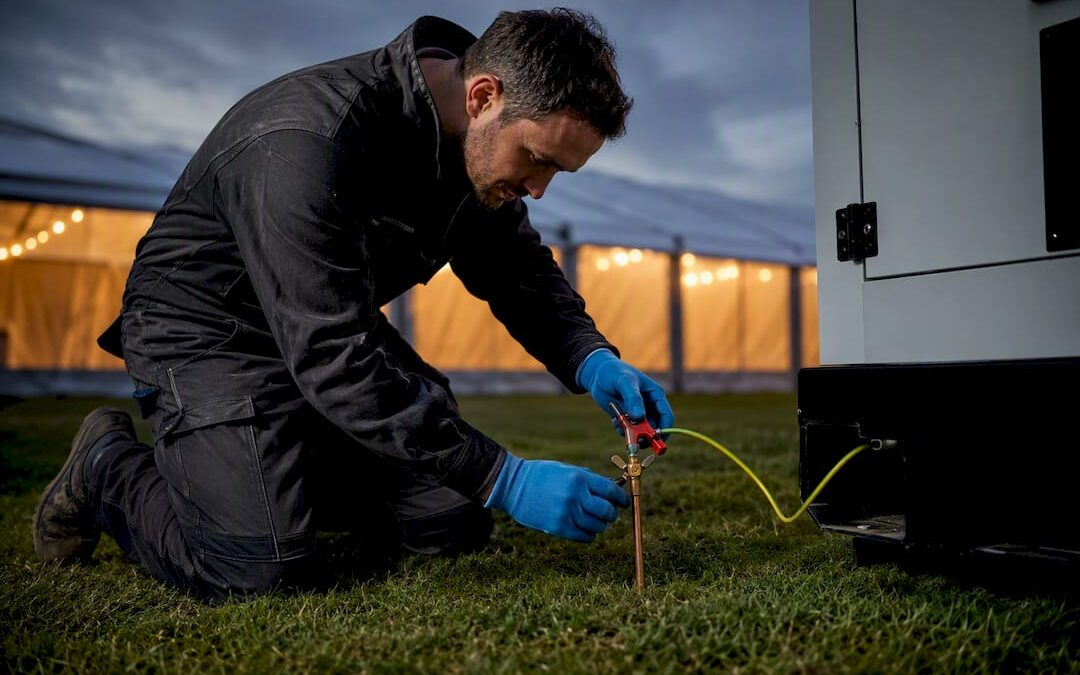
For a temporary marquee in the UK, the safest arrangement is TN-S from a generator with a properly earthed star point, or a correctly designed TT system using driven earth electrodes. Never rely on a PME supply for a temporary outdoor structure. Whichever you choose, appoint a competent person, fit residual current device (RCD) protection on every socket outlet suitable for personal protection, bond all accessible metalwork, and test the earth electrode or earthing arrangement before anyone plugs anything in.
TL;DR:
- Only TN-S or TT earthing systems are suitable for temporary marquees, with the former used when a genuinely earthed source is available, and the latter relying on driven earth electrodes.
- Proper generator earthing requires installing and testing driven copper electrodes, bonding the generator’s star point, and recording earth resistance measurements before energising any equipment.
- All accessible metalwork and structural components must be bonded with adequately sized conductors and tested for continuity to ensure safety during faults.
- Every socket outlet should have a 30 mA residual current device, with additional discrimination devices where multiple circuits are fed from a common supply.
- Visual signs of poor earthing, such as clipped earth leads on street furniture or missing test certificates, should lead to immediate supply isolation and professional testing before use.
Table of Contents
- Which earthing systems suit a temporary marquee?
- Earthing the generator: electrodes, star points and what to record
- Bonding the marquee frame, stakes and other metalwork
- RCD protection and the tests that prove it works
- Red flags no organiser should accept
- A practical checklist and a worked example
- What actually matters once you strip away the jargon
- Book a marquee power setup that’s earthed and tested properly
- Standards worth reading directly
- Sources
- FAQ
Which earthing systems suit a temporary marquee?
Four earthing arrangements turn up in temporary power discussions: TN-S, TT, PME (a form of TN-C-S), and IT. Only two of them belong on a marquee site.
TN-S means the supply has a separate earth conductor running back to source, typically the generator’s own earthed star point. It gives a low-impedance, dedicated earth path with no reliance on the ground itself, which is exactly what you want when soil conditions on a showground or a country garden are unpredictable.
TT relies on a local earth electrode, usually a driven copper-clad rod, to create the fault path through the earth itself. It’s the default for most outdoor temporary installations because there’s often no other option when you’re a field away from any permanent earthing infrastructure.
PME (Protective Multiple Earthing) is common in permanent domestic and commercial installations, where the neutral and earth are combined and shared across a network of properties. It has no place on a temporary marquee supply. If a broken neutral occurs anywhere upstream on a PME network, exposed metalwork on your site can become live, and there’s no way to isolate that risk in a field. Guidance from BS 7909 and BS 7671 is consistent on this: temporary outdoor structures should not depend on PME.
IT systems, where no part of the supply is directly earthed, appear occasionally in specialist scenarios, usually where an isolation transformer feeds sensitive equipment or where continuity of supply matters more than automatic disconnection on first fault. They demand insulation monitoring devices and careful documentation, and they’re rarely the right call for a straightforward wedding or corporate marquee.
For most events, the decision comes down to this:
- Mains-derived supply with a genuinely earthed source and no PME involvement: TN-S is achievable and preferable.
- Generator-only supply in a field: TT via driven electrodes, backed by RCD protection, is the standard approach.
- Sensitive AV or broadcast loads needing supply continuity: an IT arrangement with insulation monitoring, specified by a competent engineer.
Industry guidance from Elec-Mate on BS 7909 temporary installations reinforces this hierarchy, and it’s the same logic that shapes how large marquee power gets specified in practice.
Earthing the generator: electrodes, star points and what to record
Get the generator earthing wrong and everything downstream, however well bonded, is built on a false foundation. The job is to connect the generator’s neutral or star point to a genuine earth electrode, not just to bolt the neutral onto the generator frame and call it done.
1. Drive the electrode first. Copper-clad steel rods, each roughly over a meter in length, get driven into the ground at or near the generator. In dry, sandy, or chalky soil you’ll usually need more than one, bonded together, to bring resistance down to something an RCD can work with.
2. Connect the star point. The generator’s neutral or star point bonds to the electrode system, creating the return path for fault current. This is the step that actually makes it a TT arrangement rather than an unearthed generator with a hopeful cable running to a spike.
3. Measure before you trust it. An earth electrode resistance test tells you whether the path you’ve built will actually clear a fault fast enough. There’s no universal number that suits every site because soil resistivity swings wildly between chalk downland and waterlogged clay, but a competent electrician will know what figure the RCD protection on that circuit needs to see.
4. Record it. Note the electrode resistance, the number and location of electrodes, and the RCD types in use on the single-line diagram and test certificate. If someone questions the setup mid-event, that paperwork is what proves the installation was designed, not improvised.
Pro Tip: If you’re relying on RCD protection to compensate for a higher electrode resistance, confirm the RCD’s rated residual current actually matches what the calculation needs. A 30 mA device protects people; it doesn’t automatically forgive a badly executed electrode system.
Professional guidance on UK earthing systems and their applications is blunt about this: connecting neutral to the frame without a driven electrode isn’t a TT system at all, it’s a false sense of security.
Bonding the marquee frame, stakes and other metalwork
Every piece of metal a guest, caterer, or performer might touch needs to sit at the same electrical potential as everything else. That’s the entire purpose of supplementary equipotential bonding: it stops a fault on one piece of metalwork turning into a lethal touch voltage on another.
What typically needs bonding on a marquee site:
- Aluminium or steel frame uprights and roof structure.
- Staging and any metal decking or flooring interfaces.
- Metal bars, cooking equipment, and catering trailers connected to the supply.
- Any exposed metallic service pipework running near the structure.
- Lighting and rigging towers positioned within reach of the public.
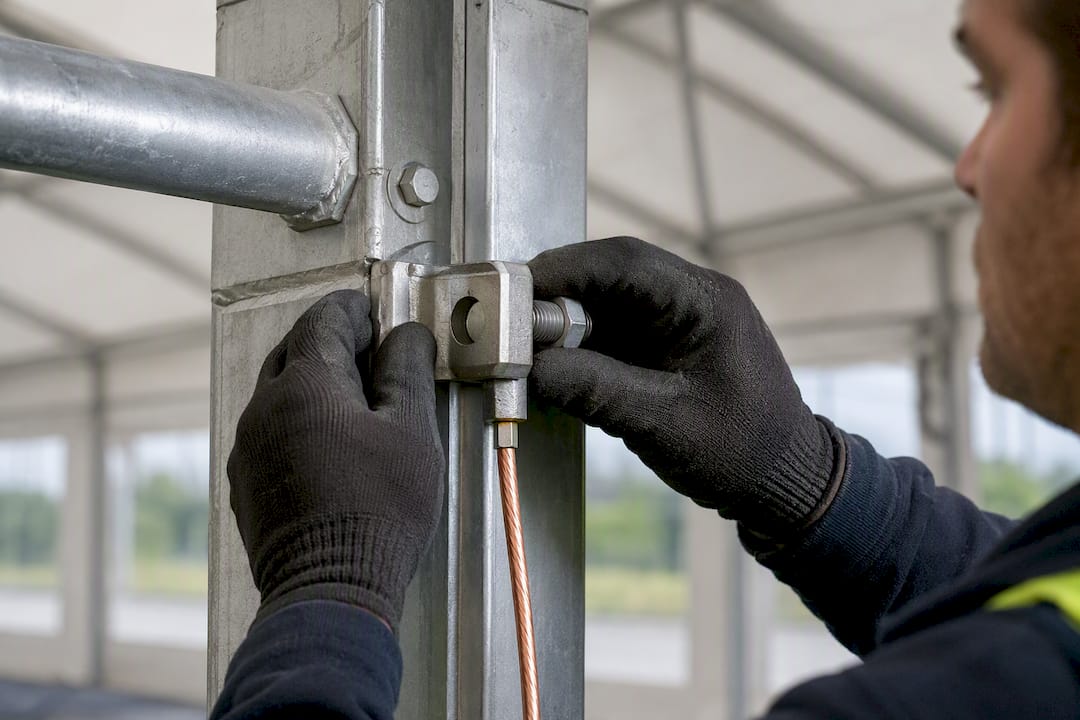
For conductor sizing, guidance referenced in the IET’s exhibitions, shows and stands note points to a practical minimum of 4 mm² copper for supplementary bonding conductors where continuity across the structure can’t be guaranteed by the frame’s own construction. Marquee frames are usually bolted or clamped sections rather than welded continuous steel, so don’t assume one bonding point at the mains intake covers the whole tent.
Plan for multiple bond points, one at each major structural junction, and use substantial clamps rather than a wrap of wire and a hope. Before energising, do a simple continuity check between bonded points with a low-resistance ohmmeter. It takes minutes and it’s the difference between a bonding scheme that exists on paper and one that actually works when a fault occurs.
RCD protection and the tests that prove it works
Bonding and earthing only do their job if the protective devices behind them are correctly specified, and if someone has actually tested the installation before it goes live.
1. Fit 30 mA RCDs on every socket outlet up to 32 A. This is the baseline for personal protection on temporary supplies and it isn’t negotiable, whatever the source of supply.
2. Use S-type (time-delayed) RCDs upstream where discrimination matters. On a distribution board feeding several final circuits, you want the local 30 mA device to trip first, not the main incomer, or one faulty extension lead takes down the whole marquee.
3. Consider 300 mA RCDs at the main incomer for fire and equipment protection on larger installations, working alongside the 30 mA devices further down the chain rather than instead of them.
TT systems in particular depend on correct RCD selection, because the earth electrode’s resistance is almost always too high to clear a fault through overcurrent protection alone. The HSE’s guidance on electrical safety at events lists earthing arrangements, generator use, and pre-energisation testing as core checks organisers should expect to see evidenced, not just assumed.
Before any supply is switched on, a competent person should complete and record:
- Continuity of protective conductors and bonding.
- Earth electrode resistance measurement where electrodes are in use.
- RCD operate (trip) tests at rated residual current.
- Insulation resistance testing on final circuits.
- Functional checks on distribution equipment and interlocks.
Every one of these belongs on a test certificate before the first guest arrives, a process covered in more detail in this guide to event electrical equipment inspection.
Red flags no organiser should accept
Some signs of poor earthing are visible without a meter in your hand, and they should stop an event dead until an electrician resolves them.
- An earth lead clipped to a lamppost, railing, or other street furniture instead of a genuine electrode.
- A spike simply resting under a generator wheel, untested and unconnected to anything.
- Sockets on a distribution board with no visible RCD protection.
- Bonding conductors that look undersized, loose, or missing at obvious junctions.
- No test certificate or single-line diagram available on request.
If you see any of these, isolate the supply, don’t energise it, and get a competent electrician on site to test and certify before power goes anywhere near the public. A visual inspection alone can’t confirm electrode resistance or RCD function. Ask for the test figures, not just a nod that “it’s earthed.” Guidance in BS 7909 specifically calls out ad-hoc earthing to street furniture as the kind of practice that undermines an otherwise well-designed system, and a planner’s guide to common venue electrical failures covers how these shortcuts tend to surface once a fault occurs.
A practical checklist and a worked example
Here’s how the whole process runs in sequence on a real job:
- Site survey — soil type, access for electrode driving, cable runs, and load requirements.
- Single-line diagram — earthing arrangement, distribution layout, and protective device schedule agreed before delivery.
- Electrode deployment — rods driven, bonded together, resistance measured and recorded.
- Bonding — every upright, staging junction, and metallic service point connected and continuity checked.
- Testing and certification — RCD trip tests, insulation resistance, and electrode resistance all logged.
- Handover paperwork — certificates and diagrams given to the organiser before the first switch-on.
A typical medium marquee running a 125 A three-phase distribution from a generator might use two driven electrodes bonded together at the generator, with supplementary bonding run to each frame upright and staging junction. That’s broadly how experienced electrical contractors approach on-site earthing across events, built on decades of electrical contracting experience rather than a generic hire-and-hope model.
What actually matters once you strip away the jargon
Most marquee earthing failures aren’t caused by ignorance of BS 7671. They’re caused by shortcuts taken under time pressure: a spike shoved into damp grass five minutes before doors open, or a neutral bonded to a frame without an electrode anywhere near it. The standards themselves are clear enough. The gap is between knowing the theory and actually driving the electrode, measuring it, and writing the number down.
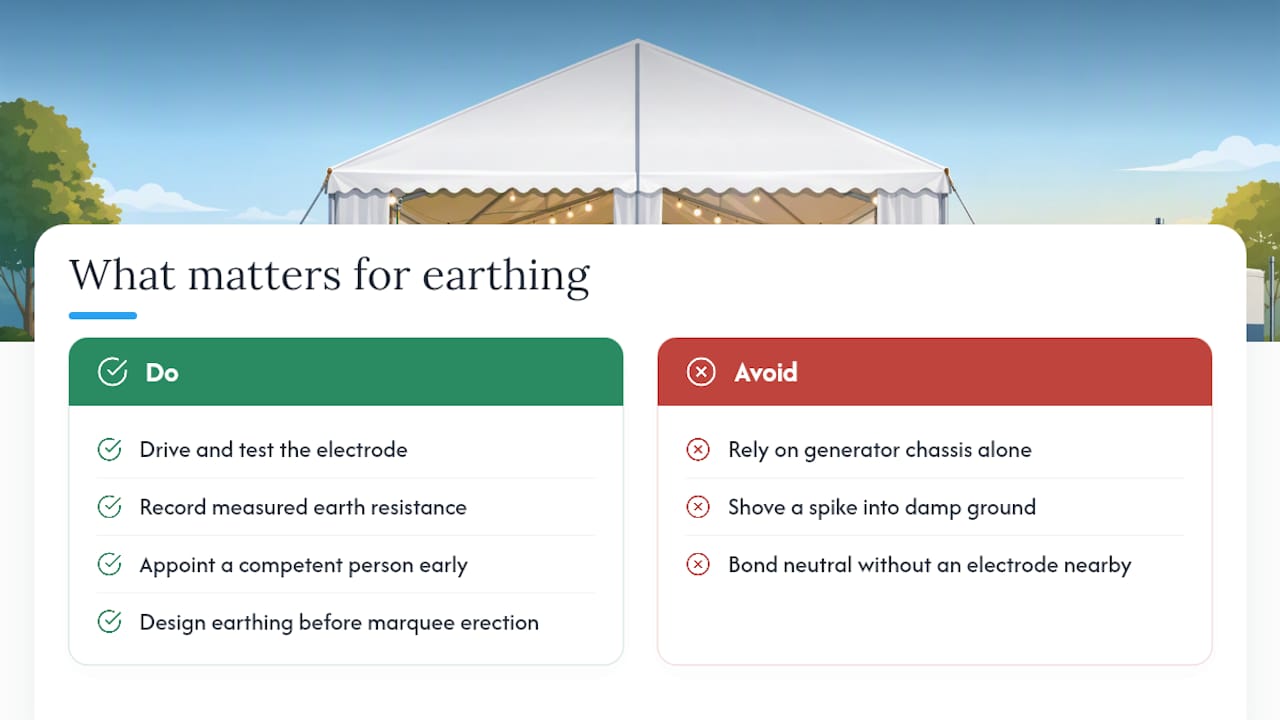
If there’s one piece of conventional advice worth challenging, it’s the idea that “the generator’s earthed anyway” is good enough. A generator frame connected to nothing but its own chassis isn’t an earthing system, it’s a rumour of one. Prioritise the electrode and the test result over the paperwork that claims it exists.
The single biggest lever for organisers isn’t technical at all. It’s appointing a competent person early enough that the earthing arrangement gets designed before the marquee goes up, not retrofitted once someone asks where the RCDs are.
— Rob
Book a marquee power setup that’s earthed and tested properly
This practical service offers an alternative to piecing together generator hire, distribution, and testing from separate suppliers for an event: one team designs, bonds, and certifies the earthing arrangement as part of the same job that delivers your power.

A typical booking runs the same sequence covered above: a site survey to assess soil and access, a quote covering the generator and distribution board specification, delivery and installation with electrode deployment and bonding, then testing and certification before you’re handed the paperwork. Additional electrician cover may be available for events where you want someone on site through the day, not just at setup.
If you’re planning a marquee event and want the earthing sorted properly rather than assumed, start with this hotel EV charging guide on how to plan, fund and operate chargers to understand interfacing temporary supplies with venue infrastructure, or look at the generator hire page to explore options for your load.
Standards worth reading directly
- BS 7430 — earthing practice referenced in IET guidance on stands and exhibitions.
- HSE electrical safety at events — organiser-facing checks including earthing and generator use.
- IET Guide to Temporary Electrical Systems, 2nd edition — updated guidance on generator earthing and modern loads.
Sources
- HSE — Electrical safety at events
- BS 7909 – Temporary electrical systems in the entertainment industry (guidance)
- Temporary installations BS 7909 | Elec-Mate
- Guide to Temporary Electrical Systems, 2nd edition (IET/Wiring Matters)
FAQ
Is earth bonding a legal requirement for a marquee?
Bonding accessible metalwork isn’t a standalone law in itself, but it’s required to meet the safety duties under health and safety legislation and to comply with BS 7671, which any competent electrician working on your event will follow as standard practice.
What is the most common earthing system used in the UK?
PME (a form of TN-C-S) is the most common arrangement for permanent domestic and commercial supplies, but it isn’t suitable for temporary outdoor marquees. TT, using driven earth electrodes, is the usual choice for generator-fed temporary events.
How do I know if a marquee supply is properly earthed?
Ask to see the earth electrode resistance test result, the RCD trip test figures, and the single-line diagram. A visual check that a cable runs to a spike in the ground tells you nothing about whether that electrode actually works.
Can I use a domestic PME supply for a marquee?
It’s best avoided. If a broken neutral occurs anywhere on the PME network, exposed metalwork on your site could become live with no reliable way to detect or isolate it, which is why BS 7909 guidance steers organisers towards TN-S or TT arrangements instead.