
Expect to pay somewhere between £400 and £1,000 for a consumer unit upgrade in the UK in 2026, with most homeowners settling around £485 to £600 for a straightforward job. The work is notifiable under Part P of the Building Regulations, meaning your electrician must self-certify through a competent person scheme or notify local authority building control, and you’re entitled to an Electrical Installation Certificate once it’s done. The single biggest swing factor is unit type and circuit count.
TL;DR:
- The cost of a consumer unit upgrade in the UK in 2026 ranges from £400 to over £1,000, depending on property size, wiring condition, and unit type.
- Fully RCBO units protect each circuit individually but cost more in parts, while dual RCD units are cheaper but offer less precise fault isolation.
- The price usually includes the consumer unit, labor, testing, certification, and notification fees, but regional and job-specific factors can significantly affect the final quote.
- Upgrades require compliance with Part P regulations and should be documented with an Electrical Installation Certificate issued by a registered electrician.
- Signs indicating the need for replacement include frequent nuisance trips, scorching, discolouration, or a lack of modern RCD protection, especially in properties built before the 1970s.
Table of Contents
- Average consumer unit upgrade cost UK: what’s included in the price
- What affects the cost: main drivers to expect in quotes
- Types of consumer units and expected hardware prices
- Cost by property size: example scenarios for common UK homes
- Legal requirements and certification: Part P, EIC and competent persons
- How long the job takes and what disruption to expect
- When to replace a consumer unit and what safety signs to watch for
- Practical contractor advice and red flags from Rob at Jaks Party Power
- Why certified, quality installation pays off
- Get a survey and quote from Jaks Party Power
- Sources
- FAQ
Average consumer unit upgrade cost UK: what’s included in the price
A £485 quote and a £950 quote for the same job title can both be legitimate. The difference usually comes down to what’s bundled in and how much the electrician had to fight your existing wiring to get there.
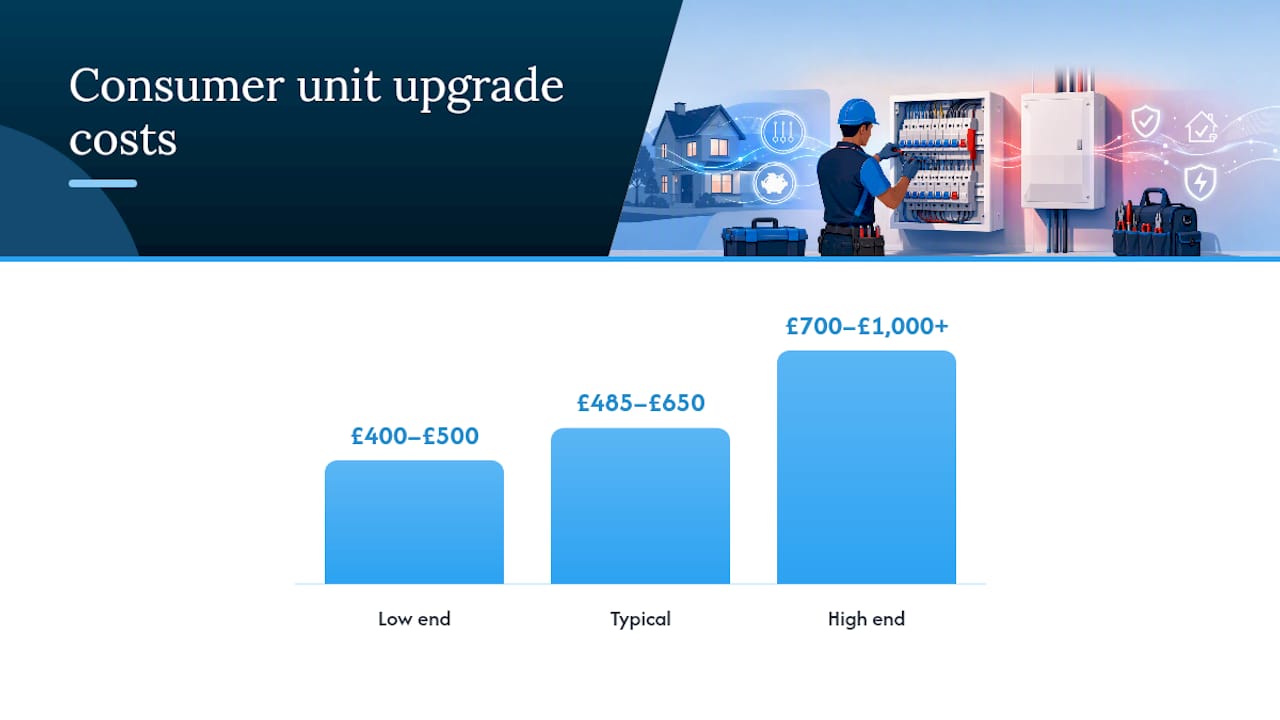
For a typical UK home in 2026, the realistic bands look like this:
- Low end (£400–£500): small flat or terraced house, straightforward swap, existing circuits in good condition, no remedial work.
- Typical (£485–£650): a populated 10 way RCBO consumer unit fitted in a 3 to 4 bed house, which several UK cost guides converge on as the practical benchmark, with Checkatrade’s 2026 figures putting the typical all in cost around £485.
- High end (£700–£1,000+): larger homes, older wiring needing earthing upgrades, or jobs where the meter tails also need replacing, a range consistent with the £400 to £1,000 UK price band Total Skills report for 2026.
A genuine “all in” quote should include: the consumer unit itself, labour, testing, the Electrical Installation Certificate, and Part P notification fees where the electrician isn’t self-certifying through a scheme.
Regional pricing varies. London and the M25 belt often command prices notably higher than national averages, largely due to labour rates rather than parts. If you’re in the South East and a quote lands near the low end of the national range, ask what’s been left out before you assume you’ve found a bargain.
Pro Tip: Ask for the quote broken into unit cost, labour hours, and testing/certification separately. If an electrician can’t or won’t split it out, that’s usually a sign the price was guessed rather than calculated.
What affects the cost: main drivers to expect in quotes
Two consumer units with the same number of ways can price hundreds of pounds apart. The reason almost always traces back to one of four things.
Unit type is the first lever. A dual RCD (split load) board splits circuits across two RCDs, so a fault on one doesn’t kill your entire lighting or socket circuits at once. A fully RCBO populated unit gives every circuit its own dedicated breaker and RCD protection, which means one faulty appliance trips only that circuit rather than half the house. RCBO units cost more in parts but save an electrician labour time on fault finding later, and most installers now recommend them as standard.
Circuit count is the second. More circuits means more RCBOs or MCBs to buy and wire in, so a 17 way unit for a large detached house will always cost more than a compact 8 way board for a flat.
Wiring condition, earthing, and meter tails are where quotes go off script. Many homeowners underestimate this: earthing and bonding improvements plus meter tail replacement are among the most common reasons a final invoice lands well above the headline unit price quoted at survey stage.
The core labour components you’re paying for break down roughly as:
- Initial survey and existing installation assessment.
- Fitting hours, which scale with circuit count and access difficulty.
- Testing and certification (continuity, insulation resistance, RCD trip timing).
- Disposal of the old unit and any redundant cabling.
Ask every installer for an itemised parts list alongside labour hours. It’s the fastest way to compare quotes that look wildly different on the surface.
Types of consumer units and expected hardware prices
Two main configurations dominate UK domestic installations, and the choice between them affects both safety and price.
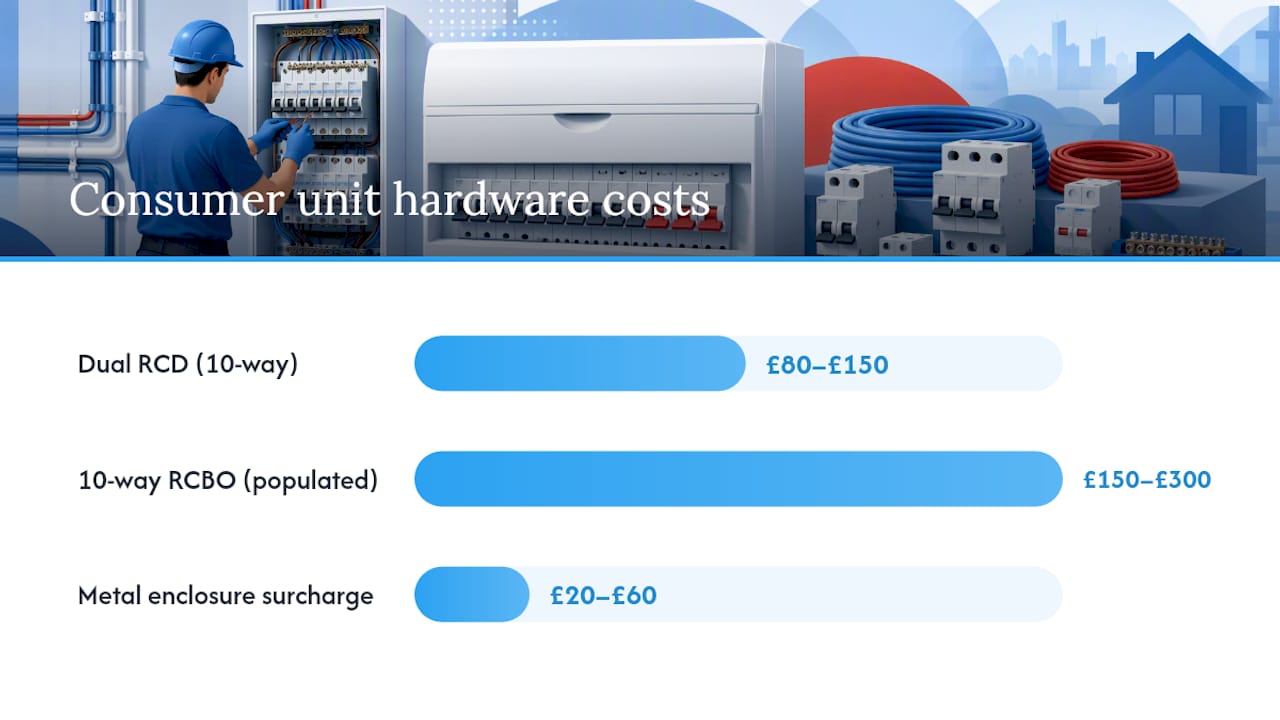
Dual RCD (split load) units divide circuits between two RCDs, typically lighting and sockets on separate sides. If one RCD trips, only half the house loses power rather than all of it. These units are cheaper to buy, often £80 to £150 for a populated 10 way board, but they offer less precise fault isolation than full RCBO protection.
Fully RCBO populated units give every single circuit its own combined breaker and RCD. A fault on the kitchen socket circuit trips only that circuit, leaving lighting, the shower, and everything else running normally. Parts alone for a populated 10 way RCBO unit typically run £150 to £300, which is why the all in installed price sits in the mid £400 to £600 bracket once labour and testing are added.
Enclosure material matters more than most homeowners realise. A plastic consumer unit in good condition doesn’t need replacing purely for being plastic, but any new work or modification to an existing installation can trigger a requirement for a non-combustible metal enclosure under current guidance. If your electrician is already swapping the board, fitting metal from the outset avoids a second job later.
Typical hardware price bands for 2026:
- 8 to 10 way dual RCD unit: £80–£180 (parts only).
- 10 to 12 way full RCBO unit: £150–£320 (parts only).
- Metal enclosure surcharge: £20–£60 over an equivalent plastic unit.
Cost by property size: example scenarios for common UK homes
Matching your home to one of these scenarios gives you a realistic starting point before you even call an electrician.
- Small flat or 1 to 2 bed property. Expect around six to eight circuits covering lighting, sockets, and perhaps a cooker or immersion heater. This sits at the lower end of the national range, typically £400 to £480 all in, since there’s less wiring to test and fewer breakers to buy.
- Typical 3 to 4 bed house. This is where the mid range £485 to £650 figure applies most often, usually built around a populated 10 way RCBO unit covering kitchen, sockets, lighting circuits, shower, and outbuilding supply if fitted.
- Large detached or high demand home. Homes with an Aga, hot tub, workshop, or annexe often need 15 to 17 ways, pushing costs to £700 upwards, especially where the existing earthing needs upgrading to match the extra load.
- Adding an EV charger, power shower, or extension. Any of these typically adds one or two circuits to whichever scenario above applies, and if your existing board has no spare ways, that alone can justify the whole upgrade rather than a partial fix.
Legal requirements and certification: Part P, EIC and competent persons
Replacing a consumer unit is notifiable work under Part P of the Building Regulations in England and Wales. Your electrician has two legitimate routes: self-certify the job through membership of a competent person scheme such as NICEIC, or notify your local authority building control directly before work starts.
Once the job is finished, you should receive an Electrical Installation Certificate (EIC), not a Minor Works Certificate. A full consumer unit change is new circuit protection work, and an installer offering only a Minor Works certificate for this job is a red flag worth questioning before you pay a final invoice.
Electrical Safety First advises using a registered electrician who works to BS 7671, the wiring regulations that govern how the installation must be designed, tested, and documented. The IET publishes the official BS 7671 model forms, including the EIC template, so ask your installer if they’re using these standard documents rather than something improvised.
Keep every piece of paperwork indefinitely. Buyers’ solicitors, mortgage surveyors, and home insurers increasingly ask for evidence of certified electrical work, and a missing EIC can hold up a house sale years after the job was done.
How long the job takes and what disruption to expect
A straightforward consumer unit swap on a well maintained installation typically takes four to six hours, often completed in a single day with the power off for most of that window. Add remedial wiring, meter tail replacement, or a board relocation and the job can stretch to a full day and a half or require a second visit.
Before the electrician packs up, expect them to run:
- Continuity testing on protective conductors.
- Insulation resistance testing across all circuits.
- RCD trip time verification for every RCD and RCBO fitted.
- A final visual inspection and commissioning check against BS 7671.
What you should do beforehand: clear access to the unit itself, photograph existing circuit labelling before it’s removed, and agree with the electrician whether you’ll need any temporary power arrangement, particularly if you work from home or have medical equipment relying on mains power.
When to replace a consumer unit and what safety signs to watch for
Some signs mean you should book a replacement rather than wait for it to fail on its own:
- Nuisance trips that happen repeatedly with no obvious cause.
- Scorch marks, discolouration, or a burning smell near the unit.
- Rewirable fuses with fuse wire rather than modern circuit breakers.
- Any exposed live parts or a unit with no RCD protection at all.
Modern RCDs and RCBOs cut off power within milliseconds of detecting a fault, which is the main reason older boards without them are considered a genuine shock risk rather than just outdated. If your wiring is original to a pre-1970s property, replacing the consumer unit alone sometimes exposes faults that force wider remedial work before the new board can be safely energised.
Pro Tip: If you’re a landlord, don’t treat this as optional once flagged. Government guidance requires remedial work identified in an inspection report to be completed within set timeframes, commonly 28 days, and councils can enforce and recover costs where landlords don’t act.
Practical contractor advice and red flags from Rob at Jaks Party Power
The pattern often seen is a homeowner comparing two quotes without realising they’re comparing two different jobs. The cheaper one frequently excludes meter tail replacement, bonding upgrades, or access to boxed-in trunking, all of which surface later as “extras.”
Ask any installer three things before they start: which certificate they’ll issue (it should be an EIC, not a Minor Works certificate), who’s submitting the Part P notification and through which scheme, and whether they can show you evidence of BS 7671 compliance for a recent similar job. A contractor who answers these without hesitation is usually one worth hiring. One who gets vague about paperwork is the biggest red flag in this entire process.
Why certified, quality installation pays off
Cutting corners on a consumer unit upgrade rarely saves money once you account for what happens later. A properly certified job with a full EIC protects you at resale, when solicitors ask for evidence, and with insurers, who can query claims linked to uncertified electrical work. I’d always steer a homeowner toward the installer who takes testing and paperwork seriously over the one who’s simply cheapest, because the certificate is worth as much as the hardware itself.
— Rob
Get a survey and quote from Jaks Party Power
If you’re weighing up a domestic consumer unit upgrade in Sussex, a contractor with extensive electrical contracting experience can provide residential services backed by proper EIC issuance and Part P handling rather than a rushed swap and a handshake. That combination of contracting depth and paperwork discipline is exactly what separates a compliant upgrade from one that causes problems at your next house sale.

Whether you need a straightforward consumer unit replacement, additional circuits for an EV charger or extension, or a wider rewire assessment, request a survey through Jaks Party Power and get a proper quote based on your actual wiring, not a guess over the phone. If your project also touches distribution boards or event style power setups, the rewiring house cost UK guide is worth a read before you book.
Sources
- Consumer units and fuse boxes | Installation and replacement | NICEIC
- Part P guidance | Electrical Safety First
- Consumer Unit Replacement Cost UK: £400–£1000 (2026) | Total Skills
- Gov
- Model forms – Electrical Installation Certificate and Minor Works (IET)
FAQ
How much does it cost to have a new consumer unit fitted in the UK?
Most 2026 UK quotes fall between £400 and £1,000, with a populated 10 way RCBO unit typically landing around £485 to £600 all in for labour, testing, and certification.
Is it worth upgrading a consumer unit?
Yes, particularly if your current board lacks RCD or RCBO protection, since modern units cut power within milliseconds of a fault and the certified paperwork adds value at resale and for insurance purposes.
How much does it cost to upgrade a fuse box?
A fuse box upgrade to a modern consumer unit follows the same £400 to £1,000 price band, with the final figure depending on unit type, circuit count, and whether earthing or meter tails need attention.
Can you put in a new consumer unit with old wiring?
Sometimes, but a competent electrician should survey the existing circuits first, since defective or non-compliant wiring often needs remedying before reconnection rather than simply connecting old cables to a new board.