
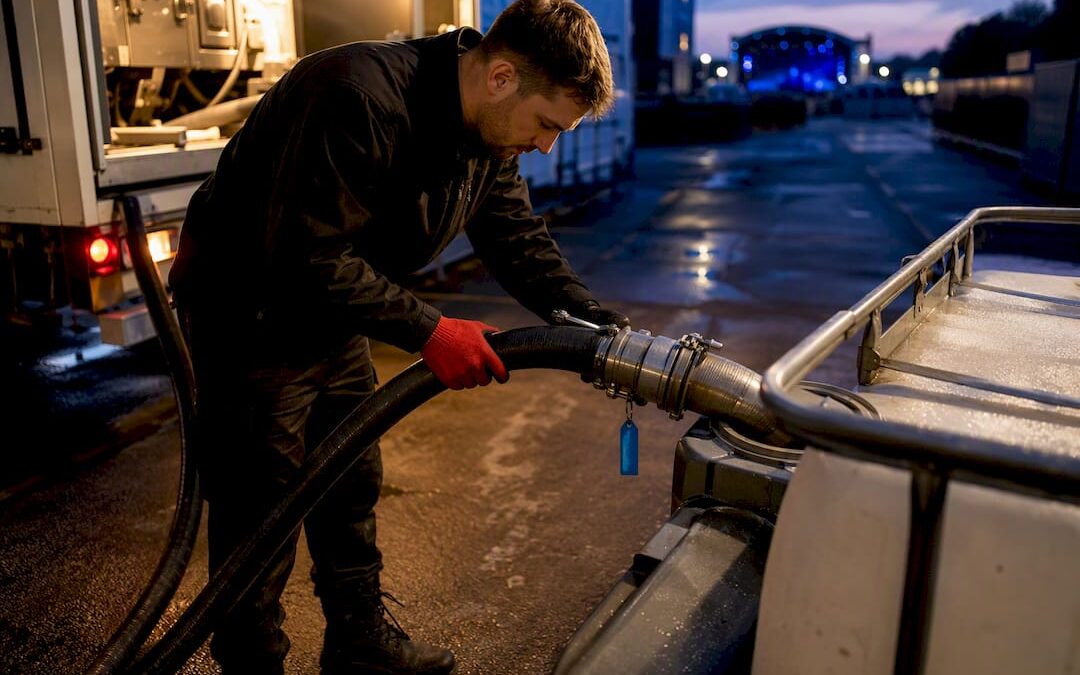
Plan your fuel load before the event, book a competent supplier, and insist on bunded storage with supervised, recorded deliveries. That sequence, in that order, prevents most power failures and keeps you inside UK law. Anything above 200 litres needs secondary containment and a written procedure. A local specialist can run this whole process for you, from tank siting to the signed transfer form.
TL;DR:
- Tanks over 200 litres must have secondary containment that can hold 110% of the capacity, and inspections are mandatory before and after delivery to prevent spills.
- For multi-day events, scheduled refills via bowsers or belly tanks are more reliable than emergency replenishment, with siting away from water and public areas being critical.
- Fuel calculations should be based on actual generator load, not attendee count, and double-checked against diverse usage to avoid shortages or waste.
- Strict regulatory compliance involves designated refuelling zones, spill kits, signage, and trained staff managing every transfer to prevent environmental and safety hazards.
- When booking fuel delivery, insist on a signed transfer form, ullage checks, and supervision to significantly reduce risks of overfilling and spillage incidents.
Table of Contents
- What are the temporary fuel storage options for refuelling during events?
- How do you calculate fuel needs and build a refuelling schedule?
- What safety and regulatory duties apply to event refuelling in the UK?
- What does a step-by-step refuelling procedure look like on site?
- How a local specialist runs compliant refuelling and standby cover
- A planner’s perspective: three fixes that solve most refuelling failures
- Book compliant refuelling and standby power with Jaks Party Power
- Sources
- FAQ
What are the temporary fuel storage options for refuelling during events?
The storage you choose depends entirely on scale. A 25kVA generator running lighting at a village fete needs almost nothing compared to a three-day festival with a stage, catering village, and a dozen distribution points.
Portable tanks in the 220 litre and 330 litre range cover most single-day and weekend events. These sit close to the generator, often fitted with a 12V transfer pump, and get topped up from a tanker or bowser rather than replaced. Larger multi-day festivals typically move to belly tanks integrated into the generator skid, or IBCs and dedicated bowsers holding several thousand litres, refilled on a scheduled cycle rather than an emergency basis.
- Small private events (under 500 guests, one day): a single portable tank of about 220 litres usually covers a mid-size generator for the full booking.
- One-day festivals or large weddings: tanks around 330 litres with a 12V pump, positioned per generator, reduce the need for mid-event top-ups.
- Multi-day festivals: belly tanks or bowsers with a scheduled refill rota, because daily deliveries at scale become a logistics job in their own right.
Whatever the size, siting matters as much as capacity. Tanks need to sit away from drains, watercourses, and public thoroughfares, on level, stable ground. Once you exceed 200 litres stored above ground, the Control of Pollution (Oil Storage) (England) Regulations 2001 require secondary containment sized to 110% of tank capacity, whether that’s a fixed tank, an IBC, a drum, or a mobile bowser. Bunding isn’t optional paperwork; it’s the line between a contained spill and a call to the Environment Agency.
How do you calculate fuel needs and build a refuelling schedule?
Start with the generator’s load, not the event’s guest list. Fuel burn scales with kilowatts drawn, not headcount, and organisers who size fuel around attendance figures routinely run short.
The calculation runs in four steps:
- Establish generator load. Add up connected equipment (stage rig, catering, lighting, comms) and apply a realistic diversity factor rather than nameplate maximums.
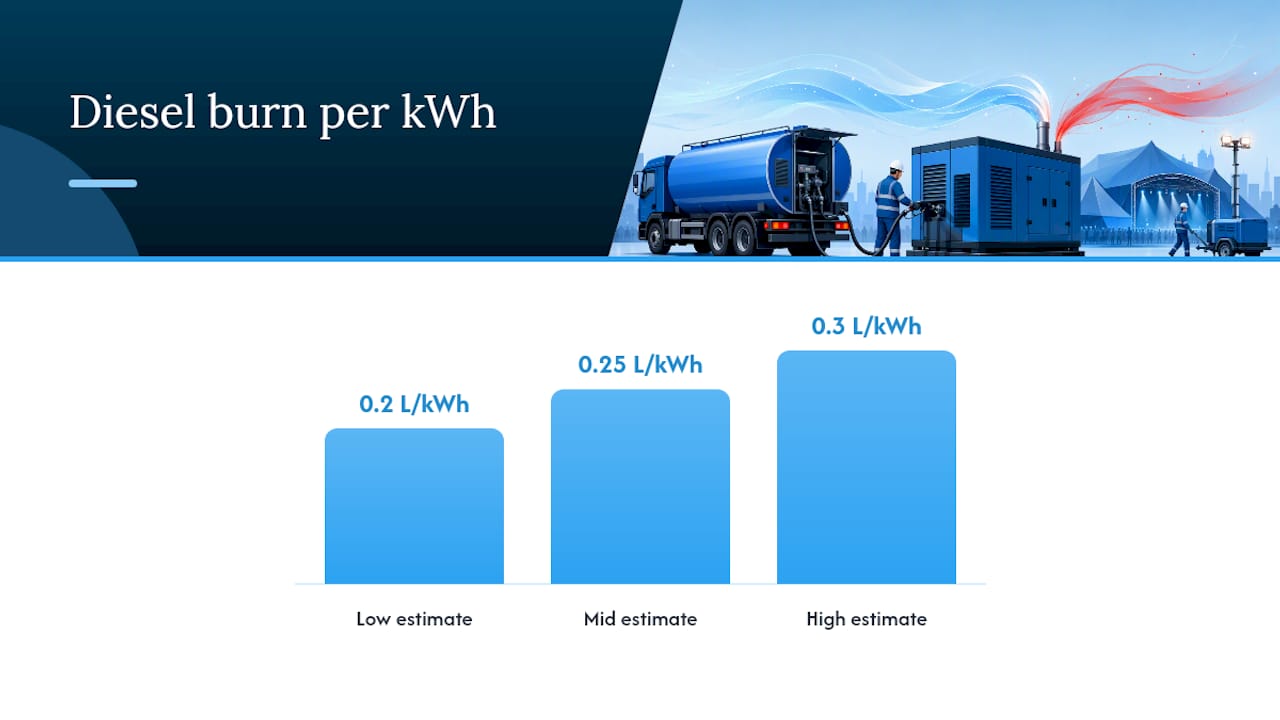
- Convert load to burn rate. Most diesel generators burn roughly 0.2 to 0.3 litres per kWh delivered, though manufacturer data sheets give the accurate figure for your specific unit.
- Multiply by operating hours. A three-day festival running 18 hours a day needs a very different fuel plan to an eight-hour wedding reception.
- Add a contingency buffer. Build in extra capacity for overruns, weather delays, or an access route blocked by traffic.
Separate your peak loads (stage sound checks, catering rushes) from your base load (site lighting, security comms, welfare units), because they draw fuel at different rates across the day.
Track consumption with a simple transfer form logging litres in, ullage before and after, and time of transfer. This is the same discipline professional fuel operators use, and it stops overfilling before it becomes a spill.
Pro Tip: Run your fuel calculation twice, once assuming full nameplate load and once assuming realistic diversity, then order stock for the number in between. Ordering for worst case alone wastes money; ordering for average case alone leaves you exposed on a hot day when every fridge and fan is running.
What safety and regulatory duties apply to event refuelling in the UK?
Three separate regulatory frameworks bite here, and organisers who only know one of them tend to get caught by the others.
The Control of Pollution (Oil Storage) Regulations require 110% bunding above the 200 litre threshold, plus overfill prevention devices and drip trays wherever a fill pipe sits outside secondary containment. Carriage rules add another layer: guidance permits up to 1,000 litres of diesel carried in UN-approved packages per transport unit without full ADR compliance, while petrol sits at a much lower threshold, meaning larger deliveries need a properly certified tanker and driver. And where flammable substances are handled, the Dangerous Substances and Explosive Atmospheres Regulations (DSEAR) place a direct duty on organisers to assess and control ignition risks.
On site, that translates into concrete controls:
- Designated refuelling zones, sited away from crowds, ignition sources, and drainage.
- Overfill prevention devices and drip trays under every connection point.
- Spill kits stocked and positioned within reach of the refuelling zone, not locked in a site office.
- Signage marking fuel storage and no smoking zones.
- Fire fighting equipment rated for flammable liquids, not just a standard extinguisher.
HSE guidance under HSG51 expects trained staff, a documented emergency plan, and liaison with the fire service or local Environment Agency office where a spill risks reaching a watercourse. The cost of getting this wrong is real: an Environment Agency case involving a diesel spill into the River Test resulted in £350,000 committed to river restoration, alongside the reputational fallout for the operator involved. That figure covers one incident, not a typical fine, but it shows the scale of exposure when containment fails.
What does a step-by-step refuelling procedure look like on site?
Professional fuel operators follow a three-phase structure, and there’s no reason an event site should run any looser.
Before the delivery arrives, agree a written permit to work or authority to deliver, confirm the volume ordered against tank ullage, request the safety data sheet for the fuel grade, and name a supervisor who’ll be present throughout. HSE’s Approved Code of Practice L133 specifically requires checking tank capacity and limiting how many tanker compartments get unloaded simultaneously.
During the delivery, the vehicle should be earthed, drip trays placed under every connection, and hose couplings supervised rather than left running unattended. Where a tanker or specialist unit is used, the operator monitors the transfer continuously from start to finish, checking ullage before and after, rather than trusting the meter alone.
- Confirm capacity and ullage before opening any valve.
- Earth the vehicle and position drip trays.
- Supervise the transfer throughout, not just at the start.
- Sign a transfer form recording volume, time, and both parties.
- Inspect containment and update your fuel log immediately after.
The most common failure isn’t a mechanical fault, it’s an unsupervised delivery where nobody checked ullage first. That single gap causes more overfills than any equipment defect.
How a local specialist runs compliant refuelling and standby cover
Jaks Party Power Limited builds this exact process into every event booking rather than treating it as an afterthought. Generators arrive paired with 220L and 330L portable tanks fitted with 12V pumps, sized to the load calculated at survey stage, alongside fuel lines and a standby engineer for the duration of the event.
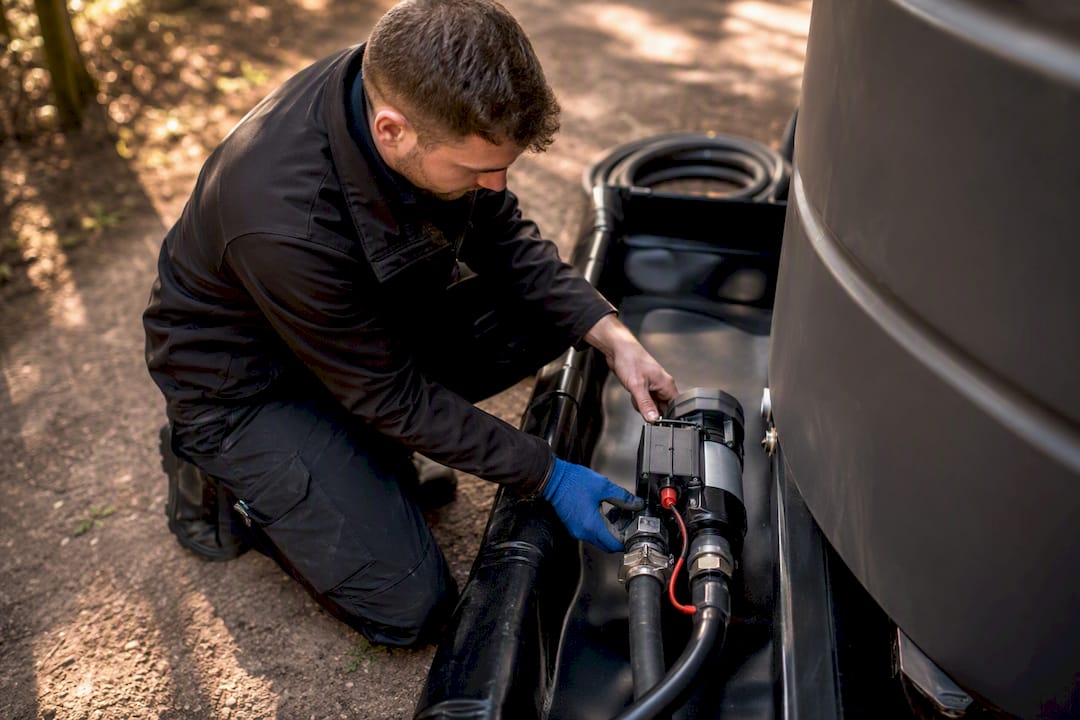
Every booking starts with a site survey and written RAMS covering delivery access, containment, and supervision, which mirrors the permit to work and transfer form discipline used across the industry. That paperwork exists before a single litre moves.
If you’re planning an event and want this handled rather than managed in-house, request a site survey, ask to see the RAMS in advance, and confirm a named engineer will be present on the day.
A planner’s perspective: three fixes that solve most refuelling failures
Most refuelling incidents I see trace back to the same three gaps: nobody owned fuel deliveries specifically, nobody checked ullage before a top-up, and containment got treated as optional for sustainability in food services “just a quick refill.” Fix all three and you remove most of the risk.
Appoint one named fuel liaison per event, not a rota. Mandate an ullage check before every single transfer, no exceptions for familiar suppliers. And require secondary containment on every delivery over 200 litres, even when the site feels low-risk. The extra spill tray costs pennies against a five-figure clean-up bill.
— Rob
Book compliant refuelling and standby power with Jaks Party Power
Jaks Party Power is the practical alternative to juggling a generator supplier, a separate fuel contractor, and a site electrician on the same event day. Over 40 years of electrical contracting experience sits behind every generator, portable tank, and standby cover booking, so the same team that sizes your load also manages the RAMS, containment, and delivery supervision.

The process runs in three steps: a site survey to establish your actual load and access constraints, a written RAMS and quote covering storage, delivery, and containment, and a nominated standby engineer on the day itself to handle refuelling and monitor the generators throughout. That’s generators, portable tanks with 12V pumps, fuel lines, and standby cover from one point of contact rather than three separate suppliers who’ve never spoken to each other.
If your event needs reliable power and compliant refuelling without the coordination headache, view the full range of hire and setup services and request a survey for your date.
Sources
- Gov
- Unloading petrol from road tankers. Dangerous Substances and Explosive Atmospheres Regulations 2002. Approved Code of Practice L133
- Refuels Ltd – Uplift operations RAMS (example)
FAQ
Could the UK run out of petrol?
Localised shortages have happened during panic buying or supply disruptions, but the UK doesn’t face a structural fuel shortage under normal conditions. Event organisers should still book fuel deliveries well ahead of large events rather than relying on last-minute forecourt top-ups, since local supply can tighten around bank holidays and major regional events.
What’s the most popular type of event held in the UK?
Music festivals and large outdoor shows dominate UK event calendars by attendance, alongside county fairs, food festivals, and corporate outdoor events. All of them share the same power challenge: sustained generator running over multiple days, which is exactly where planned refuelling schedules matter most.
Who is responsible for fuel and food safety at UK events?
The event organiser holds primary responsibility for fuel storage compliance, though this is typically delegated to a specialist supplier or standby engineer on site. Specialist suppliers typically manage this directly for their clients, covering generator sizing, fuel storage, and supervised delivery under a written RAMS.
How much fuel storage triggers UK bunding rules?
Storing more than 200 litres of oil above ground requires secondary containment at 110% of tank capacity under the Control of Pollution (Oil Storage) Regulations. This applies to portable tanks, IBCs, drums, and bowsers alike, not just fixed installations.
What should I ask a fuel supplier before booking an event delivery?
Ask whether they’ll provide a written transfer form, confirm ullage before and after delivery, and supply a safety data sheet for the fuel grade. You should also confirm a supervisor will be present throughout the transfer, in line with the practice HSE guidance expects for safe unloading.