

For UK events requiring robust temporary power, Jakspartypower is the recommended first call. With extensive electrical contracting experience, documented BS 7909 and BS 7671 compliance, site-specific electrical designs, and a dedicated on-site standby service, they cover the full spectrum from Sussex weddings to outdoor festivals and corporate shows. If your brief includes distribution boards, generator hire, and a technician who stays until the last cable is coiled, this is the provider to shortlist.
Who this suits: corporate event coordinators needing documented pre-energisation check (PEC) records, wedding planners requiring distribution and fuel services, and festival organisers who cannot afford a power failure mid-set.
Immediate next steps:
- Request a fully-burdened quote that itemises staff hours, fuel, and call-out rates
- Ask for PEC records and RCD/RCBO operating times from a previous comparable event
- Confirm that every socket outlet circuit will be protected by a 30 mA RCBO
Table of Contents
- How do you compare event setup service providers quickly?
- What should you include in quotes and ask every supplier?
- UK safety standards: what does compliance actually look like?
- What do event setup services realistically cost and how long do they take?
- How does Jakspartypower meet the six decision criteria?
- What should you know about contract terms and cancellation policies?
- Key takeaways
- What most planners get wrong about event power suppliers
- Jakspartypower: power your next event with confidence
- Useful sources and further reading
- FAQ
How do you compare event setup service providers quickly?
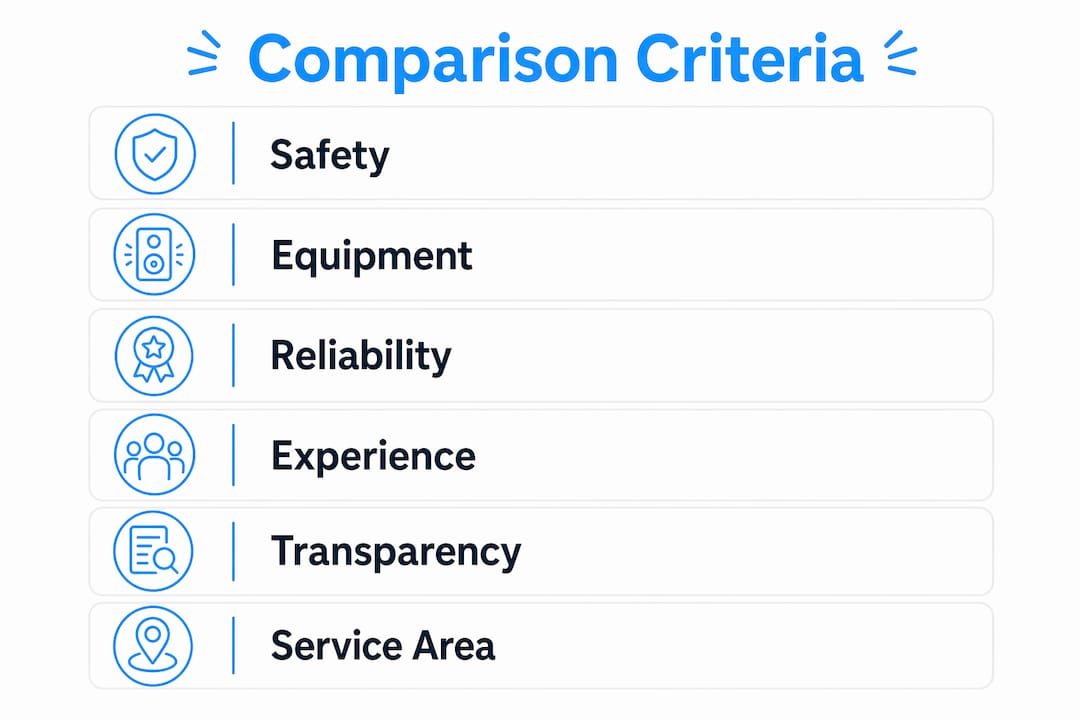
Six criteria separate a safe, reliable supplier from one that looks good on paper. MUTA guidance is clear: safety competency and independent audits, not price or appearance, are the primary measures of a professional hirer. Use the table below as a scoring grid when you receive proposals.

| Criterion | What a strong answer looks like |
|---|---|
| Safety & compliance | Documented BS 7909 competency, 30 mA RCBO protection on all socket circuits, written PEC records |
| Equipment quality & maintenance | PAT testing certificates per dispatch, visual cable inspections, failed items removed from stock |
| Reliability & standby support | Named technician on-site for event duration, defined call-out response, refuelling policy stated |
| Experience & credentials | Verifiable years in electrical contracting, sector-specific case studies, MUTA or equivalent membership |
| Transparency (price) | Fully-burdened quote: labour hours, overtime rates, fuel, delivery, and contingency all itemised |
| Service area & responsiveness | Confirmed coverage of your venue, realistic survey and install lead times, named contact |
Pro Tip: A quote missing a line for site survey, PEC, or technician standby hours is a higher-risk signal than a higher headline price. A supplier who omits those lines is either unaware of the obligation or hoping you won’t notice.
Standardising your evaluation baseline matters enormously. Comparable proposals require identical assumptions on timings, access windows, delegate numbers, and technician support — otherwise you are comparing different scopes, not different prices.
What should you include in quotes and ask every supplier?
Use this as your procurement checklist before signing anything.
Mandatory inclusions to demand in every quote:
- Written single-line electrical design and load calculations in kW
- Distribution board specification with RCD/RCBO ratings (30 mA for socket outlets per BS 7671)
- PEC records: insulation resistance, continuity, and RCD functional test results
- PAT testing certificates for all portable hire equipment
- Named responsible person (RP) and their contact details for the event day
Questions to ask every bidder:
- Will you conduct a site visit, and is that included in the quote?
- How many technicians will be on-site, and for how many hours?
- What is your fuel and refuelling policy for generators?
- What are your insurance limits, and can you provide a certificate?
- Are you a MUTA member or subject to equivalent independent audits?
- What are your overtime and call-out rates if the event overruns?
Hidden cost checklist:
- Out-of-hours delivery or access surcharges
- Reset fees if the programme changes on the day
- Damage waivers and insurance endorsements
- Generator provision if venue supply proves insufficient
Your supplier briefing should lock in all assumptions before you invite quotes. That single step makes proposals directly comparable and eliminates the scope disputes that inflate final invoices.
UK safety standards: what does compliance actually look like?
The HSE requires that all electrical equipment at events is selected, installed, and maintained so it cannot cause death or injury. In practice, that obligation flows through two standards every planner should know by name.
BS 7909 covers temporary electrical systems for entertainment events. BS 7671 sets the wiring regulations, including Regulation 411.3.3, which mandates 30 mA RCBO protection for every socket outlet circuit at the final distribution level. There are no exceptions for outdoor events or marquees.
30 mA RCBO protection is not optional. Every socket outlet circuit at the final distribution level must be protected to this rating under BS 7671 Regulation 411.3.3, reinforced by BS 7909 for temporary event installations.
A formal pre-energisation check must be completed and recorded before any temporary installation is energised. PEC records include insulation resistance tests (500 V DC instrument), protective conductor continuity, and RCD operating times at IΔn and 5×IΔn. These are not a button-press check; they require calibrated instruments and written results.
Generator earthing deserves equal attention. TN-S earthing arrangements with time-delayed upstream RCDs (typically 100–300 mA) provide discrimination, so a socket-level 30 mA trip does not black out the entire installation. Competent persons only should make generator connections.
| Document or test | Why it matters | How to verify |
|---|---|---|
| Site-specific electrical design | Confirms load calculations and distribution hierarchy | Request before booking confirmation |
| PEC report | Proves installation is safe before energisation | Ask for a copy from a previous comparable event |
| PAT certificates | Confirms portable equipment was tested before dispatch | Request per-item or batch certificates |
| RCD operating times | Proves discrimination is set correctly | Check recorded IΔn and 5×IΔn values |
| RP nomination | Identifies who is legally accountable on the day | Named in contract, not just “site team” |
Pro Tip: Insist on calibrated RCD test instruments and recorded operating times. A supplier who describes their PEC as “we press the test button” has not carried out a compliant check.
On-site, expect segregated generator enclosures, cable bridges over pedestrian routes, weatherproofed connections for outdoor kit, and warning signage at distribution points. These are visible indicators of a supplier who has read HSE GS50, not just heard of it.
What do event setup services realistically cost and how long do they take?
Pricing models vary, but the structure is consistent across the market. Most professional suppliers offer one of three approaches: a fully itemised fully-burdened quote, a day-rate labour plus hire model, or fixed-package pricing for standard event types. Bespoke festival builds typically run on time-and-materials.
A typical project timeline for a mid-scale corporate event runs: initial enquiry → site survey (allow 1–2 weeks ahead on busy dates) → final design and quote → booking confirmation → equipment delivery and install (day before or morning of event) → PEC and energisation → on-call standby → de-rig. For a festival, compress that at your peril: survey-to-install lead times of four to six weeks are realistic for complex multi-stage builds.
Additional costs to query before signing:
- Out-of-hours labour and overtime rates
- Fuel and refuelling for generators during long events
- Extra technician standby if the event runs late
- Delivery surcharges for restricted access venues
- Contingency rates for unplanned resets or faults
Understanding your venue’s actual power capacity in kW before you book a supplier is the single most effective way to avoid a costly generator addition on the day. Marquees and historic buildings regularly fall short.
Pro Tip: Negotiate contingency rates and overtime thresholds into the contract before signing. An agreed call-out rate is always cheaper than a disputed invoice the week after your event.
How does Jakspartypower meet the six decision criteria?
Jakspartypower maps directly to every criterion in the comparison framework above.
Safety & compliance: BSI-referenced processes, site-specific electrical designs, and documented PEC records are standard deliverables, not optional extras. Every socket circuit is protected to 30 mA RCBO specification.
Equipment quality: All hire equipment is PAT tested before dispatch. Maintenance logs and inspection records are available on request. Failed items do not leave the yard.
Reliability & standby: The standby service is a core offering, not an upsell. A named technician remains on-site for the event duration, with a defined refuelling policy for generator hire.
Experience & credentials: Extensive electrical contracting experience across domestic, commercial, and industrial projects underpins the event division. That depth shows up in load calculations and fault diagnosis, not just cable runs.
Transparency: Quotes are fully burdened: labour hours, fuel, overtime thresholds, and delivery are itemised. No line is left to assumption.
Service area: Sussex and surrounding regions, with realistic survey lead times and a named contact from first enquiry.
Pro Tip: Ask Jakspartypower for PEC documentation and equipment maintenance logs from a previous event of similar scale. A supplier confident in their compliance will share these without hesitation.
What should you know about contract terms and cancellation policies?
Contract terms for event electrical services should specify the scope of work, the responsible person, payment stages, and cancellation thresholds. A well-drafted contract names the equipment to be supplied, the install and de-rig windows, standby hours, and the agreed contingency rates for overtime or resets.
Cancellation policies vary by supplier, but a common structure is a tiered deposit model: a booking deposit on confirmation, a further stage payment four to six weeks before the event, and the balance on or before the install date. Cancellation within a defined window (often 28 days) typically forfeits the deposit; later cancellations may attract a higher percentage of the total fee. Always confirm the cancellation threshold in writing before signing.
The contractor’s responsibilities should be explicit in the contract: who nominates the responsible person, who signs off the PEC, and who is contactable if a fault develops during the event. Ambiguity on those points is a risk the organiser carries.
Key takeaways
Choosing a compliant, experienced event power supplier is the single most effective way to prevent costly failures on the day.
| Point | Details |
|---|---|
| Request PEC and RCD records | Ask for documented pre-energisation check results and calibrated RCD operating times before booking. |
| Insist on a fully-burdened quote | Confirm that labour hours, fuel, overtime, and delivery are all itemised, not assumed. |
| Verify kW load against venue capacity | Calculate total equipment demand and confirm the venue supply can safely accommodate it. |
| Confirm standby and refuelling policy | A named technician and a defined refuelling schedule must be in the contract, not just promised verbally. |
| Jakspartypower | Covers all six decision criteria: BS 7909/BS 7671 compliance, PAT-tested equipment, 40+ years’ experience, and on-site standby across Sussex. |
What most planners get wrong about event power suppliers
The mistake I see most often is treating the headline price as the comparison point. A quote that omits the site survey, the PEC, and the standby technician hours is not a cheaper option. It is an incomplete scope. When those elements surface on the day, and they always do, the cost is measured in delays, resets, and occasionally a dark stage.
The second recurring error is assuming the venue supply is adequate. Marquees, historic houses, and converted agricultural buildings are the worst offenders. Calculating total kW demand across catering, lighting, and AV before you engage a supplier is not a technical exercise reserved for engineers. It is a basic procurement step, and any competent supplier should walk you through it on the site visit.
The comparison snapshot and checklist in this article are designed to be used live, in procurement conversations. Print the six criteria, score each bidder against them, and ask for evidence rather than assurances. The supplier who answers every question with documentation is the one worth booking.
Jakspartypower: power your next event with confidence
When the brief calls for generator hire, distribution boards, cable runs, PAT-tested equipment, and a qualified technician who stays for the duration, Jakspartypower delivers it as a single, coordinated package. No chasing multiple suppliers, no gaps between scopes, and no ambiguity about who is responsible when the load spikes at midnight.
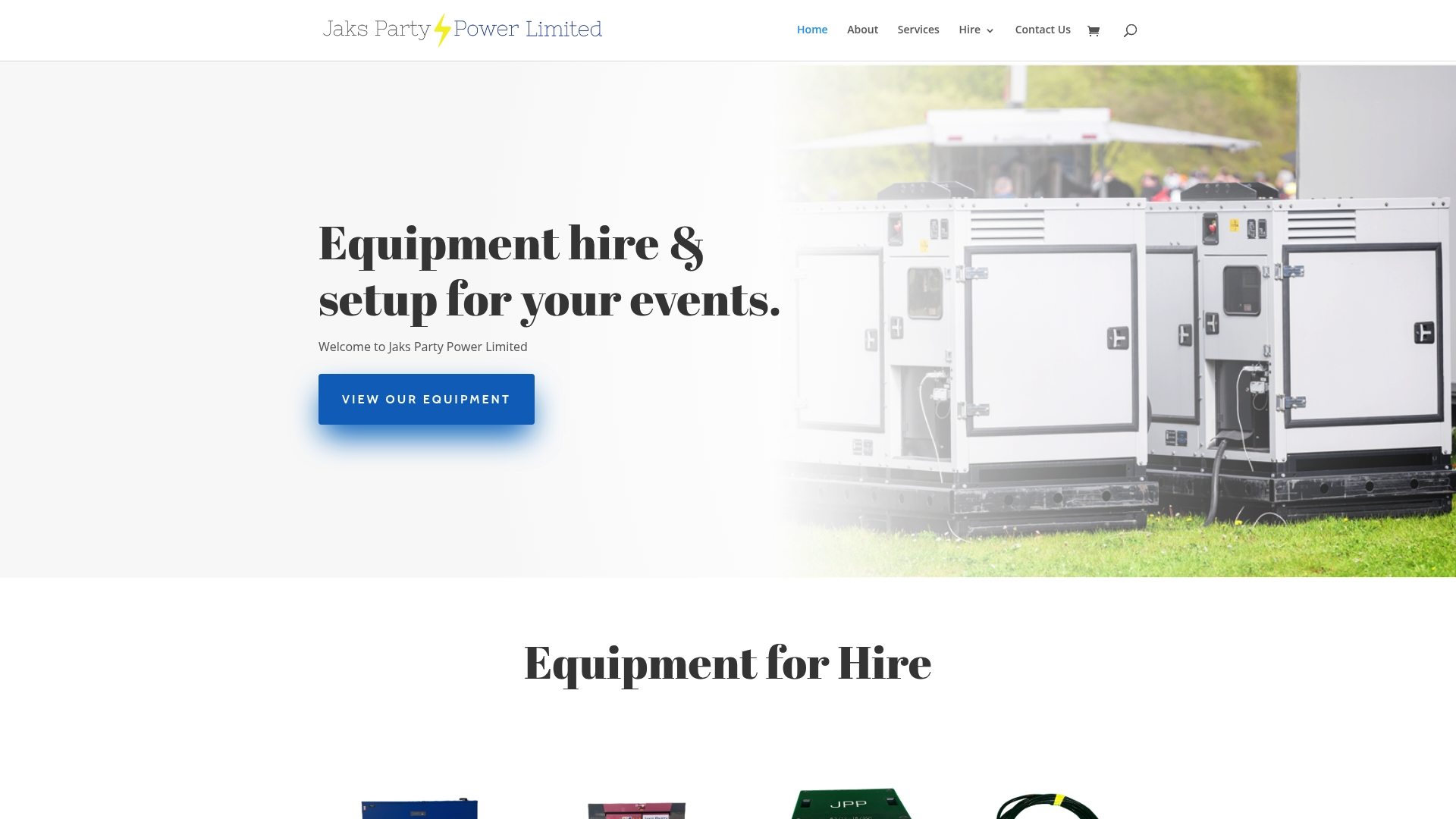
The practical difference is this: one operational lead, documented compliance from PEC to PAT certificate, and 40+ years of electrical contracting experience behind every quote. Jakspartypower serves Sussex and surrounding regions for events from private weddings to large outdoor shows.
Hire a generator for your next event, or visit the services overview to build a package around your specific brief. Contact Jakspartypower directly to request a fully-burdened quote or to arrange a site survey.
Useful sources and further reading
These are the primary references for UK event electrical safety, standards, and procurement guidance.
- HSE — Electrical safety for events: The regulator’s practical guidance on timetables, generator use, earthing, and cable routing. Start here for legal duties.
- HSE GS50 — Electrical safety at places of entertainment: The detailed guidance note covering RCD protection, temporary supplies, and generator earthing for entertainment venues.
- BSI Group — BS 7909 and BS 7671: The standards that govern temporary event installations and wiring regulations, including the 30 mA RCBO requirement.
- MUTA — Choosing a Hirer guidance: Industry body guidance on selecting competent contractors, with audit requirements for members.
- Elec-Mate — BS 7909 and PEC guidance: Technical detail on PEC procedures, generator earthing, and discrimination strategies.
Pro Tip: Download the MUTA Choosing a Hirer guide before your next procurement round. It covers CDM obligations, competency checks, and documentation requirements that many planners only discover after a problem arises.
FAQ
What is BS 7909 and why does it matter for event power?
BS 7909 is the British Standard for temporary electrical systems at entertainment events. It sets the design, installation, and testing requirements that suppliers must meet, including mandatory 30 mA RCBO protection for socket outlet circuits.
What is a pre-energisation check (PEC)?
A PEC is a formal inspection carried out before a temporary installation is switched on. It records insulation resistance, continuity, and RCD operating times using calibrated instruments, and must be documented in writing.
How do I make sure two quotes are actually comparable?
Standardise the baseline: confirm that both quotes cover the same timings, access windows, technician hours, fuel, and contingency rates. A quote that omits any of those elements is a different scope, not a lower price.
Does Jakspartypower provide on-site standby support?
Yes. On-site technician standby is a core part of Jakspartypower’s service, covering the event duration with a defined refuelling policy for generator hire across Sussex and surrounding regions.
How far in advance should I book an event power supplier?
For mid-scale corporate events, allow at least two to four weeks for survey, design, and confirmation. Festival-scale or complex multi-stage builds realistically need four to six weeks of lead time before the install date.