
For most UK events, Jakspartypower is the strongest practical alternative to festivalpower.co.uk: it combines a local Sussex fleet, standby engineer support, and integrated hire packages covering generators, distribution boards, and lighting under one contract. If you are comparing event power service alternatives and want a single supplier who arrives, installs, monitors, and demobilises, Jakspartypower is the shortlist’s top pick.
Quick shortlist:
- Jakspartypower — local fleet, standby service, all-in packages for weddings to mid-size festivals in Sussex and surrounding areas
- festivalpower.co.uk — marketplace-style platform for sourcing multiple quotes from different suppliers
- Aggreko — large international fleet for very large festivals, multi-site productions, and long-duration contracts
- thorncliffeeventpower.co.uk — regional event power supplier suited to mid-size events and regional festivals
- Gofer.co.uk — another marketplace option for comparing multiple suppliers quickly
Why Jakspartypower suits most planners:
- BS 7909 compliance awareness and documented application
- Standby engineer on site during events
- Fleet covering small private parties through to large shows
- Over 40 years of electrical contracting experience behind every hire
- Single-supplier accountability: one quote, one contact, one team
Pro Tip: Before you contact any supplier, write down your estimated peak load in kVA, your event dates, and any access constraints. Suppliers who ask for this information upfront are the ones who will give you a meaningful quote rather than a ballpark.
Key takeaways
For most UK events, the right alternative to festivalpower.co.uk is a local specialist with standby support, BS 7909 compliance evidence, and a single-supplier package that covers generator, distribution, and cabling under one contract.
| Point | Details |
|---|---|
| Lead with safety documents | Always request BS 7909 competence evidence, a site-specific single-line diagram, and a risk assessment before confirming any booking. |
| Match kVA to event size | Apply a diversity factor and a 20% headroom margin to your connected load; confusing kVA and kW is the most common sizing error. |
| Fix the fuel contract | A fixed-fee fuel arrangement aligns supplier incentives with efficiency and removes post-event billing surprises. |
| Vet before you commit | Request references for similar-size events, check PAT and EICR certificates, and confirm the standby engineer is on site, not on call. |
| Jakspartypower for Sussex events | Jakspartypower offers integrated generator, distribution, and standby engineer packages for weddings to mid-size festivals across Sussex. |
Table of Contents
- How do these festivalpower.co.uk alternatives compare?
- What does each supplier actually offer?
- How do you choose the right event power supplier?
- What kVA do you actually need?
- What do temporary power suppliers actually provide?
- Which safety documents should you always request?
- What does the hiring process look like from enquiry to event day?
- How do you plan for power failures and fuel shortages?
- How do suppliers price temporary power?
- National fleet or regional specialist: which suits your event?
- How do you vet a supplier’s reliability before you commit?
- What do industry standards and sustainability guidance actually recommend?
- Why a safety-first, local-first approach usually wins for UK events
- Get a quote or site survey from Jakspartypower
- Sources
- FAQ
How do these festivalpower.co.uk alternatives compare?
Key differentiators at a glance:
- Jakspartypower is the only supplier on this list offering a fully integrated local package (generator, distribution, lighting, standby engineer) from a single Sussex-based team.
- Aggreko is the right call when you need very large kVA capacity, multi-site coordination, or an international project management structure; the trade-off is that it is built for scale, not for the personal service a wedding or 500-person corporate event usually needs.
- festivalpower.co.uk and Gofer.co.uk are marketplaces, not suppliers. They are useful for generating competing quotes, but you will still need to vet each supplier individually against the criteria in this article.
- thorncliffeeventpower.co.uk and kes.co.uk are regional specialists. Their value is local knowledge and faster response times; their limitation is fleet depth compared with national providers.
What does each supplier actually offer?
Jakspartypower
Jakspartypower’s core proposition is straightforward: one team handles generators, distribution boards, cabling, and lighting, then stays on site. That standby service is the detail most planners underestimate until something goes wrong at 9 PM on a Saturday. The company draws on over 40 years of electrical contracting experience, which means the person who designed your single-line diagram is the same type of professional who signs off permanent commercial installations.
Strengths:
- Integrated hire packages reduce the coordination risk of using multiple suppliers
- Standby engineer included, not an optional add-on
- Covers weddings, private parties, corporate events, and mid-size festivals
- Sussex-based with local fleet and fast response times
Limitations:
- Geographic focus on Sussex and surrounding areas; not the right pick for a multi-site national tour
- Fleet scale is suited to small and medium events; very large festival kVA demands may require Aggreko
festivalpower.co.uk
festivalpower.co.uk operates as a marketplace rather than a direct supplier. Planners use it to reach multiple temporary power companies and gather quotes in one place. That is genuinely useful at the research stage, particularly for larger events where you want competing bids. The limitation is that quality, compliance, and standby support vary entirely by which supplier responds to your enquiry. You are the one who must vet each quote against the criteria in this article.
Strengths:
- Broad supplier reach; useful for generating multiple quotes
- Convenient starting point for unfamiliar planners
Limitations:
- No direct accountability for supplier quality or compliance
- Standby engineer, BS 7909 familiarity, and environmental options depend entirely on the individual supplier
Aggreko
The name “Aggreko” frequently arises when event briefs require 500 kVA minimum or multiple sites with simultaneous delivery. This supplier is known for a large fleet and strong project management capacity to handle complex, multi-stage events. For a 10,000-person festival with multiple stages, Aggreko is a credible choice. For a 300-person wedding in West Sussex, it is almost certainly over-specified and priced accordingly.
Strengths:
- Extensive fleet; can supply very large kVA requirements
- Hybrid generator options and telemetry reporting
- Experienced project management for complex events
Limitations:
- Built for scale; personal service at smaller events is not its strength
- Pricing reflects its enterprise positioning
thorncliffeeventpower.co.uk
Thorncliffe Event Power sits in the mid-market: regional fleet, event-focused distribution equipment, and a focus on festivals and outdoor events of moderate scale. If you are running a regional festival and want a supplier with local knowledge, it is worth a quote. Planners looking for more context on similar regional options can also read the thorncliffeeventpower.co.uk alternatives comparison on this site.
Strengths:
- Regional knowledge and event-specific equipment
- Suited to mid-size outdoor events and festivals
Limitations:
- Fleet depth is regional; not suited to very large or multi-site events
Gofer.co.uk and kes.co.uk
Gofer.co.uk is another marketplace entrant, useful for quick multi-supplier comparisons. kes.co.uk is a regional supplier referenced in event power comparisons, suited to small and medium events in specific areas. Both are worth knowing about; neither replaces the need to vet the underlying supplier on compliance and standby capability.
Pro Tip: When using a marketplace like festivalpower.co.uk or Gofer.co.uk, always ask the responding supplier directly: “Who is the named electrician responsible for this installation, and can you provide their BS 7909 competence evidence?” A supplier who cannot answer that question clearly is a red flag.
How do you choose the right event power supplier?
The decision comes down to five criteria, in this order.
1. Safety and compliance first. A supplier who cannot produce evidence of BS 7909:2023 familiarity, a method statement, and a risk assessment should not be on your shortlist. BS 7909:2023 is the UK code of practice for temporary electrical systems for entertainment purposes and is the recognised way to evidence compliance with IET Wiring Regulations. It now includes revised RCD guidance, a new annex on power quality, and requirements for battery storage systems.
2. Standby support. Confirm whether a standby engineer is included in the quoted price or charged as an extra. An engineer who can respond within minutes on site is a fundamentally different proposition from one who is available by phone.
3. Fleet capacity and kVA range. Match the supplier’s available fleet to your estimated peak load. See the sizing guide below for rules of thumb.
4. Pricing structure. Fuel-included fixed-fee contracts are generally preferable for budget certainty. Per-litre billing can produce surprises if the event runs long or load is higher than estimated.
5. Environmental options. For multi-day events, ask about hybrid generators, telemetry, and post-event fuel reporting. Powerful Thinking recommends requesting these as standard, noting that fixed-fee fuel contracts can align supplier incentives with efficiency.
Documents to request before signing:
- Evidence of BS 7909 competence (named electrician or company accreditation)
- Single-line diagram for your specific site
- Method statement and risk assessment
- PAT certificates for all distribution equipment
- EICR or EIC for mobile units
- Public liability insurance certificate (check the limit is adequate for your event size)
- Standby engineer name and contact details
Questions to ask at site survey:
- What is your contingency plan if the primary generator fails?
- How quickly can a replacement unit be on site?
- Who signs the single-line diagram and method statement?
- Is fuel included, or billed per litre post-event?
- What telemetry or monitoring do you provide during the event?
- Do you produce a post-event fuel and usage report?
Red flags: A supplier who resists providing a site survey, cannot name the responsible electrician, or quotes without asking for your load schedule is one to avoid.
What kVA do you actually need?
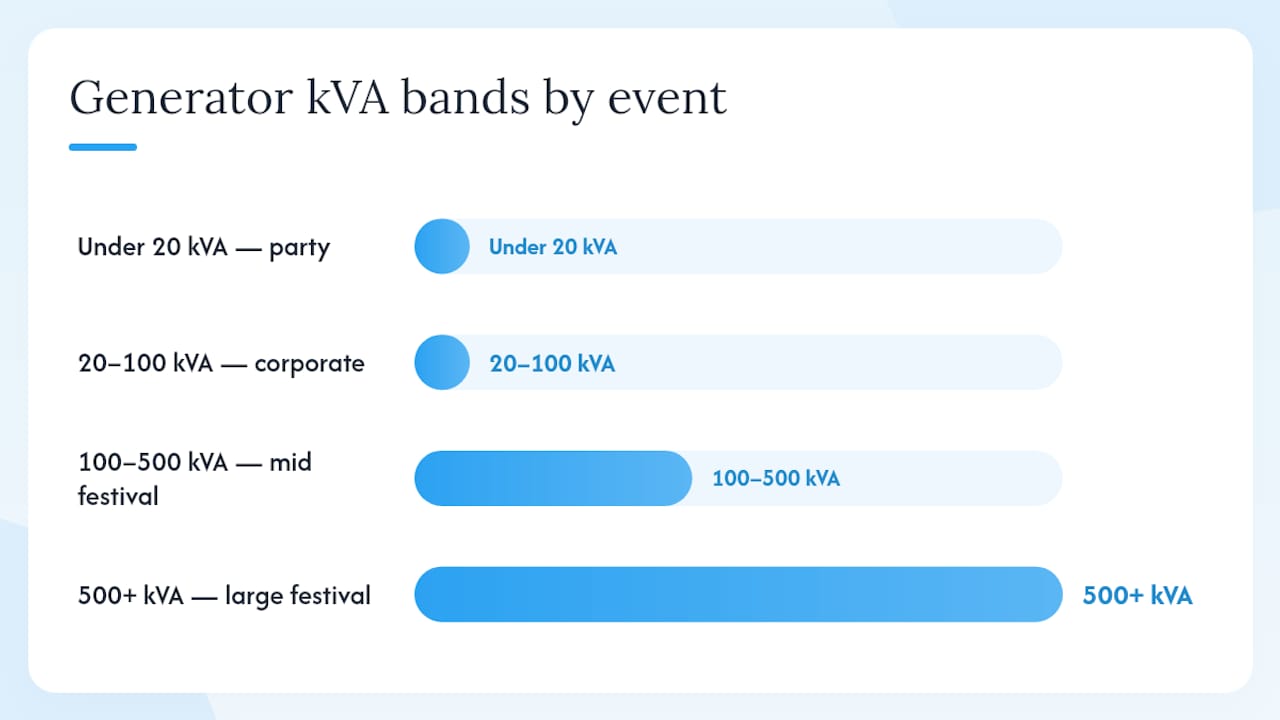
Generator sizing is where planners most often get caught out, usually by underestimating diversity and power factor. The table below gives practical starting points; a proper site survey will refine these numbers.
| kVA band | Typical event type | Typical loads |
|---|---|---|
| Under 20 kVA | Small private party, garden wedding, pop-up stall | Basic lighting, small PA, catering equipment |
| 20–100 kVA | Corporate event, medium wedding, small outdoor festival | Stage PA, professional lighting rig, catering, bar |
| 100–500 kVA | Mid-size festival, large corporate event, multi-stage outdoor show | Multiple stages, full production lighting, large catering, traders |
| 500+ kVA | Large festival, multi-site production, long-duration event | Full festival infrastructure, multiple stages, broadcast, large-scale catering |
Worked example: A 300-person outdoor corporate event with a 10 kW PA system, a 15 kW lighting rig, and 8 kW of catering equipment gives a connected load of 33 kW. Apply a diversity factor of 0.8 (not everything runs at peak simultaneously) to get 26.4 kW. Divide by a power factor of 0.8 to convert to kVA: approximately 33 kVA. Add a 20% headroom margin and you are looking at a 40 kVA generator as a sensible minimum.
Sizing rules of thumb:
- Never size to connected load alone; apply a diversity factor of 0.7–0.9 depending on how predictable the load schedule is.
- Always include a headroom margin of at least 20% above your calculated figure.
- Three-phase supply is usually required above 32 A single-phase; confirm with your supplier at site survey.
- Power factor matters: a generator rated at 100 kVA delivers 80 kW at a typical 0.8 power factor. Confusing kVA and kW is one of the most common sizing errors.
- Check whether any loads are motor-driven (pumps, HVAC); motor start-up currents can be three to six times running current and must be factored in.
The IET’s Guide to Temporary Electrical Systems emphasises resilience and weather-related risk planning, which in practice means sizing with enough headroom to handle unexpected load spikes rather than cutting it fine.
What do temporary power suppliers actually provide?
A reputable hire package typically includes the generator, distribution cabling, and a field distribution unit (FDU) as standard. Everything else is worth confirming explicitly before you sign.
Standard inclusions in most hire packages:
- Generator (diesel, specified kVA)
- Field distribution unit (FDU): a weatherproof distribution board that splits the generator output to multiple circuits
- Powerlock connectors or CEE-form cabling for main feeds
- Cable ramps and protection where required
- Delivery, installation, and collection
Common extras (confirm in writing):
- Fuel (often billed separately unless a fixed-fee fuel contract is agreed)
- Standby engineer (sometimes included, sometimes charged per day)
- PAT testing and certification of distribution equipment
- Telemetry and remote monitoring
- Site survey and single-line diagram production
- De-rigging and post-event reporting
Practical guidance from Raiden stresses using certified distribution boards rather than improvised connections, and confirms that reputable suppliers will include site surveys and formal test certificates as part of the hire.
Short glossary for planners:
- FDU (Field Distribution Unit): a weatherproof distribution board that takes the generator output and splits it to multiple circuits across the site.
- Powerlock: a high-current connector system (typically 400 A or 630 A) used for main generator feeds; safer and more reliable than standard connectors at high current.
- RCD (Residual Current Device): a safety device that cuts power if a fault current is detected; required under BS 7909 and BS 7671.
- kVA: kilovolt-amperes, the unit of apparent power used to rate generators. Differs from kW (kilowatts, real power) by the power factor.
Pro Tip: Ask your supplier to confirm in writing which items are included in the hire price and which are billed separately. A quote that looks competitive can become expensive once fuel, standby engineer time, and PAT certification are added.
Which safety documents should you always request?
HSE guidance is clear: event organisers must take reasonably practicable steps to ensure electrical installations are properly selected, installed, and maintained. That obligation does not transfer to the supplier; it stays with you as the organiser. The documents below are how you discharge it.
Must-request documents:
- BS 7909 competence evidence: a named electrician or company accreditation showing familiarity with the current code of practice. BS 7909:2023 is the current version; check the supplier is working to this edition, not an older one.
- Single-line diagram: a schematic of the complete electrical installation for your specific site. If a supplier cannot produce one, walk away.
- Method statement: a written description of how the installation will be carried out, by whom, and in what sequence.
- Risk assessment: site-specific, not a generic template. It should reference your venue, access conditions, and any proximity to the public.
- PAT certificates: for all portable appliances and distribution equipment brought to site.
- EICR or EIC: an Electrical Installation Condition Report or Electrical Installation Certificate for mobile units. NAPIT confirms that BS 7671 applies to temporary installations and that inspection and testing schedules should be applied with the same rigour as permanent installations.
- Public liability insurance: check the limit. For a large public event, £5 million is a common minimum; some venues require £10 million.
- Qualified electrician details: name, qualification, and contact number for the person responsible for the installation.
Validation steps:
- Check that PAT stickers are current (within the last 12 months for event equipment is a reasonable standard).
- Confirm the single-line diagram matches the actual site layout on arrival; discrepancies should be resolved before power is energised.
- Verify insurance certificates are dated and in-date; ask for the insurer’s name and policy number.
- For larger installations, check whether a permit is required under Gov; larger or long-duration generator use may trigger notification or permitting obligations.
BS 7909:2023 and BS 7671 are complementary, not interchangeable. Elec-Mate explains that BS 7909 supplements BS 7671 specifically for entertainment and event installations, providing detailed guidance on generator-supplied systems, earthing arrangements, and documentation. A supplier who cites only BS 7671 without BS 7909 familiarity is missing the event-specific layer that matters most to you.
What does the hiring process look like from enquiry to event day?
Lead times vary significantly by fleet size and season. A small generator hire for a private party can sometimes be arranged within a week; a festival-scale deployment with multiple units, standby engineers, and a full distribution design typically needs six to twelve weeks of lead time, sometimes more during peak summer season.
Typical process:
- Initial enquiry: provide your estimated load, event dates, site address, and access details. The more specific you are, the more accurate the quote.
- Site survey: a competent supplier will want to visit the site, or at minimum review detailed site plans, before confirming price. The survey identifies access routes, ground conditions, proximity to mains supply, noise restrictions, and cable routing requirements.
- Single-line diagram and risk assessment: produced after the site survey; these documents define the installation scope and form part of your event safety file.
- Quote confirmation and deposit: most suppliers require a deposit to secure the booking. Confirm the deposit percentage, payment terms, and cancellation policy in writing.
- Delivery and installation: typically the day before the event, or early on the event day for smaller hires. Confirm the installation window and who is responsible for signing off the installation before the public arrives.
- On-site support: confirm whether a standby engineer is present throughout the event or on call. “On call” and “on site” are very different propositions.
- Demobilisation: collection of equipment after the event. Confirm the collection window and any charges for extended hire periods.
- Post-event reporting: fuel usage, load data, and any incidents. Not all suppliers provide this; request it explicitly.
Site survey items that typically change price or scope:
- Restricted access (narrow lanes, weight limits, no-dig zones)
- Soft ground requiring cable bridging or matting
- Long cable runs from generator to distribution points
- Noise restrictions requiring a silenced or super-silenced generator
- Proximity to mains supply (affects earthing strategy)
For private events and weddings, lead times of two to four weeks are usually workable. Festival-scale deployments should be booked as early as possible; summer availability for large fleet items fills quickly.
How do you plan for power failures and fuel shortages?
Contingency planning is the part of the brief that most planners leave until something goes wrong. Three elements matter most: standby engineer response, fuel management, and telemetry.
Contractual elements to confirm:
- Standby engineer response time: if an engineer is on site, what is their remit? Can they authorise a generator swap, or do they need to call back to a depot? Confirm this in writing.
- Fuel-included vs fuel-recovery: a fixed-fee fuel contract means the supplier has a financial incentive to run the generator efficiently. Per-litre billing means the incentive runs the other way. Powerful Thinking’s guidance specifically recommends fixed-fee fuel contracts to align supplier incentives with efficiency.
- Telemetry and remote monitoring: real-time load and fuel data lets the supplier (and you) spot problems before they become failures. Ask whether the supplier’s generators are fitted with telemetry and whether you get access to the data.
- Post-event fuel report: a written record of fuel consumed, load profile, and any anomalies. Useful for budgeting future events and for sustainability reporting.
Contractual clauses to request or clarify:
- Minimum hire period and what happens if the event finishes early
- Cancellation fees and the notice period required to avoid them
- Emergency call-out terms: what triggers a call-out, what it costs, and how quickly a replacement unit can be delivered
- Generator swap procedure if the primary unit fails
Pro Tip: Structure your fuel contract as a fixed-fee arrangement and ask the supplier to include a post-event telemetry report. If the supplier resists either, ask why. A confident, well-run operation has nothing to hide in its fuel consumption data.
How do suppliers price temporary power?
Pricing for temporary power is rarely a single line item. Understanding the components helps you compare quotes on a like-for-like basis.
Typical cost components:
- Generator hire (daily or per-event rate, varies by kVA)
- Delivery and collection
- Installation labour
- Fuel (fixed-fee or per-litre; confirm which)
- Standby engineer (per day or included)
- Distribution equipment hire (FDUs, cabling, cable ramps)
- PAT testing and certification
- De-rigging
Common pricing models:
| Model | How it works | Best when |
|---|---|---|
| Fixed-fee (all-in) | One price covers generator, distribution, fuel, standby engineer, and de-rig | You want budget certainty and a single point of accountability |
| Daily hire + fuel recovery | Generator and equipment at a day rate; fuel billed at cost post-event | Short hires where fuel consumption is predictable and low |
| Per-hour standby | Engineer billed by the hour on top of equipment hire | Events with unpredictable run times |
| Tiered project rate | Larger events quoted as a project with milestones | Festival-scale or multi-day events with complex distribution |
Quote checklist for apples-to-apples comparison:
- Is fuel included or billed separately?
- Is the standby engineer included or an extra?
- Are PAT testing and certification included?
- What is the delivery and collection charge?
- Are cable ramps and distribution boards included?
- What are the cancellation terms and deposit requirements?
A quote that looks 20% cheaper than a competitor’s may simply have excluded fuel and the standby engineer. Always ask for a fully itemised breakdown.
National fleet or regional specialist: which suits your event?
The choice between a national provider like Aggreko and a regional specialist like Jakspartypower or thorncliffeeventpower.co.uk is not simply about price. It is about what you are actually buying.
Regional specialists:
- Faster response times for site surveys and emergency call-outs
- Local knowledge of venues, access routes, and ground conditions
- Personal service and direct contact with the team delivering your event
- Better suited to events under 500 kVA where fleet depth is not the constraint
National providers:
- Fleet depth for very large kVA requirements
- Multi-site coordination capability
- Hybrid generator and telemetry infrastructure at scale
- Better suited to large festivals, broadcast events, and long-duration contracts
When to pick a regional specialist: your event is in a specific location, you need a site survey within a week, or the personal relationship with the delivery team matters to you. A regional supplier who knows your venue is worth more than a national one who sends a different crew each time.
When to pick a national provider: your peak load exceeds what a regional fleet can supply, you are running simultaneous sites, or you need a project management structure rather than a hire relationship.
Factors that push lead times up: festival season (June to September), multi-site coordination, fuel logistics for remote sites, and any requirement for super-silenced generators (which are less common in regional fleets and often need to be sourced from a national depot).
For planners comparing similar regional options, the kes.co.uk alternatives and Gofer.co.uk alternatives pages on this site cover additional regional and marketplace options in more detail.
How do you vet a supplier’s reliability before you commit?
A supplier’s website tells you what they want you to think. References, documentation, and a site survey tell you what they actually do.
Practical vetting steps:
- Request two references for events of similar size and type. Ask specifically for events where something went wrong and how the supplier handled it.
- Ask for the EIC or EICR for the mobile units they plan to bring to your event. A supplier who cannot produce these documents has not been testing their equipment to the standard NAPIT recommends.
- Ask for the method statement and risk assessment before the site survey, not after. A supplier who produces these documents quickly and specifically has done this before; one who sends a generic template has not.
- Verify insurance: ask for the certificate, not just a confirmation that they have it. Check the limit and the expiry date.
- Check whether the supplier’s personnel hold relevant qualifications. BBC safety resources on BS 7909 note that training and certification for event electrical personnel is a recognised way to confirm competency.
- For larger installations, confirm whether a permit is required under GOV.UK’s specified generator guidance.
Sample reference questions:
- Did the supplier arrive on time and complete installation before the event opened?
- Was a standby engineer present throughout, and did they need to intervene?
- Were there any power interruptions, and how were they handled?
- Did the supplier provide a post-event report?
- Would you use them again?
What to look for in online reviews: specificity beats volume. A review that describes a named event type, a problem that was resolved, or a specific piece of equipment tells you more than a five-star rating with no text. Weight recent reviews more heavily; a supplier’s operational quality can change quickly with staff turnover or fleet age.
What do industry standards and sustainability guidance actually recommend?
The two primary standards every event power supplier should be working to are BS 7909:2023 and BS 7671. BS 7909:2023 is the event-specific code of practice; BS 7671 is the overarching IET Wiring Regulations that apply to all electrical installations, permanent or temporary.
The IET’s updated guidance on temporary electrical systems emphasises resilience and weather-related risk planning as priorities for event power design. The IET Guide to Temporary Electrical Systems, 2nd edition covers transformer-based designs and supplementary measures to mitigate risks from public-supply neutral conductor failures, earthing strategies, and continuity planning for critical systems. Planners should ask suppliers whether their designs account for these scenarios, not just the standard case.
Practical sustainability recommendations for planners:
- Ask for telemetry data during the event; real-time load monitoring reduces fuel waste and flags overloads before they cause failures.
- Request hybrid generator options for multi-day events; battery-hybrid units reduce fuel consumption and noise during low-load periods.
- Specify energy-efficient festoon lighting and LED equipment where possible; lighting is often the easiest load to reduce without affecting the event experience.
- Insist on a post-event fuel and usage report; this data is the foundation for reducing consumption at future events.
- For events with significant generator use, check whether a permit is required under GOV.UK’s specified generator rules.
Translating standards into procurement requirements:
- Require BS 7909:2023 competence evidence as a pass/fail criterion, not a nice-to-have.
- Require a site-specific single-line diagram and risk assessment before confirming any booking.
- Require PAT certificates and EICR/EIC for all mobile units.
- Require a named, qualified electrician responsible for the installation.
MUTA’s best practice guide provides practical operational templates that translate these standards into event-specific checklists, which planners can use to structure their supplier briefings.
Why a safety-first, local-first approach usually wins for UK events
There is a tendency in event planning to treat power as a commodity: find the cheapest generator, confirm it is the right kVA, and move on. That approach works until it does not, and when it fails, it fails publicly, at the worst possible moment.
The case for prioritising safety and local capacity is not sentimental. It is operational. A standby engineer who is already on site can isolate a fault and restore power in minutes. A supplier who knows your venue has already solved the access problem, the cable routing question, and the noise restriction before you even ask. A fixed-fee fuel contract means the supplier’s incentive is to run the generator efficiently, not to bill you for every extra litre.
Jakspartypower’s approach reflects this: integrated packages, a standby engineer as standard, and a team that has been doing electrical contracting in Sussex for over 40 years. That depth of experience shows up in the quality of the documentation, the speed of the site survey, and the confidence of the team on event day.
There are situations where a different supplier is the right answer. Very large festivals with peak loads above what a regional fleet can supply should talk to Aggreko. Planners who genuinely need competing quotes from multiple suppliers will find festivalpower.co.uk or Gofer.co.uk useful at the research stage. But for the majority of UK events, a local specialist with standby support and a single-supplier package is the lower-risk, lower-stress choice.
Get a quote or site survey from Jakspartypower
When you are ready to move from shortlist to booking, the most useful thing you can do is contact Jakspartypower with four pieces of information: your estimated peak load in kVA (or a list of your main equipment), your event dates, your site address, and any known access constraints.
From there, Jakspartypower will arrange a site survey, produce a single-line diagram and risk assessment specific to your event, and give you a fully itemised quote covering generator hire, distribution, cabling, standby engineer, and fuel arrangements. No hidden extras, no generic templates.
For weddings, corporate events, and mid-size festivals across Sussex and the surrounding area, hire a generator or browse the full event hire packages to see what is available for your event date.
Sources
- Temporary electrical systems for entertainment and related purposes: Code of practice | BSI Knowledge
- Guide to Temporary Electrical Systems (2nd edition) | IET Wiring Matters
- Event safety: electrical safety | HSE
- Gov
- What to ask your energy supplier | Powerful Thinking
- Event Temporary Power Distribution Setup Guide | Raiden
- Temporary Installations BS 7909 | Events & Construction | Elec-Mate
Planners can use these sources to validate supplier claims, cross-check documentation, and confirm that the standards a supplier cites are current editions.
FAQ
What is the best alternative to festivalpower.co.uk for UK events?
For most UK events, Jakspartypower is the strongest direct alternative: it provides generators, distribution, cabling, and a standby engineer as an integrated package, with over 40 years of electrical contracting experience behind every hire. Aggreko is the right choice for very large or multi-site events requiring extensive fleet capacity.
What safety standard should I insist on from any event power supplier?
BS 7909:2023 is the UK code of practice for temporary electrical systems for entertainment purposes and is the recognised way to evidence compliance with IET Wiring Regulations. Ask any supplier for named evidence of BS 7909 competence before confirming a booking.
Do I need a permit for a generator at my event?
Possibly. GOV.UK guidance explains that certain generators are classified as “specified generators” and may require a permit or notification depending on size and duration of use. Check the GOV.UK specified generator guidance for your specific installation before the event.
What is the difference between kVA and kW for generator sizing?
kVA is apparent power; kW is real power. At a typical power factor of 0.8, a 100 kVA generator delivers 80 kW. Confusing the two leads to undersized generators, so always confirm with your supplier which unit their rating refers to and apply the correct power factor to your load calculation.
How far in advance should I book event power?
For small private events and weddings, two to four weeks is usually sufficient. For mid-size festivals and events requiring multiple generators or complex distribution, six to twelve weeks is a more realistic lead time, particularly during peak summer season when fleet availability tightens.