
Nine lighting types cover almost every professional outdoor event brief: festoon, LED flood and wash, profile spots and pin-spots, moving heads, LED battens, cyc lighting, uplighters, and pixel/DMX tape. None of these arrive as a standalone product. They come as a powered package, with a generator sized to the load, a distribution board to split and protect the circuits, and usually an engineer on standby to fix anything that trips at 9pm on a Saturday.
That last part catches out a lot of first-time planners. Lighting hire without a verified load calculation is one of the most common causes of site failure once the sun goes down and the real draw hits the supply.
- Festoon and string lighting — low power, ambient, easy to distribute
- LED flood and wash — medium power, broad coverage
- Profile spots and pin-spots — low to medium power, focused beams
- Moving heads — medium to high power, DMX controlled
- LED battens and cyc lighting — moderate power, colour washes for stages
- Uplighters — low-voltage, architectural accents
- Pixel tape / RGB effects — low-voltage, needs a control channel
Every one of these should be quoted alongside generator capacity, distribution and standby cover, and checked against BS 7909 and HSE guidance before you sign anything.
Key Takeaways
Professional outdoor lighting only performs reliably when it’s ordered as a powered package, with generator sizing, distribution and standby support specified alongside the fixtures themselves.
| Point | Details |
|---|---|
| Nine lighting types cover most briefs | Festoon, flood/wash, spots, moving heads, battens, cyc lighting, uplighters and pixel tape each pull a different load class. |
| Power sizing follows rough bands | Small setups sit under 6 kVA, medium shows run 6 to 50 kVA, large productions can need 100 kVA or more. |
| RCD type is not optional detail | Type A is the usual minimum, but Type F or B may be needed for LED dimmer loads with mixed-frequency residual currents. |
| Documentation separates good suppliers from risky ones | Ask for a single-line diagram, test certificates, PAT records and evidence of engineer competence before booking. |
| Integrated hire reduces fault risk | Jakspartypower supplies lighting, generators, distribution and standby cover as one contract across Sussex, cutting the coordination gaps that cause on-site failures. |
Table of Contents
- Types of professional outdoor party lighting and their typical power class
- Power and distribution: getting the supply right before the lights go up
- Safety, standards and what the planner is actually responsible for
- Choosing a lighting and power supplier: your checklist
- Decorative lighting for smaller, private outdoor gatherings
- Matching lighting types to your event theme and setting
- Weather resistance and how long outdoor lighting actually lasts
- Energy use and sustainability in outdoor lighting choices
- Setting up outdoor lighting safely: what to get right on the day
- Controlling your lighting: DMX, smart systems and remote options
- Why integrated hire and standby actually earns its cost
- How Jaks Party Power helps with lighting, power and standby
- Sources
- FAQ
Types of professional outdoor party lighting and their typical power class
Each lighting type does a different job on site, and each pulls a different load. Knowing which is which lets you brief a supplier properly instead of asking for “some lights for the garden” and hoping for the best.
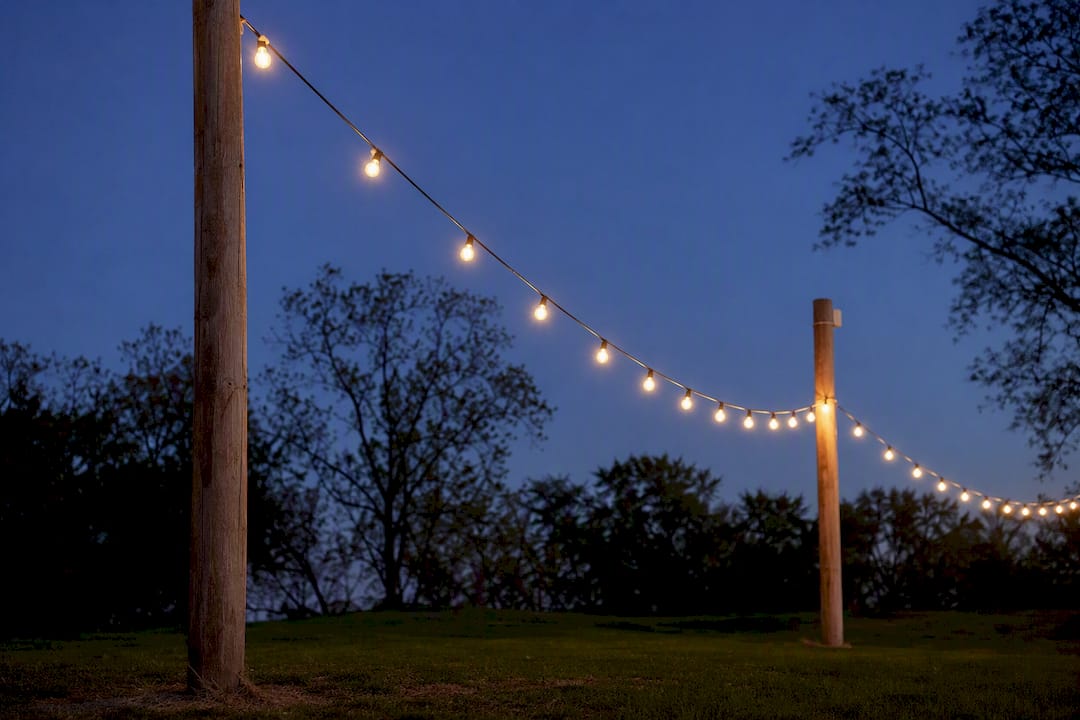
Festoon and fairground string lighting is the workhorse of outdoor hospitality. It runs warm white bulbs along a catenary wire, usually strung between marquee poles, trees or a purpose-built rig, and it draws very little power per run. Distribution is simple: most festoon runs sit happily on a standard 230V circuit, though longer runs across a large garden or vineyard need careful cable routing to avoid voltage drop.
LED flood and wash lights cover broad areas: a lawn, a marquee exterior, a car park, a building facade. These sit in the medium power bracket and, for larger installations, are often run in three-phase clusters to balance the load across circuits rather than overloading one leg.
Profile spots and pin-spots throw a tight, controlled beam, which is why they turn up on top tables, over cake displays, and picking out a ceremony arch. Power draw is modest, but positioning and rigging matter more than wattage here.
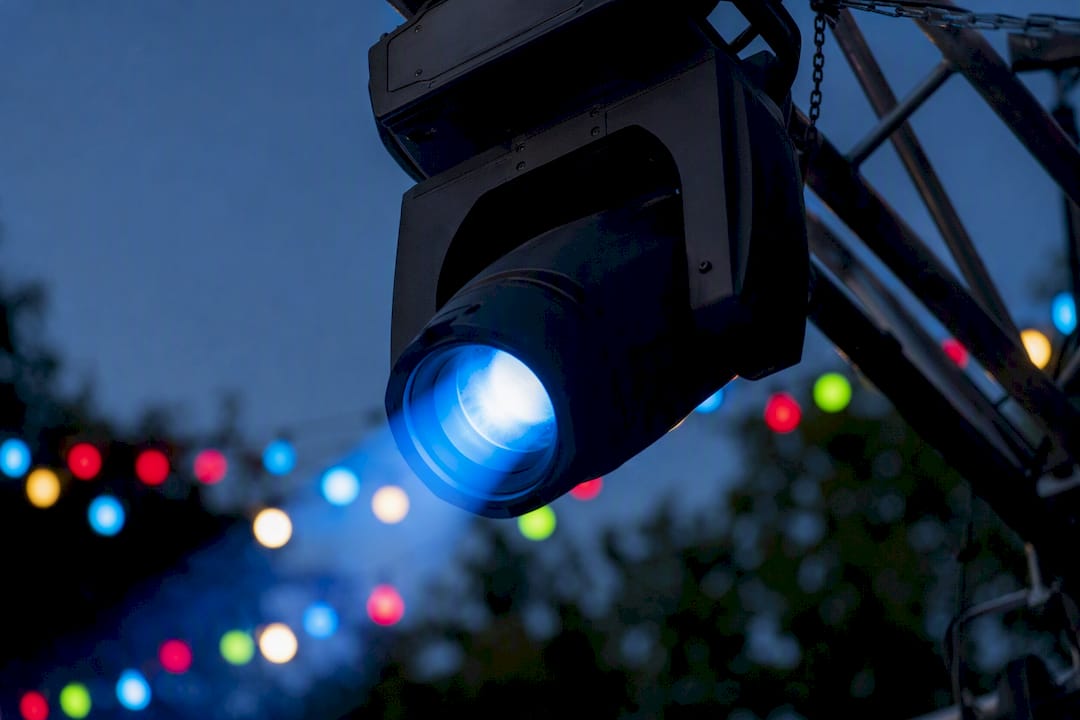
Moving heads and intelligent fixtures bring the dancefloor and stage to life with colour changes, gobos and movement, all driven by a DMX control signal. They sit in the medium to high power range and need a dedicated, well-planned circuit rather than being an afterthought bolted onto the festoon supply.
LED battens and cyc lighting create the colour-changing backdrop washes you see behind a live band or a stage set. Also DMX-controlled, moderate power, but they benefit from their own distribution feed so a lighting cue doesn’t dim the PA.
Uplighters and architectural grazing pick out trees, marquee poles and building features from ground level. Most are low-voltage LED units, which keeps the load light but still needs proper distribution and RCD protection given their frequent proximity to grass and damp ground.
Pixel tape and RGB effects add accent lighting to bars, furniture and structures. Low-voltage, but the control side (DMX or a wireless protocol) needs planning just as much as the power side.
Pro Tip: Ask your supplier for the wattage draw per metre on any festoon or pixel tape run, not just the total. It’s the fastest way to spot an underspecified distribution board before it becomes your problem at 6pm on the day.
Power and distribution: getting the supply right before the lights go up
Every one of the nine lighting types above eventually asks the same question: single-phase or three-phase? Single-phase 230V handles most festoon, uplighting and small profile rigs comfortably. Three-phase 400V becomes necessary once you’re running multiple moving heads, several flood clusters, or combining lighting with catering, bar refrigeration and a PA system on the same site.
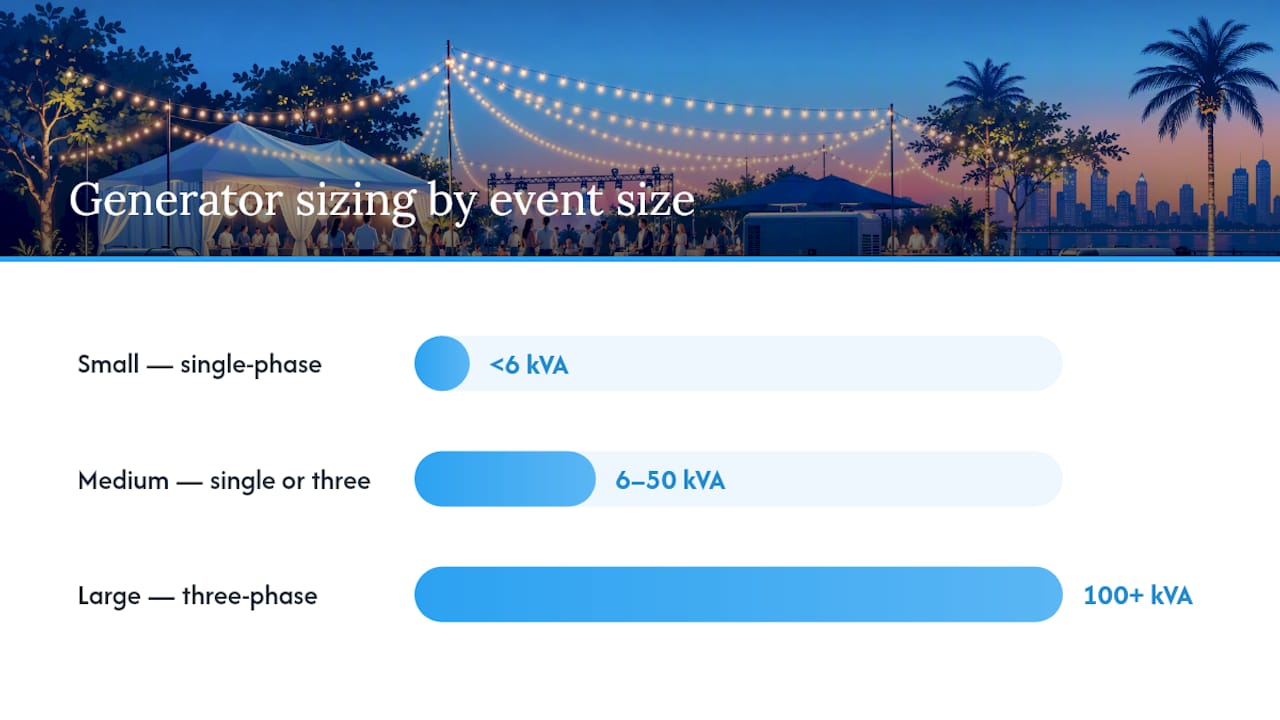
Generator sizing follows a rough band structure. Small garden parties and intimate weddings typically sit under 6 kVA. Medium shows, marquee weddings and corporate functions with a full lighting rig and catering load usually run in the 6 to 50 kVA range. Large productions, festivals and multi-marquee events can require 100 kVA or more, sometimes from multiple synchronised generators rather than a single unit.
Whatever the size, never quote to the exact load. Diversity and headroom matter: a generator running flat out all night is a generator likely to trip or fail when someone plugs in a phone charger you didn’t budget for.
Distribution needs the right hardware, not improvisation:
- A site distribution board as the main hub
- Sub-distribution boards feeding lighting, catering and technical zones separately
- Powerlock connectors for high-current generator-to-distribution runs
- Cable routing that segregates lighting circuits from public walkways and water sources
RCD selection is not a tick-box exercise. Type A is the usual minimum for modern lighting loads, but Type F or Type B protection may be required for mixed-frequency loads such as LED dimmers and switch-mode drivers that produce pulsating or smooth DC residual currents. Get this wrong and you get nuisance tripping, or worse, no tripping when you need it. Your supplier’s single-line diagram should show earthing arrangements clearly, in line with BS 7909 documentation standards.
Safety, standards and what the planner is actually responsible for
You don’t need to become an electrician to run a safe outdoor event, but you do need to know what “safe” looks like on paper, because the responsibility for checking it often lands on you, not the supplier.
BS 7909 is the code of practice covering temporary electrical systems for entertainment and events. It sits alongside BS 7671, the UK wiring regulations, and adds event-specific detail: management structures, design principles, and how systems should be set up and taken down safely. The 2023 revision (with a 2024 amendment) covers systems at 230V and 400V and is written for producers, hire companies, venues and contractors alike, which means your supplier should be able to speak to it fluently.
The HSE’s own checklist gives planners a practical way to interrogate a proposal:
- Is there a clear timetable for when power is live, tested and struck?
- Are earthing arrangements documented, not just assumed?
- Is cable routing planned to avoid trip hazards and water ingress?
- Are main isolators clearly located and accessible in an emergency?
- Is lighting equipment segregated from public areas where required?
Every event, however small, benefits from a named Senior Person Responsible (SPR) who owns the risk assessment and signs off the completion certificate. Ask for test records and PAT testing evidence as standard, not as an extra.
The most common failure modes on temporary sites are earthing loops, neutral loss on shared supplies, and RCDs specified for the wrong residual current type. A neutral loss on a TN-C-S supply can make exposed metalwork live, which is exactly the kind of fault a proper single-line diagram is designed to catch before it happens.
Ask what mitigation is in place for each of these before you book, not after.
Choosing a lighting and power supplier: your checklist
A good supplier will hand you the paperwork before you ask for it. A weak one will need chasing, and that gap tells you something.
Documents to request as standard:
- A single-line diagram showing generator, distribution and lighting circuits
- Test certificates for the distribution equipment being supplied
- Generator specification sheets, including kVA rating and fuel capacity
- Current PAT testing records for hired lighting fixtures
- Public liability insurance details
- Evidence of the installing engineer’s competence and qualifications
Questions worth asking directly, because vague answers are a signal in themselves:
- What RCD type is fitted on the lighting circuits, and why?
- How is earthing handled where our supply meets the venue’s existing system?
- Is there a standby engineer on site, and what’s the response time if something trips?
- How is refuelling managed for an overnight event without disturbing guests?
- Are there noise or generator placement constraints for this venue?
Pro Tip: If a supplier can’t produce a load calculation on request, treat that as a hard stop, not a minor gap. It’s the single document that tells you whether your generator is actually big enough for your lighting plan.
Red flags to walk away from: no load calculation offered, reluctance to provide completion paperwork after the event, a standby arrangement that’s “on call” rather than confirmed on site, or an RCD type nobody can actually name.
Decorative lighting for smaller, private outdoor gatherings
Not every outdoor party needs a generator and a distribution board. For a small garden gathering, a backyard birthday or a casual evening with friends, decorative lighting run from a standard domestic socket or battery pack often does the job perfectly well.
Solar-powered lights charge during the day and switch on automatically at dusk, which makes them useful for pathway marking or fence-line accents where running a cable isn’t practical. Output is modest and depends on how much sun the panel actually got, so they suit atmosphere rather than functional illumination.
Lanterns, whether candle-based or battery LED, add a warm, low-level glow to tables and seating areas. Battery versions are the safer choice near fabric, dry grass or children, since an open flame outdoors is always a bigger risk than it looks on a still evening.
Tiki torches bring a distinct beach or tropical feel and double as citronella-based insect deterrents in some designs, but they’re an open flame source, which means keeping them well clear of bunting, dry foliage and anywhere children are running around.
Fairy lights are the most flexible of the four, wrapping around trees, fences and furniture on battery packs or low-voltage transformers. They’re the closest domestic cousin to professional festoon lighting, just at a fraction of the scale and power draw.
None of these decorative options need the safety documentation covered earlier in this guide, but they also can’t do what festoon, flood or moving-head fixtures do across a marquee, a stage or a 200-guest wedding. Scale is the dividing line.
Matching lighting types to your event theme and setting
The right lighting type depends entirely on what you’re actually running, not just what looks good in a supplier’s brochure photo.
Garden parties lean heavily on festoon lighting overhead, paired with uplighters on trees or hedging and pin-spots on any food or drink displays. The effect wanted is usually warm and ambient rather than dramatic, so heavy moving-head rigs are usually overkill unless there’s a DJ set planned late into the evening.
Beach parties and coastal venues need equipment rated for exposure to sand, salt air and wind, which rules out anything not properly weatherproofed. Festoon and flood lighting on stable, weighted rigging work well; delicate pixel tape or exposed control gear does not, given the corrosion risk from salt air alone.
Evening weddings typically combine several types at once: festoon for the ambient marquee glow, pin-spots for the top table and cake, uplighters on structural features or trees, and moving heads if there’s dancing planned later. This is exactly the scenario where a single integrated power and distribution plan matters most, because five lighting types on five separate circuits is a recipe for confusion when something needs fixing at 10pm.
Match the lighting brief to the venue’s actual conditions and guest flow, then let the power and distribution plan follow from that, not the other way round.
Weather resistance and how long outdoor lighting actually lasts
Outdoor lighting lives or dies, quite literally, on its ingress protection rating. An IP44-rated fixture handles light rain and splashing. An IP65 or higher rating is what you want for anything exposed all night to genuine British weather, particularly connectors and joints where water tends to find its way in.
Professional festoon and flood fixtures used for hire are built for repeated outdoor use, with sealed connectors and cabling designed to sit on wet grass without becoming a hazard. Decorative fairy lights and solar units sold for home use vary enormously in build quality, and a cheap set left out in a downpour is far more likely to fail, or trip a circuit, than a hired festoon run designed for exactly that environment.
Wind is the other factor that gets underestimated. A flood light on a lighting stand needs proper weighting or guying, not just a flat base, because a gust that catches a wash light mid-beam can bring the whole stand down. Rigging that would be fine indoors often isn’t outdoors once you factor in an open field or a coastal site.
Durability over a single night matters less than durability over a season of hire, which is where properly maintained, tested equipment earns its keep. A fixture that’s been PAT tested and inspected between bookings, rather than left in a shed since last summer, is the one that survives an unexpected downpour without cutting your dancefloor lighting at 9pm.
Energy use and sustainability in outdoor lighting choices
LED fixtures now dominate professional outdoor lighting hire for one straightforward reason: they draw a fraction of the power older halogen or incandescent equivalents needed for the same brightness, which directly reduces the generator size required for a given lighting plan.
That matters beyond the electricity bill. A smaller load means a smaller generator, less fuel burned over the course of an event, and less noise on site, which venues with noise restrictions or residential neighbours will thank you for. Festoon lighting in particular has moved almost entirely to LED lamping, which cuts both running cost and heat output compared with the traditional filament bulbs it’s replacing.
Fuel management for the generator itself is where a lot of the genuine sustainability gains sit. A properly sized generator running at the right load percentage burns fuel more efficiently than an oversized unit idling well below capacity all night. This is one of the practical reasons a supplier’s load calculation matters as much for your environmental footprint as it does for safety.
Solar-powered decorative lighting has a role for smaller, low-power accents, but it isn’t a substitute for a properly powered professional rig once you’re running moving heads, flood clusters or a stage wash. Treat solar as a genuine option for pathway and accent lighting, and LED-driven mains or generator power as the realistic choice for anything that needs to perform reliably across a full evening.
Setting up outdoor lighting safely: what to get right on the day
Installation day is where good planning either holds up or falls apart, and most problems trace back to a handful of avoidable mistakes.
Cable routing is the first one. Every cable run between generator, distribution and fixture needs to avoid public walkways, or be properly covered with cable ramps where it can’t. Water and cables don’t mix, so routing away from low-lying ground, puddles and anywhere drinks might get spilled matters more than it sounds.
Rigging comes second. Festoon runs need proper tensioning and secure fixing points, not just tying to whatever’s nearby. Lighting stands for flood and wash fixtures need weighting appropriate to the wind conditions expected, and anything overhead needs a secondary safety fixing in case a primary one fails.
Testing before guests arrive is non-negotiable. That means checking every circuit is live, every RCD trips correctly on test, and every fixture actually works, not assuming it will because it did at the warehouse. This is also the point where a distribution board installed and labelled properly saves real time if something needs isolating quickly later in the evening.
Finally, segregation from guests matters throughout, not just at setup. Generators, distribution boards and main isolators should sit somewhere guests won’t wander near, clearly marked and, ideally, with barrier or fencing if the site layout allows for it.
Controlling your lighting: DMX, smart systems and remote options
Most professional fixtures beyond basic festoon strings run on DMX512, the industry-standard lighting control protocol that lets one console or controller manage colour, intensity and movement across dozens of fixtures at once. Moving heads, LED battens and cyc lighting all expect a DMX signal, which means your control plan needs to be part of the brief, not an afterthought once the fixtures are already rigged.
Smart control has moved well beyond a single wall dimmer. Wireless DMX transmitters let an operator manage lighting cues from a tablet at the back of a marquee rather than running physical control cable across a site, which matters when the console position and the lighting rig aren’t conveniently close together. For simpler festoon or uplighting setups, app-controlled smart plugs and timers can automate on and off times without anyone needing to be present.
The trade-off is reliability versus convenience. A wired DMX line is less likely to drop out than a wireless signal competing with guest WiFi and phone traffic on a busy site, so for anything mission-critical, like a first dance cue or a stage cyc change, a hard-wired backup is worth having even if wireless is the primary control on the night.
Whatever control system is used, it still needs to sit on a properly protected circuit. A DMX controller failing mid-event is an inconvenience; a lighting circuit losing its RCD protection because nobody accounted for the control gear’s load is a safety issue.
Why integrated hire and standby actually earns its cost
Forty years in electrical contracting teaches you that the failures which ruin an event are rarely the dramatic ones. It’s the loose neutral nobody checked, the RCD that was the wrong type for the dimmer load, the generator running at 95% capacity because the load calculation was a guess rather than a measurement.
Splitting lighting, power and distribution across separate suppliers multiplies the points where something can be missed, and where responsibility becomes unclear the moment a fault appears. An integrated package with standby cover means one phone call fixes a fault, not three, and the person answering already knows the single-line diagram because they wrote it.
That’s the practical argument for treating lighting hire as a power decision first, not a decorative one.
— Rob
How Jaks Party Power helps with lighting, power and standby
Booking festoon, flood or moving-head lighting as a standalone item leaves you managing the generator, distribution and safety paperwork separately, often with different suppliers who’ve never spoken to each other. Jakspartypower puts all of it under one contract in Sussex: lighting hire, generator sizing, distribution boards, fuel management and onsite standby, delivered by the same team from quote to strike.
A typical quote from Jakspartypower includes a single-line diagram showing exactly how lighting, generator and distribution connect, current test certificates, generator specifications matched to your actual load, and confirmation of the installing engineer’s competence, all backed by insured supply. That’s the paperwork this guide has told you to ask for, provided as standard rather than chased after.
Services cover:
- Lighting hire across festoon, flood, moving head and architectural fixtures
- Generator hire sized to your event, not a generic default
- Distribution boards, sub-distribution and Powerlock cabling
- Onsite standby engineer cover for rapid fault response
- Fuel management for overnight and multi-day events
If your next brief involves anything more than a handful of festoon strings on a domestic socket, view current hire packages or request a site visit to get a proper load calculation before you commit to a supplier.
Sources
- Electrical safety – HSE
- BS 7909: Temporary electrical systems for entertainment and related purposes – BSI Knowledge
- IET guide: Temporary Power Systems and Infrastructure for Entertainment
- Temporary installations and BS 7909 – Elec-Mate guide
FAQ
What are the main types of outdoor party lighting used professionally?
Festoon, LED flood and wash, profile spots and pin-spots, moving heads, LED battens, cyc lighting, uplighters and pixel/DMX tape cover the vast majority of professional outdoor event briefs.
Do I need a generator for outdoor party lighting?
For anything beyond a handful of festoon strings on a domestic socket, yes: generator sizing depends on the total lighting and equipment load, typically ranging from under 6 kVA for small events to 100 kVA or more for large productions.
What RCD type do I need for outdoor lighting circuits?
Type A is the usual minimum, but Type F or B protection may be required where LED dimmers or switch-mode drivers create mixed-frequency or smooth DC residual currents.
What’s the difference between dry hire and installed lighting solutions?
Dry hire means the equipment is delivered without installation or standby support, while an installed solution includes onsite setup, testing and often a standby engineer, which matters most once lighting and power move beyond a simple domestic supply.
Can Jakspartypower provide lighting, generators and standby together?
Yes, Jakspartypower supplies lighting hire, generator sizing, distribution boards and onsite standby cover as a single contract across Sussex, rather than requiring separate suppliers for each part.