
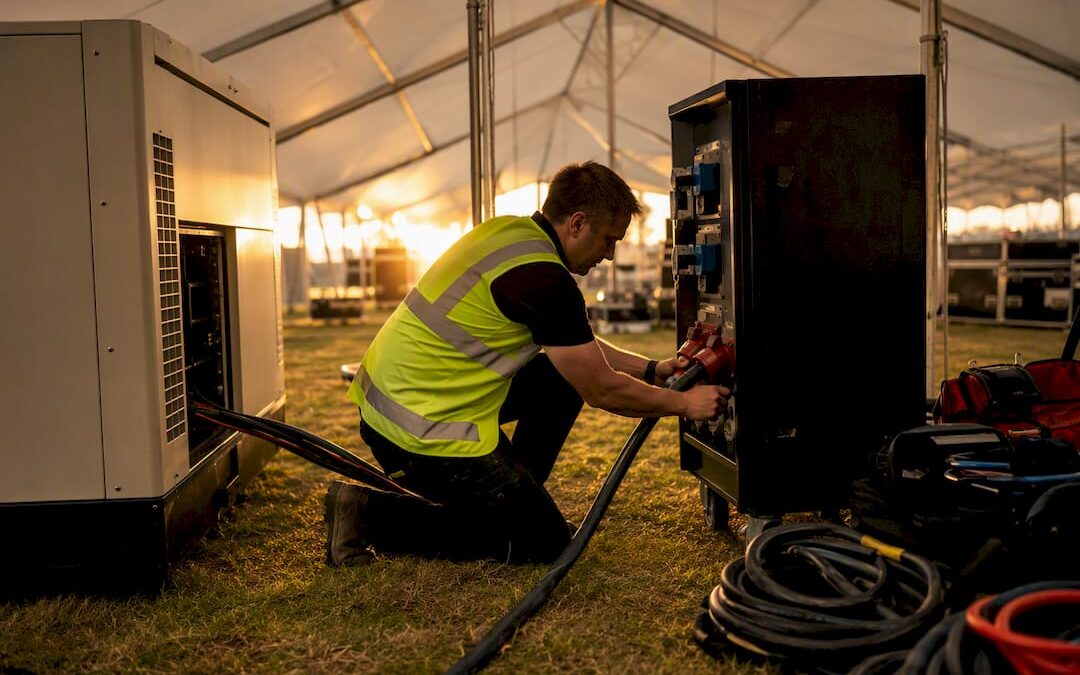
A large marquee needs power sized according to catering load according to, lighting design and guest count, but the honest answer is you calculate it, you don’t guess it. Start by collecting peak watt or amp figures from every supplier, caterer to DJ, before booking anything. If total demand exceeds about a medium household supply capacity, or the site sits away from a mains connection, size a generator at double peak load, and build in 30 mA RCD protection as the non-negotiable safety baseline for every temporary circuit.
TL;DR:
- Generators should be sized at least double the peak load to ensure reliable operation and accommodate inrush currents from equipment like compressors and induction hobs.
- Circuit separation and proper load distribution are more critical to preventing failures than simply overestimating generator capacity, with 16A, 32A, or three-phase supplies recommended for high-draw equipment.
- All temporary electrical systems must comply with BS 7671 and BS 7909 standards, including 30 mA RCD protection, voltage drop limits, and supervision by a qualified person.
- Using mains power is suitable only when the venue has adequate spare capacity and a short connection distance; otherwise, a generator with appropriate safety margins is necessary.
- Proper pre-event documentation, site checks, and standby electrical personnel significantly reduce the risk of failures and safety violations during marquee events.
Table of Contents
- Calculating large marquee power: running loads vs peak loads
- When should you use mains power versus hire a generator?
- What distribution and socket packages do large marquees need?
- What safety standards apply to temporary marquee power?
- How can you reduce marquee power costs without cutting corners?
- What should you check with suppliers before the event?
- What do 40 years of electrical contracting teach you about marquee power?
- Emergency power failure protocols and backup plans
- What permits and regulatory compliance do temporary power setups need?
- Environmental considerations and noise regulations for marquee generators
- What actually reduces risk on a marquee power job?
- How Jaks Party Power takes the guesswork out of marquee power
- Sources
- FAQ
Calculating large marquee power: running loads vs peak loads
Every marquee power calculation starts with two numbers: running load (what everything draws once it’s settled and working) and peak load (the surge when catering equipment, chillers and motors all kick in together). Peak load is what sizes your generator, not running load, because inrush current from compressors and induction hobs can spike two or three times higher than steady-state draw.
Work in amps, not watts, since that’s what your distribution kit is rated in. At the UK’s 230V mains basis, 1,000 watts converts to roughly 4.3 amps, and most planners round to 4.5 A per kW for a fast estimate.
Here’s how that plays out across three common event types:
- A 100 guest wedding marquee with string lighting, a small bar, a DJ and a coffee station typically runs a moderate continuous current, with peaks that can be considerably higher when equipment like fridge compressors and kettles operate simultaneously.
- A 200 guest corporate event with AV, staging lights and a hot buffet regularly needs a significant running current, which climbs substantially at peak demand.
- A catering-heavy layout, such as mobile kitchens with multiple ovens and induction rings, can require very high current loads, separate from guest-facing supplies.
Long cable runs matter too. Long cable runs on a 16 A circuit risk voltage drop exceeding the 5% limit set by BS 7671, so a bigger cable cross-sectional area often costs less than the fault-finding call-out later.
When should you use mains power versus hire a generator?
Mains supply works when the venue has spare capacity, the distance from the intake to your marquee is short, and your total demand sits comfortably within what the building’s supply can spare without starving other users. Most rural sites, farm venues, and anywhere needing more than a domestic supply can offer will need a generator instead.
The sizing rule that matters here: take your calculated peak load and at least double it. Generators run most efficiently and reliably at 50 to 70% of rated capacity, and the NADJ Power Planner builds that safety margin into its recommendations automatically, then rounds up to the nearest available kVA size rather than leaving you short.
A few things worth checking before you commit to a unit:
- Confirm whether the generator is AVR-controlled or true pure-sine, since sensitive electronics like AV desks and lighting consoles can misbehave on dirty power.
- Ask how the generator will be earthed on site. HSE guidance notes that generators usually need their own local earthing arrangement, tested by the installing electrician rather than assumed safe out of the box.
- Ask whether a standby electrician is included, because a technician on site catches a tripped circuit in minutes rather than after the band has already stopped.
Pro Tip: Never book a generator sized exactly to your peak load. Round up to the next available kVA size and treat that headroom as insurance, not waste.
What distribution and socket packages do large marquees need?
Distribution is where a well-sized generator either delivers reliably or gets undermined by a single overloaded socket strip. Domestic 13A sockets are fine for phone chargers and small AV kit, but anything catering-related or high-draw needs 16A or 32A CEE form connectors, and large events regularly need 63A or three-phase distribution boards to split load sensibly.
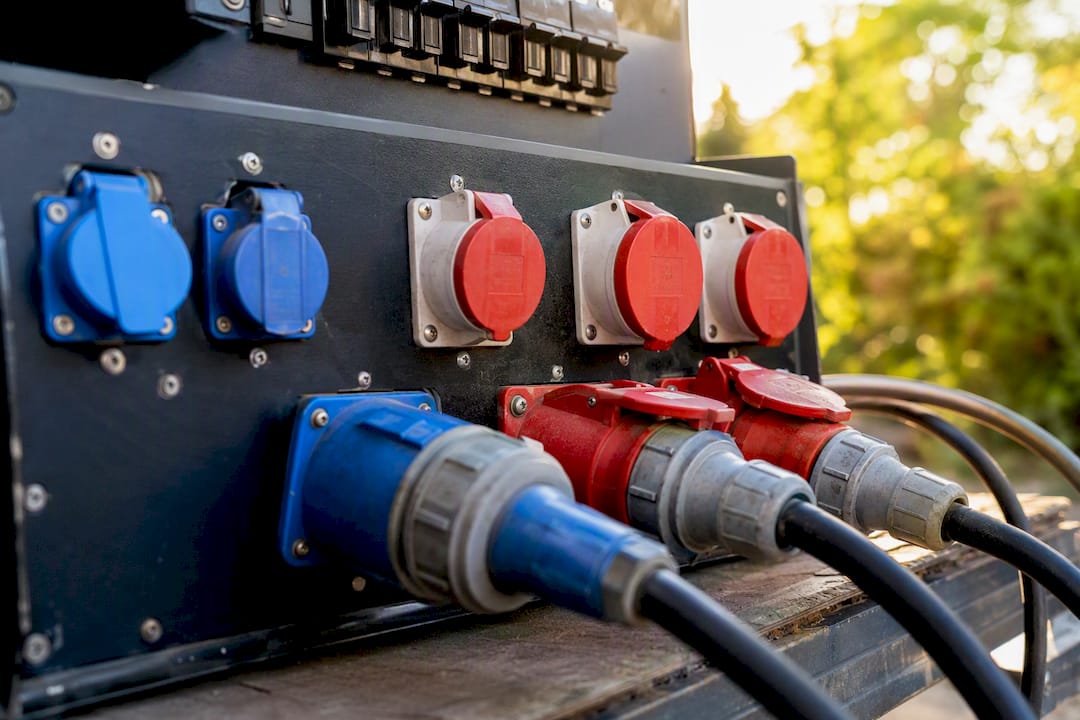
The principle that saves events from mid-service blackouts: never put catering, lighting, PA and climate control on the same circuit. Industry guidance recommends keeping continuous socket loading under 80% and separating critical circuits so one fault trips one line, not the entire site.
A typical large-marquee layout looks like this:
- A dedicated 32A or 63A supply for the catering tent, kept entirely separate from guest-facing power.
- A 16A circuit for lighting and effects, ideally on its own RCD.
- A protected 16A or 32A line for sound and AV, since a nuisance trip here is the most visible failure of the night.
- Domestic 13A outlets reserved strictly for low-draw incidentals.
For anything beyond a modest single marquee, ask your supplier for three-phase distribution rather than trying to stretch single-phase capacity across the whole site. Examples of layouts that work well for larger footprints are worth reviewing before you fix your floor plan.
What safety standards apply to temporary marquee power?
Two standards govern everything here: BS 7671 (the IET Wiring Regulations) for the electrical installation itself, and BS 7909 for temporary systems built specifically for entertainment and event use. Both are non-negotiable, not best-practice suggestions.
- RCD protection: every temporary or outdoor circuit needs 30 mA RCD protection under BS 7671 Regulation 411.3.3, full stop, no exceptions for “just a small load”.
- Voltage drop: keep it under 5%, roughly 11.5V on a 230V supply, or equipment further down the run starts underperforming or failing outright.
- Competent supervision: BS 7909 specifically requires that temporary systems be designed and supervised by a competent person, with equipment pre-tested before it reaches site.
- Organiser responsibility: HSE places overall accountability for electrical safety on the event organiser, which means coordinating contractors and keeping commissioning paperwork, not just trusting that the supplier “sorted it”.
At handover, insist on seeing the RCD test result, an earth resistance reading, and confirmation that circuits are discriminated separately so one fault doesn’t kill the whole event.
How can you reduce marquee power costs without cutting corners?
Cost control in marquee power comes down to reducing run-time and avoiding over-specification, not skipping safety margin. LED fixtures cut lighting draw by roughly 80% against old tungsten rigs, and zoning lighting circuits so unused areas switch off automatically saves fuel across a long event.
- Schedule heavy simultaneous loads, catering peaks and full lighting rigs, apart where the event timeline allows it.
- Choose induction over gas-fired catering equipment where power budget allows; it’s more efficient per dish served.
- Fit a UPS on control desks and lighting consoles rather than oversizing your whole generator just to smooth a brief voltage dip.
- Stagger generator start-up so motors and compressors don’t all draw inrush current in the same thirty seconds.
Pro Tip: A generator idling at 20% load burns almost as much fuel per hour as one running at 60%. Right-sizing beats over-sizing every time.
Monitor fuel levels through the event rather than guessing, since an unplanned refuelling call-out midway through a wedding reception costs far more than the diesel itself.
What should you check with suppliers before the event?
Get this from every supplier in writing before deposit day, not on the morning of the event:
- Peak amps or watts for their equipment, plus any inrush notes for motors, compressors or induction kit.
- Plug and connector type, so nobody arrives with a 32A CEE lead and no matching socket.
- A named commissioning contact who can confirm the installation before doors open.
On site, three things need physical checking before guests arrive: generator siting away from public walkways and fire exits, cable runs protected from trip hazards and weather, and clear signage marking the distribution board location for staff.
Sign-off on the day should include a written RCD test result, an earth-test record, and the mobile number of the competent person who commissioned the system. A pre-event risk assessment checklist makes this far less likely to slip through the cracks when everyone’s focused on flowers and seating plans.
What do 40 years of electrical contracting teach you about marquee power?
The same three mistakes come up again and again on marquee jobs: undersized cable for the run length, domestic extension leads daisy-chained together to reach a distant tent, and every device crammed onto one RCD so a single fault takes down catering, lighting and sound in one go.
A standby electrician on site isn’t a luxury add-on, it’s the difference between a five-minute fix and a stalled event while someone drives out from the depot. Brief your supplier properly: ask for written commissioning documentation, confirm who’s responsible for refuelling during a multi-day event, and get contact details for the person actually attending, not just a head office number.
Emergency power failure protocols and backup plans
Even a correctly sized system fails occasionally, so plan for it rather than hoping it won’t happen. The first decision to make before the event, not during it, is who has authority to call it if power can’t be restored quickly.
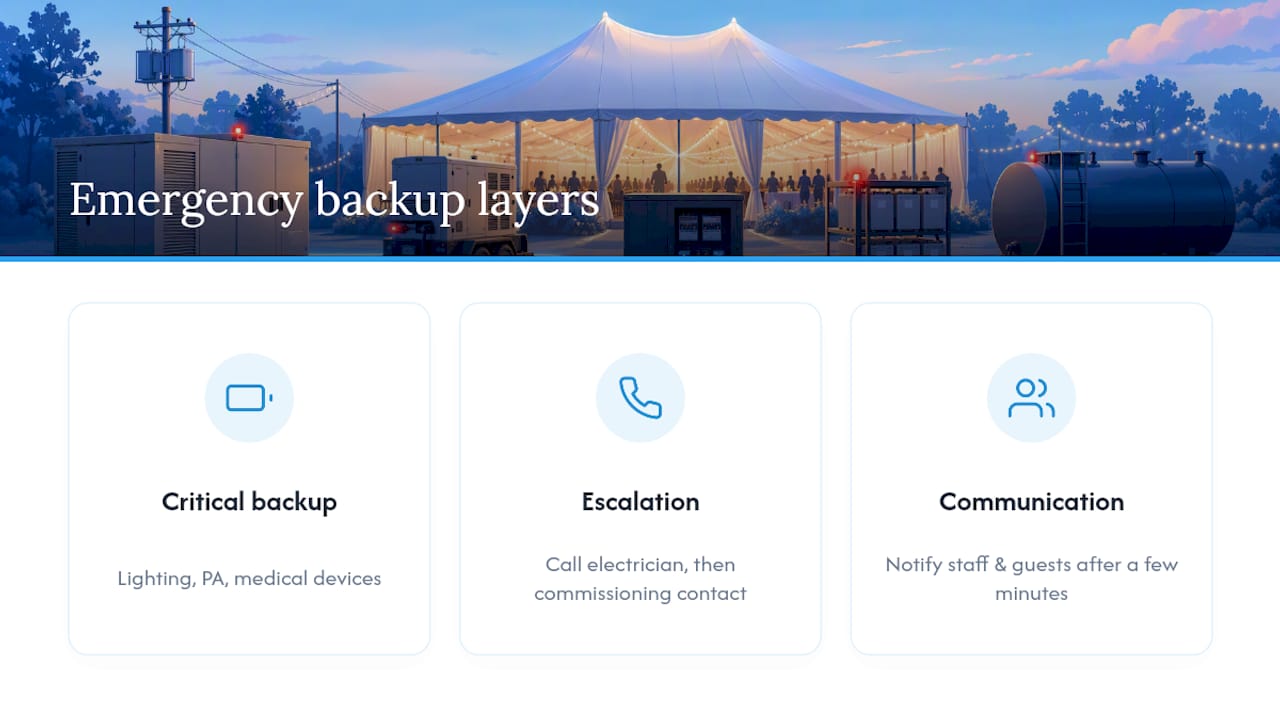
A workable backup plan has three layers. First, a secondary smaller generator or battery backup for genuinely critical circuits only, think emergency lighting, PA announcements and any medical or accessibility equipment, never the full event load. Second, a clear escalation path: who gets called first (the standby electrician or commissioning contact), how quickly they can reach site, and what temporary measures buy time while they travel. Third, a communication plan for staff and guests if the outage runs longer than a few minutes, since panic causes more disruption than darkness itself.
Battery-backed emergency lighting units are worth the modest cost for any marquee holding more than 100 guests, since they satisfy both safety obligations and simple guest reassurance if the main supply drops. For control electronics and AV desks, a UPS bridges the gap between mains failure and generator restart far more cheaply than running two full generators in parallel.
Document the failure protocol in the same paperwork as your commissioning records. If something does trip, having a known sequence, who checks the RCD first, who calls the standby contact, who informs the event manager, turns a stressful ten minutes into a routine one.
What permits and regulatory compliance do temporary power setups need?
Permit requirements for temporary power depend heavily on venue and local authority rather than following one national rulebook. Council-licensed outdoor sites, public parks and city centre locations often require an electrical safety statement as part of the event licence application, while private venues and farmland typically leave compliance entirely between the organiser and their electrical contractor.
What stays constant regardless of venue is the underlying legal responsibility: HSE guidance is explicit that event organisers carry overall accountability for electrical safety, which means keeping documentation ready even where no formal permit is demanded. That documentation should cover supplier load calculations, generator specifications, RCD test results and the name of the competent person who commissioned the installation.
Insurance providers increasingly ask for the same paperwork before confirming event cover, so treat compliance records as something you’ll need twice, once for the local authority or venue, and again for your insurer. Building this into your supplier contract from the start, rather than chasing it after the fact, avoids a scramble in the final week before the event.
If your event involves temporary structures near overhead lines or underground services, additional permissions from the distribution network operator may be required. It’s advisable to check this early due to potentially lengthy approval times.
Environmental considerations and noise regulations for marquee generators
Generator noise is one of the most common complaint triggers at outdoor events, and local authorities increasingly set explicit decibel limits for evening hours, particularly near residential boundaries. Check your venue’s licence conditions or local authority guidance before booking equipment, since a generator that’s perfectly adequate on power can still breach a noise condition if it’s the wrong model for the setting.
Modern super-silenced generators run considerably quieter than older open-frame units, often quiet enough to sit within 20 metres of a marquee without disturbing conversation inside it. Positioning still matters more than most planners expect: siting the unit behind a solid barrier, a vehicle, a wall, even stacked equipment cases, can cut perceived noise significantly without spending more on the generator itself.
Fuel handling carries its own environmental obligations. Diesel spillage on grass or near watercourses is a genuine pollution risk, and most professional suppliers use bunded fuel tanks specifically to contain any leak. Ask whether your supplier’s tanks are bunded as standard, since it’s a quick question that flags whether you’re dealing with a properly equipped operator.
Emissions are becoming a live issue too, particularly for venues with sustainability commitments or council contracts that specify low-emission plant. Where that applies, ask about Stage V compliant engines or hybrid battery-generator setups, which cut both fuel use and idle emissions considerably compared with a generator left running continuously through a quiet afternoon.
What actually reduces risk on a marquee power job?
Most marquee power failures I’ve seen traced back not to underpowered generators, but to distribution decisions made to save a few pounds on cable or a splitter. The conventional advice tells planners to focus on getting a big enough generator, and that matters, but it’s rarely where the actual failure happens. It happens at the socket, the daisy-chained lead, the single RCD covering four unrelated circuits.
If you take one thing from this article, prioritise load separation over raw capacity. A correctly sized generator feeding one poorly distributed circuit will still trip and ruin an evening. A slightly modest generator with proper circuit separation, tested RCDs and a standby electrician on call will get you through almost anything.
The other habit worth building: treat your supplier’s load figures as a starting document, not a final answer. Cross-check them against a proper power planning tool before you sign off on generator size. It takes twenty minutes and it catches the gaps that guesswork misses every time.
— Rob
How Jaks Party Power takes the guesswork out of marquee power
Jakspartypower is the practical alternative to piecing together generator hire, cabling and distribution from separate suppliers who’ve never worked together on your site before. We provide event-spec generator hire sized correctly for your calculated peak load, distribution boards built for the circuit separation this article recommends, and standby electricians who can diagnose a fault in minutes rather than hours.
With over 40 years of electrical contracting experience behind every commissioning sign-off, we handle the RCD testing, earth checks and documentation that keep your event compliant and your insurer satisfied, all as one coordinated package rather than four separate invoices. If you’re planning a wedding, corporate event or large show and need power sized properly the first time, request a bespoke quote or ask us for a pre-event power audit before you commit to a generator size.
Sources
- Temporary installations and BS 7909 guidance
- Electrical safety at events — HSE
- NADJ Power Planner
- BS 7909: Code of practice for temporary electrical systems (BSI Knowledge)
FAQ
How much does a 200 person marquee cost to power?
There’s no fixed figure since it depends on catering intensity and lighting design, but a 200 guest corporate event typically needs 60 to 80 A running load, often requiring a generator in the 30 to 40 kVA range once the double-peak safety margin is applied.
What size marquee suits 60 guests?
A 60 guest event usually fits a marquee suitable for moderate continuous current, with power needs generally lower than larger setups, though catering equipment can push demand higher.
What size marquee do you need for 1,000 guests?
Events at that scale typically need multiple linked marquee structures rather than one single tent, with power planning built around three-phase distribution and generator capacity sized to comfortably cover combined catering, staging and lighting loads.
What size generator does a large event need?
Size the generator at least double your calculated peak load, rounded up to the nearest available kVA size, a rule the NADJ Power Planner applies automatically once you enter your equipment list.
Should I use mains power or hire a generator for my marquee?
Mains works when the venue has genuine spare capacity and the connection is close by; anywhere remote, or where demand exceeds roughly 30 A, a properly sized generator with standby support is the more reliable choice.