
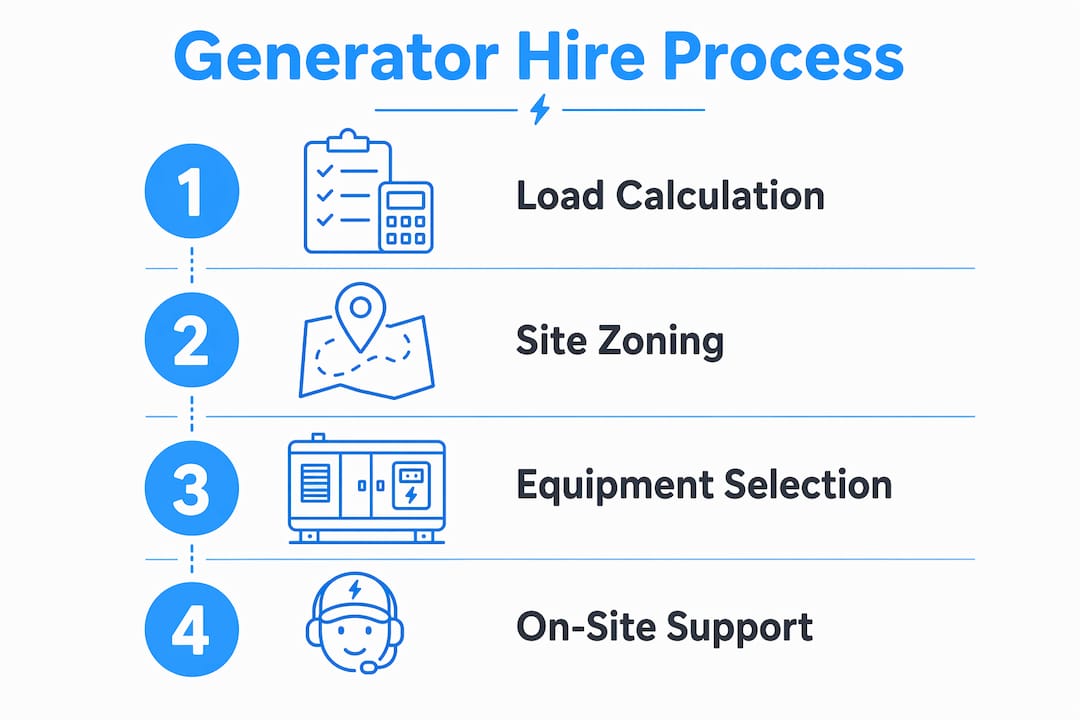
The corporate event generator hire process is a defined sequence of four critical steps: load calculation, site zoning, equipment selection, and on-site support planning. Each step determines whether your event runs on reliable power or faces a costly failure. Get the process right, and your power infrastructure becomes invisible. Get it wrong, and it becomes the only thing anyone remembers. This guide walks corporate event planners through every stage of the event generator rental process, from early preparation through to live-event contingency planning.
What does the corporate event generator hire process involve?
The corporate event generator hire process is the structured method by which planners assess, source, contract, and manage temporary power for corporate events. The industry standard framework covers four stages: load calculation, site zoning, equipment selection, and on-site support. Typical generator requirements range from 30 to 100 kVA for medium-sized events. That range reflects the difference between a 200-person conference with basic AV and a 1,000-person product launch with full staging, LED walls, and catering.
Power planning must also align with your event brief and ROI targets. Every power infrastructure decision should be filtered through the event’s core objectives to prevent unnecessary costs. A generator sized for a festival will not serve a boardroom dinner, and vice versa.

What preparation do you need before starting generator hire?
Early planning is the single biggest factor in avoiding problems. A minimum planning lead time of 6 months is advised to avoid rush fees and limited equipment availability. That window gives you time to gather accurate venue data, confirm load requirements, and compare suppliers without pressure.
Before you contact any supplier, assemble the following documentation:
- Event brief: confirmed guest numbers, programme schedule, and power-dependent equipment list
- Venue details: site plan, access routes, existing power infrastructure, and any restrictions on generator placement
- Vendor contacts: confirmed AV, catering, and staging suppliers with their individual power draw figures
- Budget parameters: production and AV typically account for 10–15% of total event budget, with a 10–15% contingency recommended
For larger events, you will also need structural drawings, local authority permissions, and noise restriction data for generator placement.
| Requirement | Smaller events (under 200 guests) | Larger events (200+ guests) |
|---|---|---|
| Event brief | Basic schedule and equipment list | Detailed production schedule with power schedules |
| Site plan | Sketch with key zones marked | Scaled drawing with cable routes |
| Vendor power data | Estimated figures acceptable | Confirmed technical riders required |
| Permissions | Venue approval sufficient | Local authority and noise assessment needed |
| Lead time | 3 months minimum | 6 months minimum |
Pro Tip: Store all event documentation in a single shared folder, accessible to your venue contact, AV supplier, and generator hire company. Centralising vendor communication into one system prevents the miscommunication that scattered email chains cause.
How do you calculate power requirements and zone the site?
Load calculation is the technical foundation of the entire hire process. Add up the wattage of every powered item at your event: lighting rigs, PA systems, LED screens, catering equipment, and HVAC units. Apply a safety margin of at least 20% above your calculated total. This prevents overload when multiple systems run simultaneously at peak draw.
Site zoning follows directly from load calculation. Event zones must be clearly identified before finalising contracts. Typical zones include the main stage, vendor areas, medical points, catering units, and guest facilities. Each zone needs its own dedicated circuit to prevent one area’s fault from affecting others.
Cable routing is where many planners underestimate complexity. Mapping cable distribution panels such as spider panels or distribution boards reduces voltage drops and tripping hazards. Long cable runs increase resistance, which drops voltage at the end of the run. A qualified electrician or your generator hire company should calculate maximum cable lengths for each zone.
| Generator size | Typical use case | Example equipment supported |
|---|---|---|
| 6–15 kVA | Small corporate dinners, networking events | Basic lighting, PA, laptop presentations |
| 20–30 kVA | Medium conferences, outdoor receptions | Full AV rig, catering, ambient lighting |
| 50–60 kVA | Large product launches, award ceremonies | LED walls, full staging, multiple catering units |
| 80–100 kVA | Multi-zone exhibitions, outdoor shows | Complete production infrastructure |
Key safety considerations during site zoning:
- Keep generator placement at least 10 metres from public areas where possible
- Plan cable routes away from pedestrian walkways and vehicle access points
- Identify earthing points for each generator before the site visit
- Confirm fuel storage complies with site fire safety requirements
Pro Tip: Work directly with your power equipment rental specialist during the load calculation stage. Experienced suppliers will identify load conflicts and zone issues that planners without electrical backgrounds routinely miss.
What criteria should guide equipment selection and contracts?
Equipment selection starts with the load calculation output. Choose generators rated above your calculated peak load, not at it. Alongside the generator itself, confirm that your hire package includes all necessary cables, distribution boards, and connection panels. A generator without adequate distribution is like a mains supply without sockets.
Obtaining three quotes per vendor category is the baseline standard for corporate event procurement. Price matters, but it is not the primary criterion. Evaluate each supplier on their responsiveness, references, and flexibility. Slow responsiveness during quoting predicts vendor challenges during live events. A supplier who takes four days to return a quote will not respond quickly when a distribution board trips at 8:00 PM during your keynote.
Your contract must be explicit on the following points:
- Deliverables: exact equipment list with model numbers or specifications
- Delivery and collection times: confirmed windows with named contacts on both sides
- Setup and breakdown responsibilities: who connects, who tests, who signs off
- Fuel policy: who supplies fuel, at what intervals, and who monitors tank levels
- Insurance and liability: confirmed public liability coverage and equipment damage terms
- Emergency contact: a named technical contact available throughout the event, not just a general office number
Avoid informal agreements. An email chain is not a contract. If a supplier resists putting terms in writing, treat that as a warning sign. The corporate event setup vendor checklist approach, where every vendor commitment is documented before the event, is the standard that protects planners when things go wrong.
What should on-site support planning include?
On-site support planning covers everything that happens from generator delivery through to post-event collection. The most common failure point is not equipment quality. It is the absence of a qualified person on-site who can respond immediately when something goes wrong.
A complete on-site support plan includes:
- Delivery and installation schedule: confirmed arrival time, access route, and installation sequence
- Pre-event testing: full load test before guests arrive, with sign-off from a qualified electrician
- Fuel management: confirmed fuel type, starting tank level, consumption rate estimate, and resupply plan for events over 8 hours
- Technical standby: a named electrician or generator technician on-site for the full event duration
- Emergency switching protocol: a written procedure for transferring load to a backup unit if the primary generator fails
Backup power is not optional for high-stakes corporate events. A standby generator on-site is essential when the event involves live broadcasts, keynote speeches, or time-critical presentations. The cost of a backup unit is minimal compared to the revenue loss or reputational damage from a power failure during a live moment.
Key checklist items for on-site power management:
- Confirm generator fuel level at least 2 hours before event start
- Test all distribution circuits individually before opening to guests
- Establish a direct communication line between the technical standby and the event production manager
- Agree a clear escalation path: technician, then hire company emergency line, then venue facilities manager
Pro Tip: Ask your hire company whether their standby service includes a dedicated on-site technician or only a remote call-out. On-site presence is the only option that provides a fast enough response for live events.
What are the most common mistakes in generator hire for corporate events?
The most damaging mistakes in the generator hire process are not technical. They are logistical and contractual.
- Compressing the planning timeline: booking a generator within 4–6 weeks of the event limits your equipment options and removes your negotiating position
- Relying on email chains as contracts: verbal agreements and email threads leave liability undefined when disputes arise
- Skipping site zoning: placing a single generator without mapping cable routes creates voltage drop, tripping hazards, and zone conflicts
- Ignoring backup power: assuming the primary generator will not fail is the most expensive assumption in event production
- Choosing on price alone: the cheapest quote rarely includes adequate on-site support, fuel management, or emergency response
Vendor responsiveness during the quote phase is a reliable predictor of their ability to perform under pressure during the event. A supplier who communicates clearly and quickly before the contract is signed will do the same at 9:00 PM when your main stage loses power.
Pro Tip: Review common event setup mistakes before finalising your supplier shortlist. Knowing what typically goes wrong gives you the right questions to ask during the quoting process.
Key takeaways
The corporate event generator hire process succeeds when planners combine accurate load calculation, detailed site zoning, clear contracts, and confirmed on-site technical support before the event day.
| Point | Details |
|---|---|
| Start planning early | A minimum 6-month lead time avoids rush fees and equipment shortages. |
| Calculate load accurately | Size generators above peak load, not at it, and apply a 20% safety margin. |
| Zone the site before contracting | Map all event zones and cable routes before finalising any supplier agreement. |
| Secure a detailed contract | Define deliverables, fuel policy, insurance, and emergency contacts in writing. |
| Plan for backup power | A standby generator on-site is non-negotiable for high-stakes corporate events. |
Why I treat generator hire as a production decision, not a logistics one
Most planners I speak to treat generator hire as a procurement task. They get three quotes, pick the middle price, and move on. That approach works until it doesn’t, and when it fails, it fails publicly.
The planners who avoid power problems treat generator hire as a production decision. They involve their hire company at the same stage they bring in the AV supplier, not after the staging plan is finalised. Hiring a single full-service partner for power, AV, and staging dramatically reduces miscommunication and keeps production schedules intact. When one company understands the full technical picture, cable conflicts and load clashes get resolved in planning, not on the day.
The other thing I have observed consistently is that planners underestimate how much the on-site technician matters. The generator itself is almost always fine. What varies is the quality of the person managing it. A qualified technician who knows the site plan, has tested every circuit, and has a direct line to the production manager is worth more than any equipment upgrade.
My recommendation is straightforward. Build your generator hire timeline alongside your production schedule, not after it. Treat your hire company as a technical partner, not a delivery service. And never, under any circumstances, go into a high-stakes event without confirmed backup power on-site.
— Rob
Jakspartypower: full-service generator hire for corporate events
Corporate events need power that works without anyone noticing it. Jakspartypower provides generator hire with delivery, installation, fuel management, and on-site technical standby, covering everything from small networking events to large-scale award ceremonies across Sussex.
With over 40 years of electrical contracting experience, Jakspartypower brings technical depth that general hire companies cannot match. Every hire includes distribution boards, cables, and the support infrastructure your event actually needs. Browse the full generator hire options or view the complete event hire services to find the right solution for your next corporate event.
FAQ
What is the corporate event generator hire process?
The corporate event generator hire process is a four-stage framework covering load calculation, site zoning, equipment selection, and on-site support planning. Each stage must be completed in sequence to ensure reliable temporary power for the event.
How far in advance should I book a generator for a corporate event?
Book at least 6 months in advance to avoid rush fees and limited equipment availability. Larger events with complex power requirements may need even longer lead times.
What size generator do I need for a corporate event?
Medium-sized corporate events typically require between 30 and 100 kVA, depending on the equipment load. A qualified supplier should confirm the exact size after reviewing your full equipment list and site plan.
Do I need a backup generator at a corporate event?
A standby generator is essential for any corporate event involving live presentations, broadcasts, or time-critical programming. The cost of a backup unit is far lower than the cost of a power failure during a key event moment.
What must a generator hire contract include?
A generator hire contract must define the equipment list, delivery and collection times, setup responsibilities, fuel policy, insurance liability, and a named emergency contact available throughout the event.