
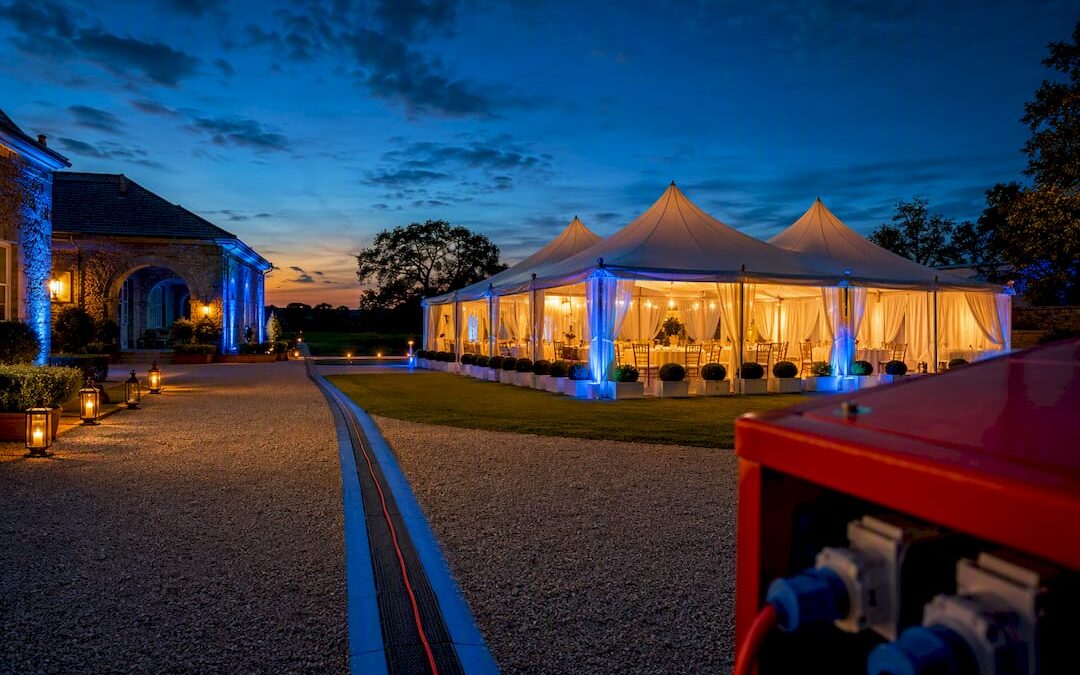
The fastest reliable route for most remote wedding venues is a battery-first setup for guest-facing zones, backed by a generator for catering and extended runtime. Get a load schedule down on paper before you ring anyone, and book a site survey early, because access and cable routes decide what’s actually possible long before kit specs do. The rest of this guide covers the options, how to size them, and what to demand from a supplier.
TL;DR:
- Battery power stations are ideal for guest zones to minimize noise and smell, but larger events may require hybrid systems combining batteries and generators.
- Proper load calculation involves listing devices, noting surge power, estimating usage, adding 20% for safety, and testing worst-case scenarios to prevent trips.
- Site cable routing and safety measures, such as proper enclosures, labeling, and zoning, are critical to prevent hazards and reduce trip risks.
- Securing early permissions hinges on understanding local rules, scheduling generator noise, and opting for battery setups to simplify approvals.
- A thorough site survey, load schedule, and clear communication with suppliers are essential for reliable power, especially for remote or rural wedding venues.
Table of Contents
- Remote venue power: your options compared
- How much power does your venue actually need?
- Where to put plant and how to run cable safely
- Do you need council permission for event power?
- What does event power actually cost?
- What to ask a power supplier before you book
- What 40 years of installs teaches you about remote power
- Why product shopping is the wrong place to start
- How Jaks Party Power supports remote and rural venues
- Where to read more on event power standards
- Sources
- FAQ
Remote venue power: your options compared
Rural venues rarely have three-phase mains, and single-phase supplies trip the moment a caterer’s oven and the DJ rig fire up together. That’s the whole problem in one sentence: not “no power,” but “not enough of the right power in the right place.” Here’s how the main options stack up.
- Diesel or petrol generators: still the right tool when you need long, unattended runtime for catering vans, marquee heaters, or a multi-day event. They cost nothing in battery capacity and refuel in minutes, but they’re loud, they smell, and guests notice both.
- Battery power stations: quiet, safe indoors, and limited only by stored energy rather than fuel supply. They’re the obvious pick near the ceremony arch, the top table, or anywhere a generator’s hum would spoil the photos.
- Hybrid systems: pair a battery bank with a generator that only fires when the battery dips below a set threshold. You get near silent running most of the night with a fuel-backed safety net for the bits that actually need it.
- Solar charging: useful as a top-up for battery banks over a multi-day setup, not a primary source for a single evening event. British weather alone makes it a poor bet as your only plan.
For scale, NXTGENbps reports battery units running events from 2kWh right up to 350kWh, with one coffee van covering a nine hour shift on 14.6kWh. That range tells you battery power isn’t a niche option anymore. A small marquee with lighting and a PA suits battery alone; full hot catering usually needs a generator or hybrid; a multi-day festival-style wedding wants both, zoned properly.
How much power does your venue actually need?
Work in two units, not one: watts (W) measure the power a device draws right now, watt-hours (Wh) measure the total energy it uses over time. Generators are usually rated in kW because they can sustain a load indefinitely from fuel; battery power stations are rated in Wh because they run out. Confusing the two is the single most common sizing mistake, and it’s why comparisons between inverter generators and battery stations insist on separating peak power from stored energy before you compare anything else.
Here’s the method:
- List every device that will draw power: lighting rig, PA, caterer’s equipment, phone charging points, heaters.
- Note continuous watts for each, then check the startup surge, motors and compressors can draw two to three times their running wattage for a second or two.
- Estimate hours of use, then multiply watts by hours to get Wh for anything running off a battery bank.
- Add roughly 20% headroom on top of your highest simultaneous total to cover surges you didn’t account for.
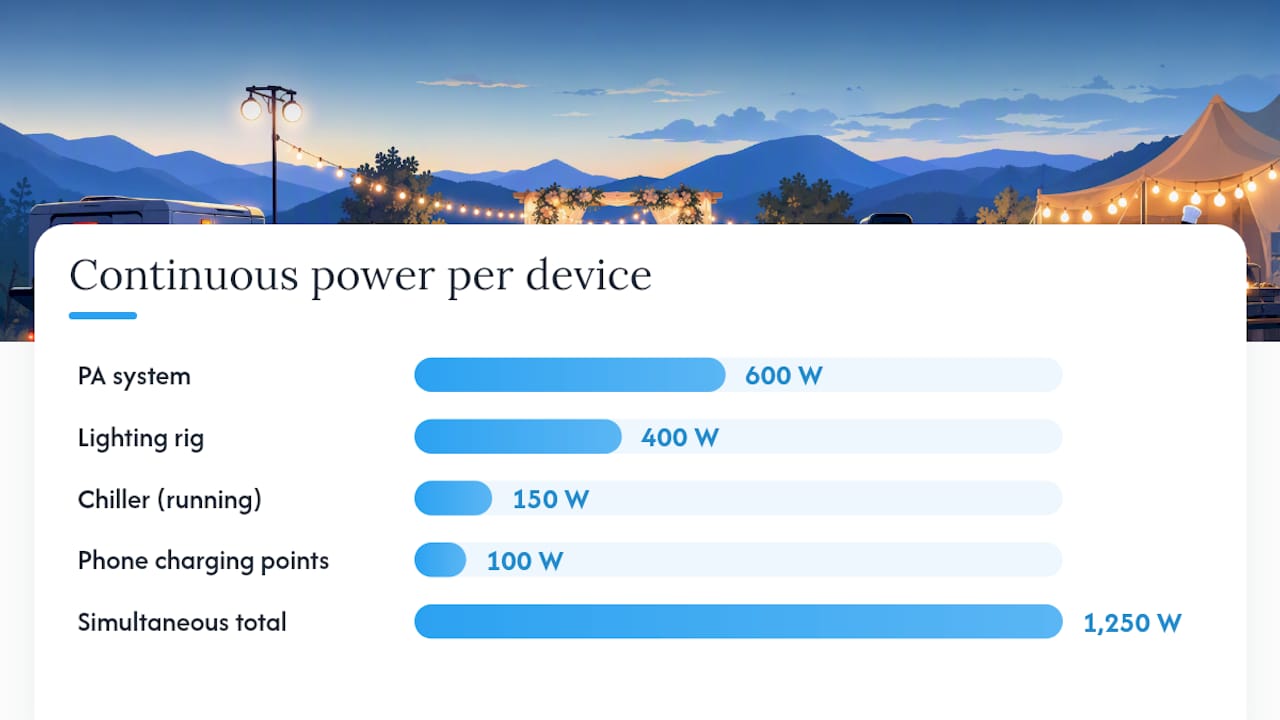
A worked example: a marquee wedding running a lighting rig (400W), a PA system (600W), a chiller for drinks (150W continuous, higher on startup), and phone charging (100W) over a six hour reception draws roughly 1,250W continuously. That’s around 7.5kWh for the evening, before headroom.
Pro Tip: Test your hardest-case scenario deliberately, run the chiller compressor’s startup surge at the same moment the band plugs in. That overlap, not the average load, is what trips a system on the night.
Where to put plant and how to run cable safely
Site plant away from guest thoroughfares, ideally behind a barrier with clear warning signage, and never on a route vehicles or catering trolleys will cross. HSE’s event electrical safety guidance points specifically to BS 7909 for temporary event power, and it covers exactly this: layout, earthing, cable routing, and clear isolation points that a competent installer should already have in hand.
- Route cables under ramps, never loose across walkways, and use IP-rated enclosures and glands anywhere cable meets ground or weather.
- Confirm correct fusing, RCD protection, and proper earthing on every distribution point, not just the main feed.
- Label isolation points clearly so anyone on site, caterers included, can find the right switch in an emergency.
- Weatherproof everything and lock plant away from public access, particularly after dark when curious guests wander.
Zoning matters here too: smaller distributed battery units at the ceremony, bar and catering areas shorten cable runs dramatically compared with one big generator feeding the whole site, which cuts trip hazards as a direct consequence. Our cable management guide covers the routing detail in full.
Do you need council permission for event power?
Check three things early: the venue’s own licence conditions, landowner permission for any generator siting, and your local council’s noise guidance, particularly for rural sites near residential boundaries. Battery-first setups sidestep most of this because there’s no engine noise to manage. This is one reason battery adoption at events is rising; it simplifies the approvals conversation as much as it improves the guest experience.
- Schedule any generator running to daytime or early evening windows where possible, not through to midnight.
- If a generator is unavoidable, ask your supplier about silent or acoustic enclosure options.
- Write a one-page noise management plan: generator hours, enclosure type, and a contact number, and share it with the venue.
- Loop in environmental health only if the venue or council specifically requests it, most rural weddings never need to.
What does event power actually cost?
Cost swings on more variables than the headline hire rate. Unit hire is just the start, delivery distance, setup time, fuel and refuelling logistics, operator hours if you want standby cover, insurance, and the cabling itself all add up separately.
- Hire vs buy: hire almost always wins for a one-off wedding. Buying only makes sense if you’re running events regularly and have somewhere dry to store and maintain kit between jobs.
- Fuel logistics: safe fuel storage away from guest areas and a clear refuelling window that doesn’t clash with the ceremony or speeches.
- Operator hours: a standby operator costs more upfront but removes the risk of nobody on site knowing where the isolation switch is.
- Access: confirm delivery vehicles can actually reach the plant location, remote venues sometimes mean a farm track, not a car park.
What to ask a power supplier before you book
Compare quotes properly by putting the same questions to every supplier. This checklist keeps that comparison fast and fair.
- Insist on a site survey and written load schedule before accepting any quote, not just a phone conversation about your guest numbers.
- Ask for evidence of insurance and competent person credentials, plus a safety method statement referencing BS 7909 where temporary power is involved.
- Confirm exactly what’s included: distribution boards, RCD protection, cable ramps, operator hours, a refuelling plan if a generator’s involved, and whether standby cover is on offer.
- Get an on-day contact name and number, and ask what contingency capacity they hold if a unit fails mid-event.
- Request test reports or references from a similar previous install, a supplier who’s done a marquee wedding on a farm before will spot problems you haven’t thought of.
Pro Tip: Put all five questions in writing and send them to every supplier you’re comparing. The ones who answer properly, rather than just quoting a day rate, are the ones worth booking.
What 40 years of installs teaches you about remote power
Jaks Party Power has run electrical contracting and event power installs for more than 40 years, and the pattern that keeps repeating is simple: failures happen at the boundary between zones, not inside them. One rural wedding brief called for a single generator to cover ceremony, bar and catering from one point 80 metres away. A site survey flagged the cable run as the actual risk, not the generator’s capacity, and the fix was splitting into three zones with a battery unit near the ceremony and a smaller generator tucked behind the catering tent.
The load schedule matters more than the kit list. Get the sequence of who draws what, and when, right, and the equipment choice becomes the easy part.
A second install, a two-day marquee event on a private estate, needed redundancy built in from the start: a hybrid setup with the battery bank carrying overnight lighting while the generator ran only for catering hours. Both jobs point to the same lesson: zone first, test the worst-case load together, and build in one spare capacity path before the day, not during it.
Why product shopping is the wrong place to start
Most guidance on this topic leads with kit, “which generator,” “how many kW,” and that’s backwards for a wedding on a remote site. The real decision is the load schedule: what draws power, when, and what happens if two things draw simultaneously that you didn’t plan for. Get that wrong and no amount of generator capacity saves you, because the failure is almost always a cable run, an unzoned circuit, or a startup surge nobody tested for, not a shortage of raw watts.
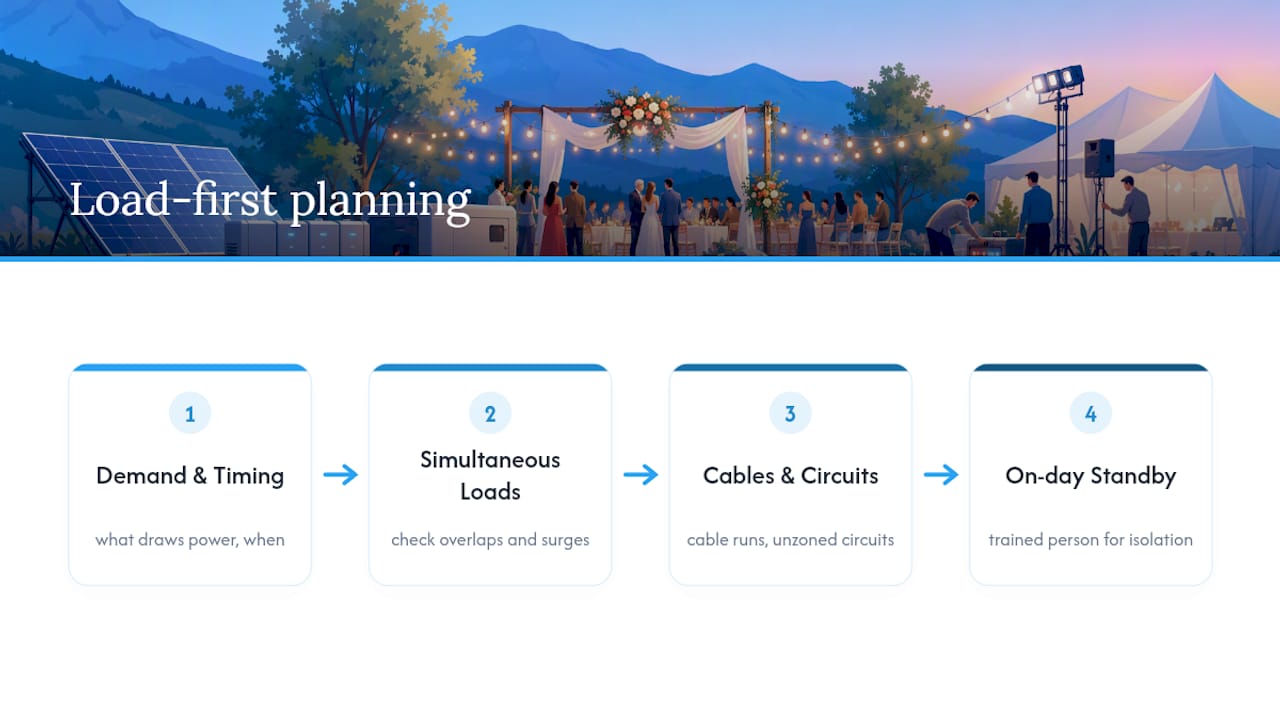
Conventional advice also underrates on-day standby. A written schedule is only as good as the person who can act on it when the chiller trips at 6pm during speeches. Every install that’s gone smoothly on a farm or estate has had someone on site who knew the isolation points cold, and every scramble has come from assuming the kit would just run itself.
If there’s one thing worth prioritising above the rest, it’s this: decide your zones before you ask a single supplier for a quote. Ceremony, catering, bar, and back-of-house each behave differently, and treating them as one big load is how remote weddings end up with a generator that’s technically big enough and still trips at the worst possible moment.
— Rob
How Jaks Party Power supports remote and rural venues
Jaks Party Power is the option that gives you a written load schedule and standby cover as standard, not as an upsell you have to ask for. Whether your venue needs a single battery unit tucked behind the ceremony arch or a full hybrid setup with generator backup for a two-day marquee event, the process starts the same way: a site survey, a proper load schedule, and equipment matched to what your day actually needs rather than a generic package.
Distribution boards, cabling, and standby operator hours all come from the same team, so nothing falls through the gap between suppliers on the day itself. If you’re planning a remote wedding or rural event and want a straight answer on what power setup fits your site, get a quote for generator hire and start with the survey before you commit to anything.
Where to read more on event power standards
For further reading, see HSE’s electrical safety at events guidance and our own event power planning stages guide for a practical planning timeline.
Sources
- HSE — Electrical safety at events
- Temporary power solutions — London Audio Visual Hire
- Battery power for live events — NXTGENbps
- Power station vs generator — Portable Power Station guides
- Inverter electric generator vs portable power station — OUPES UK
FAQ
How long will a battery power station last at a wedding?
Runtime depends entirely on your load in Wh, not the battery’s headline capacity; a battery bank running lighting, a PA and phone charging typically covers a six hour reception with margin to spare.
Can I use a generator indoors at a marquee wedding?
No, generators need ventilation and produce exhaust fumes, so they must run outdoors; battery power stations are the safe choice for anything inside a marquee or building.
Do I need a generator and a battery system, or just one?
Most remote weddings do best with a hybrid approach: battery power for guest-facing zones like the ceremony and bar, with a generator reserved for catering or extended multi-day runs.
Should I hire an operator for standby cover?
Yes, if your event has multiple power zones or runs longer than a single evening; a standby operator who knows the isolation points prevents a minor trip becoming a stopped event, and Jaks Party Power includes this as part of its hire packages.
What’s the biggest mistake planners make when sizing power?
Buying on watts alone rather than working out watt-hours needed and testing the worst-case moment when several high-draw devices start simultaneously.