
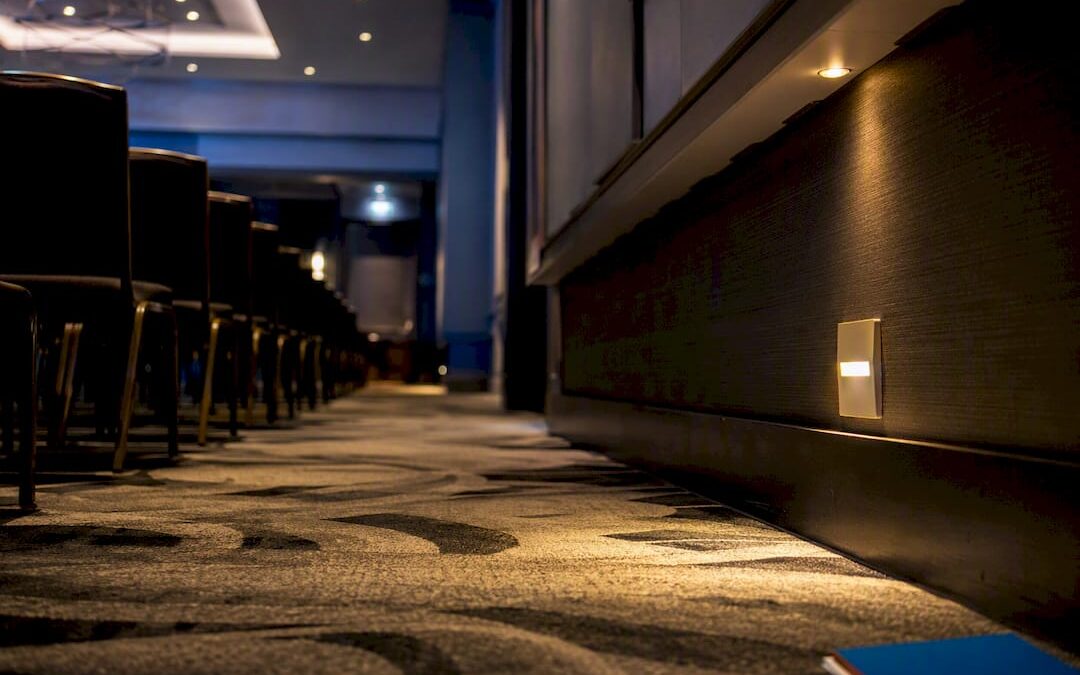
Event emergency lighting must provide automatic, independent illumination for escape routes and safety points for a minimum duration of illumination for an adequate period of time if the main power fails, and it must switch on without anyone touching a switch. Before you sign off any installation, check three things: whether the power source is genuinely independent and automatic, whether the system can hold a runtime long enough to maintain illumination appropriately, and whether the supplier can hand you a completion certificate with a named person responsible. If any of those three is missing, the system isn’t ready for the public.
TL;DR:
- Emergency lighting systems must have a genuinely independent power source that activates automatically without manual intervention during power failures.
- The minimum required runtime for emergency lighting is three hours, and both battery and generator solutions need to meet specific capacity and testing standards.
- Proper installation demands accurate lux level checks of at least 1 lux along escape routes and 0.5 lux in open areas, excluding illuminated exit signs, which do not count toward these figures.
- Suppliers must provide clear documentation, including completion certificates, test logs, and the appointed Senior Person Responsible, before the event begins.
- Common on-site mistakes include confusing floodlighting with emergency lighting, neglecting to re-certify after layout changes, and routing cables openly, all of which can compromise safety.
Table of Contents
- What UK standards actually require of event lighting
- Your handover checklist before the public arrives
- Battery units or generators: matching power to the venue
- What to put in your hire spec and quote request
- Mistakes that keep coming up on-site
- Why professional standby cover changes the risk picture
- How Jaks Party Power can help with your next event
- Sources
- FAQ
What UK standards actually require of event lighting
The rulebook here isn’t complicated once you strip out the jargon, but it is specific, and getting it wrong is one of the more common ways events fall foul of their licence conditions.
BS 5266-1 sets the baseline: emergency lighting must maintain adequate illumination for a minimum illumination duration from the moment the main supply fails. That figure isn’t negotiable, and hire kit rated for less simply doesn’t qualify, no matter how bright it looks in daylight.
You’ll also come across two terms suppliers throw around casually: maintained and non-maintained. Maintained luminaires stay lit continuously, on mains or battery, which is why they’re the standard choice for exit signs and areas that need constant visibility. Non-maintained units only activate when the mains supply cuts out, and they’re common on escape route lighting where constant illumination isn’t required outside a power failure.
BS 7909 governs temporary electrical installations at events and introduces the Senior Person Responsible (SPR), a named, competent individual accountable for the system’s design, commissioning and ongoing safety. Appointing an SPR isn’t a courtesy. It’s the control point insurers and licensing authorities look for when something goes wrong.
For illuminance, CIBSE Lighting Guide 12 and the BS 5266 pocket guidance give practical targets:
- Escape routes need at least 1 lux along the centre line.
- Open areas, such as marquee interiors or assembly points, need at least 0.5 lux across the core floor space.
- Illuminated exit signs do not count towards these lux figures. They’re for wayfinding, not evacuation lighting.
HSE guidance is blunt about the power source too: emergency lighting must run from an independent supply, separate from whatever powers your stage, bar or marquee lighting, so a single fault doesn’t take everything down at once.
Your handover checklist before the public arrives
Getting this right on the day comes down to paperwork and a few physical checks you can do in twenty minutes with a lux meter and a torch. Here’s the sequence that actually works.
- Request the documents first. Ask for the electrical risk assessment, the method statement, completion certificates, test logs, and the SPR’s name and contact details. If a supplier can’t produce these before the gates open, that’s your answer about whether to proceed.
- Test the automatic changeover. Isolate the main supply briefly (with the supplier present) and confirm the emergency lighting activates without delay and without anyone flicking a switch.
- Spot-check the lux levels. Take readings along the centre line of at least two escape routes and inside the main open area. You’re looking for 1 lux and 0.5 lux respectively, not a rough guess.
- Confirm exit signage is maintained and lit. Every designated exit should show a continuously lit, maintained illuminated sign, not just an emergency-only unit.
- Check battery or generator runtime. Ask the supplier to confirm when batteries were last serviced or when the generator was last load-tested, and get a fuel or refuelling plan in writing for anything running longer than a few hours.
- Agree a failure procedure. Know who to call and how fast they’ll respond if a luminaire fails mid-event.
Pro Tip: Keep a printed copy of the completion certificate and SPR contact in your event safety folder on-site, not just in your inbox. Licensing officers and fire safety inspectors will ask for it on the day, and a phone with no signal is not a filing system.
File everything: the handover sign-off sheet, certificates, and test logs. That folder is what protects you if there’s ever an incident review.
Battery units or generators: matching power to the venue
Small indoor spaces with shorter durations can often be served with self-contained battery-powered maintained luminaires. They’re simple, quick to deploy, and adequate for a marquee bar area or a single function room where the footprint is modest and the event ends before midnight.
Wide outdoor sites and large marquees are a different problem. Covering multiple escape routes across a big footprint for a full three-hour minimum typically demands an automatic-start generator or a central battery bank sized with real headroom, not just enough capacity to scrape by. Battery hand-lights alone rarely cover the distances involved.
If a generator is in the mix, check these before you accept the hire:
- Automatic transfer switch (ATS) fitted and tested, so changeover happens without manual intervention.
- Load headroom confirmed for the emergency lighting circuit specifically, not just the generator’s total rated output.
- Fuel plan covering the full event duration plus a safety margin, with a named person responsible for monitoring levels.
- Earthing arrangement appropriate for outdoor temporary supplies, generally TT earthing where practicable, paired with RCD protection suited to the connected lighting load.
What to put in your hire spec and quote request
A vague brief gets you a vague quote. Spell these out in writing when you approach a lighting hire supplier:
- Compliance with BS 5266-1 and BS 7909, stated explicitly in the quote, not implied.
- An independent, automatically operating power source, whether battery bank or generator.
- Completion certificate and test log supplied at handover, before doors open.
- Maintained or non-maintained status for every luminaire type, plus guaranteed required runtime.
- Battery age and service history, or the ATS model, for generator-backed systems.
- Insured standby engineer availability, attended start-up, and who owns fuel or refuelling responsibility.
- A written handover procedure confirming certification is on-site before the public are admitted.
Ask these questions before you book, not after the kit arrives. A supplier confident in their inspection process will have answers ready without hesitation.
Mistakes that keep coming up on-site
The same handful of errors cause most of the trouble, and all of them are avoidable.
- Swapping floodlighting for emergency lighting. Floodlighting causes glare that impairs evacuation rather than helping it. Diffused festoon lighting along escape routes performs better and is what HSE guidance recommends.
- Assuming exit signs cover the lux requirement. They don’t. Signage is for direction, not illumination, so check actual lux readings separately.
- Leaving cables and distribution boxes exposed. Physically protect cable runs, lock distribution boxes, and never route cables across public thoroughfares unprotected.
- Skipping re-certification after layout changes. Move a marquee wall or add a bar and the coverage may no longer meet requirements. Re-test and log any change.
Pro Tip: If your layout changes even slightly between the site survey and the event itself, tell your supplier. A five-minute call beats discovering a dark corridor during a real power cut.
Why professional standby cover changes the risk picture
Most organisers don’t fail because they didn’t care about emergency lighting. They fail because they treated it as a box to tick rather than a live system that needs monitoring throughout the event.
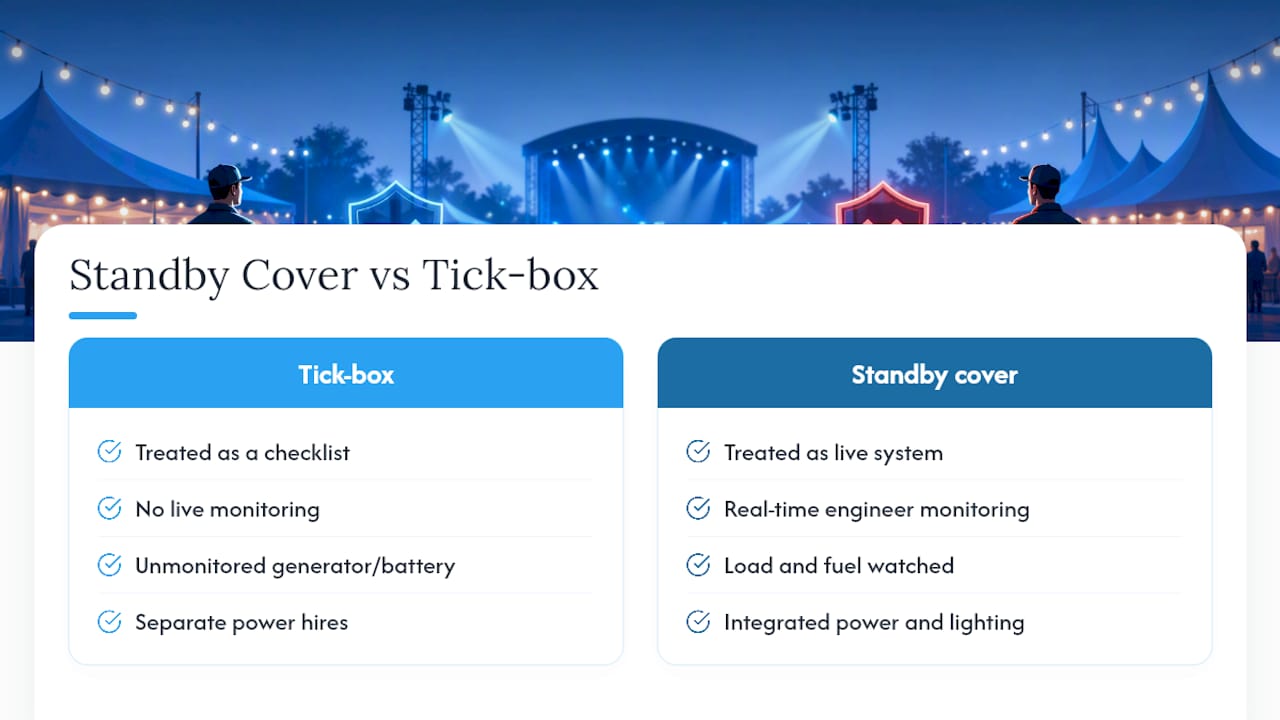
Our approach addresses that gap by combining extensive electrical contracting experience with equipment specified for event use. That matters because a generator or battery bank sitting unmonitored for six hours is a different risk proposition to one with a standby engineer watching load and fuel in real time.
The range covers generators, lighting, distribution boards and standby support, so the emergency lighting isn’t bolted onto a separate power setup as an afterthought. It’s part of one coordinated system, commissioned and tested together rather than assembled from mismatched hires at the last minute.
— Rob
How Jaks Party Power can help with your next event
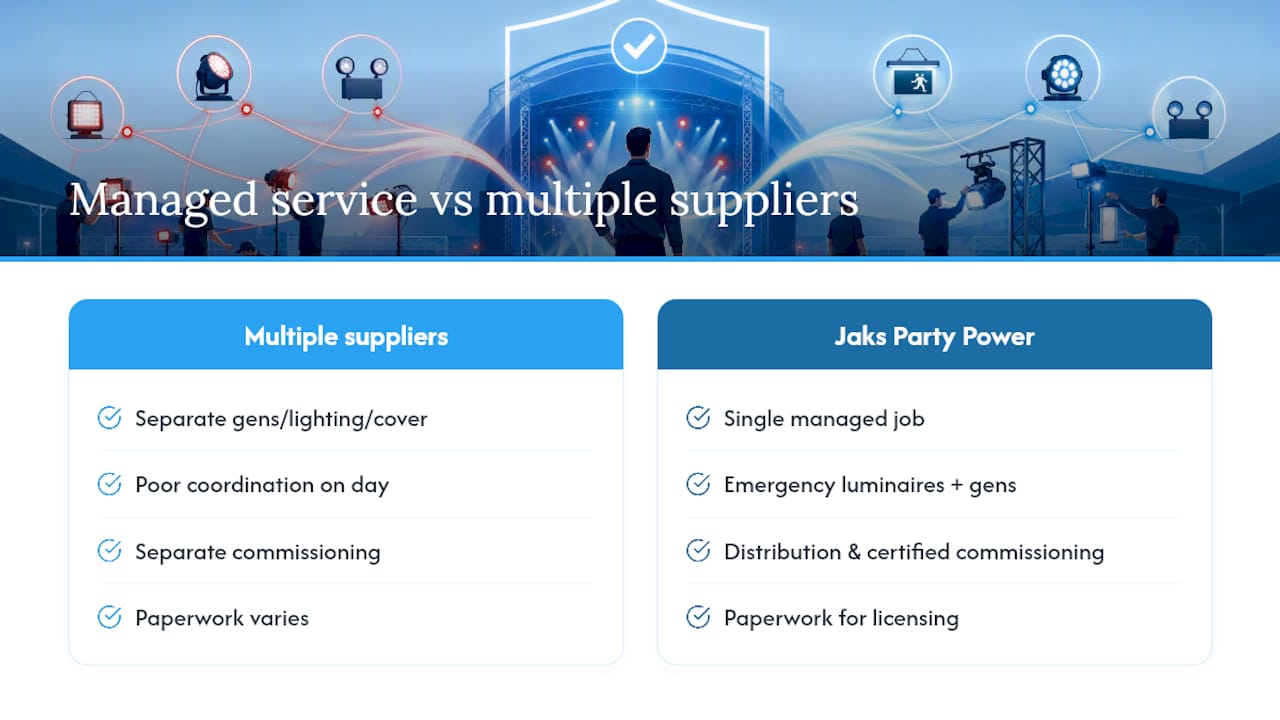
There’s a reason so many organisers end up managing three separate suppliers for generators, lighting and standby cover, then discovering none of them talk to each other on the day. The service is managed as one job: emergency luminaires, automatic-start generator hire, distribution, and certified commissioning, delivered and tested as a single system before you open the gates.
Standby options range from an onsite engineer monitoring load and fuel throughout the event to a fully monitored standby package with a fixed response time if anything trips. Both come with the paperwork licensing officers actually ask for.
To get a fast, accurate quote, send over your site plan, expected electrical loads, event hours and site access details. Head to Jaks Party Power to request a survey or check generator availability for your dates.
Sources
Attach these to your event safety folder alongside your supplier’s certificates. They’re the primary references behind every requirement covered above.
- Derbyshire Fire & Rescue Service: Event safety (emergency lighting excerpt)
- HSE: Electrical safety at events
- BS 5266 emergency lighting pocket guide (IHEEM)
FAQ
What is the required runtime for event emergency lighting?
Emergency lighting must maintain adequate illumination for at least three hours after the main power supply fails, under BS 5266-1.
What’s the difference between maintained and non-maintained lighting?
Maintained luminaires stay lit continuously, while non-maintained units only switch on when the mains supply fails, and events typically use both depending on the area.
Who is the Senior Person Responsible under BS 7909?
The SPR is a named, competent individual accountable for the temporary electrical system’s design, commissioning and safety, and must be appointed in writing before the event.
Do exit signs count towards emergency lighting lux requirements?
No, illuminated exit signs are for wayfinding only and don’t satisfy the 1 lux escape route or 0.5 lux open area minima.
Can a battery unit replace a generator for large outdoor events?
Rarely sufficient alone. Wide outdoor coverage over the required duration typically needs an automatic-start generator or central battery bank, which suppliers like Jaks Party Power size for the event’s footprint.