
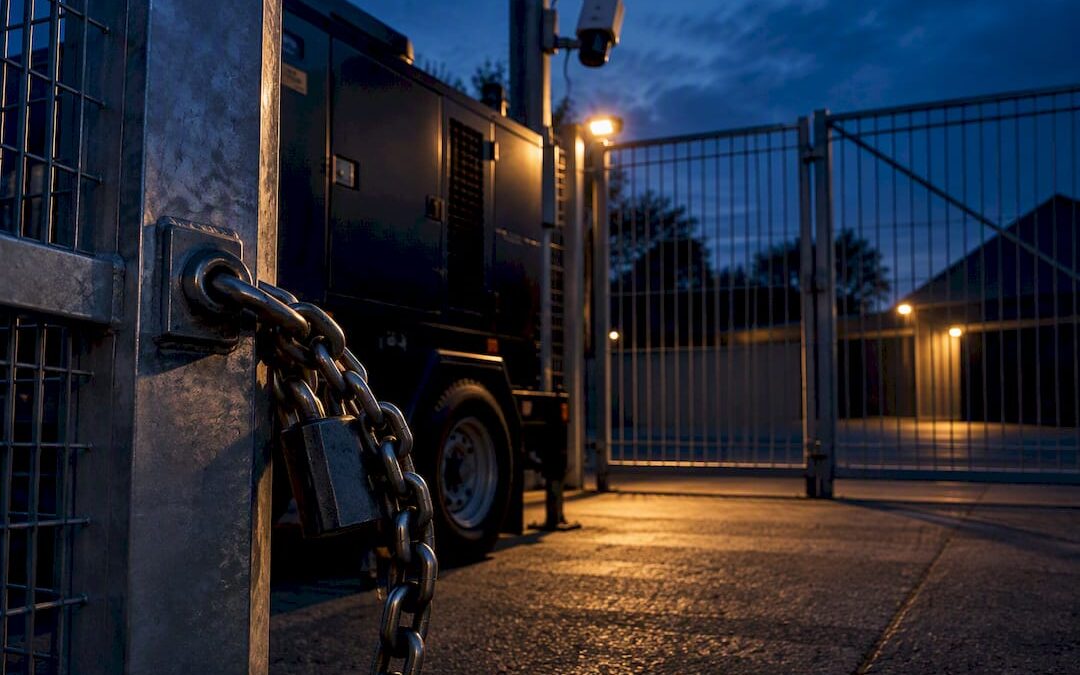
The most effective way to prevent generator theft is to layer three defences together: anchor the unit so it cannot be moved quickly, mark and register it so it cannot be sold easily, and fit a monitored tracker or alarm so it cannot disappear quietly. No single measure stops a determined thief, but combined they do. Always keep generators outdoors, away from doors and windows, to avoid carbon monoxide risk.
TL;DR:
- Combining physical anchors, forensic marking, and monitored trackers significantly increases the likelihood of recovering stolen generators and deters opportunists.
- Use military-grade security hardware rated to recognized standards, ensure locks are close to the ground, and regularly photograph and record serial numbers for quick police identification.
- Register equipment with schemes like CESAR or Datatag immediately after purchase, and display warning stickers to psychologically discourage thieves.
- Position generators outdoors in well-lit, camera-covered areas with proper ventilation, avoiding concealment that risks dangerous carbon monoxide buildup.
- Maintain strict operational procedures, including key removal, detailed logs, and daily site checks, to prevent simple lapses that lead to theft.
Table of Contents
- Why a layered security plan works
- Physical anchoring and locks: chains, ground anchors, cages and how to use them correctly
- Forensic marking and registration: CESAR, Datatag and SelectaDNA explained
- Trackers, alarms and monitoring: what works and where they fail
- Siting, storage and safety: where to place a generator and how to store it securely
- Operational best practice: keys, records, handovers and daily checks
- Business and event-specific controls: gates, patrols, signage and contractor coordination
- Practitioner perspective: field-proven checks from event hire experience
- Insurance options and claims process for stolen generators
- Legal considerations and reporting procedures after theft
- Technological advances like geofencing and real-time alerts
- What the industry gets wrong about generator security
- How Jaks Party Power can help with secure, managed hire
- Sources
- FAQ
Why a layered security plan works
Thieves look for the fastest, quietest route to a resale. A layered plan disrupts every stage of that route: deterrence stops them choosing your site, delay slows them down once they try, and detection or response catches them if they succeed. One device alone tends to fail because a lone lock can be cut, a lone tracker can be jammed, and a lone camera can be avoided. Stack the layers and each weakness gets covered by another measure.
The evidence for this is strong. CESAR-registered equipment is recovered far more often than unmarked kit, with registered plant recovery rates approaching 30%, compared with roughly 5% for unregistered machinery. National policing guidance on building site security points the same way, recommending perimeter security, lighting, marking, trackers and CCTV as the core steps for reducing plant theft and helping recovery.
A practical layered plan for a portable generator typically includes:
- A cut-resistant chain or ground anchor rated to a recognised standard.
- Forensic marking and registration on a scheme such as CESAR, Datatag or SelectaDNA.
- A concealed tracker or alarm linked to a monitoring service.
- Basic visibility measures such as lighting or CCTV coverage.
Each layer buys time or raises risk for the thief, and together they turn a five-minute opportunistic grab into a job nobody wants to attempt.
Physical anchoring and locks: chains, ground anchors, cages and how to use them correctly
A generator anchored to a weak point is barely anchored at all. Before fitting any chain, check that the frame lug, axle or built-in eyelet you are using is structural, not a thin bracket or a plastic housing that will simply tear away under leverage. On skid-mounted or wheeled units, the chassis rail is usually the strongest point; on road-tow generators, the drawbar or a dedicated lock point is often built in for this purpose.
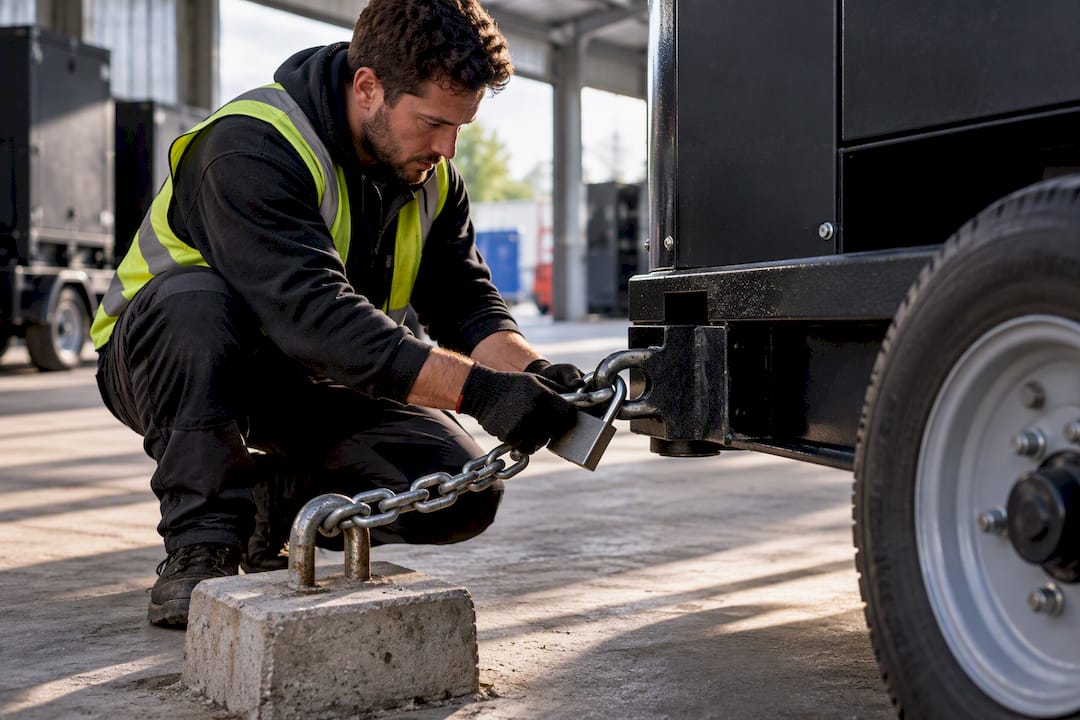
Choose hardware rated to a recognised independent standard rather than anything sold purely on thickness. Sold Secure Diamond-rated chains, anchors and closed-shackle padlocks are treated as the benchmark for high-value plant, and insurers increasingly expect this grade for cover to apply.
Pro Tip: Fit the chain so the lock sits close to the ground or against a solid surface, never dangling free, since a suspended lock gives thieves leverage and a clean strike with bolt cutters.
A consistent locking sequence keeps the job quick and reliable, even for staff who are not security specialists:
- Prepare the site: identify a fixed ground anchor, bollard or structural point close to the generator.
- Route the chain through a structural lug on the frame, never through a cable guard, handle or panel.
- Tension the chain so there is minimal slack, removing room for a jack or lever to be inserted.
- Shield the lock body against the ground or frame so cutters cannot get a clean angle.
- Add visible signage stating the unit is marked, registered and tracked.
- Check that exhaust outlets, air intakes and cooling vents remain completely unobstructed.
- Record the anchor point used and photograph the completed setup for handover notes.
The safety point in step six matters as much as the security point. A chain or cage that restricts exhaust flow risks carbon monoxide build-up and overheating, and a cable run across a walkway becomes a trip hazard. Surrey Police advises chaining or hitch-locking machinery and keeping detailed records of serial numbers and photographs, precisely because a locked, documented unit is both harder to steal and easier to identify if it is taken.
Forensic marking and registration: CESAR, Datatag and SelectaDNA explained
Marking a generator changes the economics of stealing it. A machine that carries a visible, hard-to-remove identifier is far harder to sell on, and buyers of stolen plant know it.
CESAR is the scheme most widely recognised across UK construction and plant hire, combining a registered identification number, tamper-evident markers and forensic DNA elements. Datatag uses a similar mix of visible marking, covert transponders and a searchable database that police forces can check at the roadside. SelectaDNA applies a unique forensic liquid or tag code that links directly back to a registered owner, with warning signage designed to put off opportunist thieves before they act. Rural crime guidance from forces such as Humberside Police notes that visible stickers and forensic marking act as inexpensive psychological deterrents, since many thieves simply avoid items that are harder to move on.
CESAR-registered equipment recovery rates approach 30%, compared with roughly 5% for unregistered machinery, a gap that reflects how much easier marked kit is to trace once police guidance on building site security and marking schemes work together.
A practical marking and registration checklist:
- Mark the frame, fuel tank and control panel, not just one surface, so removing one label does not remove the identifier.
- Register the serial number, make, model and marking code with the scheme provider immediately after purchase.
- Photograph the unit from several angles and store the images with your registration confirmation.
- Keep purchase invoices, service records and marking certificates together for police and insurers.
- Display the scheme’s warning sticker prominently, since visible deterrence is part of the point.
When you report a theft, having the registration number, marking scheme name and clear photographs ready lets police check the item against national databases within minutes rather than hours.
Trackers, alarms and monitoring: what works and where they fail
A tracker only works if it keeps reporting after a thief tries to disable it. GPS or GSM units are useful for location, but they rely on a mobile signal and can be defeated by cheap GSM jammers that block the very signal they depend on. Systems that add RF elements, accelerometer triggers or an immobiliser cut that single point of failure, because a jammer that blocks GSM does not necessarily block RF or stop a motion sensor firing.
The most resilient setups combine three things: a concealed tracker fitted inside the fuel tank or control panel rather than bolted visibly to the frame, a backup sensor such as an accelerometer that triggers on movement or tilt, and a link to a professional monitoring centre rather than an app that simply logs a position. A tracker that alerts a monitoring service with a direct line to police response is worth considerably more than one that only records where the generator was last seen.
Pro Tip: Fit trackers out of sight and use tamper-proof housings, since a visible tracker gives a thief something to search for and remove before moving the unit.
Alarm options worth combining rather than choosing between:
- Tilt or accelerometer alarms that trigger the moment the unit is lifted or dragged.
- Fuel-level alarms that flag unexplained draining, a common sign of tampering.
- Perimeter sensors that cover the storage area rather than just the generator itself.
- CCTV integration so an alarm trigger pulls up live footage automatically.
Police and insurers both respond faster and more favourably to incidents where a monitored alarm or tracker generated a timestamped alert, since it gives them a starting point that unmonitored equipment simply cannot provide.
Siting, storage and safety: where to place a generator and how to store it securely
Security decisions cannot override safety rules, and the most important one is this: generators must run outdoors, never indoors or in a partly enclosed space, because exhaust fumes carry a fatal carbon monoxide risk. Guidance commonly cites a minimum distance of 6 metres from buildings, doors, windows and vents, and that distance should never be compromised for the sake of hiding the unit from view.
Within that safety boundary, several storage options reduce theft risk without compromising ventilation:
- Locked compounds with mesh or palisade fencing that allow airflow while blocking casual access.
- Purpose-built ventilated cages or containers designed for genset duty, with proper intake and exhaust ducting rather than a sealed box.
- Concrete bases with clearance of several feet around the unit to prevent heat build-up and allow safe access for fuelling and maintenance.
Visibility works in your favour here. A generator sitting in a well-lit, camera-covered position is a far less attractive target than one tucked into a dark corner where nobody would notice it being lifted onto a trolley. Building site security guidance recommends dusk-to-dawn lighting and monitored CCTV, including mobile camera systems for sites without a permanent power supply, precisely because darkness and blind spots are what thieves rely on.
When locked storage genuinely is not available, a temporary but effective tactic borrowed from plant and event hire operations is to muster equipment together overnight and position smaller, more portable units behind heavier machinery that cannot easily be moved. It will not stop a determined thief, but it adds friction, noise and time, all of which work against a quiet theft.
Operational best practice: keys, records, handovers and daily checks
Most opportunistic generator theft succeeds because of simple lapses: a key left in the ignition, a serial number nobody wrote down, a handover with no sign-off. Fixing these costs nothing but attention.
- Remove keys the moment the generator is not in active use and store them in a locked key cabinet away from the site, not in a site cabin drawer.
- Keep an asset log recording serial number, make, model, marking scheme reference and photographs for every unit you own or hire.
- Run a standard end-of-shift checklist covering lock condition, tracker status and fuel level before anyone leaves site.
- Require a signed handover between outgoing and incoming staff or contractors so responsibility for the unit is never ambiguous.
- Report any theft to police immediately with the serial number, marking scheme reference, photographs and last known tracker location.
Surrey Police is specific on this last point, noting that detailed records including serial numbers and photographs materially help identification once a stolen item resurfaces at auction, on a resale site or at a scrapyard. An insurer will also ask for the same information before processing a claim, so the log you keep for security purposes doubles as your claims evidence.
Business and event-specific controls: gates, patrols, signage and contractor coordination
Businesses and event operators managing several units across a temporary site face a different problem: multiple entry points, multiple contractors and equipment that moves between locations during a single day.
Perimeter control matters more here than anywhere else. Gated access with locking posts, a logged entry point for vehicles and staff, and a single point of accountability for who is on site all reduce the number of people who get near your generators unsupervised. For larger events or longer builds, temporary manned guarding or scheduled patrols linked to your CCTV system close the gap between working hours and the empty overnight period when most theft actually happens, as detailed in Custom Valet Solutions for Hospitality and Event Venues – Caymil Printing Co., Inc.. Our guide to generator hire for private events covers practical siting steps for operators who cannot rely on a locked compound.
Contractor coordination is often the weakest link. Every handover between a hire company, an electrical contractor and event staff should include a signed record of which keys were passed over, when, and to whom, mirroring the sign-off routine covered above. For businesses that hire regularly, it is worth checking whether your insurance policy or supplier contract already requires marking, tracking or compound storage as a condition of cover:
- Confirm whether your policy mandates a minimum lock rating or marking scheme.
- Check whether hire paperwork specifies who is liable for security during the hire period.
- Ask suppliers whether tracked or marked units are available as standard.
Practitioner perspective: field-proven checks from event hire experience
Years of setting up temporary power for events across Sussex have taught one lesson repeatedly: theft prevention succeeds or fails on the boring details, not the expensive kit. A generator anchored to the wrong point, or a tracker nobody checked before the event started, gives a false sense of security that is worse than having no tracker at all.
A day-of-event checklist that mirrors standby cover practice looks like this: confirm the anchor point before the generator is even fuelled, photograph the marking and serial number on arrival, test the tracker signal on site rather than assuming it works, and log a handover at every shift change. None of this replaces a managed hire service with standby support built in, but it is exactly what that kind of service does as a matter of course. Readers running their own events can find more detail in our breakdown of what event planners need to know about generators.
Insurance options and claims process for stolen generators
Standard business or event equipment policies usually cover generator theft, but cover is frequently conditional on the security measures already discussed. Insurers commonly expect a minimum lock standard, evidence of marking or registration, and in some cases a fitted tracker before they will pay out in full, so it is worth reading the security clauses in your policy before you need to rely on them.
When a generator is stolen, the claims process moves faster if you can supply what you should already have logged: the serial number, purchase invoice, marking scheme reference, photographs of the unit and lock, and the police crime reference number issued when you reported the theft. Insurers typically require the police report before processing a claim, since it confirms the loss is genuine and gives them a reference to cross-check against.
Cover levels and excess amounts vary between insurers and policy types, and portable generators used at events may sit under a separate equipment or hired-in-plant clause rather than general contents cover, so it is worth confirming which section of your policy applies before an incident happens. Businesses that hire equipment for events should also check whether the hire company’s own insurance covers theft during the hire period, or whether that liability sits with the hirer. Clarifying this in advance avoids a dispute over who claims, and against which policy, at the worst possible moment.
Legal considerations and reporting procedures after theft
Report a generator theft to the police as soon as you discover it, giving them the serial number, marking scheme reference, last known location from any tracker, and photographs of the unit. This generates a crime reference number, which you will need for any insurance claim and which allows the marking scheme provider to flag the item on their database if it resurfaces at auction or through a scrap dealer.
If your generator was registered with CESAR, Datatag or SelectaDNA, tell the scheme provider as well as the police, since their databases are checked independently by dealers, scrap merchants and some police forces during routine stops. This is precisely why national police guidance on building site security treats marking and registration as core theft-prevention steps rather than optional extras: it gives multiple parties, not just the original owner, a reason to flag suspicious equipment.
Keep a written record of everything you tell the police and your insurer, including dates, reference numbers and the names of officers or advisers you speak to. If the generator is recovered, you may still need to provide proof of ownership, such as the original invoice and marking certificate, before it is released back to you. Businesses hiring out generators should also check their contractual obligations toward the hire company, since most hire agreements make the hirer responsible for reporting theft promptly and cooperating with any police investigation.
Technological advances like geofencing and real-time alerts
Newer tracking systems go beyond simple location logging. Geofencing lets you draw a virtual boundary around a site or storage compound and receive an alert the moment a generator crosses it, which turns a slow discovery of theft into an immediate one. Combined with real-time push notifications to a phone or a monitoring centre, this closes much of the gap between a generator being taken and someone noticing.
The most resilient setups still follow the same principle covered earlier: layer the technology rather than relying on one signal type. A geofenced GPS tracker paired with an accelerometer trigger and a concealed, tamper-proof housing is harder to defeat than any single component, because a thief has to identify and disable several independent systems rather than one. Professional monitoring adds a further layer, since a monitored alert reaches a response team or liaises directly with police, rather than simply appearing as a missed notification on an unattended phone.
These systems are becoming more affordable and easier to retrofit to existing generators, which makes them a realistic addition for smaller operators, not just large plant fleets. As with any tracker, the value depends entirely on whether someone is actually watching the alert when it fires.
What the industry gets wrong about generator security
Most advice on this topic treats a single product, usually a tracker or a padlock, as the answer, when the real answer is procedural as much as physical. The businesses that lose generators most often are not the ones with cheap locks. They are the ones with good equipment and no routine: no logged handover, no photograph taken at drop-off, no check that the tracker was actually transmitting before the event started.
The conventional advice also underplays safety. Security guidance sometimes recommends enclosing a generator to hide it, without addressing what that does to ventilation. Any storage or concealment measure that risks exhaust restriction is not a security improvement, it is a hazard with a lock on it.
If you take one thing from this guide, prioritise the anchor and the record-keeping before you spend money on a tracker. A £15 chain routed through the right lug and a five-minute habit of photographing serial numbers will stop more opportunistic theft than an expensive gadget nobody remembers to check.
— Rob
How Jaks Party Power can help with secure, managed hire
Not every event or business wants to manage generator security themselves, and that is exactly what a managed hire service is for. A managed hire service can provide generator hire, distribution and event setup, backed by standby cover during the event itself, so there is always someone accountable for the equipment on site rather than a checklist left to chance.

Experienced electrical contractors handle siting, cabling and setup safely as well as securely, whether for a private party or a large corporate event. If you would like site-specific security advice alongside a hire quote, get in touch through our services page or browse generators available for hire to see what suits your event.
Sources
- CESAR benefits for construction
- Building site security (national police guidance)
- Heavy machinery theft prevention | Surrey Police
FAQ
What is the best way to protect a generator from theft?
The most effective approach combines physical anchoring, forensic marking and registration, and a monitored tracker or alarm, since each layer covers a weakness in the others. Police guidance on building site security recommends this combination alongside lighting and CCTV as core steps for reducing plant theft.
What is the 20/20 rule for generators?
There is no recognised industry or police standard for a “20/20 rule” in generator security, so treat any definition you encounter as unofficial. Focus instead on the layered measures covered by police and marking scheme guidance: secure anchoring, registration and monitored tracking.
Is it safe to store a generator in your house?
No, a generator should never run indoors or in a partly enclosed space because exhaust fumes create a fatal carbon monoxide risk. Guidance recommends keeping it outdoors and away from doors, windows and vents, commonly citing a minimum distance of 6 metres from any building.
Where’s the safest place to put a generator?
The safest position is outdoors, away from doors, windows and air intakes, in a well-lit and ideally camera-covered spot rather than a hidden corner. A visible, anchored position on a stable base with proper clearance for ventilation reduces both fire and theft risk at the same time.