

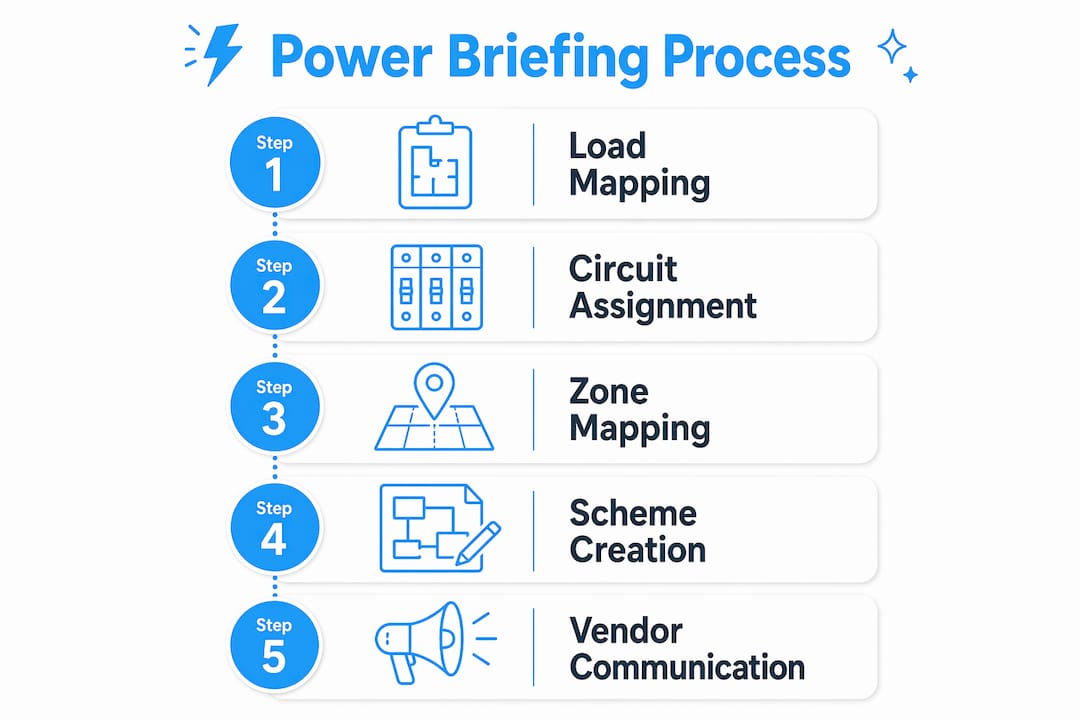
An event power supplier briefing is a structured planning process that maps every electrical load, assigns circuits by zone, and confirms safety compliance before a single cable is laid. Most organisers mistakenly treat it as a quick check of available outlets. Real planning demands detailed load and zone analysis by device wattage, covering everything from stage rigs to vendor tablet chargers. Get this process right and your event runs without a single breaker trip. Get it wrong and the consequences range from nuisance outages to genuine fire risk. This guide covers every stage of a thorough event power supplier briefing, grounded in UK standards and practical field experience.
What does an event power supplier briefing involve?
An event power supplier briefing is the formal coordination process between an event organiser, their power supplier, and all vendors who draw electricity on site. The industry term used in UK electrical practice is a “temporary electrical installation scheme,” governed by BS 7671 and BS 7909. Both terms describe the same discipline. Using both keeps you credible with suppliers and searchable to fellow organisers.
The briefing produces three outputs: a load schedule, a zone map, and a written scheme of work. The load schedule lists every device and its wattage. The zone map assigns circuits to physical areas such as stage, catering, and production. The written scheme of work is the formal compliance document your electrician signs off before the event opens.
Jakspartypower has delivered event power management solutions across Sussex for over 40 years, covering weddings, corporate gatherings, and large outdoor shows. That depth of experience shapes every recommendation in this guide.
How do you calculate power requirements for your event?
Accurate load calculation is the foundation of every reliable temporary power setup. The process starts with a zone-by-zone device audit, not a rough estimate of “how many sockets you need.”
Work through each zone in turn:
- Stage and production: lighting rigs, amplifiers, mixing desks, LED walls, and haze machines. Each has a rated wattage on its specification sheet.
- Catering and vendors: coffee machines, hot plates, refrigeration units, and point-of-sale terminals. Catering loads are often the biggest surprise on a site.
- Guest and operational areas: phone charging stations, control tablets, Wi-Fi access points, and emergency lighting.
- Temporary structures: marquee heating or cooling, inflatable blowers, and decorative lighting strings.
Add every wattage figure together to reach your total calculated load. Then apply a 30–50% power headroom above that total. That buffer protects the generator from overload and extends engine life. For a 6,000-watt total load, the correct generator size is 8,000–9,000 watts. Running a generator at full rated capacity accelerates wear and raises the risk of thermal shutdown mid-event.
Pro Tip: Ask every vendor to supply a written equipment list with wattage ratings at least two weeks before the event. Verbal estimates are almost always lower than actual draw.

Devices like control tablets and charging stations are critical in load planning yet routinely omitted from first-draft load schedules. A 10-port charging station can draw 200–500 watts on its own. Multiply that across several vendor stalls and the gap between estimated and actual load becomes significant.
What safety standards apply to temporary event power?
BS 7671 and BS 7909 are the two UK standards that govern temporary electrical installations at events. BS 7671 is the IET Wiring Regulations, covering all fixed and temporary electrical work. BS 7909 applies specifically to temporary electrical systems for entertainment and events. Both are mandatory references for any compliant installation.
The key technical requirements under these standards include:
- RCD protection: every circuit must have a residual current device rated at a minimum of 30mA RCD protection. This is the threshold at which current leakage becomes lethal to a person.
- Voltage drop: the maximum permitted voltage drop on a 230V supply is 5%, which equals 11.5V. Exceeding this causes equipment to malfunction and motors to overheat.
- Cable selection: use industrial IP-rated cables throughout. Daisy-chaining domestic extension leads is a primary cause of voltage drop and event power failures.
- Cable management: fully unwind all cable drums before use. A coiled cable acts as an inductor and generates heat. That heat builds up inside the drum and creates a genuine fire risk.
- Testing and certification: a written scheme of work and a completion certificate are required before the installation goes live.
Cables left coiled on a drum during use generate inductive heat that can melt insulation and trip breakers. Always fully unwind cable drums before energising any circuit. This single step prevents a disproportionate number of on-site failures.
Testing is not optional. Every RCD must be tested with a push-button check before the event opens. Spare breakers and fuses should be kept on site for fast fault resolution. A pre-event RCD test takes under two minutes per circuit and eliminates the most common cause of mid-event outages.
How do you communicate power needs to your supplier and vendors?
Clear communication between the organiser, the power supplier, and every vendor is what separates a smooth event from a chaotic one. The briefing process is the mechanism for that communication.
Follow this sequence to keep everyone aligned:
- Issue a vendor power questionnaire at least four weeks out. Ask for equipment lists, wattage ratings, connection types (13A, 16A, 32A, three-phase), and arrival times.
- Build a zone power map from the responses. Assign each vendor or production element to a named circuit. Label every circuit on the distribution board and on the map.
- Share the zone map with your power supplier before equipment is ordered. This allows the supplier to size distribution boards and cable runs correctly.
- Confirm arrival and setup sequences with all vendors. A vendor who connects a 3kW coffee machine to a circuit already at 80% capacity will trip the breaker. Staggered connection times prevent this.
- Appoint a named power contact for the event day. This person holds the zone map, knows the location of every distribution board, and has direct contact with the power supplier’s on-site engineer.
Pro Tip: Colour-code your zone map by circuit. Give each vendor a printed copy showing only their assigned circuit. This removes ambiguity and stops vendors from plugging into the wrong supply.
A corporate event vendor checklist formalises this process for professional events. The same discipline applies to weddings and private parties, where vendors often arrive with undisclosed equipment.
What power supply options suit different event types?
The right power source depends on event size, location, noise sensitivity, and load profile. Three main options cover the majority of events.
Mains connection is the preferred source where available. It provides stable voltage, no fuel cost, and no noise. The limitation is that mains supply is not always accessible at outdoor or rural venues, and the available capacity may not match event demand.
Diesel or petrol generators are the standard solution for temporary power at outdoor events. Generator sizing follows the 30–50% headroom rule: a 6kW load requires an 8–9kW generator. Generators perform best when loaded at no more than 70% of rated capacity. Running them harder than that shortens service life and increases the chance of thermal shutdown.
| Power source | Best suited to | Key limitation |
|---|---|---|
| Mains connection | Indoor venues with adequate supply | Not always available outdoors |
| Diesel/petrol generator | Large outdoor events, high loads | Noise, fuel management, emissions |
| LiFePO4 battery station | Small loads, quiet events, vendor stalls | Limited capacity (600W–3,600W) |
Portable LiFePO4 battery stations handle loads between 600W and 3,600W with recharge times of approximately 2.5 hours. They produce no emissions and no noise, making them ideal for wedding ceremonies, quiet vendor stalls, and indoor corporate breakout areas. They are not a substitute for a generator on high-load events.
Backup power is non-negotiable for any event where failure is unacceptable. A standby generator, sized to cover critical circuits only, provides resilience if the primary source fails. For smaller events, a battery pack covering the PA system and emergency lighting is a proportionate backup. Hiring event generators from a specialist supplier gives you access to correctly sized, maintained equipment without the capital cost.
What are the most common event power briefing mistakes?
Power failures at events are almost always preventable. The same mistakes appear repeatedly across event types and scales.
- Underestimating total load. Organisers calculate the obvious loads and miss the small ones. Tablet chargers, Wi-Fi routers, and decorative lighting add up fast.
- Using domestic extension leads. Domestic leads are not rated for continuous high-current draw. They overheat, cause voltage drop, and fail without warning. Industrial IP-rated cables are the correct choice for all outdoor and temporary installations.
- Skipping safety testing. An untested RCD is a liability. Testing takes minutes and is required under BS 7671.
- No circuit separation. Running all loads on a single circuit means one fault takes down the entire event. Separate critical circuits with individual RCDs so a nuisance trip on the catering circuit does not kill the stage.
- Late vendor communication. Vendors who confirm equipment lists on the day of the event make accurate load planning impossible.
Pro Tip: Walk the site with your zone map one hour before doors open. Physically verify that every vendor is connected to their assigned circuit and that no additional equipment has appeared since the briefing.
Avoiding common event setup mistakes requires a checklist mentality. The briefing document is your checklist. Treat it as a live document that is updated every time a vendor changes their equipment list.
Key takeaways
A thorough event power supplier briefing, grounded in BS 7671 and BS 7909, is the single most effective way to prevent power failures and protect everyone on site.
| Point | Details |
|---|---|
| Apply 30–50% headroom | Size your generator above calculated load to protect the engine and prevent overload trips. |
| Use BS 7671 and BS 7909 | Both standards are mandatory for temporary event electrical installations in the UK. |
| Separate circuits by zone | Individual RCDs per zone prevent a single fault from shutting down the whole event. |
| Collect vendor power data early | Request written equipment lists with wattage ratings at least four weeks before the event. |
| Test every RCD before doors open | A two-minute push-button test eliminates the most common cause of mid-event power failure. |
Why I think most event power briefings fail before the event starts
The briefing conversation almost always happens too late. Organisers finalise their supplier booking, then send a rough equipment list the week before the event. By that point, cable runs are planned, distribution boards are ordered, and there is no room to accommodate a catering vendor who just added a second commercial oven.
The briefings that work are the ones that start at the same time as venue booking. Load planning is not a technical afterthought. It is a design constraint, the same as floor space or catering capacity. When you treat it that way, every subsequent decision, generator size, cable routing, circuit allocation, fits together without last-minute scrambling.
The other thing I have seen consistently is that resilience-first planning pays for itself in client trust. Documenting uptime, energy usage, and any incidents in a post-event report gives clients something tangible. It also gives you a baseline for the next event. Clients who receive that report come back. Clients who experienced a power cut and received no explanation do not.
The briefing is not a formality. It is the difference between an event that runs and one that does not.
— Rob
Reliable event power from Jakspartypower
Jakspartypower brings over 40 years of electrical contracting experience to every event power brief, from intimate Sussex weddings to large outdoor shows.
The hire range covers generators, distribution boards, industrial cables, and accessories, all maintained to BS 7671 and BS 7909 standards. The team supports load estimation, zone mapping, and on-site standby cover so you are never managing a power issue alone. Whether you need a 6kVA trolley generator for a small private party or a 50kVA road-tow unit for a large production, Jakspartypower sizes and delivers the right equipment for your event.
FAQ
What is an event power supplier briefing?
An event power supplier briefing is a structured planning session that maps all electrical loads, assigns circuits by zone, and confirms compliance with BS 7671 and BS 7909 before installation begins. It produces a load schedule, a zone map, and a written scheme of work.
How much power headroom does an event generator need?
Generators require 30–50% headroom above the total calculated load. A 6,000-watt load requires an 8,000–9,000-watt generator to run reliably without overheating.
What UK standards apply to temporary event power?
BS 7671 (IET Wiring Regulations) and BS 7909 (temporary electrical systems for entertainment) both apply. They require a minimum 30mA RCD on every circuit and a maximum 5% voltage drop on a 230V supply.
Can battery power stations replace generators at events?
LiFePO4 battery stations handle loads between 600W and 3,600W and suit quiet or indoor applications such as wedding ceremonies and vendor stalls. They are not suitable as the primary power source for high-load events with stage production or commercial catering.
When should I start the power briefing process?
Start the briefing at the same time you confirm your venue booking. Collecting vendor power data at least four weeks out gives your supplier time to size equipment correctly and eliminates last-minute load surprises.