
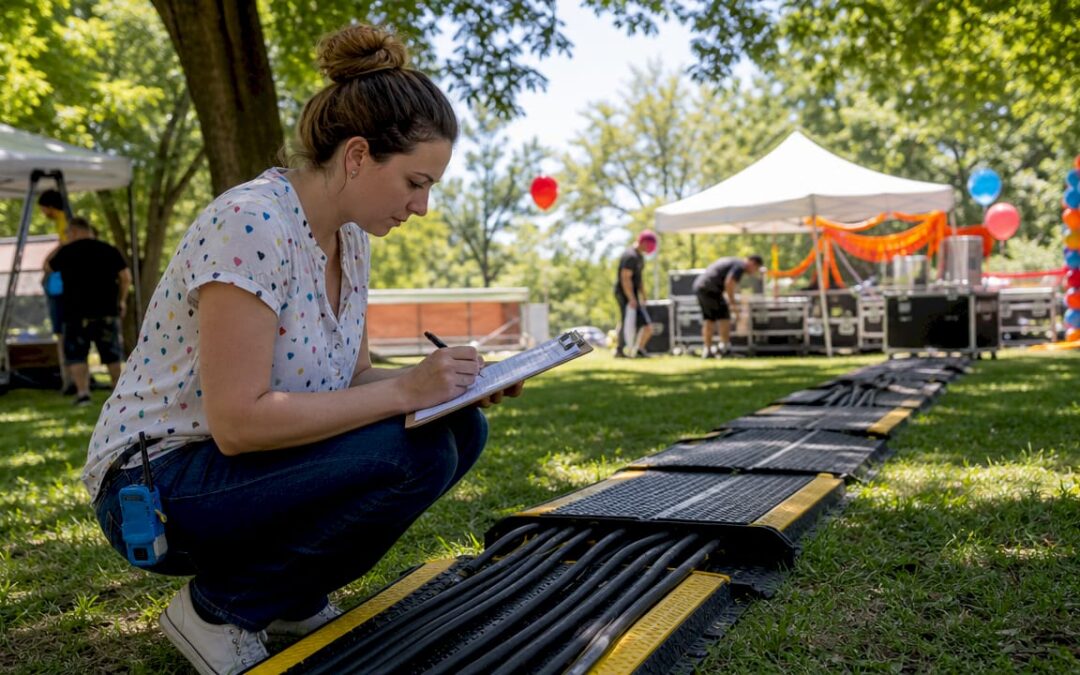
Cabling is the single most important infrastructure decision you make for any event. The role of cabling in event reliability is to deliver stable power and clean data signals to every piece of equipment on site, from PA systems and LED rigs to ticketing terminals and broadcast feeds. UK temporary electrical installations must comply with BS 7909 and BS 7671, with the Health and Safety Executive’s HSG107 guidance adding mandatory risk assessment requirements. Get cabling wrong and you face power failures, fire hazards, and legal liability. Get it right and everything else on your event runs as planned.
What are the key cabling standards for event reliability?
UK law treats temporary event electrical installations with the same seriousness as permanent ones. Temporary event power must meet full compliance standards, with event organisers legally responsible for all equipment and PAT certification. That responsibility sits with you, not just your supplier.
BS 7909 is the primary standard for temporary electrical systems used in entertainment. It requires a competent person to oversee design, installation, and commissioning. It also mandates 30mA RCD protection as a minimum on all outdoor and temporary circuits, and limits voltage drop to no more than 5% of the nominal supply voltage. Exceed that threshold and sensitive AV equipment begins to malfunction.
BS 7671, the IET Wiring Regulations, underpins all electrical installation work in the UK, including temporary setups. HSE HSG107 adds a further layer, requiring written risk assessments covering power supply routing, cable positioning, and generator placement for outdoor events. Failing to produce these documents leaves you exposed to prosecution if an incident occurs.
- Appoint a competent person as defined by BS 7909 before any design work begins.
- Commission a written scheme of work covering all circuits, load calculations, and RCD specifications.
- Arrange PAT testing for all portable equipment before it arrives on site.
- Document cable routing plans and share them with your site manager and safety officer.
- Arrange a formal inspection and sign-off before the event opens to the public.
Pro Tip: Request a copy of your electrical supervisor’s written scheme of work at least two weeks before your event. If they cannot produce one, find a different supplier.
How does cabling infrastructure affect event technical performance?
Cable faults cause the majority of AV and power disruptions at live events, yet they are routinely misattributed to hardware or software. A mixing desk that cuts out mid-set is rarely a faulty desk. More often, it is a voltage drop caused by an undersized cable run or a loose connection at a distribution board.
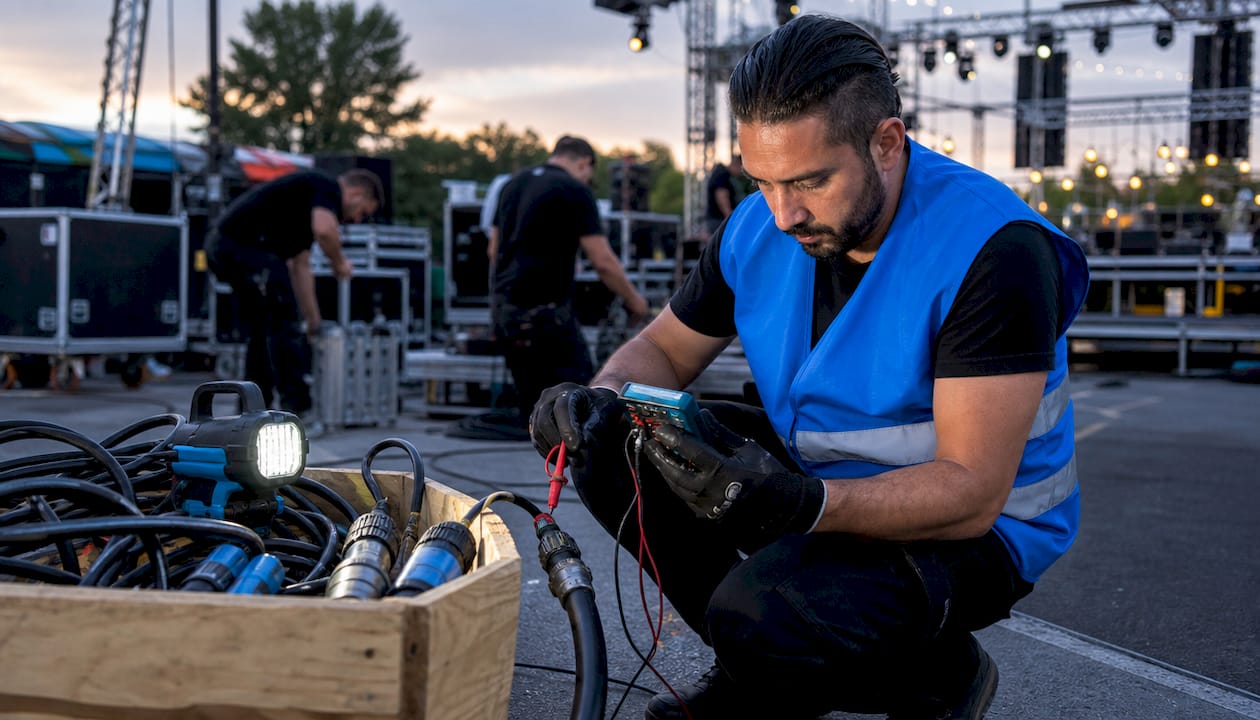
Voltage drop is the most common performance killer. When a cable is too thin for the current it carries over a long run, resistance causes voltage to fall below the equipment’s operating threshold. Audio amplifiers clip, lighting dimmers flicker, and network switches reboot. All of these failures look like equipment problems but trace back to the cable.
Electromagnetic interference (EMI) is the second major threat. Unscreened signal cables running parallel to power cables pick up electrical noise. The result is audible hum in PA systems, corrupted DMX lighting data, and unstable network connections. Screened cables with proper earthing eliminate this problem entirely.
Thermal risk is less visible but equally serious. Poor cable bundling causes heat to build up inside tightly wrapped groups of cables, degrading insulation and increasing fire risk. A cable drum left partially wound while carrying load can reach dangerous temperatures within minutes.
- Loose connections at connectors and distribution boards cause intermittent faults that are difficult to trace during a live event.
- Circuit overloads trip RCDs and cut power to entire zones, not just the offending piece of equipment.
- Accidental disconnections from foot traffic or equipment movement are the most preventable cause of signal loss.
- Insulation damage from repeated bending or heavy vehicle crossings creates latent defects that fail under load.
Pro Tip: Run a full load test on every circuit for at least 30 minutes during your technical rehearsal. Faults that appear under sustained load rarely show up during a brief soundcheck.
What best practices in cabling solutions improve event reliability?
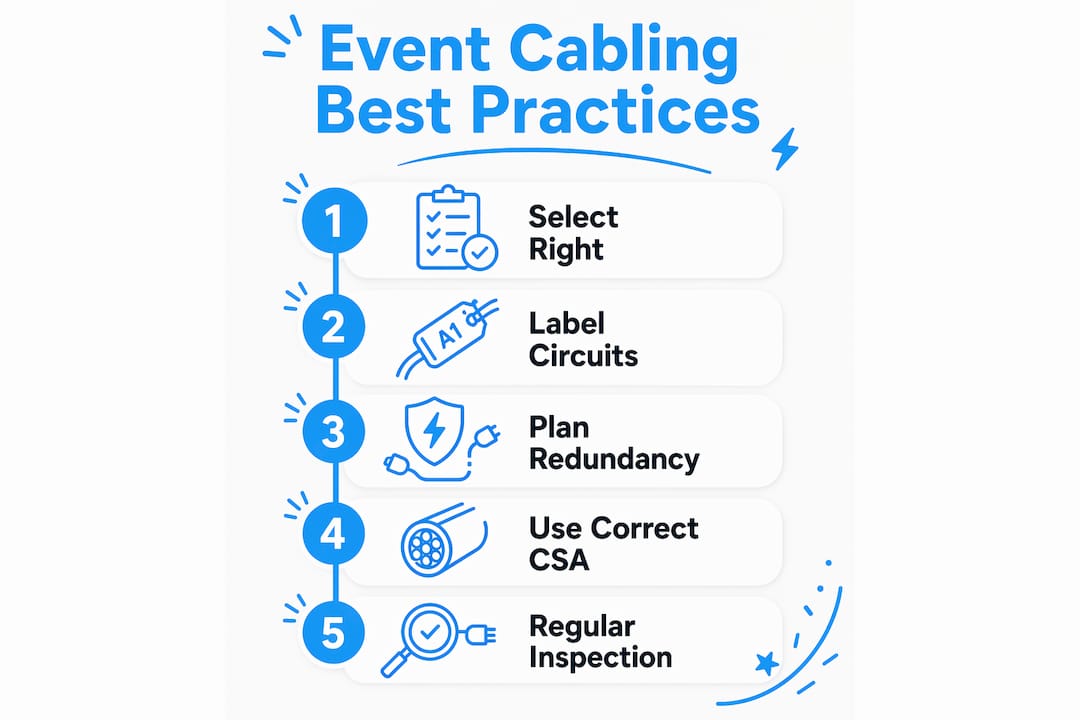
The single most dangerous cabling decision you can make is using domestic 13A extension leads for event power distribution. At runs over 100 metres, domestic leads overheat even when carrying current below their rated limit. Industrial-grade cables with the correct cross-sectional area (CSA) and IP-rated connectors are not optional. They are the minimum standard for any professional event.
Selecting the right cables
Industrial cables for event use are rated by their CSA in square millimetres. A 2.5mm² cable suits lighting circuits up to 16A. A 4mm² or 6mm² cable is needed for higher-load audio or catering circuits. For long runs feeding main distribution boards, 16mm² or larger three-phase cables are standard. Hire-grade event cables are built to these specifications and include robust connectors rated for repeated connection cycles.
Protecting and managing cables on site
Cable containment is not about tidiness. Organised, labelled cable systems reduce fault diagnosis time from hours to minutes and cut fire risk caused by heat build-up. Every cable crossing a pedestrian or vehicle route needs a cable protection ramp or matting rated for the expected load.
| Practice | Why it matters |
|---|---|
| Label every circuit at both ends | Allows rapid isolation without cutting power to the wrong zone |
| Separate power and signal cables | Prevents electromagnetic interference reaching AV and data systems |
| Use RCD-protected distribution boards | Limits fault impact to a single circuit rather than the whole event |
| Plan redundant signal paths | Keeps critical systems running if a primary cable fails |
| Inspect cables before and after each event | Catches insulation damage and connector wear before it causes failure |
Redundancy planning is the practice most event planners skip and most regret. A second signal path for your main PA feed costs little to install during setup. Restoring audio from a backup cable takes seconds. Tracing and repairing a failed primary cable during a live performance takes far longer.
Polymer-insulated cables degrade over time through moisture exposure and mechanical stress. Compliance at installation does not guarantee ongoing reliability. Build a regular inspection schedule into your supplier contracts and replace cables that show any sign of insulation cracking or connector damage.
How does early supervisor involvement improve cabling reliability?
Qualified electrical supervisors must be involved from pre-production, not called in on the day of the build. The competent person defined by BS 7909 carries responsibility for design, installation, inspection, and commissioning. That scope of work cannot be compressed into a single build day.
Early involvement prevents the most costly mistakes in event cabling. A supervisor who reviews your site plan before equipment is ordered will catch undersized cable runs, missing RCD protection, and inadequate circuit separation before they become on-site emergencies. The same issues discovered during a live build cost significantly more to fix and often cannot be fully corrected under time pressure.
- Load balancing across phases prevents voltage imbalance that destabilises sensitive equipment.
- Overcurrent protection sizing must match actual circuit loads, not theoretical maximums.
- Generator positioning affects cable run lengths and therefore voltage drop calculations.
- Phase balancing on three-phase supplies keeps neutral currents within safe limits.
Selecting the right supervisor means checking their BS 7909 competency, their familiarity with your event type, and their ability to produce a written scheme of work. A practical event power briefing with your electrical supplier before the event is the most effective way to align on load requirements, circuit design, and compliance documentation. Treat this meeting as non-negotiable, not optional.
The networking event electrical setup guide from Jakspartypower outlines how this pre-production process works in practice for corporate events, where data cabling and power distribution must be planned together from the outset.
Key takeaways
Reliable cabling requires correct cable specification, RCD protection, professional supervision, and ongoing inspection. Skipping any one of these creates failures that no amount of visible equipment quality can prevent.
| Point | Details |
|---|---|
| Standards are mandatory | BS 7909 and BS 7671 apply to all temporary event electrical installations in the UK. |
| Cable specification matters | Use industrial-grade cables with the correct CSA for each circuit; domestic leads are not suitable. |
| Supervision from pre-production | Appoint a BS 7909 competent person before design begins, not on build day. |
| Cable management reduces risk | Labelled, contained, and protected cables cut fault diagnosis time and prevent fire. |
| Inspection is ongoing | Insulation degrades over time; inspect cables before and after every event. |
Why cabling is the part of your event that nobody sees until it fails
After years of working with event planners across Sussex and beyond, one pattern stands out clearly. When an event has a technical failure, the first call goes to the AV company. The second goes to the lighting supplier. The cable infrastructure is almost never the first suspect, even though it is the most frequent cause.
Poor cable selection and routing are the root cause of most AV and power failures, not the equipment at the end of the cable. Planners who understand this stop treating cabling as a commodity and start treating it as critical infrastructure. That shift in thinking changes how they budget, how they brief suppliers, and how they structure their build schedules.
The misconception I encounter most often is that a bigger generator solves power problems. It rarely does. A 50 kVA generator feeding undersized cables to a distribution board with no phase balancing will still produce voltage drops and tripped circuits. The generator is not the problem. The cabling between it and the equipment is.
BS 7909 and HSG107 have raised standards significantly over the past decade. Events that follow these frameworks genuinely perform better and recover faster from unexpected faults. The planners who embrace compliance as a planning tool rather than a box-ticking exercise are the ones whose events run without incident.
— Rob
Jakspartypower’s event power and cabling services
Reliable event power starts with the right equipment and the right expertise behind it.

Jakspartypower brings over 40 years of electrical contracting experience to event power and cabling across Sussex. The full equipment hire range includes industrial-grade cables, distribution boards, and generators specified for temporary event use and compliant with BS 7909 and BS 7671. Every hire comes with professional guidance on circuit design, load calculation, and safe cable routing. Jakspartypower’s standby service means a qualified engineer is on site throughout your event, ready to respond to any fault within minutes. Contact Jakspartypower directly to discuss your event’s power requirements and get a specification that removes the guesswork from your planning.
FAQ
What does BS 7909 require for event cabling?
BS 7909 requires a competent person to oversee all temporary electrical installations for entertainment events, with 30mA RCD protection on all circuits and a maximum voltage drop of 5%. A written scheme of work and formal inspection before the event opens are also mandatory.
Why can’t I use domestic extension leads at events?
Domestic 13A extension leads overheat on runs over 100 metres even below their rated current, creating a serious fire risk. Industrial-rated cables with the correct cross-sectional area and IP-rated connectors are required for all professional event power distribution.
How does poor cabling affect AV performance?
Voltage drop from undersized cables causes audio amplifiers to clip, lighting dimmers to flicker, and network switches to reboot. Unscreened signal cables running near power cables introduce electromagnetic interference, producing audible hum and corrupted lighting data.
When should I involve an electrical supervisor in event planning?
A BS 7909 competent person should be appointed before any design work begins, not on the build day. Early involvement allows correct load calculations, circuit separation, and RCD sizing before equipment is ordered, preventing costly last-minute changes.
How often should event cables be inspected?
Cables should be inspected before and after every event. Polymer insulation degrades through moisture and mechanical stress over time, creating latent defects that do not cause immediate failure but reduce circuit reliability under sustained load.