

Add up the running watts of every appliance likely to fire at once, add the largest single start-up surge on top, build in headroom of roughly 20 to 50%, then round up to the next standard generator size. Before you sign off on that figure, check whether any appliance demands a three-phase supply and confirm RCD protection and earthing are correctly specified for a temporary installation.
TL;DR:
- A medium-sized catering setup usually requires a 10 to 15 kVA generator, calculated by summing appliance start-up surges, adding headroom, and rounding up to standard sizes.
- Combi ovens, large dishwashers, and heavy-duty fryers often need three-phase supplies, which must be confirmed by checking appliance data plates before selecting a generator.
- Proper site setup involves correctly rated industrial connectors, protected cabling, and documentation of earthing, RCD testing, and cable routing consistent with BS 7909 standards.
- Staggering appliance start-up and choosing models with soft-start technology can significantly reduce the risk of overload trips during peak operation.
- Use professional support for installation, testing, and ongoing monitoring to ensure safety compliance and reliable power during events.
Table of Contents
- Catering electricity needs: typical wattages and sizing tiers
- How do you calculate catering power requirements step by step?
- Single-phase or three-phase: which does your kit need?
- What safety standards apply to temporary catering power?
- Distribution, cabling and site setup for catering power
- Managing start-up surges and peak-service load
- Pre-event checklist: commissioning your temporary power supply
- What experience teaches about catering power failures
- Get your event power right with professional support
- Standards and official guidance worth checking
- Sources
- FAQ
Catering electricity needs: typical wattages and sizing tiers
Most sizing mistakes happen before anyone touches a calculator. Someone eyeballs the kit list, picks a generator that “should be fine,” and finds out mid-service that the fryer trips the supply the moment the griddle kicks in. Knowing the ballpark wattage of common catering equipment stops that guesswork before it starts.
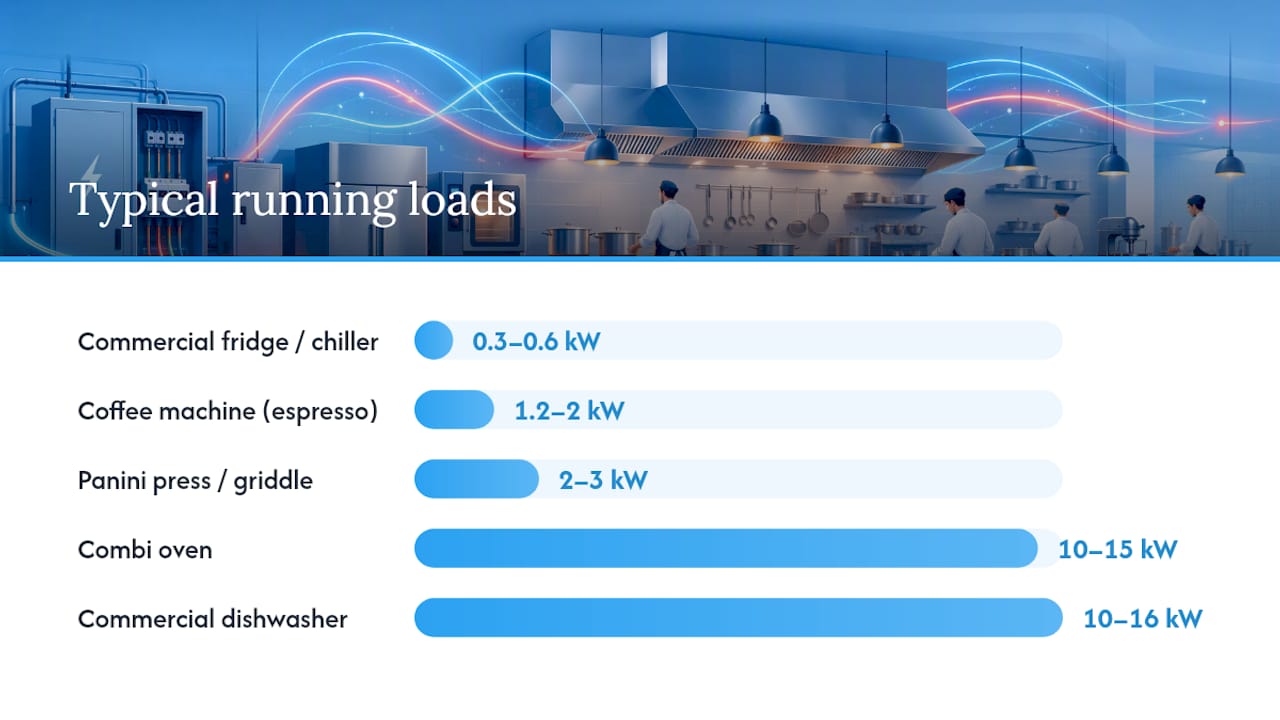
Running watts (the steady draw once equipment is up to temperature) differ hugely from start-up watts, which spike for a second or two when a compressor or heating element first engages. Here’s a working catalogue of what typically shows up on an event catering rig:
- Coffee machine (espresso, single group): 1.2 to 2 kW running, minimal surge
- Panini press / griddle: 2 to 3 kW running, low surge
- Deep fat fryer (single basket): around a few kilowatts running, moderate surge on the heating element
- Commercial fridge / chiller: 0.3 to 0.6 kW running, but compressor start-up can briefly demand two to three times that
- Combi oven: 10 to 15 kW running with a notable start-up surge, and often three-phase only
- Commercial dishwasher: 10 to 16 kW running, per data from Elec-Mate
- Hot cupboard / bain-marie: 1 to 2 kW, steady draw with no meaningful surge
- Extraction fan / canopy: 0.5 to 1.5 kW depending on motor size
Those combi oven and dishwasher figures are drawn from full commercial kitchen fit-outs rather than event trailers, but they show why a single griddle van and a three-oven hospitality unit sit in completely different sizing categories.
Industry practice generally splits catering setups into three tiers, and it’s worth thinking in these bands before you get into exact maths:
- Small setups (a coffee cart, a hot drinks stall, a simple hog roast van): generally cover running load plus surge within a few kilowatts.
- Medium setups (a food trailer with a fryer, griddle, and fridge running together): usually 6.5 to 10 kW, depending on how many heat-producing appliances run simultaneously.
- Large setups (multiple ovens, walk-in chillers, dishwashing stations, or a full hospitality marquee kitchen): often 10 to 15 kW or more, frequently pushing into three-phase territory.
Those bands are starting points, not gospel. Every trailer and every menu is different, and the only way to know for certain is to check the nameplate rating on each appliance you’re actually bringing, not the average figure for “a fryer.” Manufacturers stamp voltage, current, and sometimes wattage directly onto the appliance or its data plate, usually near the power cable entry or on a sticker inside a service panel. That number, not an online table, is what you plug into your calculation.
Pro Tip: Keep a laminated card in your event kit listing the nameplate wattage of every appliance you own. It saves a scramble through instruction manuals the morning of a booking, and it’s the single fastest way to catch a sizing error before it becomes a service-day trip.
How do you calculate catering power requirements step by step?
Generator sizing isn’t complicated once you break it into stages. The process below is the same one professional installers use, just without the specialist software.
- List every appliance and its electrical data. Read the nameplate for volts and amps; if only amps are shown, convert using Watts = Amps × 230 for a standard UK single-phase supply.
- Group appliances by what runs together. Not everything switches on at once. Identify the worst-case combination, the moment when the most heat-producing kit is likely to be live simultaneously, usually mid-service on a busy order.
- Total the running watts for that worst-case group. This is your baseline continuous load.
- Identify the single largest start-up surge among that group. Compressors, motors, and some heating elements draw more on start-up than while running. Add only the biggest one; you don’t stack every surge, because appliances rarely all start in the same instant.
- Apply a headroom multiplier. A sensible range is 1.2 to 1.5 times the combined figure, covering unexpected overlap, voltage sag, and future kit additions.
- Round up to the next standard generator size. Generators come in fixed increments (2.5 kW, 5 kW, 6.5 kW, 10 kW, 20 kW, and so on), so your calculated figure rarely lands exactly on an available unit.
Here’s how that plays out for a medium-sized food trailer running a fryer, griddle, coffee machine, and fridge during peak lunchtime service:
Add the fryer’s start-up surge, which on a typical 3.2 kW unit might briefly draw an extra 1.5 to 2 kW above running load. That brings the working figure to around 9,100 to 9,600 W. Apply a 1.3 headroom multiplier and you land at roughly 11,800 to 12,500 W, which means a 12.5 kVA or 15 kVA generator is the sensible choice rather than trying to scrape by on a 10 kVA unit.
That worked example is exactly why the small/medium/large tiers mentioned earlier only work as a starting estimate. The trailer above sits at the top end of “medium” purely because the fryer’s surge pushed the final figure higher than the running watts alone suggested. Skip the surge step and you’d undersize the generator by a meaningful margin, and that’s precisely the kind of miscalculation that causes trips the moment two appliances hit their compressor cycle together.
Single-phase or three-phase: which does your kit need?
The answer sits on the appliance itself, not on guesswork. Every commercial catering appliance carries a data plate, usually near the power inlet or inside an access panel, stating voltage, phase, and current draw. A single-phase UK appliance will show 230V; a three-phase appliance will show 400V, often alongside a note like “3N~” or a wiring diagram with more than the standard two power conductors.
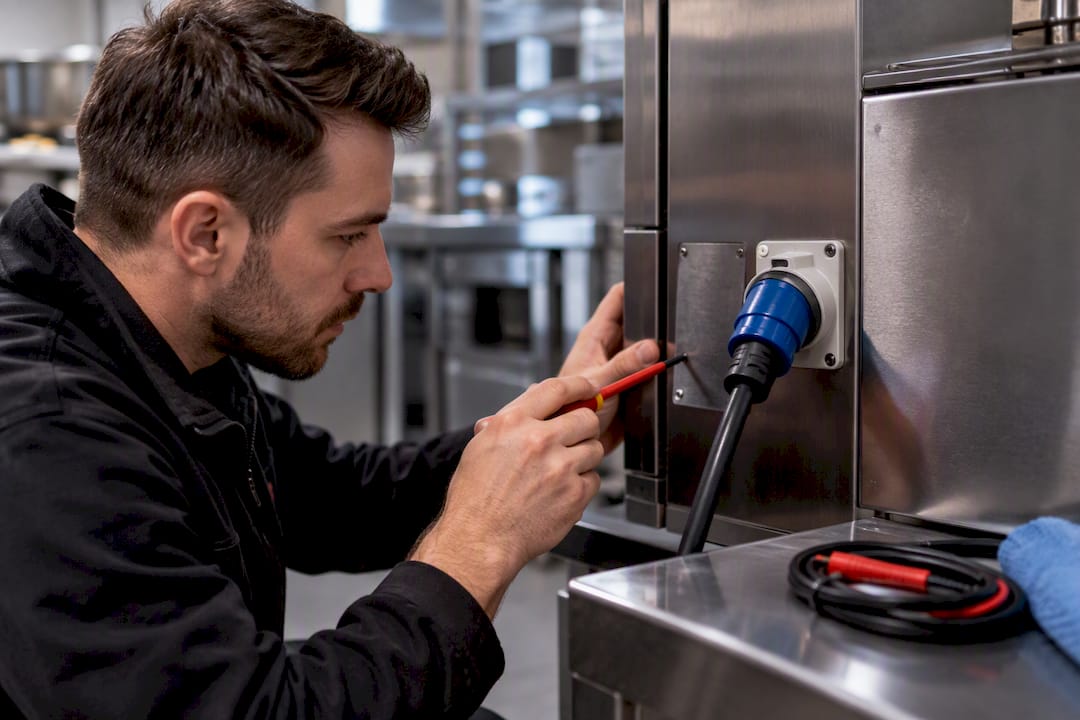
Three-phase supplies aren’t a luxury upgrade, they’re often mandatory. Combi ovens, large dishwashers, and heavy-duty fryers frequently draw enough current that a single-phase supply simply can’t deliver it, and running them from an undersized single-phase generator causes repeated trips or outright equipment failure, as noted in guidance from Herits on catering equipment power. If your menu involves a full combi oven setup or a commercial-grade dishwashing station, check the phase requirement before you book any generator, not after.
Choosing generator type matters almost as much as choosing size:
- Inverter generators produce a cleaner, more stable waveform, which suits sensitive electronics like point-of-sale systems, card readers, and coffee machine control boards.
- Conventional generators handle large continuous loads well and are typically the more economical choice for heavy cooking equipment where waveform purity matters less.
- Silent (acoustic-enclosed) generators reduce noise significantly, useful for weddings, corporate functions, or any venue with noise restrictions.
- LPG and dual-fuel generators offer cleaner emissions and easier fuel logistics for events in enclosed or semi-enclosed spaces, though running costs and availability vary by supplier.
Pro Tip: If your event mixes delicate electronics with heavy cooking kit, consider running them from separate supplies. It protects the sensitive equipment from voltage fluctuations caused by heavy motor loads cycling on and off.
What safety standards apply to temporary catering power?
Sizing the generator correctly solves half the problem. The other half is making sure the installation itself meets the standards that govern temporary event power in the UK, and this is the part that most non-electricians underestimate.
BS 7909:2023 is the industry code of practice covering temporary electrical systems for events, and it sets out clear expectations for planning, RCD placement, and earthing on any temporary supply, according to BSI’s published standard. Treat it as the reference document, not an optional guideline, if you’re responsible for signing off an event’s electrical setup.
HSE recommends no more than six final circuits per 30 mA RCD at distribution board level for temporary installations, a specific limit designed to reduce the risk of nuisance tripping while keeping fault protection tight, per HSE guidance GS50.
Portable equipment used at events should sit on circuits protected by a 30 mA RCD, and that protection needs to be verifiable, not assumed. Generators must be correctly earthed, and earthing resistance should be tested by a competent person before the event opens, a requirement BS 7909 makes explicit for portable generating sets. The HSE’s own guidance on electrical safety for events goes further, listing the elements a temporary installation plan should document: layout, cable routing, earthing arrangements, and contingency provisions if a supply fails mid-event.
In practice, that translates to a short list of non-negotiables:
- RCDs fitted at the distribution board, not bolted on as an afterthought at the appliance end.
- A written record of RCD test results, kept with the event paperwork, not just a verbal “it’s fine.”
- Earthing arrangements checked and documented by whoever installs the generator, especially where multiple generators or supplies feed one site.
- A documented risk assessment covering cable routes, public access points, and what happens if a circuit trips during service.
None of this is bureaucratic box-ticking. A caterer who skips the RCD check because “the generator’s brand new” is gambling on the one piece of protection that stops a fault becoming a shock incident in a space full of members of the public.
Distribution, cabling and site setup for catering power
Getting the generator size right means nothing if the cabling between it and the appliances can’t handle the load safely, or trips a hazard for the public walking past your stall.
High-current outlets should use industrial BS EN 60309 connectors (the round, colour-coded “commando” sockets), reserving standard 13A domestic sockets for lighter loads like phone chargers or small display units. Mixing the two, running a fryer off a 13A domestic-style plug because it was convenient, is one of the fastest routes to a melted socket.
Cable protection matters just as much as connector choice. The HSE is explicit that cables must be routed to minimise tripping hazards and protected against mechanical damage, with joints kept away from foot traffic and shielded from water ingress. In a public event, that means:
- Cable ramps or catenary supports wherever a cable crosses a walkway.
- Never running a high-load cable coiled on its reel, coiled cable heats up under load and can melt its own insulation.
- Keeping joints elevated, covered, or inside weatherproof enclosures, particularly for outdoor bookings.
- Balancing loads across phases on a three-phase supply, since an uneven split drives excessive current through the neutral conductor and risks nuisance trips.
Document the distribution plan before the event, not during setup. A simple sketch showing generator position, cable runs, distribution board location, and which appliances sit on which circuit saves a huge amount of confusion if something needs isolating quickly. Readers setting up smaller events might find the practical detail in this guide to backyard party electrical best practices a useful companion, and for a deeper look at cable specification itself, this breakdown of temporary power cabling types covers what UK contractors actually use on site.
Managing start-up surges and peak-service load
Running watts tell you what a generator needs to sustain, but inrush current, the brief spike when a compressor, motor, or heating element first engages, is what actually catches people out. A fridge compressor, for instance, can draw two to three times its running wattage for a second or two on start-up, and if that spike coincides with a fryer element cycling on, the combined demand can exceed what a marginally-sized generator can deliver.
Headroom exists precisely for this. Building in that extra 20 to 50% on top of your calculated running-plus-surge figure isn’t padding, it’s the buffer that absorbs the unpredictable overlap of multiple appliances cycling at once.
A few operational habits reduce surge risk without needing a bigger generator:
- Stagger equipment start-up. Switch on the fryer, wait a few seconds, then bring the griddle online, rather than flicking every switch simultaneously.
- Favour soft-start appliances where you have a choice. Some commercial fridges and compressors now come with soft-start technology that reduces inrush significantly.
- Sequence heavy loads deliberately during service. If you know the fryer surge is your biggest spike, avoid triggering the extraction fan’s own start-up at the exact same moment.
Pro Tip: If your kit list includes two or more compressor-based appliances, stagger their power-up by even 10 to 15 seconds. It’s a free habit that meaningfully reduces the odds of a nuisance trip during the breakfast rush.
Pre-event checklist: commissioning your temporary power supply
A generator that looks correctly sized on paper still needs proving on site before you open to the public. This is the stage most commonly skipped under time pressure, and it’s the stage that catches problems while there’s still time to fix them.
- Run the full setup under realistic load for 20 to 30 minutes. Switch on every appliance you’ll actually use simultaneously and watch for voltage sag or unexpected trips.
- Test and record RCD operation. Use the test button on each RCD and log the result; if any RCD fails to trip on test, do not open until it’s replaced.
- Check earthing resistance where a generator is supplying the site. This should be carried out and documented by a competent person, per BS 7909 recommendations.
- Confirm labelling and isolation points are accessible. Anyone on site should be able to find and operate the main isolator without hunting for it in an emergency.
- Check fuel reserves and contingency plans. Know how long your fuel lasts under peak load and have a plan if the primary supply fails mid-service.
For a look at how these checks play out in real failures, this rundown of common venue electrical failures is worth reading before your next booking.
What experience teaches about catering power failures
The pattern behind most catering power failures rarely changes: someone undersizes the generator slightly, cables get run without proper protection because “it’s just for the day,” and RCDs get treated as an afterthought rather than a checked, recorded safeguard. Each mistake is individually survivable. Together, on a busy service, they compound.
The clearest sign you need professional installation or standby cover isn’t the size of the event, it’s the complexity of the load. Multiple heat-producing appliances, three-phase requirements, or a public footfall that turns a minor trip into a real hazard all point the same way. Forty years of fixing these exact failures shapes every checklist above.
— Rob
Get your event power right with professional support
Working through the sizing maths above gets you a solid estimate, but matching that figure to an actual generator, wiring it safely, and keeping it running through a six-hour service is a different job entirely. Professional event power providers bring extensive electrical contracting experience, ensuring the sizing calculations above are supported by practical expertise in installing earthing, testing RCDs, and monitoring generators during critical surge events.
Jakspartypower’s services cover the full chain: generator hire matched to your calculated load, distribution boards and cabling specified to BS 7909 standards, and standby cover so a qualified electrician is on hand throughout your event rather than a phone number you hope not to need. Browse the generator range to see what capacity is available for hire once you’ve worked out your figure, or check distribution boards and accessories if you’re planning the cabling side yourself. For weddings, corporate functions, or any event where catering power failure simply isn’t an option, get in touch to request a quote and talk through your specific kit list before the day arrives.
Standards and official guidance worth checking
The recommendations in this article draw directly on published UK standards and official safety guidance, worth bookmarking if you’re responsible for signing off event electrics regularly.
- BS 7909:2023, the code of practice covering temporary electrical systems at events, including RCD placement and earthing recommendations.
- HSE guidance GS50, covering electrical safety requirements for portable equipment and performer-facing supplies at events.
- HSE’s electrical safety for events page, setting out the planning elements a temporary installation should document.
- Guidance on single-phase versus three-phase catering equipment, useful for checking whether your kit list needs a three-phase supply.
Sources
- HSE guidance (GS50) — Event safety: Electrical safety
- BS 7909:2023 — Temporary electrical systems for entertainment and related purposes (BSI Knowledge)
- Single-phase vs three-phase catering equipment — Herits blog
- HSE — Electrical safety for events
- Restaurant electrical cost (Elec-Mate)
FAQ
What size generator do I need for a catering trailer?
It depends entirely on your equipment list, but a medium trailer running a fryer, griddle, coffee machine, and fridge together typically needs somewhere between 10 and 15 kVA once surge and headroom are factored in. Work through the step-by-step calculation above using your own appliance nameplates rather than relying on a single rule of thumb.
What are common catering power mistakes to avoid?
The most frequent mistake is sizing a generator on running watts alone and ignoring start-up surge, which causes trips the moment a compressor or heating element engages. Close behind that is treating RCD protection and earthing as optional extras rather than the checked, documented safeguards that BS 7909 and HSE guidance both require.
Do I need qualifications to set up catering power at an event?
Basic generator connection for small, low-risk setups doesn’t legally require an electrical qualification, but earthing checks, RCD testing, and three-phase installations should be carried out by a competent person under BS 7909 recommendations. For anything beyond a small single-phase setup, hiring qualified support or standby cover removes the liability risk of getting it wrong in a public space.
What is the best type of generator for a catering trailer?
Silent, canopy-enclosed generators suit most catering trailers well, since they keep noise low for guests and staff while handling continuous cooking loads reliably. If your setup mixes heavy cooking equipment with sensitive electronics like card readers, running an inverter generator for the electronics and a conventional set for the cooking load, as discussed above, often works better than a single generator trying to serve both.