
Size your generator from a proper load schedule, not a guess. List every item’s running watts, convert the total to kW, then divide by a power factor of around 0.8 to get kVA, and add margin for motor starting current and harmonic derating before picking a set. Once you have that figure, check it against the generator’s continuous or prime rating, never its standby rating, because that’s the number the set can actually sustain for the length of your event.
TL;DR:
- Proper generator sizing depends mainly on a detailed load schedule that accurately lists all equipment’s power requirements and their simultaneous use.
- Converting total wattage to kVA requires dividing by a default power factor of 0.8 and adding margins for motor start-up currents and harmonic derating to avoid undercapacity.
- Always compare the calculated load against the generator’s prime or continuous rating, not its standby rating, to ensure reliable operation during extended events.
- Equipment with multiple motors or non-linear loads, such as LED dimmers and switch-mode power supplies, can cause harmonic distortion and overheating if not properly derated or staggered in starting.
- Coordination of cable runs, phase balancing, and site-specific factors like noise limits and refuelling logistics are critical to prevent voltage drops, protection trips, and safety violations.
Table of Contents
- What is a load schedule and how do you build one?
- How do you convert a load schedule into generator kVA?
- What size generator do most events actually use?
- Why does a correctly sized generator sometimes still struggle?
- What safety standards and site rules apply to event generators?
- How does an experienced supplier approach generator sizing?
- Why involving a specialist early saves events
- How Jakspartypower supports your generator sizing and hire
- Sources
- FAQ
What is a load schedule and how do you build one?
A load schedule is the itemised list of every piece of equipment drawing power at your event, and it’s the only reliable starting point for event generator sizing. Skip it and you’re sizing by guesswork, which is exactly how undersized generators end up tripping mid-speech or blowing catering equipment at the worst possible moment.
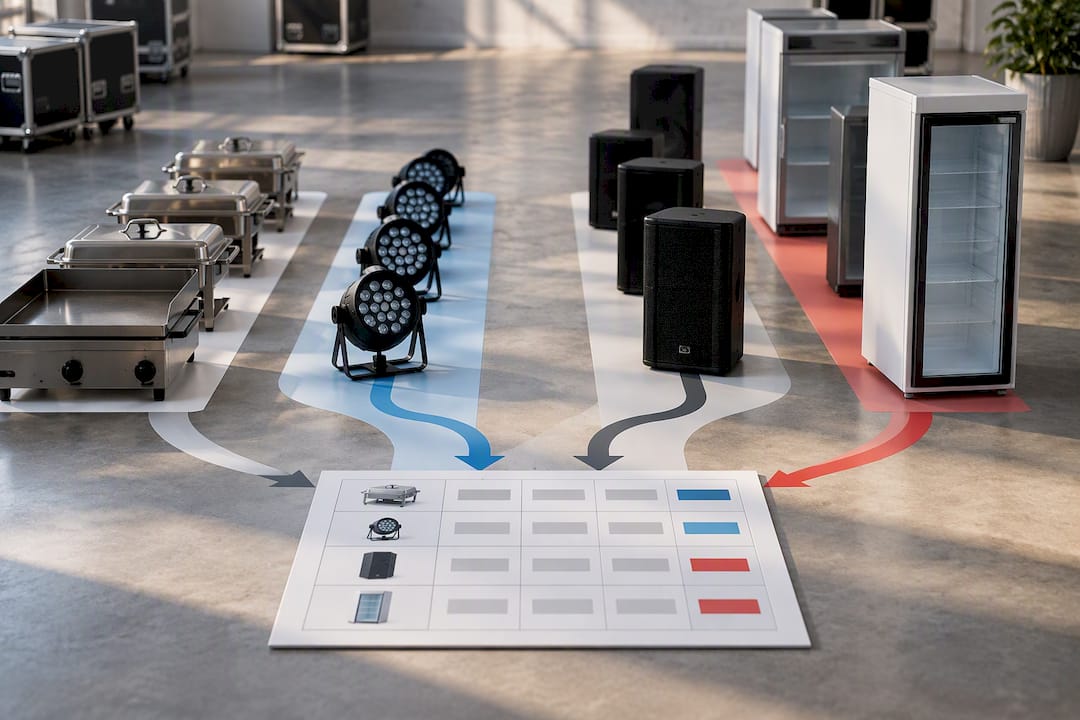
Build the schedule as a simple table. For each item, record the quantity, running watts or kW, voltage, whether it’s single or three phase, the connector or plug type, and whether it runs continuously, intermittently, or only draws its full load briefly at start up. Then group items by which ones actually run at the same time, because a generator only has to cover the peak simultaneous demand, not the sum of everything you own.
Some categories deserve extra attention on that list:
- Motors (fridge compressors, extraction fans, pumps) draw far more current for a second or two at start up than while running.
- Dimmers and lighting control can introduce non-linear, harmonic-heavy loads that behave differently from a simple resistive heater.
- Battery chargers for phones, radios, or e-bikes add a small but constant background load that’s easy to forget.
- Refrigeration and catering equipment often cycles on and off, so peak and average demand can differ sharply.
Where you’ve got several single-phase loads, such as bar chillers, lighting rigs, and sound equipment, spread them across the three phases of a three-phase supply rather than piling them onto one. An unbalanced phase can trip protection or overheat a conductor even when the generator’s total headline kVA looks perfectly adequate, because phase mapping and connector ratings often decide whether a set can actually supply the load, regardless of what the nameplate says.
Alongside the equipment list, a supplier needs site facts: a plan showing generator and distribution positions, cable run distances, vehicle access for delivery and refuelling, any noise limits from the venue or local authority, the total runtime, and how often refuelling will be practical. Cable distance matters more than most planners expect, since long cable runs need voltage drop checks and mechanical protection, which can change the cable size a supplier specifies even when the generator itself is correctly rated. Get this brief right and a competent supplier can quote accurately on the first pass, rather than sending someone out to redo the sums on site — see this event mood board guide for resources to support your coordination.
How do you convert a load schedule into generator kVA?
The conversion runs in a fixed sequence: total the running watts, convert to kW, divide by power factor to get kVA, then add margin for starting currents and derating before matching against a prime rated set.
Two formulas do the heavy lifting for current, which matters when you’re checking cable and breaker sizing rather than just the generator itself:
- Single phase current: I ≈ Watts ÷ 230
- Three phase current: I = P ÷ (√3 × V × PF)
- kVA from kW: kVA = kW ÷ PF
That last formula is where most sizing mistakes start. Power and lighting technicians often assume kW and kVA are interchangeable, but they only are when the power factor equals 1, which almost never happens with real event equipment. The IET treats maximum demand including starting currents and power factor as two entirely separate calculations, and conflating them is the single most common error in DIY sizing.
Statistic to remember: a 100 kVA generator running at a power factor of 0.8 delivers only 80 kW of usable power, so sizing by appliance wattage alone can leave you short even on a generator that looks big enough on paper.
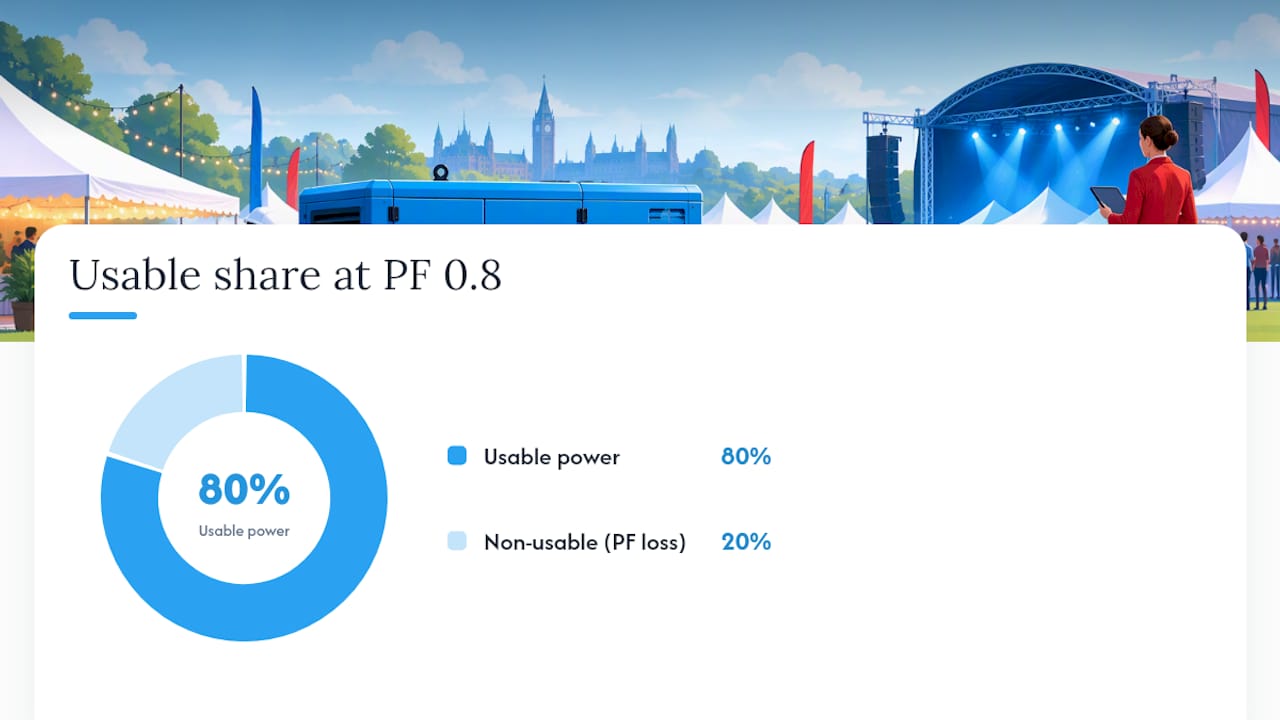
Unless your equipment supplier can confirm a higher power factor from actual nameplate data, 0.8 is the sensible conservative default for event loads. Motors, dimmers, and switch mode power supplies all pull the effective power factor down, and building in that margin now is far cheaper than a generator struggling on the night.
Starting current is the other variable that catches planners out. Motors typically draw somewhere between two and six times their running current for a second or two when they start, and if several motors happen to start together, that spike can be large enough to trip the generator even though the running load sits comfortably within capacity. Where you’ve got multiple large motors or unfamiliar equipment, ask the manufacturer for actual starting current data rather than relying on a rule of thumb, and consider staggered starting where the equipment allows it.
Here’s how that comes together for a fairly typical small marquee wedding:
- List the loads: catering trailer (6 kW), bar chiller and back bar lighting (2.5 kW), event lighting rig (3 kW), PA system and DJ (2 kW), phone charging and miscellaneous (0.5 kW). Total running load: 14 kW.
- Convert to kVA: 14 kW ÷ 0.8 PF = 17.5 kVA.
- Add starting margin: the catering trailer’s compressor and the chiller both have motor starts, so add roughly 20% headroom for inrush: 17.5 kVA × 1.2 ≈ 21 kVA.
- Round up to the nearest practical rental size: a supplier would typically recommend a 25 to 30 kVA set at prime rating, leaving genuine spare capacity rather than running the generator flat out.
- Verify against prime, not standby, rating: the quoted 30 kVA figure must be the set’s continuous prime output, since standby ratings assume short term emergency use and aren’t designed to run an event for six or eight hours straight.
Once the generator size is settled, don’t stop there. Cables, breakers, and distribution boards downstream of the generator all need checking against the same load figures, because an undersized cable run can cause voltage drop and nuisance tripping even when the generator itself has plenty of headroom left.
What size generator do most events actually use?
There’s no single “standard” event generator, and the rental market spans a genuinely wide range, from small towable sets up to 300 kVA units used for major shows. The right band depends entirely on your load schedule, not on the type of event alone, but a few patterns hold up across most bookings.
- Small private parties rarely need more than a 6 to 10 kVA set, but a domestic petrol generator sized for a garden barbecue is usually the wrong choice for anything with public access, hired catering equipment, or lighting rigs, since it lacks the earthing and RCD protection a public event needs.
- Weddings and medium corporate events commonly sit somewhere between 20 and 80 kVA, depending on catering, lighting, and whether there’s a live band or DJ rig on top of basic marquee lighting. Above roughly 40 to 50 kVA, it’s often worth centralising distribution through a single board rather than running multiple small sets.
- Festivals and large shows frequently need multiple generators paralleled together, or a single central set above 100 kVA, particularly where stage production, food vendor rows, and site infrastructure all draw from one supply.
- Rental examples, such as JCB’s range of 18 to 300 kVA units, are useful as a sense check for what’s typically available, but they’re indicative only. Your own load schedule, not a manufacturer’s product line, is what determines the correct size.
If your total keeps landing between two standard rental sizes, round up rather than down. The cost difference between adjacent size bands is usually modest compared with the cost of a generator that can’t cope on the day.
Why does a correctly sized generator sometimes still struggle?
Sizing the headline kVA correctly is only half the job. A generator can be nominally big enough and still misbehave on site because of harmonics, phase imbalance, or starting currents that weren’t properly accounted for.
Harmonic distorting loads, things like LED dimmer racks, variable speed drives, and switch mode power supplies in modern AV and catering kit, don’t draw current in a smooth sine wave. That distortion heats the alternator windings more than an equivalent linear load would, and manufacturers may require derating of up to 50% for heavily non-linear loads. A generator that looks comfortably oversized on paper can still run hot or trip if a large share of its load is harmonic heavy equipment.
Assuming a power factor of 1 is the other trap. Real event loads almost never run at unity power factor, and treating kW and kVA as interchangeable is flagged by the IET as the single most common sizing mistake organisers and even some contractors make.
Multiple motors starting together compounds the problem. If a chiller, an extraction fan, and a catering compressor all kick in within the same few seconds, the combined inrush can momentarily exceed what the generator can supply, even though none of those motors is a problem individually. Staggering start times, or specifying soft start equipment where it’s available, avoids the spike entirely.
Pro Tip: Never size against a generator’s standby rating. Standby figures assume occasional short duration use during a mains failure, not eight hours of continuous running at a festival. Always ask your supplier for the prime or continuous rating, and check that figure against your calculated load, not the number printed largest on the spec sheet.
Phase imbalance rounds off the common pitfalls. If every single-phase load gets plugged into whichever socket is nearest, one phase can end up carrying far more than the others, tripping protection on that phase while the other two sit under used. Mapping loads across phases deliberately, as part of the load schedule, prevents this before it becomes a site problem.
What safety standards and site rules apply to event generators?
Three sources govern how event power should be designed, installed, and checked in practice: BS 7909, BS 7671, and HSE’s event safety guidance, with The Purple Guide filling in event-specific practical detail. BS 7909:2023+A1:2024 covers temporary low voltage systems for entertainment specifically, and the 2023 revision puts more weight on documented planning than earlier versions did. It sits alongside BS 7671 (the wiring regulations) and the Electricity at Work Regulations, rather than replacing either.
On site, a few items are non-negotiable regardless of event size:
- Earthing and RCD protection appropriate to a generator supply, with the earth electrode resistance actually tested, not assumed.
- Segregation from the public, since HSE guidance is explicit that generators should be located away from public access and protected from weather.
- Cable routing planned to avoid trip hazards and to eliminate underground joints, which HSE flags as a recurring cause of event electrical failures.
- Bunded fuel storage and a documented refuelling plan, so refuelling never happens near running equipment or an open flame.
- A competent installer, someone who can produce test and inspection records, not just deliver a box and walk away.
Before the event, ask your supplier for a handover pack: a completed load schedule, a single line diagram of the distribution, earth test results, and protective device settings. That pack is what lets a second electrician troubleshoot quickly if anything goes wrong mid-event, rather than starting from zero. For anything under canvas, a dedicated marquee earthing checklist is worth working through alongside the generator sizing itself, since earthing failures cause more event day problems than undersized generators do.
How does an experienced supplier approach generator sizing?
A competent supplier doesn’t start with a generator size. They start with your brief, then work backwards to a recommendation, because sizing is really a design exercise, not a shopping decision.
Some suppliers have over 40 years of electrical contracting experience before specialising in event power, and that background shapes how a sizing conversation typically runs:
- Receive the brief: load schedule, site plan, event dates, and runtime.
- Site survey or technical rider review: checking access, distances, and any venue restrictions that affect distribution.
- Confirm load schedule and phase balance: querying anything vague or missing before quoting, not after delivery.
- Quote with prime rating stated explicitly, plus an installation plan covering earthing, cabling, and standby cover if the event needs it.
Behind that quote sits work most organisers never see directly: paralleling multiple sets for larger loads, planning fuel logistics for multi-day runtimes, and managing noise and public safety around the generator compound itself.
When you approach a supplier, copy this short checklist into your enquiry: full load schedule with running watts, site plan with distances, access and delivery times, total runtime and refuelling constraints, and any noise limits from the venue. A supplier who asks follow up questions on that brief, rather than quoting a size instantly, is usually the one worth booking.
Why involving a specialist early saves events
The single biggest mistake I see in event power planning isn’t a maths error. It’s organisers submitting an incomplete load list, or sending it to a supplier days before the event when there’s no time left to query anything.
A generator quoted against a vague brief is a guess dressed up as a number. Documented design, proper testing, and a clear handover process aren’t paperwork for its own sake. They’re what stops a generator failing three hours into a wedding reception because nobody checked whether the caterer’s second fridge was on the list. Bring a specialist in early enough that a gap in the brief becomes a phone call, not a site day crisis.
— Rob
How Jakspartypower supports your generator sizing and hire
Getting the sizing right is only useful if the equipment and installation behind it are just as solid, which is where Jakspartypower’s services come in. Beyond generator hire itself, the team handles distribution, cabling, fuel, and standby cover, backed by over 40 years of electrical contracting experience that goes into every quote.

To get an accurate quote rather than a rough estimate, send across your load schedule, a site plan, access and delivery times, and your expected runtime. That’s the same brief a competent supplier should always ask for before recommending a set, and it lets Jakspartypower confirm phase balance and prime rating before anything gets delivered. Some clients highlight the standby cover and equipment reliability in their feedback, which matters most on the day something unexpected happens. If you’re planning an event and want a straight answer on what size generator you actually need, hire a generator through Jakspartypower and send your load schedule across for a proper quote.
Sources
- Temporary power distribution webinar Q&A (IET)
- Electrical safety at events (HSE)
- BS 7909:2023+A1:2024 (BSI Knowledge)
- JCB rental generator range
FAQ
What size generator do I need for my event?
Size it from your load schedule, not from event type alone. Add up running kW, divide by a power factor of around 0.8 to get kVA, then add margin for motor starting current before checking the figure against the supplier’s prime rating.
What is the 20/20/20 rule for generators?
There’s no recognised UK standard behind this rule. BSI, IET, and HSE guidance don’t reference a universal 20/20/20 sizing method, so treat any supplier quoting it as shorthand rather than an established calculation, and ask for a proper load schedule instead.
How do I calculate generator sizing?
List every load’s running watts, total them into kW, then divide by power factor (typically 0.8) to convert to kVA.
What is the standard size of a generator?
There isn’t one. UK rental ranges span roughly 18 kVA up to 300 kVA and beyond, and the correct size for any given event depends on its own load schedule, phase balance, and starting currents rather than a fixed industry figure.
How much does it cost to hire an event generator from Jakspartypower?
Pricing depends on the generator size, hire duration, and whether standby cover or installation is included, so current costs are available directly through Jakspartypower’s services page on request.