
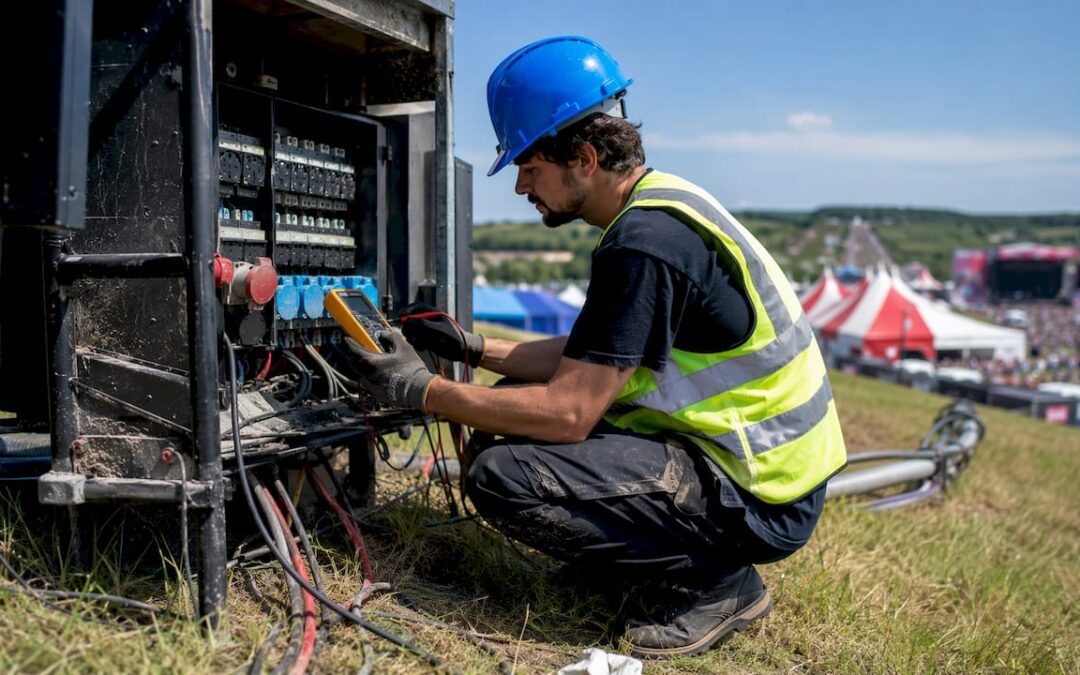
For most UK outdoor festivals and large shows, generator-fed three-phase distribution with RCD-protected sub-boards is the right call. For small indoor venue events, a temporary mains supply with local sub-distribution boards is usually simpler, cheaper, and perfectly adequate. The decision between these approaches comes down to four things: available supply at the venue, total load, whether the event is indoors or outdoors, and your redundancy requirements.
Quick recommendations by event type:
- Wedding (indoor venue): Temporary mains supply via venue intake, local sub-boards for catering, AV and lighting zones
- Corporate conference: Temporary mains or venue mains with dedicated sub-distribution; single-phase usually sufficient unless large AV rigs are involved
- Outdoor festival or large show: Generator-fed three-phase distribution with generator interface units (GIU) for load sharing and N+1 redundancy
- Exhibition or trade show: Temporary mains supply from venue, modular distribution towers or boxes per stand zone
- Film or TV location shoot: Generator-fed distribution, often with a separate quiet generator for sound-sensitive areas and a hybrid mains/generator arrangement where a grid supply is available
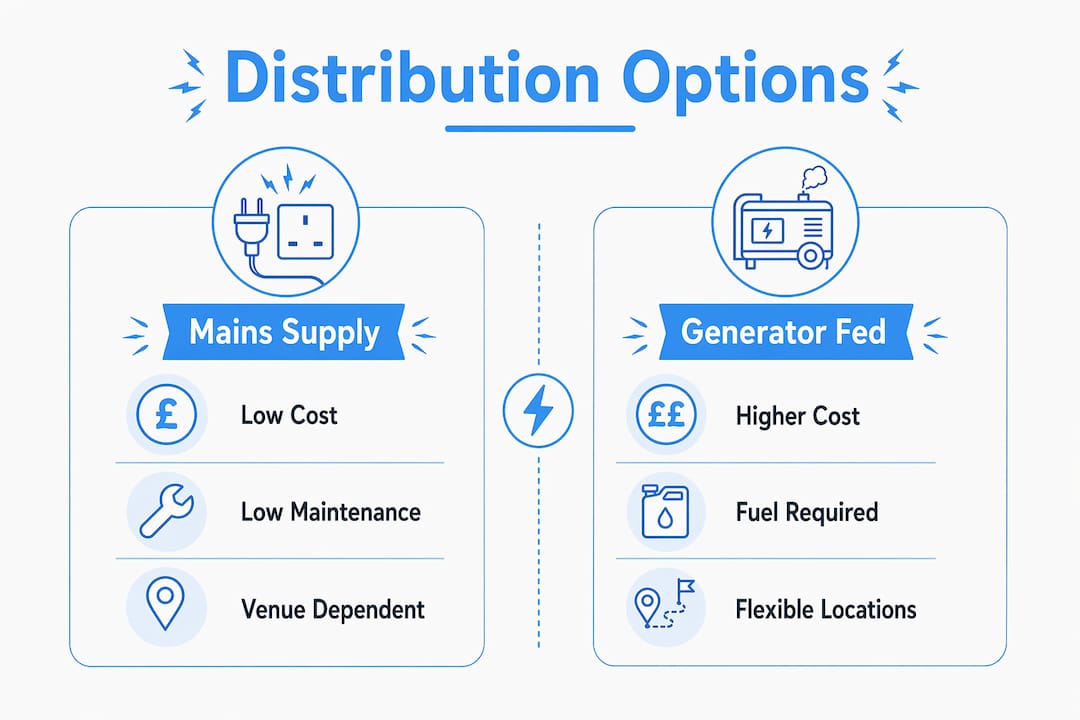
The rationale is straightforward. Mains temporary supply is lower cost and lower maintenance when a venue can provide adequate capacity, but it offers no redundancy if the grid fails. Generator-fed distribution gives you full control over supply quality, location, and resilience, at the cost of fuel, noise management, and more complex logistics. Cam-lock systems and modular distribution boxes sit on top of either supply type and determine how power reaches each zone of the site.
Table of Contents
- What does event power distribution actually mean?
- Event electrical distribution options compared
- Single-phase vs three-phase: which do you actually need?
- UK safety standards every event planner must know
- Generator logistics, fuel planning, and redundancy
- On-site installation: cabling, connectors, and weatherproofing
- What to ask a hire partner or venue before you commit
- How Jakspartypower implements distribution on UK events
- How much does each distribution option cost?
- Setup and teardown timelines for each distribution method
- Key takeaways
- The thing most planners get wrong about event power
- Jakspartypower: site surveys, hire packages, and standby cover
- Useful sources and further reading
- FAQ
What does event power distribution actually mean?
At its simplest, event power distribution is the chain of equipment that takes electricity from a source (either the mains or a generator) and delivers it safely to every load on site: lights, PA, catering, AV, production offices, and everything else.
The chain has three tiers. The main distribution assembly (often called the “main distro”) connects directly to the supply source and houses the primary protective devices: main circuit breakers, RCDs or RCBOs, and metering. From there, sub-distribution boards or towers receive power via feeder cables and break it down into smaller circuits for specific zones or departments. Finally, final circuits run from those sub-boards to individual pieces of equipment.
“Beyond the fixed electrical installation, the temporary element is purely a kit-of-parts assembled to suit the situation or event.” — IET Wiring Matters, Temporary Power Distribution Systems for Entertainment Purposes
Connectors are standardised across the industry. BS EN IEC 60309 connectors (commonly called “Ceeform”) are used at 16A, 32A, 63A, and 125A ratings, colour-coded by voltage. For high-current feeds above 125A, cam-lock connectors (single-pole, large-diameter) are standard. Multipole connectors are used where a single plug must carry several circuits simultaneously, reducing connection time on complex rigs.
A typical site schematic runs: generator or mains intake → main distro → feeder cables → sub-distribution boards → final circuit cables → equipment. Each tier steps down the current rating and adds a layer of protection. Getting that hierarchy right before you arrive on site is what separates a clean build from a chaotic one.
Event electrical distribution options compared
The four principal options you will encounter when comparing electrical systems for events are: temporary mains supply, generator-fed distribution, cam-lock systems, and modular distribution boxes or towers. Most large events combine two or more of these.

| Distribution option | Typical use-cases | Capacity and scalability | Deployment speed | Safety and compliance | Cost shape | Weatherproofing | Redundancy |
|---|---|---|---|---|---|---|---|
| Temporary mains supply | Indoor venues, exhibitions, conferences, weddings | Limited by venue intake (typically 100A–400A single or three-phase) | Fast if venue supply is pre-wired; slow if DNO work is needed | Requires BS 7671 compliance; venue responsible for fixed installation | Low equipment cost; DNO connection fees can be significant | N/A (indoor); outdoor requires weatherproof intake | None unless dual-feed arranged with DNO |
| Generator-fed distribution | Outdoor festivals, location shoots, greenfield sites | Highly scalable; multiple sets can be paralleled | Moderate; generator delivery and fuel logistics add time | Full BS 7671 and BS 7909 compliance required; earthing critical | Higher hire and fuel cost; no DNO fees | Generator enclosures rated for outdoor use; IP-rated distros required | N+1 achievable with GIU and standby set |
| Cam-lock systems | High-current feeds (above 125A) between main distro and sub-boards | Handles very high currents; used on large festival stages | Quick to connect once laid; cable runs require planning | Single-pole connectors must meet at least IP44 when connected | Moderate cable hire cost; requires trained crew | IP44 minimum when connected | Dependent on upstream supply |
| Modular distribution boxes/towers | Any event needing zoned distribution; trade shows, outdoor markets | Modular; add or remove boxes per zone | Fast; self-contained units deploy in minutes | Individual RCD/RCBO protection per circuit; IP-rated enclosures | Low to moderate hire cost per unit | IP-rated enclosures available from IPX4 to IP66 | Limited; single point of failure unless fed from redundant supply |
Match your event type to the right option:
- Small indoor event (under 32A total): venue socket-outlets and a single sub-board are sufficient
- Medium outdoor event (32A–125A): a single generator feeding one or two modular distribution boxes covers most needs
- Large outdoor festival (above 125A per zone): generator-fed three-phase with cam-lock feeds to zone sub-boards and GIU load sharing
- Hybrid venue (partial mains, partial generator): automatic mains failure (AMF) panel switches load to generator if grid supply drops
For a deeper look at how distribution boards function across different event scales, the principles of zoning and circuit protection apply regardless of supply type.
Single-phase vs three-phase: which do you actually need?
Single-phase supply (230V, one live conductor) suits most small events: lighting rigs up to around 6kW per circuit, small PA systems, laptop charging banks, and catering equipment rated under 3kW. Three-phase supply (400V line-to-line, three live conductors) becomes necessary when total load exceeds roughly 20kVA, when you have large motor loads (catering ovens, HVAC, large compressors), or when you need to distribute load efficiently across a site without oversized cable runs.
A practical worked example: a medium outdoor festival with a 20kW stage lighting rig, a 10kW PA system, 8kW of catering, and 4kW of production office load totals 42kW connected. Apply a diversity factor of 0.7 (not everything runs at full load simultaneously) and you arrive at approximately 29kW of demand. Add 20% headroom and you need a generator rated around 35kVA. That fits comfortably on a single 63A three-phase supply, split across three phases: lighting on L1, PA on L2, catering and production on L3.
Phase balancing is where many planners lose money. An unbalanced three-phase load forces the generator to work harder on the loaded phase, increases neutral current, and can cause nuisance trips on sensitive equipment. Splitting loads as evenly as possible across phases reduces fuel consumption and keeps the system stable. Efficient phase balancing is explicitly recognised in BS 7909 as a way to reduce operational cost and improve reliability.
Pro Tip: When estimating diversity, ask each department head for their “worst-case simultaneous draw” rather than their total connected load. A lighting designer running a full show will use 80–90% of rig capacity; a catering team rarely runs all appliances at once. Building your load schedule from department-level diversity figures gives a far more accurate generator size than simply summing nameplate ratings.
For detailed guidance on lighting power budgets, breaking down rig loads by circuit type helps refine the calculation further.
UK safety standards every event planner must know
Temporary electrical installations at UK events sit at the intersection of three regulatory pillars: BS 7671 (the IET Wiring Regulations), BS 7909:2023+A1:2024 (the code of practice for temporary electrical systems at entertainment events), and HSE event electrical safety guidance. Together, these define what “safe” means legally and practically.
BS 7909 is the document most directly relevant to event work. It covers management, design, installation, and operation of temporary low-voltage AC systems for entertainment. Compliance with BS 7909 is widely accepted as the way to demonstrate that a temporary installation meets the requirements of BS 7671 for event conditions.
Essential protective devices and arrangements:
- RCDs rated at 30mA on all socket-outlet circuits up to 32A and all final circuits except emergency lighting
- Type S (time-delayed) or IEC 60947-2 compliant RCDs on distribution circuits feeding sub-boards, to allow discrimination and prevent a fault on one circuit tripping the whole site
- MCCBs (moulded case circuit breakers) at the main distro for short-circuit and overload protection
- Equipotential bonding of all accessible extraneous conductive parts: stage structures, lighting grids, scaffolding, and metal fencing within the electrical zone
- TT earthing system for outdoor temporary installations where a TN-C-S (PME) supply is not appropriate; separate earth electrodes required for generator-fed systems
Commissioning checklist before opening to the public:
- Insulation resistance test on all distribution cables and final circuits
- Continuity of protective conductors
- Polarity check on all outlets
- Earth fault loop impedance measurement on final circuits (critical where extension leads are used in series)
- RCD functional test at rated tripping current (30mA for final circuits)
- Visual inspection of all connectors, cable joints, and mechanical protection
The HSE guidance is explicit: planning and managing temporary electrical installations is a legal duty for event organisers, not a recommendation. Appointing a Competent Person to oversee the installation and holding documented test certificates is both a legal requirement and a practical necessity for insurance purposes. Poor documentation is a recurring factor in negligence findings after incidents.
For a structured approach to pre-event checks, the event electrical equipment inspection guide covers the full inspection sequence in practical terms.
Generator logistics, fuel planning, and redundancy
Generator placement is not just a logistics question; it directly affects safety, noise levels, and the reliability of your supply. The core principles are straightforward.
Placement and segregation:
- Position generators away from public access areas, behind solid barriers or within purpose-built acoustic enclosures
- Ensure adequate ventilation: hot exhaust air must not recirculate into the intake; minimum clearances vary by set size but 1m on all sides is a working minimum for smaller sets
- Route exhaust away from public areas, catering, and any enclosed structures
- Allow vehicle access for refuelling and maintenance without crossing public zones
Fuel planning:
- Calculate run-time from generator fuel tank capacity and expected load (a 50kVA set at 75% load typically consumes 10–12 litres of diesel per hour; confirm with the hire specification)
- Plan refuelling windows during low-activity periods; never refuel a running generator
- Store bulk fuel in approved containers with secondary containment; comply with the Dangerous Substances and Explosive Atmospheres Regulations 2002 (DSEAR) for quantities above 30 litres
Redundancy strategies:
- N+1: one standby generator for every N running sets, connected via a generator interface unit (GIU) that manages load sharing and allows hot-swap servicing without loss of supply
- Automatic mains failure (AMF) panels: switch load from grid to generator within seconds of a grid failure; essential for events where any supply interruption is unacceptable
- Hybrid mains/generator: grid supply handles base load; generator covers peak demand or takes over on grid failure; reduces fuel consumption significantly
When multiple generators are used, a properly specified GIU or synchronising system prevents generator overload, allows optimal fuel use, and permits maintenance without dropping the supply. Load sharing circuitry should be specified in the quotation and supplied by the generator hire partner.
Pro Tip: Always ask the hire partner for a written contingency fuel plan and confirm the standby response time. For multi-day events, agree a refuelling schedule in advance and identify the nearest bulk fuel supplier to the site. A generator that runs dry at 11 PM on a Saturday is not a theoretical risk.
For a detailed look at power contingency planning, the principles of redundancy apply equally to venue-based and greenfield events.
On-site installation: cabling, connectors, and weatherproofing
Cable selection is where many temporary installations cut corners, and where the consequences show up fastest. Outdoor cables must be rubber-insulated and sheathed to BS 6007 (H07RN-F is the widely used type), with a minimum voltage designation of 450V/750V. Indoor cables may use PVC or rubber sheathed types to BS 6500, minimum 300V/500V. Armoured cables are required wherever mechanical damage is a realistic risk; flexible cords must not be laid in public-access areas unless protected.
Connector selection by current rating:
- 16A and 32A circuits: BS EN IEC 60309 connectors, IPX4 minimum when connected
- 63A circuits: BS EN IEC 60309, IPX4 to IPX7 depending on exposure
- 125A and above: cam-lock single-pole connectors, IP44 minimum when connected; higher IP ratings available for exposed outdoor use
Cable routing rules:
- Route cables to minimise trip hazards; use cable ramps at pedestrian crossings and catenaries (overhead suspension) where ground routing is impractical
- Overhead cables where vehicles pass beneath must be at a minimum height of 5.8 metres per HSE guidance
- Maintain physical segregation between power cables and signal/data cables to avoid electromagnetic interference (EMI); a minimum 300mm separation is standard practice
- Never run cables across emergency access routes without a crossing solution that maintains the required clearance
Distribution board placement:
- Mount boards at a height accessible for operation but not reachable by the public; secure with padlocks or within locked enclosures
- Provide weatherproof covers or shelters for outdoor boards; IP66-rated steel enclosures for high-current assemblies in exposed locations
- Label every circuit clearly; include emergency isolation instructions on the board door
- Use recessed sockets and crash frames on boards likely to be struck by vehicles or equipment
Dos and don’ts for rigging crews:
- Do test every cable and connector before connecting to the distribution system
- Do use the correct connector type and current rating for each circuit
- Do keep a cable schedule showing every run, its rating, and its destination
- Don’t use domestic extension leads in public-access areas
- Don’t join cables with tape; use rated connectors or approved junction boxes
- Don’t cover cables with matting that traps heat; use purpose-made cable ramps
Numbered installation sequence:
- Lay and secure all feeder cables before connecting to the main distro
- Connect sub-distribution boards and verify mechanical protection is in place
- Run final circuit cables and connect equipment
- Carry out all commissioning tests before energising the system
- Energise in sequence: main distro first, then sub-boards, then final circuits
- Confirm all RCDs trip correctly before opening to the public
What to ask a hire partner or venue before you commit
A site survey is not optional for any event above the most basic scale. Before you visit, prepare a checklist.
Site survey checklist:
- What is the venue’s mains intake rating and where is it located?
- Are there any overhead lines, underground services, or restricted access routes that affect cable routing?
- What are the ground conditions (hardstanding, grass, soft ground) and how does that affect cable protection requirements?
- What are the build and teardown windows, and are there noise or access restrictions during those periods?
- Is there a venue electrical schematic available, and has the fixed installation been recently tested?
Technical questions for suppliers:
- What earthing arrangement do you propose (TT, TN-S) and how will earth electrodes be installed?
- What is your RCD strategy: individual RCBOs per circuit or group RCDs per sub-board?
- Can you provide test certificates and an electrical schematic on the day of commissioning?
- What is your contingency fuel plan and standby response time?
- What are your installation and teardown windows, and how many crew do you need on site?
- Who is the appointed Competent Person and what are their qualifications?
Commercial questions:
- What is included in the hire cost: delivery, collection, fuel, installation labour, and standby service?
- Who is responsible for damage to equipment during the event?
- What is your public liability insurance cover, and does it extend to the temporary installation?
- What are your standby call-out rates if additional support is needed during the event?
When comparing quotes, build an apples-to-apples checklist: confirm that every quote includes the same scope (equipment, delivery, installation, commissioning, standby, and collection). A quote that excludes installation labour or fuel can look attractive until you add those costs back in.
The event equipment hire checklist provides a structured framework for preparing a hire brief that suppliers can price consistently.
How Jakspartypower implements distribution on UK events
Jakspartypower’s process starts before any equipment leaves the depot. A site survey establishes the intake location, load schedule, cable routes, and earthing strategy. From that survey, a distribution schematic is drawn up showing every feed, sub-board, and final circuit, along with the protective device specification for each.
Equipment selection follows the schematic: generators sized to the calculated demand with headroom, distribution boards matched to the current ratings required at each zone, H07RN-F outdoor cables in the correct cross-sections, and cam-lock or BS EN IEC 60309 connectors appropriate to each connection point. For events requiring standby cover, a standby engineer remains on site throughout, with a direct line to the hire depot for additional equipment or fuel if needed.
Service features typically included in a Jakspartypower package:
- Pre-event site survey and load calculation
- Distribution schematic and equipment schedule
- Generator hire (from small single-phase trolley sets to large road-tow three-phase sets)
- Distribution boards, feeder cables, and final circuit cables
- Fuel supply and on-site fuel management
- Installation and commissioning by qualified electricians
- Test certificates and inspection records provided on commissioning
- Standby engineer during the event
The combination of electrical contracting experience and event-specific equipment means the same team that designs the schematic installs and commissions the system, and holds the documentation to prove it. That continuity matters when an HSE inspector or insurer asks for evidence of due diligence.
For planners who want to understand the full event power planning process before requesting a quote, the stages from site survey to commissioning are consistent regardless of event scale.
How much does each distribution option cost?
Cost comparisons across electricity distribution options for events depend heavily on scale, but the broad shapes are consistent.
Temporary mains supply is the lowest-cost option when a venue already has adequate capacity. The main costs are the hire of distribution boards and cables, plus any DNO (Distribution Network Operator) connection fees if a new temporary supply point is needed. DNO connection costs vary significantly by location and required capacity; for a standard temporary supply at an existing venue, equipment hire typically runs from a few hundred pounds for a small event to several thousand for a large exhibition requiring multiple sub-boards and extensive cable runs.
Generator-fed distribution carries a higher baseline cost: generator hire, fuel, delivery, and collection are all additional line items. A small 6kVA single-phase set for a private party costs significantly less than a 50kVA road-tow three-phase set for a medium festival, and fuel consumption scales with load and run-time. The trade-off is complete independence from the venue’s supply and full control over supply quality.
Cam-lock systems add cost through specialist cable hire and the need for trained crew to make connections safely. They are rarely hired in isolation; the cost is usually bundled into a larger generator-fed distribution package.
Modular distribution boxes and towers are the most cost-effective way to add zoned distribution to either a mains or generator-fed system. Hire costs per unit are modest, and their plug-and-play nature reduces installation labour.
Operational costs are often underestimated. Generator fuel is the largest variable; a 50kVA set running at 75% load for a 10-hour event day will consume roughly 100–120 litres of diesel. Standby engineer time, refuelling logistics, and any call-out costs for faults add further. Against that, the cost of a power failure mid-event, in lost revenue, reputational damage, and potential safety liability, makes the investment in a properly specified system straightforward to justify.
Setup and teardown timelines for each distribution method
Timeline planning is one of the areas where event planners most often underestimate the electrical build. Distribution is rarely the last thing to go in, but it is almost always on the critical path.
Temporary mains supply (venue-based):
- Setup: 2–4 hours for a small event with pre-wired venue supply; up to a full day if new cable runs are required or if the venue’s intake needs reconfiguration
- Teardown: 1–2 hours; disconnection and coiling of temporary cables, reinstatement of venue supply to normal configuration
Generator-fed distribution (medium event):
- Setup: Allow half a day for generator delivery and positioning, cable laying, connection of distribution boards, and commissioning tests. A 50kVA set with two sub-boards and 100 metres of cable runs typically takes a two-person crew 4–6 hours
- Teardown: 2–3 hours for disconnection, cable recovery, and generator collection preparation
Large festival with three-phase distribution and GIU:
- Setup: A full day or more; multiple generator sets, cam-lock cable runs, zone sub-boards, and full commissioning across all circuits. Complex rigs with 10 or more sub-boards and several hundred metres of cable may require two days
- Teardown: Half a day to a full day depending on cable volume and site access
Modular distribution boxes (add-on to any supply):
- Setup: 30–60 minutes per box once the feeder supply is in place; self-contained units connect quickly
- Teardown: 15–30 minutes per box
The practical rule: book your electrical build window first, then fit everything else around it. Commissioning tests cannot be rushed, and opening to the public before test certificates are signed off is not a risk worth taking.
Key takeaways
The right distribution approach maps directly to event scale, site type, and redundancy requirements: generator-fed three-phase with RCD-protected sub-boards for large outdoor events; temporary mains with modular sub-distribution for most indoor and venue-based events.
| Point | Details |
|---|---|
| Match supply type to site | Generator-fed three-phase suits outdoor and greenfield events; temporary mains suits venues with adequate existing capacity. |
| Phase balance reduces costs | Splitting loads evenly across three phases reduces fuel consumption and prevents nuisance trips on generator-fed systems. |
| BS 7909 is the compliance benchmark | BS 7909:2023+A1:2024 is the current standard for temporary event electrical systems and the primary way to evidence compliance with BS 7671. |
| Documentation is a legal duty | Appointing a Competent Person and holding commissioning test certificates is required by HSE guidance, not optional. |
| Jakspartypower covers the full chain | Jakspartypower provides site survey, schematic, generator hire, distribution boards, installation, commissioning, and standby service for UK events. |
The thing most planners get wrong about event power
The conventional wisdom is that event electrical distribution is a logistics problem: get the right generator, hire some distro boxes, run some cables. That framing misses the point almost entirely.
The real risk is not equipment failure. Modern hire equipment is reliable. The risk is design failure: an earthing arrangement that was never assessed for the site, a load schedule built from nameplate ratings rather than real diversity, a cable run that crosses an emergency access route because nobody checked the site plan against the electrical schematic. These are management failures, not equipment failures, and they happen on events with perfectly good generators and brand-new distribution boards.
The IET’s updated guidance on temporary electrical systems makes this explicit: temporary power must be designed for the specific conditions of rapid deployment, mechanical stress, and public access. That is a design discipline, not a product selection exercise. A competent hire partner does not just deliver equipment; they produce a schematic, assess the earthing, calculate the loads with real diversity figures, and hold the documentation that proves the system was commissioned correctly.
The other thing planners consistently underestimate is teardown. A system that was installed carefully over two days can be disconnected carelessly in two hours, leaving damaged connectors, bent cam-lock pins, and cables coiled wet. The commissioning records that protect you legally are only useful if the system was actually built to match them. Insist on a structured teardown sequence and a post-event equipment check as part of any hire agreement.
Jakspartypower: site surveys, hire packages, and standby cover
Planning an event in Sussex and need power sorted from the ground up? Jakspartypower takes the guesswork out of temporary electrical distribution by handling every stage: site survey, load calculation, schematic design, equipment hire, installation, commissioning, and a standby engineer on the day.

With over 40 years of electrical contracting experience behind every job, Jakspartypower supplies generators from compact single-phase trolley sets to large road-tow three-phase sets, distribution boards, feeder cables, and all the connectors and accessories needed for a compliant, documented installation. Every job comes with test certificates and an electrical schematic. The standby service means a qualified engineer stays on site throughout your event, with direct access to the depot for fuel or additional equipment.
Whether you are running a wedding, a corporate show, or a large outdoor festival, get a quote or book a site survey to start the conversation. For planners who want to understand what equipment is involved before calling, the event power equipment guide covers every category from generators to cable hire.
Useful sources and further reading
The following are the primary references for UK event electrical compliance and best practice.
| Source | What it covers | Best for |
|---|---|---|
| BS 7909:2023+A1:2024 | Management, design, installation and operation of temporary low-voltage AC systems for entertainment | Site management, earthing, protective devices, commissioning |
| HSE event electrical safety guidance | Legal duties, planning items, cable routing, competent person requirements | Practical planning checklists, legal compliance |
| IET Guide to Temporary Electrical Systems, 2nd Edition | Application of BS 7671 and BS 7909 to events; earthing, mobile units, UPS, lightning planning | Technical design, earthing assessment, supply resilience |
| IET Practitioner’s Guide to Temporary Power Systems | Practical application of BS 7671 and BS 7909 for those working with temporary power | Day-to-day operational guidance for technical coordinators |
- BS 7909 is the first document to consult for any question about earthing, protective devices, or commissioning requirements for entertainment events.
- HSE guidance is the starting point for understanding legal duties and what an inspector will look for.
- IET Guide to Temporary Electrical Systems goes beyond the standards on topics such as stage sets, equipment testing, and venue-hosted temporary events.
FAQ
What are the main types of electrical distribution used at events?
The four main types are temporary mains supply (from a venue or DNO connection), generator-fed distribution, cam-lock high-current systems, and modular distribution boxes or towers. Most large events combine generator-fed supply with modular sub-distribution boards.
What is the difference between single-phase and three-phase event power?
Single-phase (230V) suits smaller loads and most indoor events; three-phase (400V line-to-line) is needed when total demand exceeds roughly 20kVA or when large motor loads such as catering equipment are involved. Three-phase also allows load balancing across phases, which reduces fuel use on generator-fed systems.
Which UK standard applies to temporary event electrical installations?
BS 7909:2023+A1:2024 is the current British Standard for temporary electrical systems at entertainment events and is the primary way to demonstrate compliance with BS 7671 (the IET Wiring Regulations) in an event context.
What does a Competent Person need to do for a temporary event installation?
A Competent Person must oversee the design, installation, and commissioning of the temporary system, carry out or supervise all required tests (insulation resistance, continuity, polarity, earth fault loop impedance, and RCD tests), and produce documented test certificates before the installation is energised for public use.
How do I choose between generator power and venue mains for my event?
Use venue mains when the venue has adequate capacity, the event is indoors, and redundancy is not critical. Choose generator-fed distribution for outdoor or greenfield sites, when the venue supply is insufficient, or when supply continuity is essential. For critical events, a hybrid arrangement with automatic mains failure switching gives the best of both.