
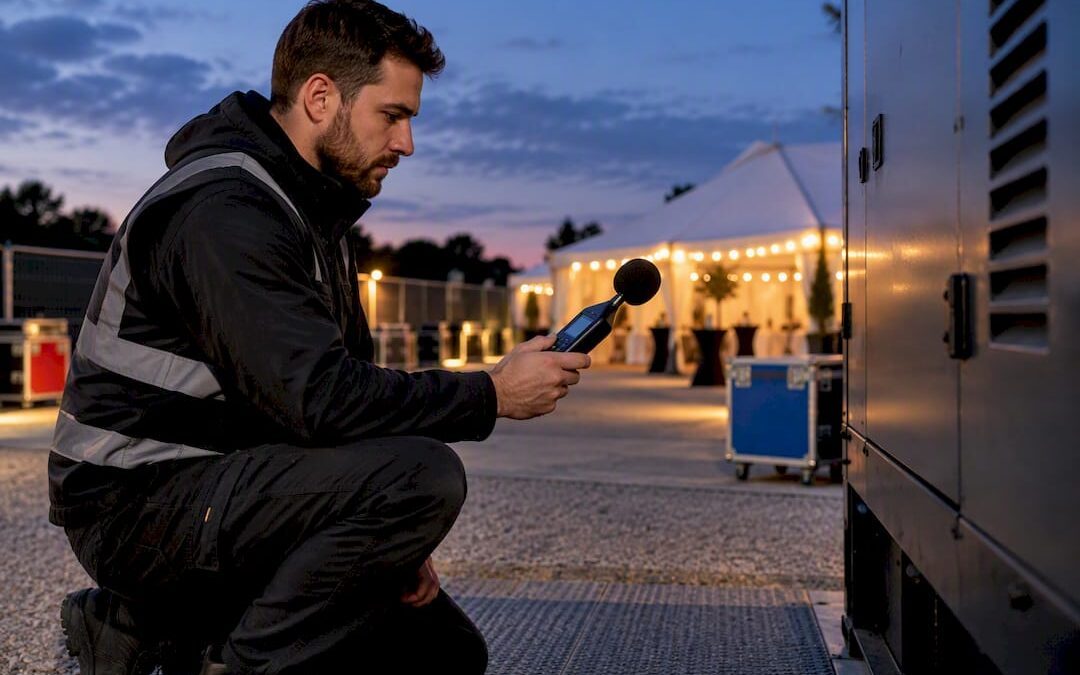
Open-frame generators run at 95 to 105 dBA close up, standard silent canopy units sit around 70 to 75 dBA, and super-silent or battery models drop below 60 dBA. The only reading worth trusting is A-weighted, taken at 7 metres, at 50% load, matching the ISO measurement standard. Noise can be reduced further by increasing distance, selecting quieter equipment, and using effective acoustic treatments.
TL;DR:
- Noise levels should always be measured at 7 meters under approximately 50% load, using the A-weighted scale to match human perception accurately.
- Open-frame generators produce about 95 to 105 dBA, comparable to a lawnmower, and are unsuitable for close residential or event proximity.
- Installing acoustic enclosures, barriers, and choosing quieter models can reduce perceived noise significantly, especially at night or near sensitive sites.
- Accurate site-specific noise assessments and documentation, including load conditions and test methods, are essential for legal compliance and avoiding statutory nuisance claims.
- Battery or hybrid systems under 45 dBA often provide the quietest operation and are ideal for nighttime use near residential areas or sensitive environments.
Table of Contents
- What do generator noise levels actually mean in practice?
- How is generator noise actually measured?
- What UK regulations govern generator noise?
- Practical ways to reduce generator noise on site
- On-site testing and compliance checklist
- What should event planners and facility managers ask suppliers?
- Why measurement beats marketing claims
- Get a noise survey before you commit to equipment
- Sources
- FAQ
What do generator noise levels actually mean in practice?
Manufacturer spec sheets throw numbers around that mean little without context. Here’s what the ranges actually sound like on site:
- Open-frame generators (95–105 dBA): roughly as loud as a petrol lawnmower running right beside you. Fine for a construction compound, unbearable at a wedding reception.
- Standard canopy or silent generators (70–75 dBA): comparable to a vacuum cleaner or busy street traffic. Workable for daytime events with some distance from guests.
- Super-silent units (60–68 dBA): closer to a normal conversation or an office environment. This is where most marquee weddings and corporate events sit comfortably.
- Ultra-silent generators (50–59 dBA): akin to a quiet living room. Suitable for close-proximity overnight running near residential boundaries.
- Battery or BESS systems (under 45 dBA): effectively background hum, similar to a fridge.
Every 10 dB increase is generally perceived as about twice as loud to the human ear, so the difference between a 75 dBA canopy unit and a 95 dBA open-frame machine represents a significant increase in perceived loudness. Real-world readings also creep above spec sheets: running a generator harder than 50% load, placing it against a reflective wall, or setting it on hard concrete instead of soft ground can all add several decibels that the datasheet never mentioned.
How is generator noise actually measured?
Decibels (dB) measure raw sound pressure, but the human ear doesn’t hear all frequencies equally. That’s why the A-weighted scale (dBA) is the standard for generator noise, filtering the reading to match how people actually perceive sound.
The ISO measurement convention sets the benchmark test conditions: a microphone positioned 7 metres from the unit, with the generator running at approximately 50% load, the point at which most machines operate in real deployments. Testing at idle or full load skews the figure in either direction, which is why quoted “quiet” specs sometimes disappoint on site.
Pro Tip: Always ask a supplier for the load percentage the quoted dBA figure was taken at. A number with no load condition attached is close to meaningless.
Getting a usable reading yourself means following a short sequence:
- Calibrate the sound level meter before use, ideally with a certified calibrator.
- Measure background noise levels before the generator starts, so you can isolate its actual contribution.
- Take readings at several points around the unit, not just one, since exhaust and intake sides differ.
- Log the load condition, weather, ground surface and time, and photograph the meter reading for a defensible record.
What UK regulations govern generator noise?
Two separate legal frameworks matter here, and confusing them causes most compliance headaches.
The Noise Emission in the Environment by Equipment for use Outdoors Regulations 2001 sits at the manufacturing end. It requires generators placed on the UK market to carry a guaranteed sound power level marking, tested and declared by the manufacturer, along with supporting technical documentation. This tells you what the machine is rated to produce, not what a local authority will tolerate on your specific site.
That second question falls under statutory nuisance law. Local authorities can treat excessive generator noise as a statutory nuisance under the Environmental Protection Act, issuing an abatement notice if a complaint is upheld. Operators facing proceedings can raise a defence that they used the “best practicable means” to control the noise, which is exactly why documented mitigation matters as much as the mitigation itself.
For construction-style and event noise assessments, many local authorities and consultants lean on BS 5228, a widely used framework for setting receptor-based thresholds distinguishing daytime and night-time limits at the nearest affected property. Key points to check before any generator goes on hire:
- Does the unit carry a guaranteed sound power label and matching documentation?
- Has your local authority set specific daytime/night-time limits for the site or event licence?
- Do you have a record of “best practicable means” in case a complaint is raised later?
Practical ways to reduce generator noise on site
Noise control works best as a stack of measures, not a single silver bullet. Start with the cheapest lever available: distance. A correctly applied inverse-square reduction means doubling the distance between a generator and the nearest receptor cuts perceived noise by roughly 6 dB, a genuinely useful first move where the site layout allows it. Orienting the exhaust away from residential boundaries or guest areas adds further benefit at zero cost.
Beyond siting, physical treatments do the heavy lifting:
- Acoustic enclosures and canopies typically deliver meaningful insertion loss over an open-frame unit, often the single biggest jump in the whole mitigation stack.
- Attenuated air paths and mufflers reduce exhaust and intake noise specifically, useful when the enclosure alone isn’t enough.
- Barriers and screening need real mass to work. A flimsy hoarding does almost nothing; a barrier needs sufficient density and, critically, must be sealed at the edges and base. Small gaps or missing “returns” let sound flank straight round the barrier and gut its performance, a mistake that catches out even experienced crews.
- Operational controls matter too: managing load so the generator isn’t labouring, scheduling noisy tasks like refuelling for daytime hours, and using remote monitoring to track running conditions without repeat site visits.
For the most sensitive jobs, a technology shift beats bolting on more acoustic treatment. Hybrid battery systems paired with a generator can run near-silent for long stretches, since battery-only operation is effectively silent at the point of use and can run 10 to 50 dB quieter than a live generator. Switching fuel to HVO biodiesel also softens the low-frequency rumble that travels furthest and annoys neighbours most, even where it doesn’t change the headline dBA figure much. Full details on layered treatments, including expected dB reductions for events, sit in our generator noise control guide.
On-site testing and compliance checklist
Getting the paperwork right before a generator starts running saves arguments later. A pre-test checklist should confirm fuel is topped up, the unit has had recent service, the load plan matches what’s actually connected, and the sound level meter is calibrated with background noise checked first.
The measurement protocol itself needs consistency: fixed meter positions, the standard 7 metre distance, the load condition noted, an averaging period long enough to smooth out fluctuation, and photos with timestamps to back every reading.
Three records make or break a compliance case:
- The guaranteed sound power label and technical documentation supplied with the unit.
- A measured dBA figure with full test conditions logged, not just a single number.
- A Declaration of Conformity where the supplier holds one.
Crews can also apply fixes immediately on site: reorienting the exhaust, adding a temporary barrier return where a gap has opened up, and fitting anti-vibration pads to cut structure-borne rumble. Remote monitoring and load-bank testing at representative loads both help too, proving the unit performs as specified while keeping it running in its quieter, more stable power band rather than labouring or idling erratically.
| Check | What it proves |
|---|---|
| Guaranteed sound power label | Manufacturer’s declared rating under the 2001 Regulations |
| Calibrated dBA reading at 7 m, 50% load | Real-world performance matching ISO test convention |
| Load-bank test record | Unit runs stable at its rated output, not overloaded or straining |
| Photographed barrier returns and seals | No flanking gaps undermining acoustic screening |
| Timestamped site log | Defensible evidence if a statutory nuisance complaint arises |
What should event planners and facility managers ask suppliers?
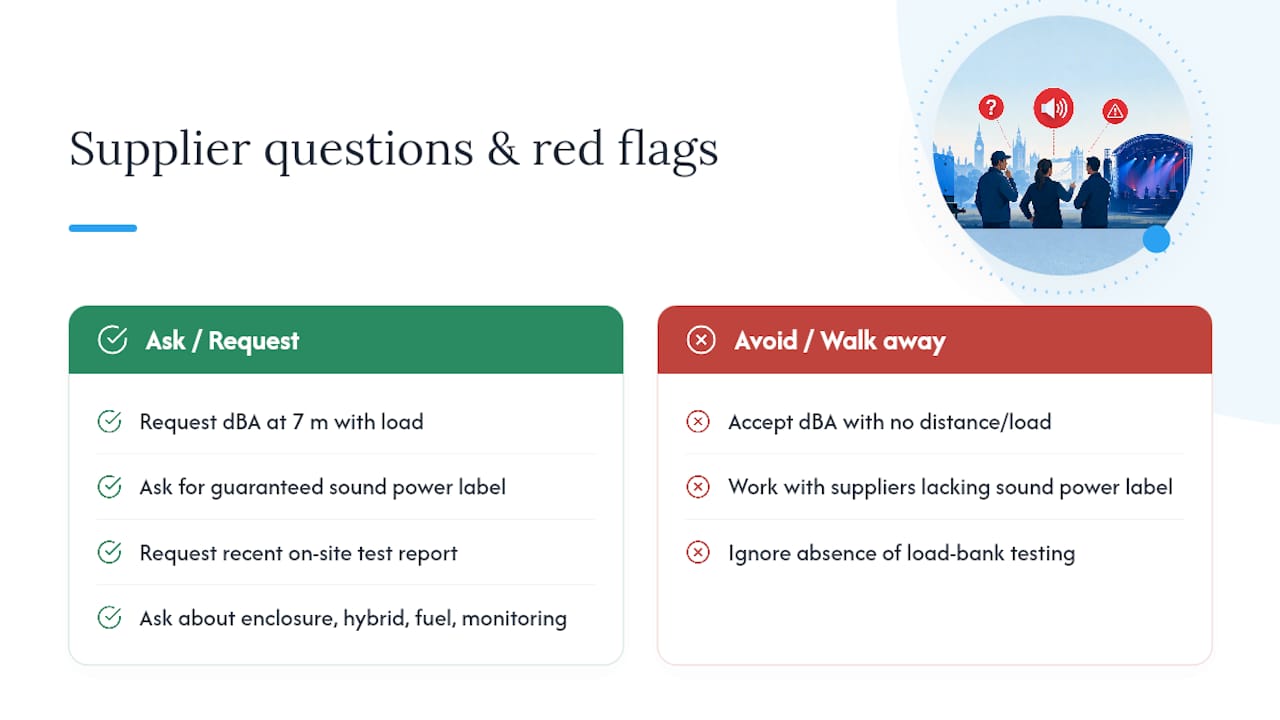
Before booking any generator, request the dBA figure at 7 metres with the load condition stated explicitly, not just a vague “quiet running” claim. Ask for the guaranteed sound power label, any recent on-site test report, and a Declaration of Conformity if one exists.
Beyond paperwork, ask direct questions: what enclosure type is fitted, is battery-hybrid support available for overnight running, what fuel options exist, and does the supplier offer remote monitoring to catch problems mid-event. Our practical guide to hiring generators for private events covers these questions in more depth.
Red flags worth walking away from: a supplier who can’t produce a sound power label, anyone quoting a dBA figure with no distance or load stated, and no evidence of load-bank testing or monitoring on offer.
Why measurement beats marketing claims
Manufacturer noise ratings are often best-case figures taken under controlled conditions, and on-site testing with a calibrated meter is the only reliable way to confirm what actually happens once a generator is running load, on real ground, near real neighbours. Over four decades of supplying event power, the pattern repeats: sites that measure, document and layer mitigation avoid complaints; sites that trust a spec sheet often don’t. Complex venues, tight residential boundaries, and night-time running all reward bringing in contractors who’ve done this before.
— Rob
Get a noise survey before you commit to equipment
An experienced electrical contracting team can measure, document, and mitigate generator noise before it becomes a complaint, rather than after.

A site survey from Jakspartypower includes an on-site dBA reading at the correct distance and load, a written report against your local authority’s likely thresholds, and a recommended mix of acoustic canopies, siting adjustments, or battery-hybrid support depending on what your event or facility actually needs. Standby cover and remote monitoring keep that quiet running verified for the duration, not just at switch-on. If you’re planning a wedding, corporate event, or need permanent power for a venue, get in touch through our services page to arrange a survey and quote, or browse the generator hire range to see what’s available for your site.
Sources
- ISO — standard for noise measurement
- Environmental Protection Act — summary proceedings to deal with noise
FAQ
What Are Acceptable Noise Levels for Generators?
There’s no single legal decibel limit for every situation. Most event and construction sites work to receptor-based thresholds derived from BS 5228, typically allowing higher levels by day and requiring much quieter running at night near residential boundaries, with super-silent units under 68 dBA generally the safer choice for sensitive settings.
Can Neighbours Complain About Generator Noise?
Yes, and a local authority can act on it by treating excessive noise as a statutory nuisance under the Environmental Protection Act, potentially issuing an abatement notice. Operators can defend a complaint by showing they used the best practicable means, which is why logged measurements and mitigation records matter.
What Is the Quietest Generator Option Available?
Battery or BESS systems run under 45 dBA at the point of use, and hybrid setups can be 10 to 50 dB quieter than a running generator once the battery takes over. Where a battery alone can’t meet the load, an ultra-silent generator under 59 dBA is the next best option.
Is It Legal to Run a Generator at Night in the UK?
There’s no blanket ban, but night-time running near homes is far more likely to trigger a statutory nuisance complaint under stricter local thresholds. Choosing a super-silent or battery-hybrid unit, positioning it for maximum distance, and keeping documented test readings all reduce that risk considerably.