

Runtime comes down to one working formula: tank litres divided by fuel use per hour at your actual average load. To get a usable number today, gather three things: your tank capacity in litres, the average electrical load you expect in kW, and the manufacturer’s litres-per-hour figure at that load. Generic fuel factors get you close; the manufacturer’s own curve gets you right.
TL;DR:
- Generator fuel consumption varies significantly with load, ambient conditions, and fuel type, so planning must consider specific load profiles and manufacturer data.
- Using both screening calculators for initial estimates and manufacturer curves for verification improves accuracy in multi-day outage planning.
- Running generators below 30% or above 75% load risks inefficiency, wet stacking, and increased wear, making load balancing crucial for optimal runtime.
- Proper fuel storage, with reserve margins and scheduled refuelling, is essential to ensure uninterrupted power during extended outages.
- Skilled monitoring, maintenance, and load sequencing before and during events prevent runtime issues and reduce the risk of unexpected shutdowns.
Table of Contents
- What does generator runtime actually mean?
- How do you calculate generator runtime step by step?
- How does fuel type change litres per hour?
- What runtime should you expect from common appliances and outage scenarios?
- How do you size fuel storage for a multi-day outage?
- What operational habits protect the runtime you planned?
- How does an event power supplier actually plan runtime?
- Calculator or manufacturer curve: which should you trust?
- Get your generator runtime right before the event, not during it
- Sources
- FAQ
What does generator runtime actually mean?
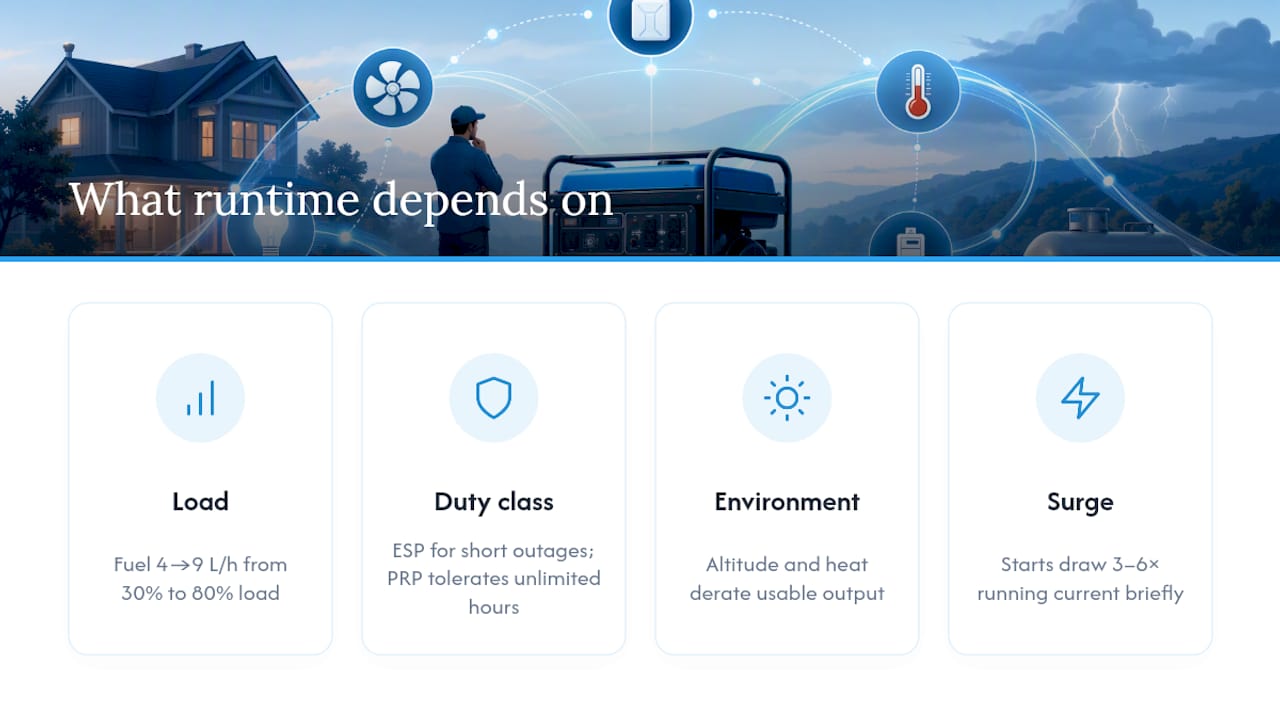
Runtime is simply how long a generator keeps running on a given fuel supply, and it moves constantly with load. A generator burning 4 litres an hour at 30% load might burn 9 litres an hour at 80% load on the same tank, so quoting “runtime” without stating the load fraction tells you almost nothing.
This is where nameplate ratings mislead people. A generator badged 20 kVA doesn’t run at 20 kVA continuously unless it’s rated for that duty. ISO 8528-1:2018 sets out four duty classes: Continuous Operating Power (COP), Prime Power (PRP), Limited Time Running Power (LTP), and Emergency Standby Power (ESP). ESP units are built for short-duration outage cover at variable load, not for running flat out for days. PRP units tolerate a defined average load over an unlimited number of hours but usually cap annual overload hours. Buying an ESP-rated set and planning a 72 hour continuous run against its nameplate figure is a common and costly mistake.
Ambient conditions bite too. Altitude and heat both derate output, because thinner air and hotter intake air reduce combustion efficiency, so a generator can deliver less usable power from the same fuel burn on a hot day or at elevation than the spec sheet implies. Fuel quality matters in the same way; poor diesel or old petrol changes combustion and pushes consumption in the wrong direction.
Then there’s the surge. Motors, compressors and pumps draw a starting current well above their running wattage, sometimes three to six times higher for a second or two. That spike doesn’t much change your fuel-per-hour average, but it changes what size generator you need in the first place, which then changes every runtime calculation that follows.
How do you calculate generator runtime step by step?
Start with a calculator if you want a quick sanity check, then verify by hand. Tools like the TRN generator runtime calculator and the UK-focused OffGrid Collective fuel usage calculator will give you a fast estimate from fuel type, tank size and load. Treat the output as a screening figure, not gospel, because most calculators use a flat fuel factor rather than your specific generator’s actual burn curve.
The hand calculation behind most of these tools is straightforward:
- Estimate hourly fuel use: nameplate kW × load fraction × fuel factor (in litres per kWh).
- Divide tank capacity by hourly fuel use to get theoretical runtime in hours.
- Subtract a 10 to 20% reserve margin so you’re never planning against an empty tank.
- Cross-check against the manufacturer’s L/h curve at the closest standard load point (25%, 50%, 75% or 100%).
Here’s a worked example. Say you’re running a 6 kW average load off a diesel unit with a 30 litre tank, and you use a typical diesel fuel factor of 0.27 L/kWh, a figure that sits within the 0.25 to 0.30 L/kWh range commonly used for screening calculations. Hourly fuel use works out to 6 × 0.27 = 1.62 litres per hour. Divide the 30 litre tank by that and you get roughly 18.5 hours.
Before trusting that number for anything important, pull the manufacturer’s data sheet and check the published litres-per-hour figure at the load percentage closest to yours. Screening formulas assume a straight-line relationship between load and fuel burn that real engines rarely deliver exactly.
How does fuel type change litres per hour?
Diesel generally wins on runtime efficiency because it packs more energy per litre and diesel engines run at higher compression ratios, converting more of that energy into usable shaft power. Petrol units are cheaper to buy but burn faster for the same output, which shortens runtime on any given tank size. LPG and natural gas sit in a different category entirely: convenient for continuous supply if you’re on mains gas or have bulk LPG storage, but gas units lose electrical efficiency more sharply at part load than diesel does, which matters for events with a variable load profile.
Typical fuel factor ranges you’ll see quoted:
- Diesel: roughly 0.25 to 0.30 L/kWh, varying with load and engine age
- Petrol: noticeably higher litres-per-kWh than diesel for equivalent output
- LPG/natural gas: efficient at higher loads, but part-load electrical efficiency drops faster than diesel
A generator running below roughly 30% of rated load for extended periods risks wet stacking, a build-up of unburned fuel and carbon in the exhaust system caused by incomplete combustion at low load, which can damage the engine and push fuel consumption in the wrong direction over time. The same physics work in reverse at the very top end: running flat out for hours also increases wear and, on some units, consumption efficiency. The sweet spot for most diesel sets sits around 50 to 75% of rated load. It is worth designing your load plan around this rather than treating it as an afterthought.
Fuel type isn’t just a cost decision.
What runtime should you expect from common appliances and outage scenarios?
Runtime planning gets easier once you map actual loads rather than guessing at a whole-house average. Typical draw figures give you a starting point:
- A fridge-freezer cycles rather than running continuously, averaging perhaps 100 to 200W but drawing several times that briefly on compressor start
- Electric heaters and space heaters run 1 to 3 kW continuously with no cycling relief
- General lighting circuits are usually well under 500W unless you’re powering stage or event rigs
- A PA system with amplifiers and powered speakers can draw anywhere from 500W to several kW depending on scale
Three scenarios illustrate how this plays out. A whole-house essentials setup (fridge, some lighting, broadband router, a couple of sockets) might average 1.5 to 2.5 kW, giving long runtimes even off a modest tank. A partial-house scenario adding electric heating or a single-phase immersion pushes average load to 4 to 7 kW and shortens runtime proportionally. An event-critical load running PA, stage lighting and catering equipment can spike well past 10 kW, and here indicative runtimes for larger long-run diesel sets can stretch to 24 hours or more depending on tank size, while smaller portable inverter units might only manage 4 to 10 hours at part load.
Sequencing matters more than most people expect; understanding commercial oven power requirements in the UK can help with hospitality load planning and sequencing for planned disconnections. Staggering motor starts, bringing heaters on one at a time rather than simultaneously, avoids nuisance surge trips and lets you size the generator to average load rather than the worst-case sum of every startup current at once.
How do you size fuel storage for a multi-day outage?
Multi-day planning turns your hourly burn rate into a storage decision. The basic formula is hourly fuel use × planned hours + reserve margin, and it scales cleanly once you know your consumption figure from the calculation above.
- Calculate hourly burn at your expected average load using the manufacturer’s L/h curve.
- Multiply by the outage duration you’re planning against, commonly 24, 48 or 72 hours as planning anchors drawn from NFPA-style tank sizing conventions.
- Add a 10 to 20% reserve on top so an unexpectedly long outage doesn’t leave you stranded.
- Confirm your refuelling or delivery cadence can keep pace with that burn rate if the outage runs longer than your stored fuel allows.
For sustained multi-day cover, a day tank paired with scheduled bulk deliveries usually beats a single oversized tank. It’s cheaper to install, easier to monitor, and reduces the risk tied to storing very large diesel volumes on one site. Check your pump and transfer-rate capacity against your consumption rate too; a generator burning 10 litres an hour needs a refuelling setup that can realistically keep up, not just a supplier who can eventually deliver.
Refuelling a hot generator, or refuelling in the dark under pressure, is when spills and safety incidents happen. Top up early.*
Site fuel storage carries its own regulatory limits and safe handling requirements that vary by volume and location, so check local rules before committing to a large static tank rather than a smaller, regularly replenished one.
What operational habits protect the runtime you planned?
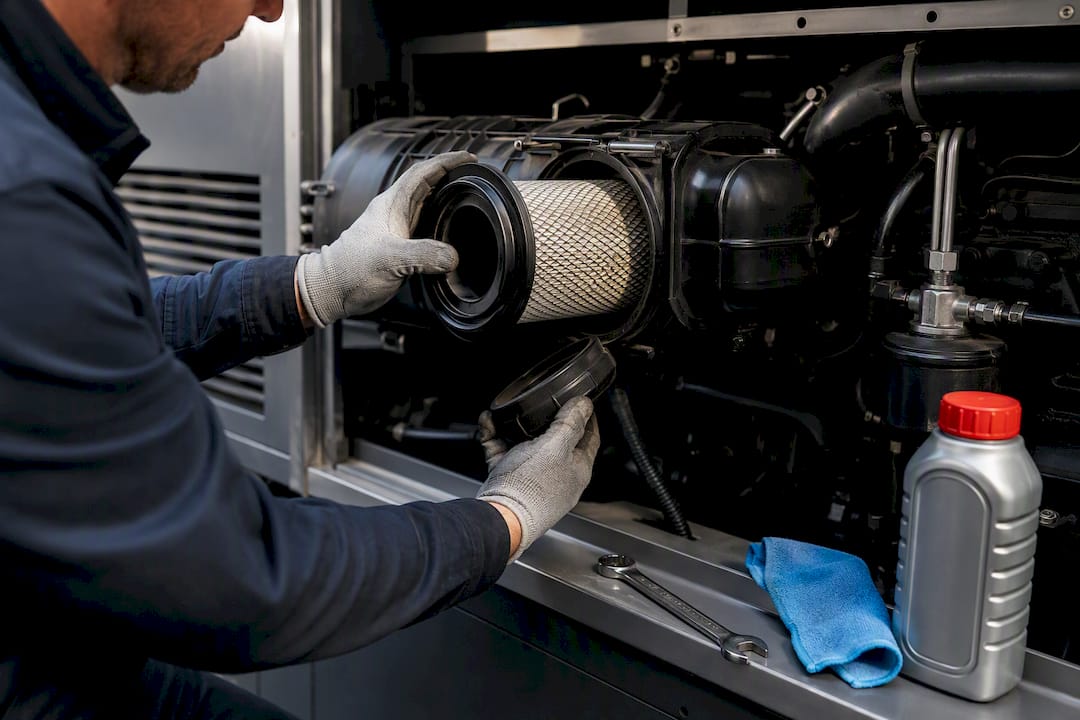
Every calculation above assumes the generator is running the way it should. Maintenance is what keeps that assumption true. Fresh oil, clean air filters, and a load test before an event catch problems while they’re still cheap to fix, not halfway through night one of a three-day outage.
Wet stacking deserves repeating here because it’s the single most common way people undermine their own runtime planning. A quick load-bank test before a big event tells you far more than trusting the spec sheet alone.
Monitoring closes the loop between plan and reality. A simple mechanical fuel gauge is better than nothing, but remote telemetry or an inline fuel meter turns a theoretical runtime figure into something you can actually track hour by hour, which matters enormously once you’re several hours into an unplanned extension.
- Check oil, coolant and filters before any extended run, not after a fault
- Keep the exhaust routed well away from tents, marquees and occupied spaces
- Never run a generator in an enclosed or poorly ventilated area
- Fit or check a carbon monoxide alarm anywhere people are working near the unit
Pro Tip: Carbon monoxide has no smell. If you’re running a generator anywhere near an enclosed structure, a CO alarm isn’t optional kit, it’s the cheapest insurance you’ll buy all event.
How does an event power supplier actually plan runtime?
Standby cover for events works from the same maths as everything above, applied at scale and with less margin for error. Event power suppliers build a load map for the event first: what’s running, when it starts, what the peak simultaneous draw looks like once catering, lighting and sound all overlap. That map decides generator size before anyone talks fuel.
Portable power distribution then handles how that supply reaches marquees, stalls and stages without overloading any single circuit.
The bigger difference is standby staff on site. A fuel gauge tells you what’s left; a person watching the load and the tank tells you what to do about it before a shortfall becomes a blackout mid-event. That’s the threshold worth thinking about: DIY generator hire works fine for predictable, low-stakes loads, but once downtime carries real cost, whether that’s a wedding band losing power or a corporate AV feed dropping mid-presentation, specialist standby support earns its keep.
Calculator or manufacturer curve: which should you trust?
The honest answer is both, used in the right order. Screening calculators and the hand formula get you a workable estimate in five minutes, and that’s genuinely useful for early planning.
Where conventional advice falls short is treating a single fuel factor as accurate enough to plan an entire outage response around. It isn’t. The manufacturer’s own L/h curve, checked at the load percentage closest to yours, is the only figure worth staking a multi-day plan on.
If there’s one habit worth adopting over any other, it’s this: calculate first, then verify against the data sheet, then build in a reserve margin anyway. Skipping the verification step is where most runtime plans quietly go wrong, usually discovered at 2am when the tank runs dry sooner than the spreadsheet promised.
— Rob
Get your generator runtime right before the event, not during it
Jaks Party Power is the practical alternative to guessing your way through generator sizing: over 40 years of electrical contracting experience means load maps, tank sizing and refuelling schedules are worked out before your event starts, not troubleshot once it’s underway.

Whether you’re running a wedding marquee, a corporate show, or a multi-day festival site, the same principles from this guide apply, just with less room for error and more equipment on the line. Jaks Party Power’s Product Hire, Event Setup and Standby cover bundle generator selection, distribution, and on-site support into a single point of contact, so you’re not juggling separate suppliers for generators, cabling and fuel logistics. For events with genuinely critical loads, standby cover means someone is watching load and fuel levels throughout, catching a problem before it becomes a blackout. Browse the current generator range or get in touch to talk through your event’s load profile and get a runtime plan built around your actual requirements, not a generic estimate.
Sources
- How to calculate generator fuel consumption (CalcEngineer)
- Generator runtime calculator (TRN / PNNL)
- Generator fuel usage calculator (OffGrid Collective)
FAQ
What is generator runtime?
Generator runtime is how long a generator can run continuously on a given fuel supply at a specific load, calculated as tank capacity divided by fuel consumption per hour at that load.
How long can you let a generator run continuously?
It depends entirely on the duty class: ESP-rated generators are designed for short-duration standby use, while PRP and COP-rated units, defined under ISO 8528-1:2018, can run continuously for extended periods provided fuel, maintenance and load stay within spec.
What does runtime mean for a generator?
It means the number of hours the unit will operate before needing a refuel, and that number changes with load fraction, fuel type, and ambient conditions rather than being a fixed spec.
How long can a generator typically run continuously?
Small portable inverter generators typically manage 4 to 10 hours at part load, while larger long-run diesel sets with bigger tanks or day-tank refuelling can run 24 hours or more, depending on tank size and average load.
Does the event power supplier help with runtime planning for events?
Yes, some providers build load maps and match generator size, tank strategy and standby cover to the specific event, rather than applying a generic fuel factor after the fact.