
Size your rig to its connected load, not its average draw, and never load a circuit past 80% for anything running longer than a few minutes. That single rule, paired with proper phase balancing, governs almost every stage lighting power decision you’ll make. Design and installation should follow BS 7909 and BS 7671, with HSE guidance covering the practical safety detail underneath both.
TL;DR:
- Connected load includes the full wattage of all fixtures, assuming they operate at maximum output simultaneously, to ensure circuit protection and sizing.
- The 80% continuous load rule applies to circuits running longer than three hours, requiring rated capacity to be limited accordingly to prevent overload.
- Larger rigs over 15 to 20 kW benefit from three-phase supplies to balance current, reduce cable size, and prevent tripping from uneven phase loads.
- Long cable runs should use heavier gauge conductors, such as H07RN-F, and keep voltage drop under 4 percent to maintain fixture performance.
- Oversized generators with headroom above the total connected load are essential to accommodate starting surges, future rig changes, and generator inefficiencies.
Table of Contents
- How do you calculate stage lighting power requirements?
- Why does the 80% continuous-load rule matter for circuit sizing?
- Should stage lighting use a three-phase supply?
- How do you size cables to avoid voltage drop on long runs?
- Which connectors and distro layout suit a stage lighting rig?
- How do you size a generator for a stage lighting rig?
- What UK standards govern stage lighting power and safety?
- What safety protocols apply to stage lighting power setups?
- How do you troubleshoot power problems during a show?
- How should dimmers and controllers integrate with power distribution?
- Do harmonics and power quality matter for LED lighting rigs?
- Practical perspective: when do you need an event electrical contractor?
- How Jaks Party Power delivers safe, compliant event power
- Sources
- FAQ
How do you calculate stage lighting power requirements?
Connected load is the sum of every fixture’s rated wattage on a circuit, assuming everything switches on at full output simultaneously. It’s the worst-case figure, and it’s what you use to size breakers, feeders and generators, because a protective device has to survive the moment every dimmer channel hits 100% at once, not the average night.
Running or average load is lower in practice. A typical show rarely pushes every fixture to full intensity for the whole performance, so actual energy consumed (measured in kWh) often sits well below the connected figure. Peak load sits between the two: the highest instantaneous draw during a real cue, which matters for generator response but less for continuous circuit sizing.
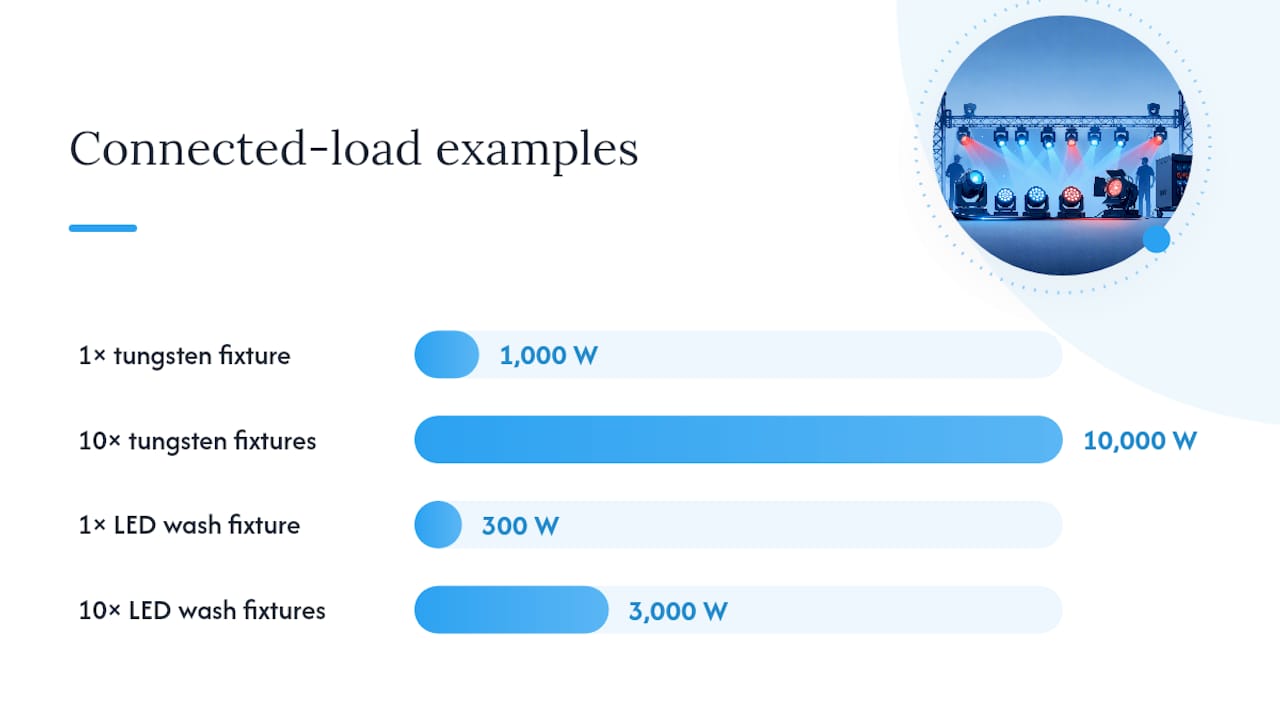
The maths is simple. Current (amps) equals watts divided by volts, so a 1,000 W tungsten fixture on a 230 V UK supply draws about 4.3 A. Ten of those on one circuit connected load hits 10 kW, pulling roughly 43.5 A, well past a standard 32 A breaker.
LED fixtures change the picture substantially. A comparable LED wash fixture might draw 300 W rather than 1,000 W, so ten units connected load falls to 3 kW, around 13 A. That’s why event lighting power consumption varies so much between a tungsten-heavy legacy rig and a modern LED house.
- Connected load = sum of all rated wattages (worst case, used for sizing).
- Running/average load = actual energy drawn over the show (used for fuel and kWh budgeting).
- Peak load = highest instantaneous draw during a cue (relevant to generator transient response).
Statistic callout: AgentCalc’s stage lighting power calculator separates connected kW from actual energy consumed and applies an 80% continuous-load convention when recommending circuit sizes, a distinction that catches out anyone sizing purely from a fixture’s rated wattage.
Why does the 80% continuous-load rule matter for circuit sizing?
Stage lighting rigs run continuously for hours, not intermittently like a domestic appliance, so treating a breaker’s full rating as usable headroom is a mistake. The safe convention, echoed by AgentCalc’s calculator, is to budget only 80% of a circuit’s rated capacity for anything running longer than three hours.
- A 13 A socket circuit should carry no more than about 80% of its rating for continuous connected load.
- A 16 A Ceeform circuit should similarly not be loaded above about 80% for sustained use.
- A 32 A three-phase or single-phase feeder should be treated using the same 80% continuous-load principle.
Discrimination between RCDs and breakers matters just as much as headroom. A single 30 mA RCD covering too many final circuits risks a nuisance trip taking down the whole rig, and HSE guidance recommends no more than six final circuits per RCD.
Pro Tip: Build a simple circuit map before you rig anything: which fixtures, which breaker, which RCD group. It takes ten minutes and saves an hour of fault-finding mid show.
Should stage lighting use a three-phase supply?
Anything above roughly 15 to 20 kW of connected load is a strong candidate for three-phase. Splitting the load across L1, L2 and L3 keeps current per conductor lower, reduces cable size and voltage drop, and avoids tripping a single-phase supply that a venue or generator simply can’t provide.
Balancing is mostly arithmetic and discipline. Group dimmer channels or fixture types into three roughly equal wattage blocks, then assign each block to its own phase rather than filling L1 first and leaving L2 and L3 half empty.
- Split symmetrical rig sections (stage left / centre / stage right) across separate phases where the physical layout allows it.
- Never park all the heavy tungsten fixtures or a moving-light hoist on one phase while LED washes sit on another.
- Recheck the balance whenever the rig changes mid production, not just at the initial hang.
How do you size cables to avoid voltage drop on long runs?
Keep voltage drop under roughly 4% of nominal supply voltage for a lighting circuit, and tighter still if dimmers or moving lights are sensitive to supply fluctuation. On a 230 V feed, that’s about 9.2 V lost between source and fixture.
Longer runs need proportionally thicker conductors. A 2.5 mm² cable that’s fine at 20 metres and 16 A can drop well outside tolerance at 50 metres carrying the same current, so the run length has to inform cable selection every bit as much as the amperage does. The voltage drop calculation for UK events walks through the formula in full if you need to check a specific run.
- Favour heavier-gauge cable over the minimum rating whenever a run exceeds around 25 to 30 metres.
- Choose H07RN-F or equivalent rubber-sheathed cable for mechanical robustness and heat resistance on stage decks.
- Route cable away from heat sources (fresnels, followspots) that can degrade insulation over a long show run.
Which connectors and distro layout suit a stage lighting rig?
Connector choice depends on load and location. BS 1363 domestic sockets are fine for small accessory loads but hopeless for anything above a few amps outdoors or in a rig. BS EN 60309 (commonly called Ceeform) industrial connectors, rated 16 A, 32 A, 63 A and 125 A with IP44/IP67 protection, are the standard for professional lighting distribution, a point HSE’s GS50 guidance makes explicitly. BS 546 round pin connectors still turn up on older dimmer racks and some theatre house circuits, but they’re being phased out in favour of Ceeform on new builds.
A sensible small-event distro carries one 63 A three-phase input, a handful of 16 A and 32 A Ceeform outputs, RCD protection on every final circuit and a simple digital meter. Medium and large rigs scale that pattern up with multiple distro boxes, phase-labelled cabling and lockable outputs to stop a well-meaning stagehand pulling the wrong plug. Choosing correctly-rated Ceeform connectors up front avoids a mid-show scramble for adaptors.
- RCD protection on every final circuit, grouped to limit nuisance trips.
- Clear phase labelling (L1/L2/L3) on every output and cable tail.
- Metering to track actual draw against the connected-load budget.
- Lockable or captive outputs on anything feeding critical equipment.
Pro Tip: Label distro boxes with a laminated card showing which phase feeds which zone. It costs nothing and it’s the first thing a visiting electrician will thank you for.
How do you size a generator for a stage lighting rig?
Generators should never be sized to bare connected load; oversizing to cover starting surges, non-lighting loads and future rig changes is standard industry practice, and tools such as the NADJ Power Planner exist specifically to convert a fixture list into a recommended generator kVA.
- Total the connected load in kW, then convert to kVA using an assumed power factor (0.8 is a common conservative planning figure for mixed lighting and audio loads).
- Add headroom above the running requirement to absorb inrush current from moving lights, hazers and any motorised rigging.
- Round up to the next standard generator size rather than specifying a unit that runs near its ceiling all night.
- Confirm fuel duration against the show’s actual running hours, not just connected load, since real energy use is usually lower than the worst-case figure.
- Site the generator for noise and access, and request load-bank test records if the unit has sat idle for any length of time.
What UK standards govern stage lighting power and safety?
BS 7909:2023+A1:2024 is the current code of practice for temporary electrical systems for entertainment, covering the management, design and operation of low-voltage temporary supplies for shows and events. BS 7671:2018+A3:2024, the IET Wiring Regulations amendment, sets the underlying rules for protective device selection and installation practice that BS 7909 builds on.
HSE’s GS50 and INDG247 translate both standards into practical checklist items: separate lighting and audio circuits, use BS EN 60309 connectors for anything above domestic load, and be aware that some dimmer types leak enough current to trip a shared RCD unnecessarily.
Statistic callout: GS50 recommends no more than six final circuits on a single 30 mA RCD, a limit rooted in avoiding one nuisance trip taking down half a rig.
- Confirm connected load and phase balance before rigging starts.
- Separate lighting RCD groups from audio and control circuits.
- Check earthing continuity and cable support at every joint.
- Label distro, phases and final circuits before the first cue.
What safety protocols apply to stage lighting power setups?
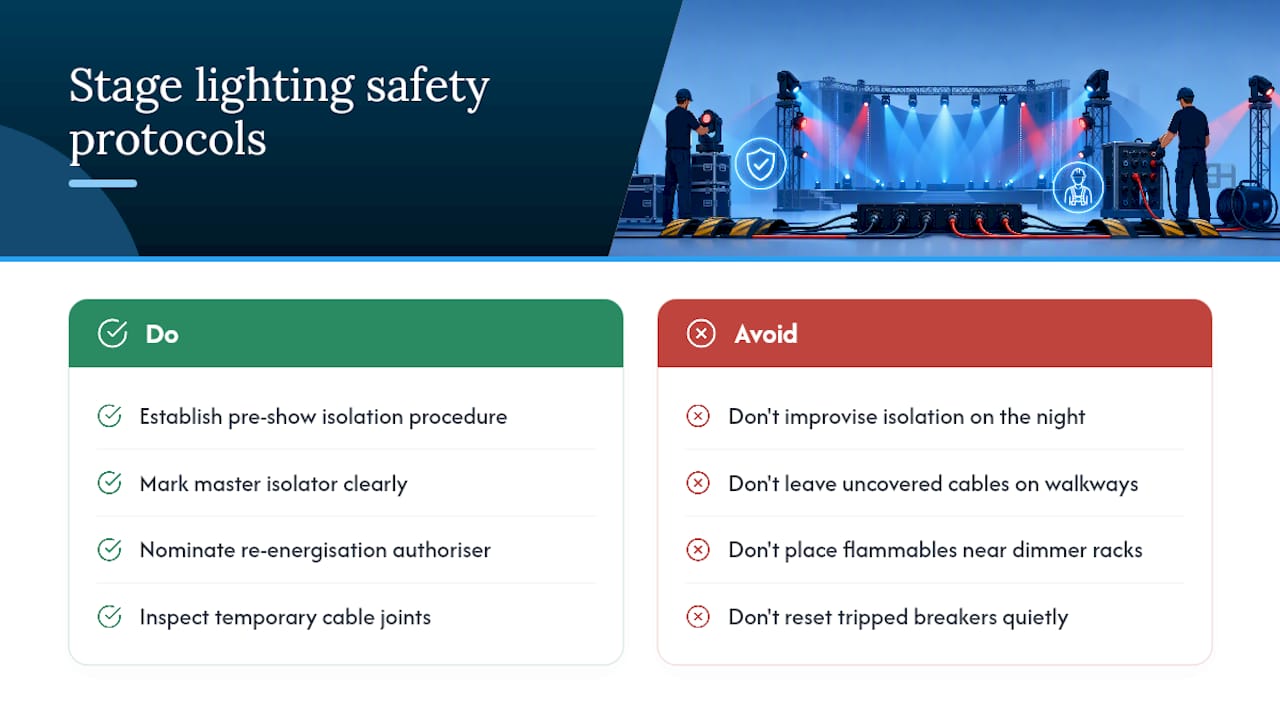
Every rig needs a pre-show isolation procedure that every crew member understands before rigging begins, not one improvised on the night. That means a clearly marked master isolator, a written lock-off procedure for maintenance work, and a nominated person responsible for authorising re-energisation after any fault.
Emergency procedures should assume the worst case: a fault mid-show with a full house in. Crews need to know where the emergency stop is, how to isolate a single distro without killing the whole venue, and who has authority to call a halt to the performance if a fault can’t be cleared safely. INDG247 is explicit that separating lighting and audio circuits isn’t just good practice, it limits how far a single fault can spread.
Cable management deserves its own protocol. Runs across walkways need proper covers or catenary support, not tape, and every joint in a temporary run should be inspected before doors open. A trailing cable that’s fine at a technical rehearsal can become a trip hazard once an audience is moving through the same space.
Fire risk around dimmer racks and distro boxes is often underestimated. Keep flammable materials clear of anything generating heat under sustained load, and make sure fire extinguishers rated for electrical fires sit within reach of every major distribution point, not just at the venue’s standard fire points.
Finally, build in a communication protocol: if a breaker trips or an RCD fires, the crew needs an agreed way to signal it to the desk operator and lighting designer immediately, rather than someone quietly resetting it and hoping nobody noticed a channel dropped mid-cue.
How do you troubleshoot power problems during a show?
A tripped RCD with no obvious fault usually points to cumulative earth leakage rather than a single failed fixture. Dimmer packs, especially older thyristor-based units, leak small currents that add up across a group; if six channels share one RCD and it trips under load, splitting those channels across two RCD groups often solves it without any fixture repair at all.
Flickering or dimming fixtures that aren’t commanded to dim are often a voltage-drop symptom rather than a fixture fault, particularly on long cable runs feeding the back of a stage or a truss at height. Measuring voltage at the fixture end against the supply end quickly confirms whether the cable, not the dimmer, is the problem.
A breaker that trips instantly on power-up, rather than under running load, almost always indicates a short or a wiring fault introduced during rigging, not an overload. Check connector pins and cable joints before assuming the fixture itself has failed.
Uneven brightness across what should be an identical group of fixtures on the same circuit can indicate phase imbalance if they’re actually split across different supplies, or a poor connection at a distro output if they’re genuinely on one circuit. Check the distro map first; it’s faster than swapping fixtures one by one.
Keep a simple fault log through the show, even a scrawled note of what tripped, when, and what fixed it. It turns a one-off mystery into a pattern the next time the same rig goes out, and it’s the first thing a contractor will ask for if you eventually call one in.
How should dimmers and controllers integrate with power distribution?
Dimmer racks sit at the junction between control and power, and that’s exactly where poor planning causes the most trouble. Each dimmer pack needs its connected load calculated the same way as any other fixture group, because a rack full of channels running near capacity behaves very differently from one with headroom to spare.
RCD grouping around dimmer packs deserves particular care. GS50 notes that some dimmer types cause enough leakage current that a single RCD covering too many channels will nuisance trip under normal operation, not fault conditions. Splitting dimmer channels across multiple RCD-protected sub-boards, rather than relying on one device for the whole rack, maintains discrimination and avoids a scenario where fixing one dimmer’s leakage means losing six channels at once.
Control signal cabling (DMX, sACN, or network-based protocols) should run physically separate from power cabling wherever practical, since power cables induce interference in poorly shielded control runs. A DMX line laid alongside a heavily loaded feeder for its full length is a common, avoidable cause of flickering or erratic fixture behaviour that has nothing to do with the power budget at all.
Placement matters too. Dimmer racks generate heat under sustained load, so ventilation and clearance around them isn’t optional, particularly in an enclosed truck or flight case set up for an outdoor event. And every dimmer rack should sit downstream of its own clearly labelled isolator, so a fault on that rack alone doesn’t require shutting down the whole distribution system to investigate.
Do harmonics and power quality matter for LED lighting rigs?
LED drivers and other switch-mode power supplies draw current in short pulses rather than the smooth sine wave a tungsten fixture pulls, and that generates harmonic distortion on the supply. It’s a real consideration for large LED-heavy rigs, particularly where a generator, rather than a stable grid connection, is providing the supply.
Generators are more sensitive to harmonic loading than a mains grid connection, because a generator’s alternator has to cope with the distorted waveform directly. A generator that’s technically sized correctly for connected kW can still run hot, or trigger protective shutdowns, if the load is almost entirely switch-mode LED drivers with poor power factor correction.
Neutral conductor loading is the practical symptom worth knowing about. On a three-phase supply with heavily unbalanced harmonic-generating loads, triplen harmonics can add up in the neutral rather than cancel out the way a balanced linear load would, occasionally pushing neutral current above what a standard-sized neutral conductor is rated for. It’s a specialist calculation, but it’s worth flagging to a contractor on any large all-LED rig running from a generator rather than mains.
The practical mitigation is straightforward even without deep harmonic analysis: choose fixtures with decent power factor correction where the specification is available, balance LED and any remaining tungsten or moving-light load across phases rather than clustering all switch-mode loads together, and treat generator sizing headroom as covering harmonic behaviour as well as simple wattage.
Practical perspective: when do you need an event electrical contractor?
Most single-phase rigs under 10 kW are manageable with careful planning and a good calculator. Once you’re balancing three-phase feeds, running a permanent venue install, or need standby cover through a live show, that’s the point to bring in a contractor rather than improvise. An experienced electrical contracting team is essential across exactly these jobs, from wedding marquees to large touring productions.
When requesting a quote, supply your fixture list with wattages, cable run lengths, and details of the site’s existing supply. It saves several rounds of back and forth and gets you an accurate answer faster.
— Rob
How Jaks Party Power delivers safe, compliant event power
Using the same team for equipment hire, distribution design, generator supply and standby cover provides a practical alternative to piecing together hire kit from multiple suppliers and hoping the connectors match. Every job draws on the same team for equipment hire, distribution design, generator supply and standby cover, so there’s one point of contact and one set of eyes on the whole electrical picture, not a handoff between separate contractors mid-rig.

That matters most on the jobs where things go wrong quietly: a dimmer rack that leaks just enough current to nuisance trip, a distro that wasn’t phase balanced properly, a generator sized for connected load with no headroom for a hazer’s inrush current. Jaks Party Power’s standby cover puts a qualified person on site through the event itself, watching for exactly these failure modes rather than leaving a venue’s duty manager to spot a tripped breaker mid show.
Beyond one-off event hire, the same team handles permanent power and sound installations for venues that want the problem solved once rather than re-rigged for every booking, alongside distribution equipment and generators for organisers managing their own crew. If you’re planning a rig above a few kilowatts, or anything involving three-phase or standby requirements, get in touch through the services page with your fixture list and site details, and get a quote built around the load you’re actually running.
Sources
- Electrical safety at places of entertainment Guidance Note GS50 (HSE)
- Introducing the NADJ Power Planner — Know your load before you plug in (NADJ)
- Stage Lighting Power Calculator: Estimate Show Energy Needs | AgentCalc
FAQ
What wattage are stage lights?
Wattage varies enormously by fixture type: tungsten fresnels commonly run around 1,000 W each, while comparable LED wash fixtures often draw significantly less power for similar output. Always check the fixture’s rated wattage individually rather than assuming a standard figure, since the difference between LED and tungsten connected load can be threefold or more across an identical rig layout.
How is stage lighting controlled?
Stage lighting is controlled through a lighting desk sending DMX, sACN or a similar protocol to dimmer packs or directly to intelligent fixtures, which then regulate output independently of the power circuit itself. The control signal and the power feed are separate systems, which is why control cabling should be routed away from heavily loaded power cables.
What are the three main types of stage lighting?
The three broad categories are wash lighting (even, general coverage), spot or profile lighting (sharp-edged, directional beams), and effects or specialist fixtures such as movers, strobes and hazers. Each category has a distinct power profile, with effects fixtures typically drawing the least continuous wattage but the highest instantaneous peaks.
What are the five elements of stage lighting?
Lighting designers commonly describe five controllable qualities: intensity, colour, direction, distribution (beam shape) and movement. None of these are electrical terms as such, but intensity and movement (via motorised fixtures) have the most direct impact on connected and peak load calculations.
How much load margin should I allow for a generator?
Generators should always be sized with headroom above the calculated connected load to cover starting surges and future changes, using kVA figures rather than raw kW once power factor is accounted for. Tools such as the NADJ Power Planner apply this heuristic automatically when converting a fixture list into a recommended generator size.