
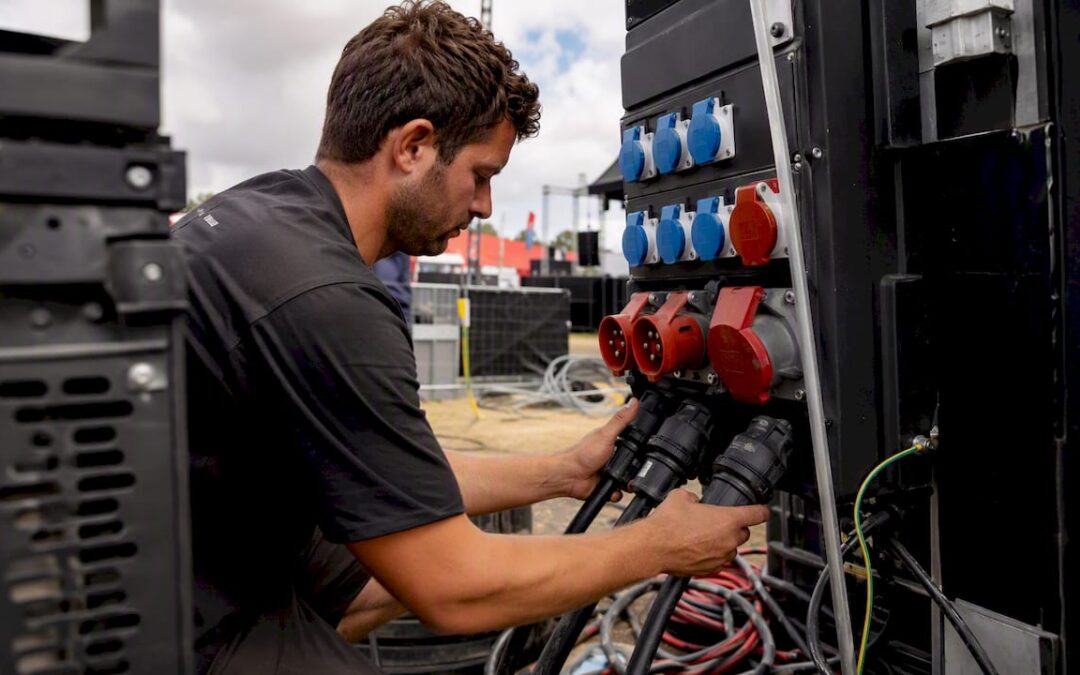
Voltage stability at an event means keeping supply voltage within tight limits so lighting, sound and control systems run reliably without damage. It comes down to three things: a generator sized and governed correctly, a distribution system built to standard, and earthing that actually works. Get those wrong and you’re chasing flicker, dropouts and tripped protection all night.
- Generator sizing and AVR/governor performance under real load, not calculated load
- Distribution board design and correct RCD selection, 30 mA where recommended
- Earthing arrangements compliant with BS 7671 and BS 7909
- A supplier like Jaks Party Power who can show commissioning records, not just a spec sheet
Key Takeaways
Voltage stability at events depends on correct generator sizing, standards-compliant distribution design, and commissioning tests carried out before the audience arrives.
| Point | Details |
|---|---|
| Symptoms come first | Flicker, LED glitches and RCD trips are early warnings; escalate to the generator operator immediately. |
| Compliance isn’t optional | BS 7909 and BS 7671 govern generator earthing, distribution design and fault protection on every temporary installation. |
| Separate audio and lighting | Shared neutrals between dimmer circuits and audio electronics cause ground loops and hum that are hard to fix later. |
| Commission before doors open | Run generators under representative load for at least 30 minutes and test voltage, RCDs and phase balance beforehand. |
| Jaks Party Power supports the full brief | Generator sizing, distribution boards and standby cover during the event, specified around BS 7909 principles. |
Table of Contents
- Why voltage stability matters at events: the immediate answer
- What does voltage instability look like on site?
- Why voltage stability matters: the real risks to shows and safety
- What causes voltage instability in temporary power setups?
- How do you specify equipment to keep voltage steady?
- What tests prove voltage stability before doors open?
- How do you brief a hire company or venue on power needs?
- What contingency options should you budget for?
- What real incidents reveal about voltage instability at events
- What tools monitor voltage stability during an event?
- Which standards govern voltage stability in temporary event power?
- How should crews respond when voltage instability strikes mid-event?
- What experienced technicians actually get wrong
- How Jaks Party Power keeps your event’s voltage steady
- Sources
- FAQ
Why voltage stability matters at events: the immediate answer
Ask any technician who’s stood at a distribution board mid-show and they’ll tell you the same thing: instability rarely announces itself with a bang. It creeps in through flicker, a slow dimming lamp, a console that reboots at the worst possible cue. That’s the practical reality behind “why voltage stability matters events” as a search term. Organisers aren’t looking for a textbook definition. They want to know what breaks, why it breaks, and how to stop it breaking on their watch.
Understanding voltage stability in this context has nothing to do with grid-scale transmission engineering. For a temporary event installation, it means the generator, distribution board and cabling deliver a consistent, correctly regulated voltage to every circuit, load after load, cue after cue, for however many hours the show runs. When that consistency slips, the impact of voltage instability on events shows up fast and it shows up in front of an audience.
What does voltage instability look like on site?
Instability has a signature. Once you’ve seen it, you spot it in seconds.
- Lighting flicker or visible dimming when a large load switches on
- LED walls glitching or briefly blanking during scene changes
- Audio hum, warble or a faint buzz through the PA
- Consoles or media servers rebooting without warning
- RCDs tripping with no obvious fault
- Fuses blowing on circuits that were fine an hour earlier
A stage manager doesn’t need an electrical qualification to run a first check. Watch how house lamps behave when a big rig fires up, glance at the distribution board’s indicator lamps, and get on the radio to the generator operator before assuming a fault lies downstream. Sudden load steps, like a full LED wall waking up at once, often outpace a generator’s governor response, causing a brief sag. Unbalanced phases show up differently: a persistent hum or warm neutral cable, caused by neutral current building where loads aren’t spread evenly across the three phases.
Why voltage stability matters: the real risks to shows and safety
This is where “why voltage stability matters events” stops being an abstract phrase and becomes a safety and compliance question. Poor voltage regulation on a temporary installation isn’t just an inconvenience for the sound engineer. It’s a fire and shock risk, and it sits squarely inside your obligations under BS 7909, the UK code of practice for temporary electrical systems in entertainment. Generator installations must also meet Section 551 of BS 7671, and where a generator acts as a switched alternative source, Regulation 21 of the Electricity Safety, Quality and Continuity Regulations requires it not to run in parallel with the public network.
Regulatory reality: BS 7909 specifically addresses generator-fed systems to ensure voltage regulation, fault protection and public safety are designed in from the start, not bolted on after a near-miss.
The equipment risks are just as real. Brown-outs stress motors and switched-mode power supplies. Inrush current from a large rig switching on can damage sensitive electronics if the supply can’t hold its voltage through the surge. Harmonics generated by dimmers and LED drivers heat transformers and distort waveforms, degrading equipment life even when nothing visibly fails on the night.
- Fire and shock risk from poor earthing or overloaded neutrals
- Damage to consoles, amplifiers and LED processors from voltage sag or surge
- Show failure: a blackout mid-headline set is a reputational cost no contract clause fixes
- Non-compliance exposure under BS 7909 and BS 7671 if an incident is investigated
What causes voltage instability in temporary power setups?
Most instability traces back to a handful of repeat offenders, and they’re almost always preventable at the design stage.
- Undersized or overly long cable runs. Voltage drop increases with cable length and load, so a run that’s fine at 30 metres can sag badly at 100 metres under full load.
- Unbalanced three-phase loading. Dump all your lighting on one phase and you get uneven current draw, neutral heating and audible hum.
- Generator governor and AVR limits. Every generator has a response lag. Step-load it too hard, too fast, and voltage dips before the governor catches up.
- Harmonics from switched-mode supplies and dimmers. Modern LED drivers and dimming systems distort the waveform, and the IET’s temporary power guidance flags this as a growing power quality issue as rapid build schedules leave less time to plan for it.
- Poor earthing. Without a proper generator earth, fault protection and voltage reference both suffer.
- Shared neutrals and daisy-chained extension leads. Convenient on site, but they concentrate load and multiply the chance of a single fault taking out several circuits at once.
Pro Tip: Keep audio and lighting on separate distribution feeds from the board outward. Shared neutrals between dimmer circuits and audio electronics are a textbook cause of ground loops and audible hum, and once that interaction is baked into the wiring, no amount of downstream conditioning fixes it cleanly.
How do you specify equipment to keep voltage steady?
This is the part organisers can control directly, through what they write into a hire brief and what they refuse to accept from a supplier.
Start with the generator. Sizing to the calculated load and nothing more is a false economy: running a genset flat out gives the AVR and governor no headroom to respond to load steps. Field practice among experienced production teams is to size well above the calculated peak and to treat inrush current, not steady-state draw, as the number that decides generator capacity. Where a show’s critical load is large enough, paralleled generators with automatic load sharing give you both headroom and redundancy in one specification.
Cabling and connectors matter just as much as the source. For outdoor runs, HO7RN-F rubber-insulated cable is the standard choice because it tolerates abrasion, moisture and repeated flexing far better than PVC-sheathed alternatives. Multicore distribution suits high-current single runs to a board; single-core is often better for flexible, split feeds across a site. Whichever you choose, phase allocation should be balanced deliberately, not left to whoever plugs in first.
- Confirm generator kVA against peak load plus inrush allowance, not average draw
- Specify AVR and, for critical shows, paralleled capability with automatic load share
- Set cable type and maximum run length per circuit to control voltage drop
- Require correctly rated RCDs, 30 mA on socket-outlet circuits as standard practice
- Add UPS provision for consoles, control PCs and any equipment that can’t tolerate a reboot
A UPS, ideally double-conversion for genuinely critical loads, is cheap insurance against the split second between a generator hiccup and the show noticing. It won’t run a full PA rig for long, but it will keep a lighting desk or vision mixer alive through a transient dip that would otherwise cause a reset.
Pro Tip: Label priority circuits on the distribution board before the doors open, not during a fault. If voltage starts sagging under peak load, your technician needs to know instantly which circuits can be shed and which absolutely cannot.
What tests prove voltage stability before doors open?
Commissioning isn’t paperwork. It’s the only way to know the installation will hold up once the audience arrives, and it should happen with the same load profile the show will actually draw.
- No-load and loaded voltage checks at the distribution board
- Voltage monitoring under representative peak load, not just at switch-on
- Earth loop impedance testing
- RCD trip tests at rated current
- Continuity checks across all protective conductors
- Insulation resistance testing where cable runs have been exposed to weather
- Phase balance measurement with a power analyser
- Run the generator under a load close to the show’s actual peak for at least 30 minutes before public access, a step that reveals fuel, regulation and grounding faults far more reliably than a static test
- Take voltage readings at the board and at the far end of the longest cable run to confirm drop stays within tolerance
- Check phase currents with a power analyser (a Fluke 1760 or equivalent) and flag imbalance beyond roughly 10% between phases for investigation
Anything showing voltage sag beyond a few percent under peak load, or phase currents noticeably skewed, needs correcting before the audience arrives, not during the opening act.
How do you brief a hire company or venue on power needs?
Suppliers can only deliver a stable supply if they know what they’re actually powering. Vague briefs produce vague quotes and under-specified kit.
- Full load schedule by department (lighting, audio, catering, staging) in watts or kVA
- Peak demand versus duty cycle for each department
- Inrush notes for LED walls, amplifiers and motorised rigging
- A single-line schematic or stage power plan showing circuit routing
- Site constraints: vehicle access, refuelling windows, noise limits, curfews
- Earthing and EMC notes for sensitive broadcast or recording equipment
- On-site contact details and shift handover arrangements
Ask suppliers directly to confirm BS 7909 compliance, operator competence, and whether standby cover is available if something goes wrong mid-show. A supplier briefing template built around these points turns a guessing-game quote into an accurate one.
What contingency options should you budget for?
Resilience scales with budget, and not every event needs the same tier.
- On-site spare generator, ready to switch in in minutes, for shows where downtime is unacceptable
- UPS for critical loads, cheap and effective for consoles and control gear
- Paralleled generators with automatic load share, for major headline shows and broadcast events
- Fuel redundancy and scheduled refuelling, non-negotiable for multi-day festivals
- Hybrid battery buffers, increasingly used to absorb transient surges from LED walls and PA rigs
- Remote monitoring with alarms, so a drifting voltage triggers an alert before it becomes a fault
Mid-size events usually cover the essentials with a UPS on critical circuits and a monitored generator. Headline shows and multi-day festivals justify the full stack, spares, parallel capacity and hybrid buffering included.
What real incidents reveal about voltage instability at events
The clearest lessons come from shows where instability wasn’t caught in time. Production teams who’ve had generators sag mid-set describe the same pattern: a load spike, usually from a lighting cue or an LED wall waking up, that outpaces the generator’s governor response, causing a visible dip and, in the worst cases, a full reboot of front-of-house control equipment. One widely discussed case among rental engineers involved a generator that audibly “hunted” as it tried to correct for repeated step loads, a sign the unit was running too close to its ceiling with no headroom to absorb transients.
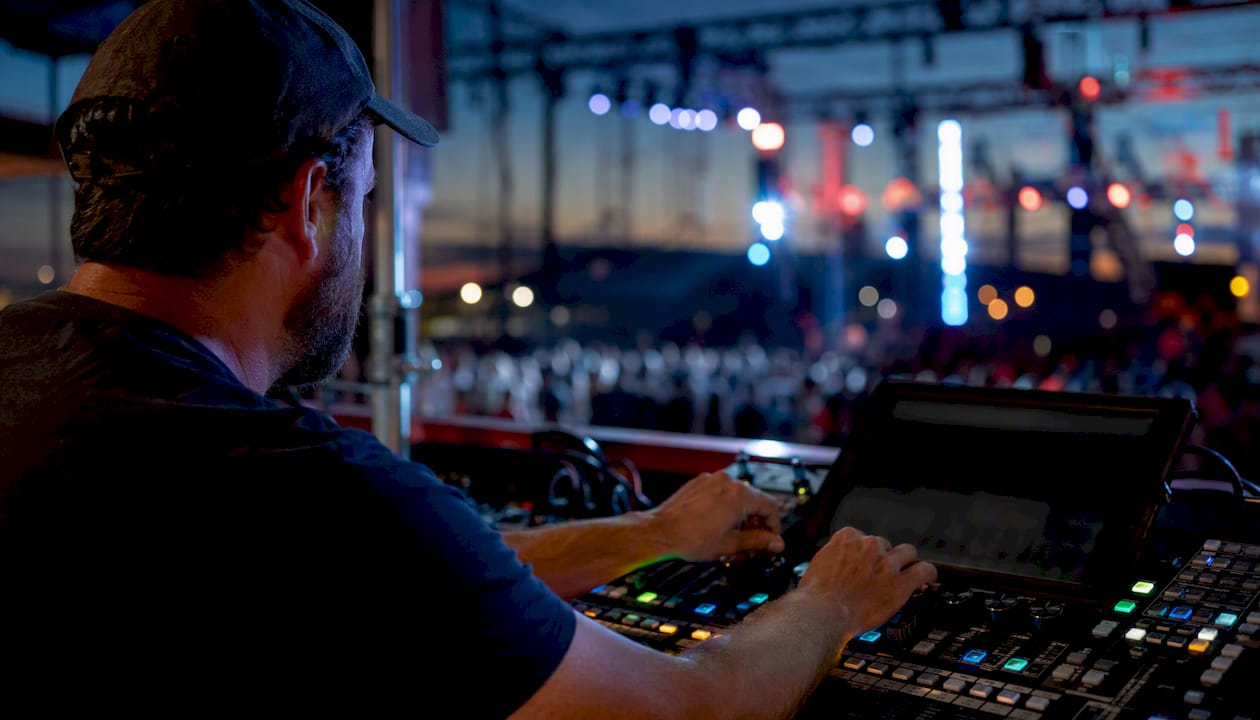
These incidents rarely stem from a single catastrophic failure. They’re usually the accumulation of small compromises: a generator sized to average load rather than peak plus inrush, a cable run stretched further than planned once the stage moved, a phase left unbalanced because nobody checked before doors. Each decision looks reasonable in isolation. Together, they leave no margin when a real load spike hits.
The recurring theme in post-event reviews is data, or the lack of it. Teams that logged voltage, current and power factor throughout a show can trace exactly when and why a dip occurred and adjust the specification for next time. Teams without logs are left guessing, often repeating the same mistake at the next event because nobody can point to the moment it went wrong. Post-show power quality recordings turn a one-off failure into a lesson the whole production learns from, rather than an unexplained gremlin that resurfaces months later at a different venue.
What tools monitor voltage stability during an event?
Monitoring during a show is what separates organisers who catch a problem early from those who find out when the audience does.
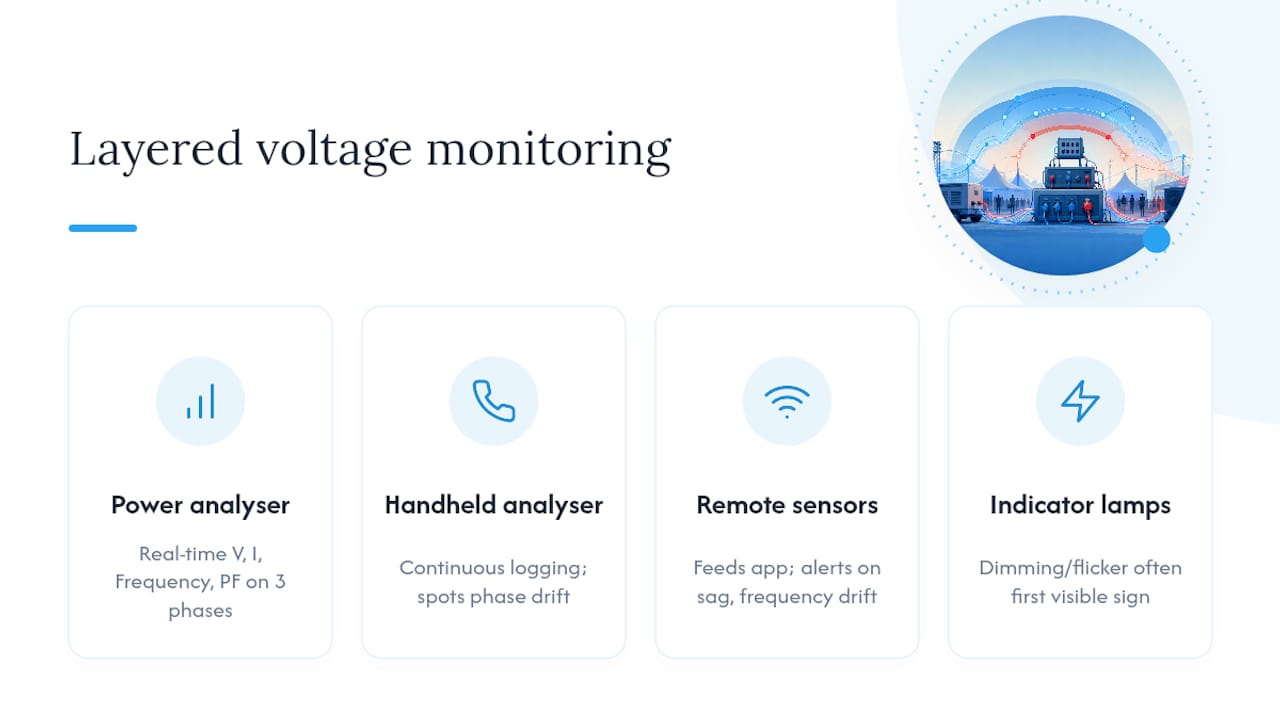
A power analyser is the core tool, clipped onto the distribution board to give real-time readings of voltage, current, frequency and power factor across all three phases. Handheld units like a Fluke 1760 or similar class of instrument log data continuously, so a technician can spot a phase drifting out of balance well before it trips protection or causes visible flicker.
Beyond handheld analysers, more sophisticated hires now include continuous remote monitoring, small sensors on the distribution board or generator output that feed data to a laptop or phone app, flagging voltage sag, frequency drift or an overloaded phase in real time rather than waiting for a fault to announce itself. For festivals and multi-day events, this kind of logging also builds a record you can hand to the next supplier: exactly when voltage dipped, by how much, and under what load.
Distribution board indicator lamps remain the simplest monitoring layer of all, and they shouldn’t be dismissed. A dimming or flickering indicator lamp at the board is often the first visible sign of a developing problem, well before any instrument confirms it. Combining that basic visual check with periodic analyser readings during the show, rather than only at commissioning, catches drift that a single pre-show test would miss entirely.
Which standards govern voltage stability in temporary event power?
Two British Standards do the heavy lifting here, and any organiser serious about “why voltage stability matters events” should be able to name both.
BS 7909 is the dedicated code of practice for temporary electrical systems in entertainment. It sets out how systems should be planned, distributed and inspected, and it specifically addresses generator-fed installations to make sure voltage regulation, fault protection and public safety are designed in rather than assumed. BS 7671, the wiring regulations that apply to all UK electrical installations, governs the underlying requirements, including Section 551, which covers low-voltage generating sets and how they must be earthed and protected.
Sitting alongside both is the IET’s own guidance on temporary power systems for entertainment, which translates the standards into practical detail: cable selection, RCD ratings, earthing arrangements and the power quality challenges introduced by modern switched-mode loads. Where a generator functions as a switched alternative source rather than an embedded generator running in parallel with the grid, Regulation 21 of the Electricity Safety, Quality and Continuity Regulations requires it not to operate in parallel with the distribution network, a distinction that matters for how the installation is designed and tested.
None of these documents are optional reading for anyone hiring temporary power. They’re the baseline any competent supplier should be working to, and asking a hire company to confirm compliance with BS 7909 specifically is a fair, direct question to put in any tender.
How should crews respond when voltage instability strikes mid-event?
The moment flicker turns into something worse, the response needs to be immediate and rehearsed, not improvised.
The first action is always communication: whoever spots the symptom, whether that’s a lighting operator seeing a dip or a sound engineer hearing a warble, needs a direct line to the power technician, not a message relayed through three people. Delay is what turns a manageable sag into a full outage.
Second, priority circuits need to be pre-labelled and understood by the team on shift, not worked out under pressure. If voltage is sagging under peak load, the fastest fix is often shedding non-critical circuits, house lighting, non-essential catering equipment, decorative uplighting, to bring demand back within the generator’s stable range. This only works if priority circuits were mapped and labelled at the commissioning stage, not decided in the dark with a torch and a guess.
Third, if a fault trips an RCD or a fuse blows, the protocol should be to investigate before resetting. Repeatedly resetting a tripped device without finding the cause risks a fire or shock incident, and it’s exactly the kind of shortcut BS 7909 compliance is designed to prevent. A competent operator checks for an obvious cause, an overloaded circuit, a damaged cable, water ingress, before restoring power.
Finally, every instability event should be logged: what happened, when, on which circuit, and what the fix was. That record is what makes the next event’s specification better than this one.
What experienced technicians actually get wrong
Most instability I see traced back to isn’t a dramatic equipment failure. It’s a generator sized to yesterday’s load schedule, or a cable run that got longer after the stage moved and nobody re-checked the drop. Commissioning tests catch this before an audience does, and a clear supplier brief prevents most of it from happening at all. That’s the practical value behind decades of standby experience, not a slogan.
How Jaks Party Power keeps your event’s voltage steady
Sussex event organisers who’ve been caught out by an under-specified generator know the cost of getting this wrong twice. Jaks Party Power supplies correctly sized generators, distribution boards and cabling built around BS 7909 principles, backed by technicians who commission every installation before your event opens, not after something trips.

The service extends to standby support during the event itself, so if voltage starts drifting mid-show, there’s someone on the other end of the phone who already knows your load schedule. Whether you need a single generator for a marquee wedding or paralleled capacity for a multi-day festival, the specification is built around your actual peak load and inrush, not a rough estimate. If you’re planning an event and want a generator sized properly the first time, hire a generator through Jaks Party Power and get a spec that holds up under real load.
Sources
- Temporary power systems and infrastructure for entertainment — IET
- Temporary electrical systems for entertainment and related purposes — BSI knowledge
- Why power distribution is one of the hardest parts of AV — Audio System Rental
FAQ
What does voltage stability mean for an event?
It means the generator, distribution board and cabling deliver consistent, correctly regulated voltage to every circuit throughout the show, without sags, surges or drift under load.
What’s the biggest cause of voltage instability at events?
Undersized generators and cable runs stretched beyond their rated voltage drop are the most common causes, closely followed by unbalanced three-phase loading.
What RCD rating should temporary event circuits use?
30 mA is the recommended rating for socket-outlet circuits on temporary installations, in line with BS 7909 and BS 7671 guidance.
How long should a hired generator run before an event opens?
At least 30 minutes under a load representative of the actual show, which reveals fuel, regulation and grounding issues before the audience arrives.
Can Jaks Party Power help with voltage stability planning?
Yes. Jaks Party Power specifies generators, distribution boards and cabling around BS 7909 principles and provides standby support during events to respond if voltage issues arise.