

An event electrical schematic is a formal design document that maps how temporary electrical power flows from its source to every load across an event site. Think of it as the blueprint your electrician, site manager, and local authority all read from. Under BS 7909, the UK’s Code of Practice for Temporary Electrical Systems for Entertainment and Related Purposes, any system over 6kVA is classified as large or complex and requires a documented design, testing records, and completion certificates before the public can access the site.
The schematic itself typically shows:
- Power sources (generators or mains supply connections)
- Main distribution boards and sub-distribution points
- Individual circuits with their protective devices (RCDs and circuit breakers)
- Electrical loads (stage lighting, sound, catering, emergency systems)
- Cable routes across the site
- Standardised symbols drawn to IEC or BS conventions for universal readability
The HSE views the electrical schematic as a primary risk assessment tool, helping identify hazards such as buried cables and segregating power intakes from public areas. Without one, you cannot demonstrate compliance, and no competent authority will grant your event an electrical supply certification.
What UK regulations govern event electrical schematics?
Two British Standards sit at the heart of every compliant event electrical design in the UK, and neither is optional.
BS 7909:2011+A1:2020 is the Code of Practice specifically written for temporary electrical systems at events, covering festivals, location filming, agricultural shows, theatre, and sporting events. It requires that all temporary installations are designed, installed, inspected, tested, and maintained by a competent person. A written scheme of work must exist before installation begins, and a completion certificate must be produced before energisation.
BS 7671:2018+A2:2022 (the IET Wiring Regulations) governs all fixed and temporary electrical installations across the UK. For event planners, two figures matter most: voltage drop must not exceed 5% of the nominal supply (11.5V on a 230V supply), and all outdoor or temporary circuits require a minimum 30mA RCD protection under Regulation 411.3.3.
The HSE’s guidance document HSG107 adds a further layer, requiring a suitable and sufficient risk assessment covering electrical supply, generator positioning, fuel storage, and cable routing. Key regulatory requirements include:
- Appointment of a named Senior Person Responsible (SPR) before any work begins
- Written scheme of work and risk assessments submitted to the licensing authority
- All equipment to be IP-rated where exposed to weather
- PAT testing records for portable appliances
- Completion certificates and test results issued before public access
Local authorities, such as Bristol City Council, will not grant electrical supply certification until every item on that list is received and approved.
What must an event electrical schematic package include?
The schematic drawing is only part of the submission. A compliant event electrical package covers both the design document and supporting paperwork, and local authorities check all of it.

The core schematic drawing shows the complete circuit layout: main power sources, distribution boards, final circuits, and the protective devices on each. Load calculations per circuit and total system load sit alongside it, confirming that no circuit is undersized and that the generation capacity matches demand.
Supporting documents that must accompany the schematic include:
- SPR details: name, qualifications, and contact information for the appointed Senior Person Responsible
- Contractor competencies: copies of relevant qualifications, public liability insurance, and RAMS (Risk Assessment and Method Statements)
- Site location plan: showing cable routes, generator positions, public areas, and access routes
- Electrical load schedule: wattages per connection point, confirming total and peak demand
- Completion certificates and schedule of test results, certifying the installation meets BS 7909 and is safe to energise
The schedule of test results is particularly detailed. It records circuit descriptions, protective device types and ratings, polarity verification, phase sequence results, earth fault loop impedance, and prospective short-circuit current for every circuit. For a planner, the practical takeaway is straightforward: commission your electrical contractor early enough to produce all of this before the event date, not the morning of load-in.
What does the Senior Person Responsible actually do?
The SPR is the named individual who carries legal accountability for the entire temporary electrical system. Appointing the SPR early is one of the most common areas where event organisers fall short, and a late appointment leaves no time to complete the design and documentation properly.
Their responsibilities span the full project lifecycle:
- Overseeing the electrical design, ensuring it meets BS 7909 and BS 7671
- Supervising installation and managing the on-site electrical team
- Conducting or witnessing RCD tests before every event
- Ensuring critical circuits (stage power, emergency lighting, first aid) are separated so a single fault cannot black out the whole site
- Liaising with the local authority and signing off completion certificates
- Managing cable management standards, IP-rated equipment, and danger signage
Pro Tip: Ask your SPR to walk the site with you before installation begins. They will spot buried cable risks, overhead line clearances, and generator positioning issues that are far cheaper to resolve on paper than on the day.
Separating critical circuits is one of the SPR’s most practical contributions. Power zoning means a tripped RCD on the catering circuit does not kill the stage. That single design decision prevents the kind of cascading failure that ends events early.
How do you plan and calculate power requirements for an event?
Start with a complete equipment load list. Every piece of kit that will draw power needs a wattage figure: stage lighting rigs, PA systems, LED screens, catering units, bar equipment, EPOS terminals, phone charging stations, and emergency lighting. Add those figures together to get your base running load.
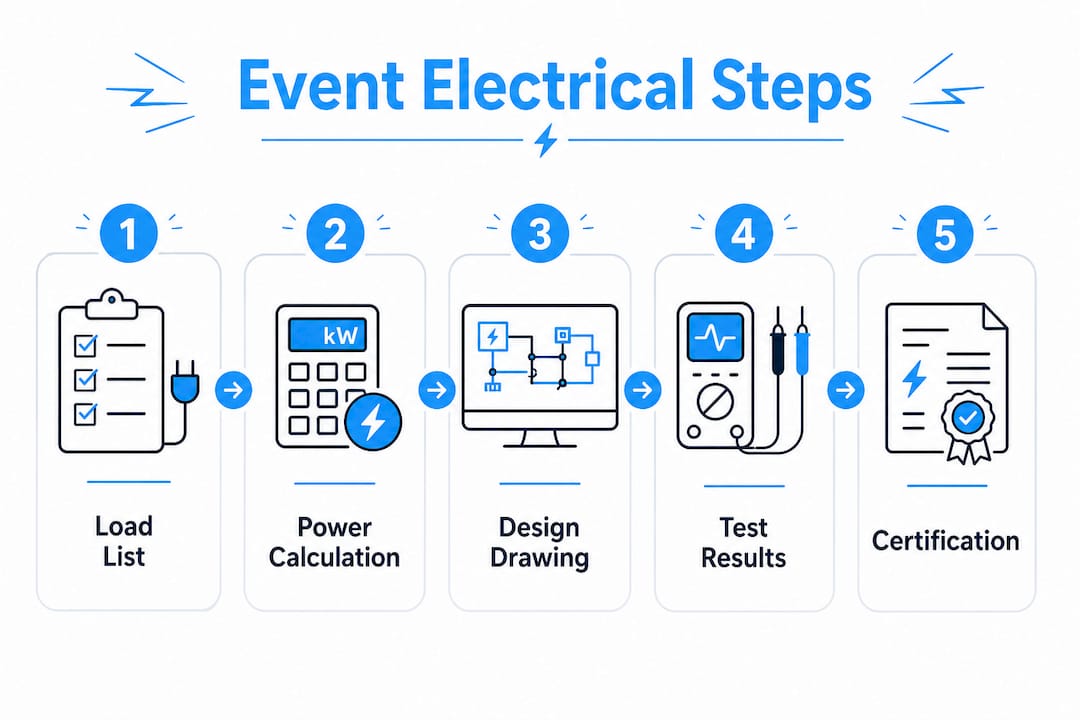
A safety margin should be added on top of the base load to account for startup surges and any equipment added late. That adjusted figure is your peak demand, and it drives your generator specification. Generators should be sized sufficiently above the peak load to allow for power factor losses, harmonic distortion, and motor start surges. Under-sizing is the single most common cause of generator failure mid-event.
Practical planning steps:
- Divide the site into power zones: stage, catering, bar, public lighting, production, and emergency systems each on separate circuits
- Size cables correctly: undersized cables generate heat and present a fire risk; use industrial-grade cable with IP-rated CEE connectors throughout
- Never daisy-chain domestic 13A extension leads: at long runs they overheat dangerously even below their rated current
- Fully unwind cable drums before use: a wound drum builds heat and can cause a fire
- Use cable ramps in all pedestrian areas and cable bridges where vehicle routes cross
For outdoor festival power or any multi-stage event, running multiple generators across zones means a fault on one unit does not interrupt the rest of the site. Generators should not run above 80% of their rated output capacity to prevent overheating and maintain consistent performance.
Why Jakspartypower is the right partner for event electrical work
Jakspartypower brings over 40 years of electrical contracting experience to every event, from Sussex weddings to large outdoor shows. That depth of experience means the team has seen the edge cases: the generator that trips at peak load, the cable route that conflicts with a last-minute stage change, the local authority that needs documentation resubmitted at 48 hours’ notice.
Their service covers the full scope of what a compliant event electrical setup requires:
- Generator hire sized and specified to your load calculations, available through Jakspartypower’s generator range
- Distribution boards, cables, and IP-rated connectors for outdoor use
- Standby support throughout the event, not just at load-in
- Documentation support including risk assessments and schematic preparation aligned with BS 7909 and BS 7671
- Lighting equipment from uplighters to festoon, all wired into the power plan from the start
Jakspartypower’s combination of 40+ years of electrical contracting expertise and a full equipment inventory means event organisers get a single point of contact for design, supply, installation, and on-site support, removing the coordination risk that comes with using multiple contractors.
For event organisers who want a clear picture of event power risk management before briefing a supplier, Jakspartypower’s resources cover the full planning process.

What do event electrical schematic templates look like?
A typical event electrical schematic uses a single-line diagram format for clarity. Rather than drawing every conductor separately, a single line represents each circuit, with standardised symbols showing the type of protective device, the load category, and the connection point. This keeps the drawing readable at site scale while still conveying the full circuit layout.
A basic outdoor event schematic template will show:
- A generator symbol at the top left, labelled with kVA rating
- A main distribution board connected by a heavy single line, with total load noted
- Sub-distribution boards branching off, each labelled by zone (Stage A, Catering, Bar, Emergency)
- Final circuit lines running to load symbols (lighting, socket outlets, specialist supplies)
- RCD and circuit breaker symbols on each protective device, with ratings marked
- Cable route annotations showing length and cross-sectional area
For a more detailed reference on how distribution boards connect into the wider schematic, the planning principles translate directly from the drawing to the physical installation. Software tools such as AutoCAD Electrical or specialist event design packages can generate these drawings to BS conventions, but many experienced SPRs still produce clear, compliant schematics by hand for smaller events.
Key takeaways
An event electrical schematic is the legally required design document under BS 7909 that maps temporary power from source to every load, and no UK event can be energised for the public without one.
| Point | Details |
|---|---|
| BS 7909 triggers at 6kVA | Systems over 6kVA require documented design, testing, and completion certificates before public access. |
| Voltage drop limit | BS 7671 caps voltage drop at 5% of nominal supply (11.5V on a 230V circuit). |
| 30mA RCD mandatory | All outdoor and temporary circuits require minimum RCD protection under Regulation 411.3.3. |
| Generator sizing rule | Generators should be sized sufficiently above the peak load to allow for power factor losses, harmonic distortion, and motor start surges, but no strict multiplier is legally required. |
| SPR appointment | A named Senior Person Responsible must be appointed early; local authorities will not certify without SPR details. |
FAQ
What is an event electrical schematic under BS 7909?
An event electrical schematic is a formal design document required by BS 7909 that shows how temporary electrical power is distributed from source to every load across an event site, including circuits, protective devices, and cable routes.
How do you read an event electrical diagram?
Start at the power source symbol, follow the single lines to distribution boards, then trace each branch circuit to its load symbol, checking the protective device ratings and cable annotations marked along each line.
What is the difference between a schematic and a wiring diagram?
A schematic shows the functional electrical connections using standardised symbols regardless of physical layout, while a wiring diagram shows the actual physical arrangement of cables and components as they are installed.
Who is responsible for the event electrical schematic?
The Senior Person Responsible (SPR), appointed under BS 7909, oversees the design, installation, and testing of the temporary electrical system and signs off the completion certificate before the event is energised.
Does every UK event need an electrical schematic?
Any temporary electrical system over 6kVA at a UK event requires a documented schematic, load calculations, and completion certificates; smaller systems still require competent installation and RCD protection under BS 7671.