

A corporate outdoor event power plan is a single document that guarantees safe, compliant, and resilient power by defining loads, supply sources, distribution, earthing, and contingency arrangements before a single cable is laid. Dutyholders retain legal responsibility under the Electricity at Work Regulations 1989 even when contractors do the physical work, so the plan is not optional paperwork. The governing standards are BS 7909 and BS 7671, which together set the baseline for every temporary outdoor installation in the UK. Your first action: commission a site survey and request a supplier brief template from your chosen provider before any other planning begins.
- Produce or request a documented single-line diagram, load schedule, and distribution layout.
- Confirm the earthing strategy (TT preferred outdoors) and protective device schedule.
- Obtain test certificates and a signed emergency procedure before public entry.
Pro Tip: Send your site plan and provisional load list to your power supplier at least eight weeks before the event. Generator availability tightens quickly for summer dates.
Table of Contents
- What must a corporate outdoor event power plan contain?
- How do you build or commission a power plan step by step?
- What UK compliance requirements apply to outdoor event power?
- What equipment do you need and how do you size it?
- How do you manage risk and build in contingency?
- What drives costs and how long does the timeline take?
- What commissioning documents must you receive before opening?
- When should you hire a specialist and what should you ask them?
- Jakspartypower: what they supply and why corporate planners use them
- Key takeaways
- What experienced planners know that the manuals don’t say
- Jakspartypower can handle your entire power setup
- Useful sources
- FAQ
What must a corporate outdoor event power plan contain?
The plan is a document set, not a single sheet. Every section below must either be produced by your supplier or checked off against their deliverables.
Mandatory document sections:
- Single-line diagram showing supply source, main intake, distribution boards, RCDs, earthing point, and critical circuits.
- Load schedule with diversity listing every load in watts or kilowatts, demand factor, and calculated maximum demand.
- Supply source details covering generator rating, fuel type, and connection method.
- Distribution layout mapping board locations, cable routes, and zone boundaries.
- Earthing and bonding strategy confirming TT arrangement and electrode test results.
- Protective device schedule specifying RCD types, ratings, and discrimination.
- Cable routing and protection plan noting ramps, catenaries, burial depths, and signage. HSE guidance requires cable crossings to be protected from vehicle and pedestrian traffic.
- Commissioning test records and Electrical Installation Certificate (EIC).
- RAMS (Risk Assessment and Method Statement) and emergency shutdown procedure.
“A power plan is more than a generator selection — it must document load management, cable routing, earthing strategies and emergency procedures so the whole system remains stable and compliant.” — BS 7909 context
Pro Tip: Insist on three documents before the event opens: the EIC, the signed handover document, and the single-line diagram. Without all three, you cannot demonstrate the installation was signed off safe.
How do you build or commission a power plan step by step?
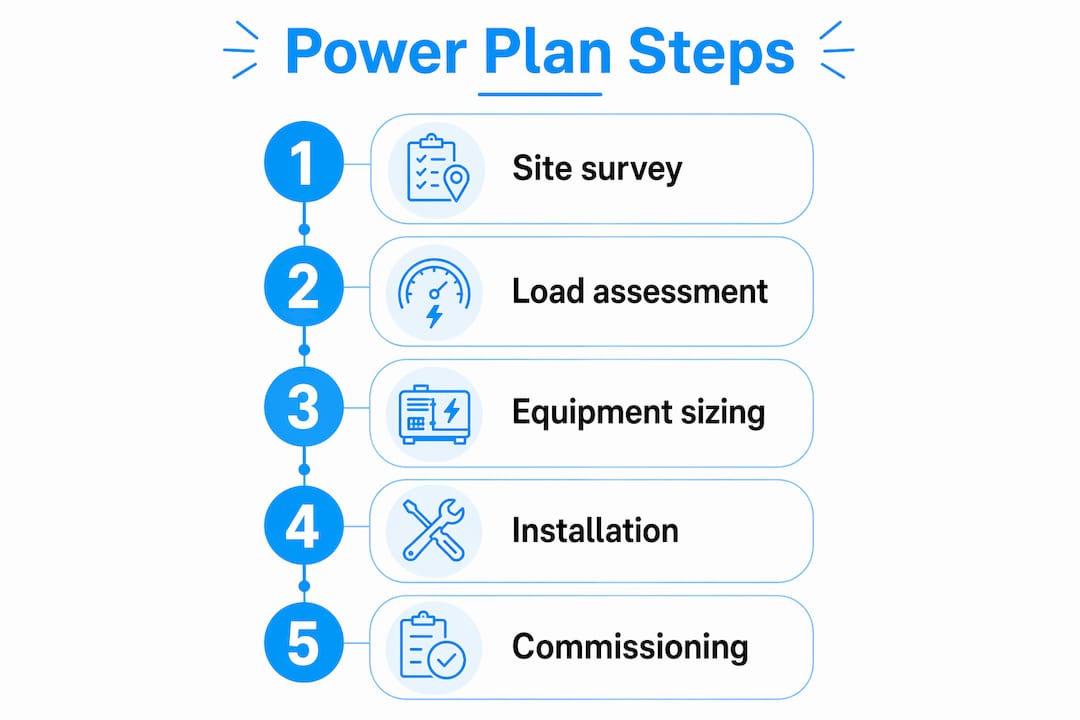
The process runs in six stages. Hand this sequence to your supplier and use it as a decision checkpoint list.
- Site survey — supplier walks the site, identifies supply source options, cable routes, and power zones. Allow two to three weeks lead time.
- Load survey — you provide a full equipment list; supplier calculates maximum demand and adds a safety margin for surges and late additions.
- Single-line diagram design — supplier produces the draft diagram and protective device schedule for your approval.
- Equipment hire and logistics — generators, distribution boards, and cabling confirmed and booked. Book generators at least six weeks out for large events.
- Installation — typically one to two days before the event opens, depending on site complexity.
- Commissioning and handover — testing, EIC issue, operator briefing, and RAMS sign-off on the day before public entry.
| Stage | Typical lead time | Decision checkpoint |
|---|---|---|
| Site survey | 3–6 weeks before event | Confirm earthing approach and zone map |
| Load survey | 4–6 weeks before event | Approve load schedule and maximum demand |
| Equipment booking | 6–8 weeks before event | Confirm generator size and distribution count |
Allow a minimum of eight weeks from first enquiry to installation day for a mid-scale corporate outdoor event, and book generators as early as possible before peak summer dates.
| Installation | 1–2 days before event | Approve cable routes and board positions |
| Commissioning | Day before opening | Sign off EIC and handover document |
Roles: The dutyholder (organiser) owns legal responsibility. The on-event electrical supervisor manages live operation. The supplier designs, installs, and tests. The venue contact provides access and fixed-supply details. The site safety officer co-signs the RAMS.
Example load calculation:
| Load | Quantity | Unit load (kW) | Total (kW) |
|---|---|---|---|
| PA system | 1 | — | — |
| Stage lighting | 1 rig | 20 | 20 |
| Catering units | 4 | 6 | 24 |
| AV screens and projectors | 3 | 2 | 6 |
| HVAC / marquee heating | 2 | 8 | 16 |
| Subtotal | 66 | ||
| +25% margin | 83 kW |
A 100 kVA generator covers this load comfortably while staying below 80% rated output.
What UK compliance requirements apply to outdoor event power?
BS 7671 is the baseline wiring standard; BS 7909 supplements it specifically for temporary entertainment installations. Both apply simultaneously. HSE guidance requires dutyholders to do all that is reasonably practicable to keep installations safe.
“Dutyholders must do all that is reasonably practicable to ensure that electrical installations and equipment used at places of entertainment are properly selected, installed and maintained so they don’t cause death or injury.” — HSE GS50
Earthing: TT earthing with driven electrodes is the default for outdoor temporary supplies. PME (TN-C-S) is discouraged because a lost PEN conductor can make exposed metalwork live. Electrode resistance should typically be 200 Ω or lower to guarantee RCD operation within disconnection times.
RCDs: Type A is the minimum for most entertainment loads. Type F or B is required where loads contain DC or mixed-frequency components, such as variable-speed drives or LED dimmer systems.
Connectors: Industrial BS EN 60309 outlets rated at 16 A, 32 A, 63 A, or 125 A are the standard for event distribution. Domestic 13 A sockets are not appropriate for high-power stage or catering feeds.
Compliance checklist to request from your supplier:
- EIC covering the full temporary installation
- Earth electrode test result (resistance value recorded)
- RCD type, rating, and test log for every board
- Single-line diagram matching the as-built installation
- RAMS signed by the electrical supervisor
What equipment do you need and how do you size it?
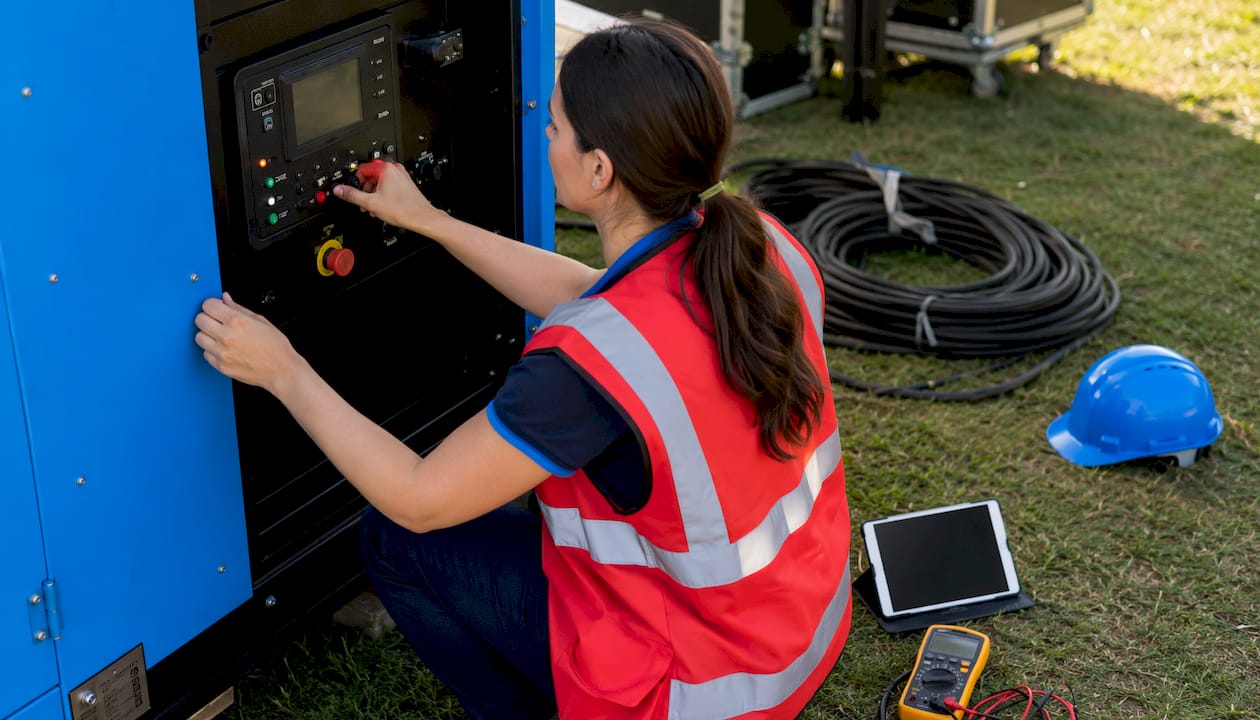
Size generation and distribution to cover calculated maximum demand with at least 20–25% headroom, and never run a generator above 80% of rated output continuously.
| Equipment | Typical sizes / ratings | Notes |
|---|---|---|
| Diesel generator | 20 kVA | Match to max demand at ≤80% load |
| Distribution board | 63 A, 125 A, 200 A | RCD-protected; label every circuit |
| SWA armoured cable | 16 mm² | For buried or vehicle-crossing runs |
| flexible cable | 1.5 mm² | For above-ground temporary runs |
| BS EN 60309 connectors | 16 A, 32 A, 63 A, 125 A | Colour-coded by voltage |
Using the 83 kW example from the load calculation above, a 100 kVA generator provides the right headroom. For a corporate award ceremony with critical AV and lighting, add a second 60 kVA unit on standby for those circuits specifically.
Pro Tip: Divide the site into power zones early — stage, catering, guest areas, production — and run a dedicated distribution board to each. Fault isolation during the event becomes a matter of minutes rather than a frantic cable trace.
Explore the full range of event power equipment to understand what each component does before finalising your specification.
How do you manage risk and build in contingency?
Every plan must name critical circuits, define redundancy, and document fuel and refuelling procedures. A show-stopping outage at a corporate exhibition is a reputational event, not just a technical one.
- Standby generator: size it to cover at minimum the critical circuits (PA, AV, emergency lighting). N+1 means one spare unit for every generator in use on critical feeds.
- Transfer arrangement: automatic transfer switches are faster and safer than manual changeover for corporate shows; document the changeover time in the plan.
- Fuel security: calculate consumption at expected load, add 25% buffer, and schedule refuelling during low-activity periods. Never refuel a running generator.
- On-event engineer: a qualified engineer on site throughout the event is the single most effective contingency measure. They can isolate a fault, reset a tripped RCD, and prevent a minor issue becoming a full outage.
- Rapid spares: carry spare RCDs, fuses, connectors, and a short cable drum on site.
Understanding why venues need power contingency plans is worth reading before your next supplier negotiation.
Red flags when vetting a supplier: undersized gensets with no headroom, no RCD discrimination between boards, missing handover documentation, no on-event engineer offered, and an unclear or undocumented earthing arrangement.
Pro Tip: For first aid and safety coordination, share the emergency power shutdown procedure with the first-aid team so they know which circuits to expect to lose if the electrical supervisor initiates an emergency stop.
What drives costs and how long does the timeline take?
Costs are driven by generator size and count, distribution complexity, cabling length and protection method, engineer days, and certification. There is no single market rate, but understanding the cost components lets you interrogate a quote properly.
| Cost component | What drives it up |
|---|---|
| Generator hire | Higher kVA rating, longer hire period, acoustic enclosure |
| Fuel | Distance from depot, event duration, load factor |
| Distribution and cabling | Number of zones, cable run lengths, buried sections |
| On-event engineer | Number of days, overnight cover, standby rota |
| Certification and testing | Number of boards, complexity of earthing arrangement |
| Delivery and cranage | Site access restrictions, distance from supplier depot |
For a mid-scale corporate outdoor event, allow a minimum of eight weeks from first enquiry to installation day. Generator availability for peak summer weekends can disappear within days of popular dates being announced.
What commissioning documents must you receive before opening?
Formal handover documentation from the electrical contractor is required before the public enter. It records inspection, tests, and the fact the installation was signed off safe — and enforcement bodies and insurers frequently request it.
“Request a formal handover document and keep it as evidence that the installation was tested and safe.” — BS 7909 handover guidance
Handover checklist:
- Electrical Installation Certificate (EIC) covering the full temporary installation
- Earth electrode test result with resistance value
- RCD test logs for every distribution board
- Circuit labelling confirmed and matching the single-line diagram
- Load test records
- Trained operator contact details and emergency shutdown procedure
- RAMS signed by the electrical supervisor and dutyholder
The organiser signs the RAMS as dutyholder. The electrical contractor signs the EIC. Even when a specialist contractor performs all the work, the organiser remains the dutyholder and cannot transfer that legal responsibility. Review the equipment inspection guide for a practical walkthrough of what a competent inspection covers.
When should you hire a specialist and what should you ask them?
Hire a specialist when multi-kW loads, complex distribution, multiple power zones, or public safety exposure are involved. For any corporate outdoor event with a stage, catering, or AV production, that threshold is crossed immediately.
Supplier brief template:
| Item | What to specify |
|---|---|
| Supply source | Generator hire required / existing mains supply available |
| Maximum demand | Calculated kW figure plus 25% margin |
| Critical circuits | PA, AV, emergency lighting — list individually |
| Site map | Scaled drawing with zone boundaries and access routes |
| Access times | Earliest delivery, installation window, breakdown window |
| Emissions / noise limits | Any planning conditions or venue restrictions |
| Handover expectations | EIC, single-line diagram, RAMS, on-event engineer SLA |
Vetting questions to ask every supplier:
- Can you provide an EIC and signed handover document?
- What is your earthing strategy for this site?
- Which RCD types will you specify and why?
- Do you carry public liability insurance of at least £5 million?
- Will a qualified engineer be on site throughout the event?
Pro Tip: Request the supplier brief template before your first call with any provider. Suppliers who push back on providing documentation before booking are a red flag.
Jakspartypower: what they supply and why corporate planners use them
Jakspartypower offers a complete package: site survey, single-line diagram design, generator hire, distribution boards, cable installation, commissioning testing, EIC issue, and on-event standby engineering. That end-to-end scope matters because it removes the coordination risk of using separate suppliers for generation and distribution.
- 40+ years of electrical contracting experience behind every installation.
- Standby service: a qualified engineer remains on site throughout the event, not just for set-up.
- Full compliance documentation: EIC, handover document, single-line diagram, and RAMS issued as standard.
- Published 2026 process guides for corporate generator hire and supplier briefing, so planners know exactly what to expect at each stage.
- HSE and BS 7909 / BS 7671 compliance built into every installation, not offered as an optional extra.
For corporate exhibitions, award ceremonies, and outdoor corporate functions, Jakspartypower’s corporate generator hire process sets out the exact steps from first enquiry to post-event sign-off.
Key takeaways
A complete corporate outdoor event power plan requires a documented single-line diagram, a load schedule with a safety margin, TT earthing, RCD-protected distribution, and a signed EIC before public entry.
| Point | Details |
|---|---|
| Dutyholder responsibility | Organisers retain legal duty under the Electricity at Work Regulations even when contractors do the work. |
| Load calculation margin | Add a safety margin to calculated maximum demand and keep generators below rated output. |
| TT earthing required | Outdoor temporary installations should use TT earthing; PME is discouraged due to PEN conductor risk. |
| Handover documents | Obtain the EIC, earth electrode test result, RCD logs, and signed RAMS before the event opens. |
| Jakspartypower | Provides site survey, generator hire, distribution, commissioning, EIC, and on-event standby engineering as a single package. |
What experienced planners know that the manuals don’t say
The biggest gap between a plan that looks compliant and one that actually works on the day is the handover moment. Always secure a signed handover document and walk the site with the electrical supervisor before public entry. Not as a formality — as a genuine check that circuit labels match the diagram, that RCDs are accessible, and that the emergency shutdown procedure is physically posted where the on-event engineer can reach it in the dark.
Briefing clients on power costs is another area where planners routinely underestimate. Generator hire is visible on a quote; the engineer day rate, fuel buffer, and acoustic enclosure often are not. Itemise every cost component in your supplier brief from the start, or you will be renegotiating on-site.
Negotiating site access windows with venues deserves more attention than it usually gets. An installation window that starts at 8 AM the morning of the event is not enough time for a complex multi-zone setup. Push for the evening before and confirm it in writing with the venue contact before contracts are signed.
On-event engineer cover is the one line item that corporate clients sometimes try to cut. It is the wrong place to save money. A qualified engineer on site can reset a tripped RCD in two minutes; without one, you are calling the supplier’s emergency line and hoping.
Jakspartypower can handle your entire power setup
Forty years of electrical contracting experience, a standby engineer on site throughout your event, and full compliance documentation as standard. That is what Jakspartypower brings to every corporate outdoor event, from a 50-person networking function to a 2,000-delegate exhibition.
The package covers everything: site survey, single-line diagram, generator hire, distribution board installation, cable routing, commissioning testing, EIC issue, and on-event standby cover. You get one point of contact, one set of documentation, and an engineer who stays until the last cable is packed away.
Request a quote or download the supplier brief template at Jakspartypower, or go straight to the generator hire page to check availability for your event date.
Useful sources
- HSE: Electrical safety at events — dutyholder responsibilities and practical guidance for temporary installations.
- HSE GS50: Electrical safety at places of entertainment — the primary guidance note for event electrical safety, covering RCDs, earthing, and generator use.
- Electricity at Work Regulations 1989 guidance (HSR25) — statutory duties for dutyholders and contractors.
- BSI: BS 7909 and BS 7671 — the UK standards for temporary event electrical systems and wiring regulations.
- Elec-Mate: Temporary installations BS 7909 guide — practical explanation of earthing, RCD selection, and compliance requirements.
- Jakspartypower: Event power planning stages — planning milestones and timeline guide for UK events.
- Jakspartypower: Corporate generator hire process 2026 — step-by-step supplier process for corporate clients.
- Jakspartypower: Event power supplier briefing guide — supplier brief template and procurement checklist.
FAQ
What is a corporate outdoor event power plan?
A corporate outdoor event power plan is a document set covering load schedules, a single-line diagram, earthing strategy, distribution layout, test certificates, and emergency procedures. It proves the installation is safe, compliant with BS 7909 and BS 7671, and resilient enough to run without interruption.
How far in advance should I book event power?
Book generators and confirm your power supplier well in advance before the event. Peak summer dates can exhaust generator availability much earlier, and the site survey alone requires two to three weeks of lead time.
Do I need an on-event engineer for a corporate outdoor event?
Yes. An on-event engineer is the most effective contingency measure available. They can isolate faults, reset tripped RCDs, and manage emergency shutdowns — tasks that cannot wait for a supplier to travel to site.
What documents must I receive before the event opens?
You must receive the Electrical Installation Certificate (EIC), earth electrode test result, RCD test logs, signed RAMS, and a handover document confirming the installation is safe. Enforcement bodies and insurers frequently request these.
Can Jakspartypower handle the full power setup for a corporate event?
Yes. Jakspartypower provides site survey, generator hire, distribution board installation, cable routing, commissioning testing, EIC issue, and on-event standby engineering as a single package, with full BS 7909 and BS 7671 compliance documentation.