
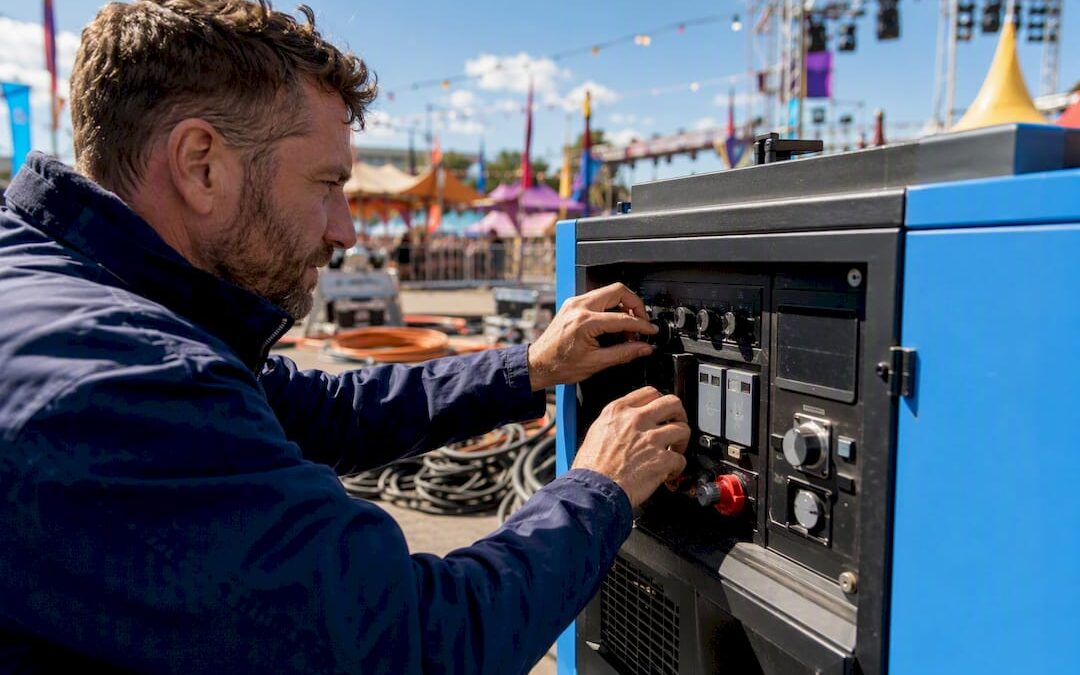
Parallel generators when your event needs combined capacity beyond a single set, or genuine redundancy, and you have synchronising and protective controls to manage it safely. Done properly, it adds capacity, buys you N+1 resilience, and keeps prime movers running nearer their efficient 75–80% load band. Done without a synchroniser, tested breakers and a commissioning plan behind it, it is one of the fastest ways to lose an event’s power entirely.
TL;DR:
- Paralleling generators requires matching phase sequence, voltage, and frequency within tight tolerances before closing the breaker to avoid damaging transient surges.
- Load sharing between generators depends on the control strategies, with droop and isochronous controls needing proper configuration to prevent circulating currents and overheating.
- Pre-start checks must include voltage, frequency, control functionality, protection relays, and individual isolation, especially under peak load conditions.
- Sequential startup involves verifying stability, synchronisation, load sharing, and staged load addition, with priority given to life-safety and critical systems.
- Using tested, manufacturer-controlled generators with documented commissioning and a standby technician reduces risk and ensures reliable power for events.
Table of Contents
- What is generator paralleling and how does it work?
- What conditions must be met before paralleling generators?
- How do you sequence a paralleled generator start-up at an event?
- Best practices, N+1 design and common failure modes
- Commissioning, testing and utility coordination
- How Jaks Party Power puts these controls to work
- What actually matters when paralleling for events
- Book paralleled generator power that’s tested before it arrives
- FAQ
What is generator paralleling and how does it work?
Paralleling means connecting two or more generators to the same bus so they share one load rather than each feeding a separate circuit. For that to happen safely, the sets must match closely enough at the moment their breakers close, or the resulting inrush can damage windings, couplings and switchgear.
Three parameters have to align within tight windows before closure: frequency, phase angle and voltage. Guidance from Stamford AVK’s AGN 022 on conditions for parallel operation sets out these tolerances and stresses that the closing angle matters as much as the numbers either side of it. Close the breaker outside that window and you get a transient synchronising surge, a brief but violent current spike as the two sources fight to align. AGN 022 recommends keeping that surge below 50% of the generator’s rated current, which is why synchronisers exist rather than relying on an operator’s judgement.
Once paralleled, the sets have to agree on how much of the load each one carries, both the real power (kW) and the reactive power (kVAR). This is load sharing, and it depends on the control strategy:
- Droop control lets frequency and voltage sag slightly as load increases, which naturally biases load sharing between dissimilar machines without any communication link between them.
- Isochronous control holds frequency and voltage constant regardless of load, giving tighter power quality but requiring a genuine load-sharing link between controllers.
- Mixing the two without a proper interface risks circulating currents, where reactive power sloshes between generators instead of reaching the load, quietly overheating windings even while the output meters look fine.
What conditions must be met before paralleling generators?
Before any breaker closes, run through the electrical checks, the equipment checks and the operational rules in that order. Skipping straight to “does it sync” without checking phase sequence first is how technicians end up chasing a fault mid event instead of before doors open.
- Phase sequence and rotation match on both machines, confirmed with a phase rotation meter, not assumed from the plug type.
- Voltage and frequency sit within the synchroniser’s window, with AVR set points aligned so neither generator is trying to “win” the voltage argument once paralleled.
- Synchroniser and load-sharing controls are fitted, powered and tested, not just present in the panel.
- Current transformers and protection relays are installed on each generator’s output and have been function-tested, not just wired.
- Individual isolation exists for every generator, so one set can be pulled off the bus for a fault or fuel run without shutting the whole system down.
- Sizing and fuel margin account for the smallest generator carrying life-safety loads alone if the others trip, plus enough fuel reserve for the show’s actual running time, not the schedule’s optimistic version.
Pro Tip: Run the synchronising check at the same time of day you expect peak load, not first thing in the morning when ambient temperatures and load are both lower. A system that syncs cleanly at 9am on a cold rig can behave differently at 9pm under full lighting and sound load.
For hire-specific checks worth putting to a supplier, the practical guide to hiring a generator for private events covers what to ask before signing off on a booking.
How do you sequence a paralleled generator start-up at an event?
The sequence below follows the pattern used in standby and emergency paralleling applications, adapted for a live event where the audience never sees the panel but absolutely feels the outcome:
- Pre-start checks: fuel levels, oil, coolant, battery voltage and isolation switches confirmed on every set.
- Start generators in the planned order, watching for stable frequency and voltage before touching the sync controls.
- Synchronise: the synchroniser (or a competent operator using sync lamps and a voltmeter as backup) brings frequency, phase and voltage into the acceptable window.
- Close the breaker at the correct closing angle, watching for a clean transition with no visible current spike on the meters.
- Confirm load share: kW and kVAR readings across the paralleled sets should track proportionally to their rated capacity within a few percent of each other.
- Add load in stages, not all at once, watching frequency dip and recovery time between each block.
Event applications typically use first-on, or random access, logic: whichever generator starts and stabilises fastest takes the bus live first, with others synchronising in as they come ready. That detail matters more at events than in a fixed standby installation, because reliability considerations in simple paralleling applications show it materially cuts the time critical circuits sit dark, which is precisely the moment an audience notices.
If load has to be shed, priority order matters. A sensible hierarchy for most events runs:
- Life-safety and emergency lighting, always last to lose power.
- Critical comms, stage management radios and broadcast feeds.
- Main stage sound and lighting.
- Backstage catering, HVAC and non-essential amenity loads, first to shed.
For guidance on how these priorities map onto distribution boards feeding different zones of a site, see the piece on portable power distribution.
Best practices, N+1 design and common failure modes
The single most useful design decision for event power is N+1: running one more generator than the load strictly needs, so any one unit can be pulled for a fault, refuelling or scheduled service without the show losing power. Analysis of paralleling generator systems describes that a well-managed N+1 scheme can achieve very high reliability, significantly reducing outage risk for events like a three-day festival.
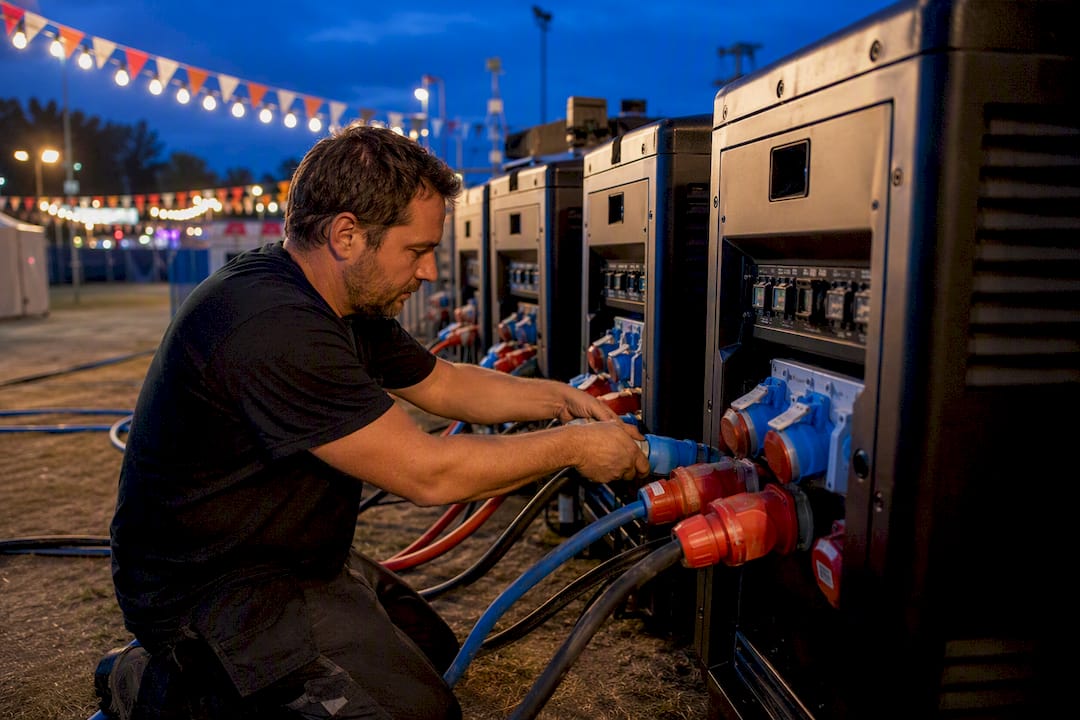
Matching control philosophy across the fleet is the second lever. Two isochronous controllers from the same manufacturer share load cleanly out of the box. Two dissimilar controllers, or one droop and one isochronous set paralleled without a proper interface, will often run but rarely run well, and the failure usually shows up as circulating current rather than an obvious fault. A Cummins technical note on paralleling dissimilar generators recommends either standardising controllers across a hired fleet or fitting a manufacturer-supplied gateway rather than trusting a mismatched pair to sort themselves out.
Common failure modes worth briefing the on-site team on:
- Synchronising surge from closing outside the tolerance window, usually from a faulty or bypassed synchroniser.
- Circulating currents from mismatched AVR settings or incompatible droop/isochronous pairing.
- Torsional oscillation, a mechanical resonance between paralleled prime movers that shows up as hunting on the load-share meters rather than an alarm.
Commissioning, testing and utility coordination
A paralleled system earns trust through documented testing, not through running once without tripping. Commissioning should cover:
- Synchroniser window validation: proving the unit actually holds frequency, phase and voltage inside tolerance under load, not just at idle.
- Closing-time calibration: checking the breaker closes at the intended point in the sync cycle, confirmed against the AGN 022 surge guidance.
- Breaker timing and CT/relay function tests, logged with timestamps and readings, not just a verbal “it’s fine.”
- Load-share tuning, run as a staged test: 25%, 50%, 75% and full load, with kW/kVAR readings recorded at each step.
For larger installations, particularly closed-transition paralleling or anything above 1 MW, the installation considerations guide for paralleling generator systems is clear that utility coordination needs to start early. A last-minute request to run closed-transition alongside a live grid connection is a common reason large event installs get refused permission days before doors open.
How Jaks Party Power puts these controls to work
Jaks Party Power has built its standby offering on over 40 years of electrical contracting experience across Sussex events, from weddings to large-scale shows. In practice, that means synchroniser settings checked before a generator ever reaches site, breaker timing verified rather than assumed, and a standby technician present who understands load-shed priority, not just fuel levels.
Before booking any standby contractor for a paralleled setup, ask for the specifics: recorded commissioning logs, the actual synchroniser tolerance settings used, and evidence of load-share tuning across the fleet you’ll be hiring. A contractor who can produce that on request has done the job properly. One who cannot has probably not tested it under real load at all.
What actually matters when paralleling for events
Most guidance on generator paralleling reads as if it were written for a data centre, and event technicians end up translating it awkwardly on site. That gap is the real problem: a hospital’s N+1 scheme has weeks of commissioning time behind it, while an event rig gets one afternoon and a sound check.
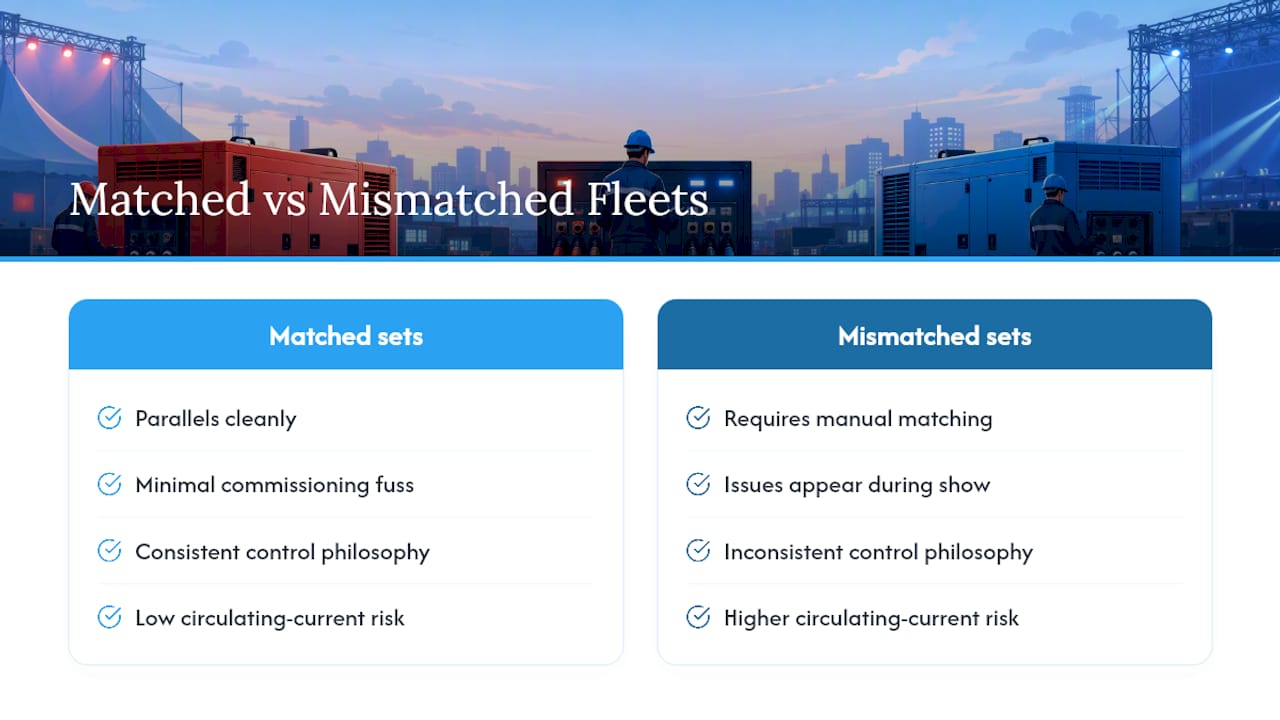
The conventional advice, “get a synchroniser and follow the manual”, undersells how much of this comes down to matching control philosophy across a hired fleet, not just hitting the sync window on the day. Two isochronous sets from the same manufacturer will paralell cleanly with minimal fuss. Two dissimilar sets from different hire yards, borrowed at short notice to cover extra capacity, are where circulating currents and torsional oscillation actually show up, often hours into a show rather than at commissioning.
If you take one thing from this, prioritise fleet consistency over generator size. A matched pair of mid-sized sets with proper load-share controls will outperform a mismatched large-and-small combination every time, even when the mismatched pair has more headline capacity on paper.
— Rob
Book paralleled generator power that’s tested before it arrives
Jaks Party Power is the practical route to paralleled event power without building the expertise in-house: instead of sourcing synchronisers, commissioning breakers and tuning load share yourself, you get generators that arrive with those checks already done and a standby technician who can produce the commissioning log if asked.

That matters most for weddings, corporate events and large shows across Sussex where a single generator can’t cover peak load, or where the risk of one set tripping mid-event is unacceptable, as detailed in Event Generator Power: Planning and Specs for Luxury Events. Jaks Party Power’s standby service for corporate events pairs synchronised generator hire with an on-site technician for the full duration of your event, and the generator hire page lets you check current stock and specifications against your load calculation. If your event needs combined capacity or genuine N+1 redundancy, get in touch to discuss the setup and request a quote before you commit to a date.
FAQ
What are the conditions for paralleling two generators?
Both generators need matching phase sequence, frequency and voltage within the synchroniser’s tolerance window, plus tested protection relays, individual isolation and a compatible load-sharing control strategy across both units.
What happens when you run two generators in parallel?
Once synchronised and connected to a shared bus, the generators automatically divide the real power (kW) and reactive power (kVAR) load between them according to their control settings, whether droop or isochronous.
How does generator paralleling work?
A synchroniser matches frequency, phase and voltage between generators before closing the connecting breaker, then load-sharing controls split the ongoing electrical load between the paralleled sets in proportion to their capacity.
What happens if two generators are not synchronised?
Closing a breaker between unsynchronised generators causes a transient current surge, potentially far above the 50% of rated current that AGN 022’s guidance recommends as a safe limit, risking damage to windings, couplings and switchgear.