
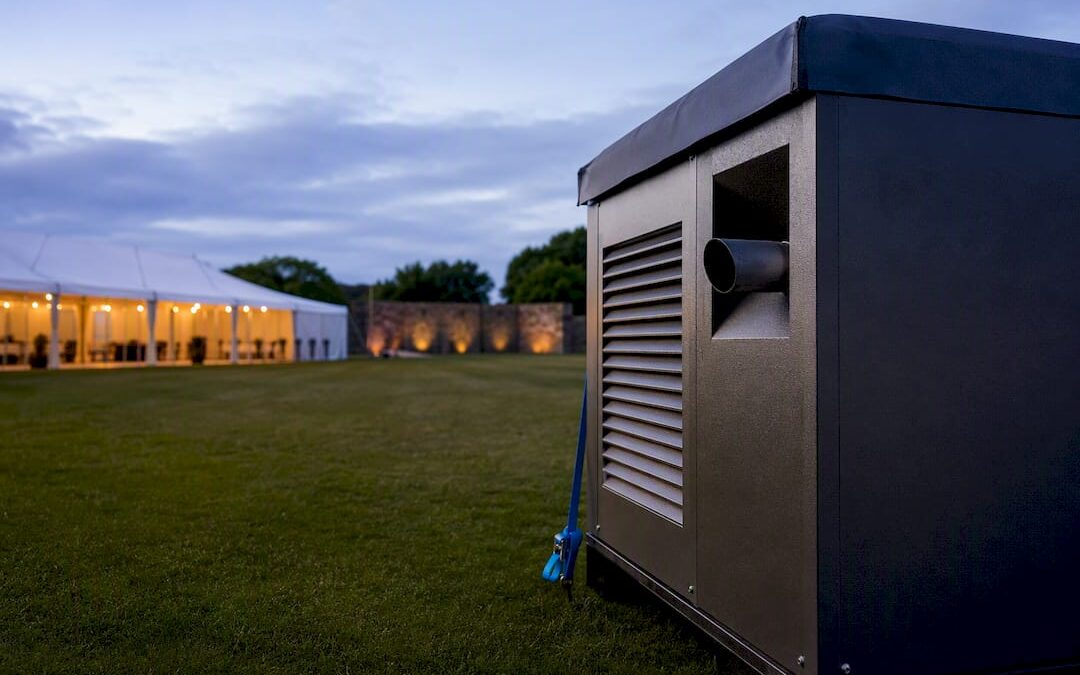
Yes, you can control generator noise effectively, and the fix is rarely just one thing. The combination that works is choosing a quiet or acoustically enclosed unit, siting it well away from bedrooms and windows, and keeping a maintenance log that proves you used best practicable means. That last point matters legally: under the Environmental Protection Act 1990, a council can serve an abatement notice if generator noise counts as a statutory nuisance, and your paper trail is often the deciding factor in whether that notice ever gets served.
TL;DR:
- Proper siting, such as placing the generator far from buildings and reflective surfaces, can halve perceived noise, making distance the most cost-effective control method.
- Using manufacturer-approved acoustic enclosures or barriers, especially with mass and height, can reduce noise levels by 15 to 25 decibels, significantly improving sound disruption.
- Maintaining the generator regularly and keeping detailed logs of noise levels, service, and mitigation measures strengthen legal defenses under the best practicable means principle.
- Choosing inverter generators operating at partial load and with sound-optimized features can be up to several decibels quieter than conventional fixed-speed units and are ideal for residential or sensitive venues.
- Proactive communication with neighbors about planned run times, setting voluntary operating hours, and documenting compliance help prevent noise complaints before they happen.
Table of Contents
- What the law says about generator noise control
- How do you physically reduce generator noise?
- How do I choose a generator that won’t upset the neighbours?
- Does maintenance actually reduce generator noise?
- How do you stop generator noise complaints before they start?
- How does weather affect generator noise control?
- What standards apply to acoustic barriers and enclosures?
- What does generator noise control actually cost?
- What does successful generator noise control look like in practice?
- Publisher perspective: what actually matters on an event day
- How Jaks Party Power can help with generator noise control
- Sources
- FAQ
What the law says about generator noise control
Generator noise sits inside the same legal framework as barking dogs, building sites, and loud music: statutory nuisance. Under section 80 of the Environmental Protection Act 1990, if noise from your premises is “prejudicial to health or a nuisance”, the local authority can serve an abatement notice requiring you to stop or reduce it. Ignore that notice and you’re looking at summary conviction in a magistrates’ court, with fines that scale depending on whether the breach is domestic or commercial, and in persistent cases, seizure of the offending equipment.
Here’s the part most people miss: environmental health officers (EHOs) don’t usually turn up uninvited. Enforcement is almost always complaint driven. Government guidance on how councils deal with noise complaints confirms that investigations are handled case by case, weighing the time of day, duration, and character of the area. That’s good news if you’ve been sensible about siting and hours, because it means the bar for prosecution is genuinely judgement based, not automatic.
Your strongest legal shield is the “best practicable means” (BPM) defence. If you can show you used the quietest reasonably available equipment, maintained it properly, and positioned it sensibly, that record can defeat a nuisance claim even if a neighbour genuinely finds the noise annoying. BPM isn’t a vague promise, it’s a documented practice:
- Keep dated service records showing exhaust, filters, and mounts were checked
- Retain purchase or hire paperwork specifying the unit’s noise rating
- Log operating hours, especially if you run outside typical daytime windows
- Note any mitigation added, such as an acoustic enclosure or barrier
One trigger people frequently overlook is the permitting regime for larger or higher-emission units. Gov.uk guidance on specified generators sets thresholds around NOx emissions (above 500 mg/Nm3) and cumulative annual operating hours (over 50 hours a year) that can require an environmental permit, separate from any noise concern. If you’re running a generator regularly rather than for an occasional event, it’s worth checking against these figures before you assume noise is your only regulatory exposure.
How do you physically reduce generator noise?
Distance is the cheapest noise control tool you own, and most people underuse it. Sound pressure roughly halves in perceived loudness every time you double the distance from the source, so moving a generator from 3 metres to 12 metres from a marquee or window can make a bigger difference than any add on accessory. Avoid siting units against a flat wall or fence, which reflects sound back toward listeners rather than letting it disperse.
Acoustic enclosures do the heavy lifting for anything you can’t simply move far enough away. A well designed canopy or enclosure can cut noise by roughly 15 to 25 decibels, turning a very loud open frame unit into something much quieter, in a range that makes a substantial difference in perceived loudness, which is the difference between “audible across a field” and “background hum.” The catch is ventilation. Sealed, improvised enclosures are dangerous, trapping heat and, critically, allowing carbon monoxide to build up around the exhaust. Safe methods stick to manufacturer approved acoustic accessories with proper airflow paths designed in, not a plywood box with holes drilled as an afterthought.
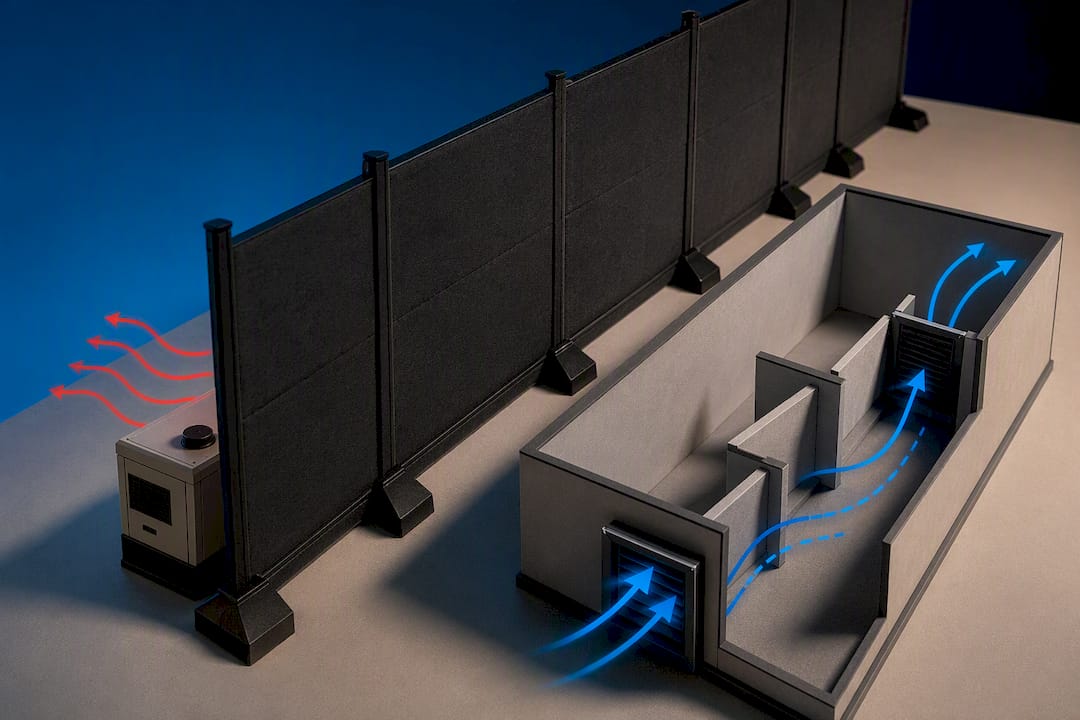
For semi-permanent or venue installations, barriers and fencing offer a cheaper middle ground. Mass and height both matter more than material choice: a barrier needs enough density to block sound rather than let it pass through, and it needs to overlap the generator’s footprint on both sides, not just stand directly in front of it, or noise simply wraps around the ends.
Follow this rough order of operations when tackling a noisy setup:
- Move the unit as far from sensitive receptors as the cable run allows.
- Reposition the exhaust away from the nearest boundary or building.
- Fit vibration isolation mounts to stop low-frequency rumble transmitting into structures.
- Add or upgrade an approved acoustic enclosure if distance and repositioning aren’t enough.
- Consider a barrier or fence section between the unit and the specific complaint direction.
- Reassess load; running a generator at 40 to 60% capacity is often noticeably quieter than running it flat out.
Vibration isolation deserves more attention than it gets. Rubber or spring mounts under the generator’s feet stop structure borne noise, the low hum that travels through a marquee frame or a building’s foundations rather than through the air. It’s a cheap fix that solves complaints traditional noise measurement sometimes misses entirely, because dB meters pick up airborne sound far more readily than the low frequency vibration a neighbour actually feels through their floor.
Pro Tip: If you’re hiring rather than buying, ask specifically for an inverter generator running at partial load for evening or overnight use. Inverter technology adjusts engine speed to match demand, so a partially loaded inverter set can run considerably quieter than a conventional generator working at the same output.
Battery and hybrid power units are worth a mention too. For quiet hours, specifically speeches, first dances, or anywhere microphones are in use, a battery bank with inverter output produces no combustion noise at all, and increasingly they’re rated to cover several hours of moderate load.
How do I choose a generator that won’t upset the neighbours?
Not all generator types are built for the same job, and picking the wrong category is the single most common mistake in noise complaints. Inverter generators, using electronic speed control, are the quietest option for loads up to a few kilowatts and are the default choice for weddings, garden parties, and anywhere close to residential boundaries. Conventional open frame generators run at a fixed engine speed regardless of load, which means constant, often intrusive noise even when barely powering anything. Enclosed diesel units sit in between: louder than an inverter set at idle, but built with acoustic canopies as standard and capable of far higher outputs for marquees, catering, and larger events.
Quoted decibel figures are where a lot of confusion creeps in. Manufacturers don’t all measure the same way. Some quote at 1 metre, others at 7 metres; some quote at partial load, others at full load, and the resulting numbers can look wildly different for genuinely similar machines. The Caravan Club’s technical guidance makes this point clearly: always ask for the measurement distance and load condition behind any dB figure, and where possible, listen to a unit running before committing to it.
Use this checklist when siting a hired or owned unit for an event:
- Position at least 10 to 15 metres from the nearest occupied building where the site allows it
- Route the exhaust away from open windows, seating areas, and neighbouring boundaries
- Check the prevailing wind direction; sound and fumes carry further downwind
- Avoid placing units against walls, fences, or hard reflective surfaces
- Keep cable runs safe and trip-free rather than compromising siting purely for cable length
On cost versus mitigation: a quieter unit costs more upfront, but it’s usually cheaper than retrofitting barriers, enclosures, and vibration mounts onto a noisy one, especially for events where you can’t guarantee ideal siting. If your venue sits close to housing, spending more on the generator itself is often the more efficient spend than layering on acoustic extras afterwards. A guide to choosing event power equipment covers how to match generator class to event size in more detail.
Does maintenance actually reduce generator noise?
Genuinely, yes, and it’s the cheapest noise reduction available to anyone already running a unit. Loose panels rattle, worn engine mounts transmit more vibration, clogged air filters make an engine work harder and louder, and a degraded exhaust system loses whatever silencing it was designed with. A basic maintenance rhythm, checking fasteners, panels, mounts, and filters on a set service interval, keeps a unit running at the noise level it was built for rather than several decibels above it.
Monitoring doesn’t need to be complicated. Spot checks with a phone based decibel meter app at the boundary line, taken at the same time each event, build a useful record over time. For fixed or frequent installations, remote generator monitoring can flag mechanical drift, the kind that quietly pushes noise output up, before a neighbour ever complains.
This is where documentation and BPM meet in practice:
- Dated service logs showing what was checked and when
- Noise readings taken at the boundary during operation
- Records of any acoustic accessories fitted and their specification
Documented, professionally serviced equipment is disproportionately persuasive to an EHO investigating a complaint. A council assessing statutory nuisance case by case is far more likely to accept BPM as a defence when there’s a paper trail behind it, not just a verbal assurance that “it’s a quiet one.” With extensive experience in electrical contracting, standby support and technical documentation exist precisely to give event organisers that kind of evidence when it’s needed.
How do you stop generator noise complaints before they start?
Prevention beats defence every time, and most of it costs nothing but a conversation. Tell neighbours in advance if you’re running a generator for an extended period, give them a rough timeframe, and mention what you’ve done to reduce noise. People are far more forgiving of disturbance they were warned about than noise that arrives unannounced.
Set voluntary operating hours even where none are legally mandated, particularly overnight. Councils commonly apply a working rule that daytime generator noise shouldn’t exceed background levels by more than 10 decibels, with expectations tightening considerably after dark. Matching that voluntarily, rather than waiting to be told, avoids most complaints outright.
If a complaint does land:
- Collect your existing logs, service records, and any noise readings immediately.
- Offer a concrete mitigation, repositioning, an added barrier, or reduced hours, rather than a vague promise.
- Contact environmental health proactively rather than waiting to be contacted.
- Respond to any formal notice within its stated timeframe and keep written evidence of your response.
Cooperation paired with solid records resolves the overwhelming majority of these situations before they reach a magistrates’ court.
How does weather affect generator noise control?
Weather changes how far generator noise actually travels, and it’s a factor people planning outdoor events consistently underestimate. Wind carries sound downwind considerably further than upwind, so a unit that seems perfectly quiet to you standing beside it can be clearly audible to a neighbour three streets away if the wind’s blowing their direction. Checking the forecast and adjusting siting accordingly, even shifting a generator a few metres to change its position relative to the prevailing wind, is a free noise control measure most people never consider.
Temperature inversions, common on still, cool evenings, trap sound closer to the ground rather than letting it disperse upward. That’s part of why generator noise often feels more intrusive at night even when the unit’s output hasn’t changed, compounding the fact that background noise itself typically drops after dark, making the same generator sound proportionally louder against a quieter backdrop.
Humidity and rain absorb high-frequency sound more than low-frequency rumble, which is why a generator can sound “duller but further reaching” in damp conditions, the sharp mechanical whine gets soaked up while the low engine drone carries on regardless. Hard, dry ground reflects sound efficiently; wet grass and soft earth absorb some of it.
None of this means weather makes noise control pointless, it means the same enclosure or barrier that works well on a still, dry afternoon may need supplementing on a windy or damp evening. Building a small margin into your siting plan, rather than assuming a fixed noise footprint regardless of conditions, is what separates a genuinely reliable setup from one that only works on good days.
What standards apply to acoustic barriers and enclosures?
There’s no single British Standard that event organisers are legally required to follow for a temporary acoustic barrier, but the engineering principles behind effective ones are well established. Mass is the dominant factor: denser materials, such as mineral wool cored acoustic panels or mass loaded vinyl barriers, block considerably more sound than lightweight materials like standard plywood or thin sheet metal, regardless of thickness.
Height and overlap matter more than most people expect. A barrier needs to exceed the line of sight between the generator and the listener, and it needs to extend well beyond the sides of the unit itself, because sound diffracts around the edges of any barrier that’s too short or too narrow. A barrier that looks adequate directly in front of a generator can be almost useless if a neighbour’s window sits at an angle where the barrier’s edge doesn’t block the path.
For enclosures specifically, manufacturers building to genuine acoustic specification design in ventilation paths that don’t compromise the noise reduction, using baffled air inlets and outlets rather than simple open vents. This is precisely why sealed DIY enclosures are actively discouraged: a genuinely effective enclosure has to manage airflow and exhaust routing as carefully as it manages sound, and getting that balance wrong creates a carbon monoxide or overheating risk rather than a quieter generator. For permanent installations, planning permission conditions often specify maximum boundary noise levels and required attenuation, which pushes the design toward professionally engineered enclosures rather than improvised ones.
What does generator noise control actually cost?
Budget for noise control roughly scales with how permanent and how sensitive the setting is. At the low end, repositioning a generator further from a boundary and adding vibration isolation mounts costs very little, sometimes nothing beyond the labour of moving the unit and a modest spend on rubber feet or anti-vibration pads.
Mid-range solutions, a proper acoustic barrier or a manufacturer supplied enclosure retrofit, represent a meaningful but proportionate spend, particularly worthwhile for venues running generators regularly rather than for a single event. Weigh this against the cost of a repeat abatement notice investigation or a soured relationship with a venue’s neighbours, and it’s usually the cheaper long-term option.
At the top end, choosing a genuinely quiet unit from the outset, an enclosed diesel set or a high-spec inverter generator built with acoustic performance as a design priority, costs more per hire or purchase than a basic open frame equivalent, but it removes the need for most of the mitigation spend that follows a noisy unit. For events near housing or in noise-sensitive venues, that upfront cost differential is frequently smaller than the combined price of barriers, enclosures, and the time spent managing complaints afterwards.
Hire costs also reflect this trade off. A quieter, better specified generator typically commands a higher hire rate, but for events where noise genuinely matters, weddings with evening speeches, venues with residential neighbours, corporate events with recorded content, that premium buys back the hassle of retrofitting noise control on site.
What does successful generator noise control look like in practice?
The pattern behind successful noise control setups is consistent: the right equipment class for the job, sensible siting decided before the event rather than adjusted afterwards, and a mitigation layer matched to the actual sensitivity of the location. A wedding marquee 20 metres from the nearest house, using an inverter generator at partial load with the exhaust routed away from the property, typically needs nothing beyond that positioning to avoid any complaint at all.
A corporate event in a tighter urban venue, running a larger enclosed diesel unit to cover catering and lighting loads, is a different case entirely. Here the combination that works is the manufacturer’s acoustic canopy as standard, a barrier section angled toward the nearest office windows, and a voluntary cutoff time agreed with the venue before doors open, none of which requires exotic equipment, just planning the mitigation stack before the unit arrives on site.
The common failure pattern is almost always the same: a generator ordered on power output alone, dropped in the most convenient spot for cable runs rather than the quietest available spot, and run at full capacity regardless of actual load. Reversing just those three decisions, right size unit, considered siting, appropriate load, resolves the majority of noise issues before any acoustic accessory gets involved. Enclosures, barriers, and isolation mounts are genuinely valuable, but they’re a correction for constraints you couldn’t avoid, not a substitute for getting the basic decisions right first.
Publisher perspective: what actually matters on an event day
Statutory limits matter less on a wedding day than one thing: the fifteen minutes around speeches and first dances, when even a moderately quiet generator can bleed into a recording or distract a room. That’s the moment planners underestimate, focusing on daytime dB thresholds while ignoring that a microphone picks up far more than a human ear standing at the same distance. Consider a wedding film’s audio quality something worth protecting deliberately, not an afterthought.
Professional standby support earns its cost precisely here: someone on site who can reposition a unit or switch to battery power for a sensitive thirty minutes, rather than hoping the generator behaves. For anything beyond a small private gathering, a proper site assessment before the day, not on it, is what actually prevents both noise complaints and awkward audio.
— Rob
How Jaks Party Power can help with generator noise control
Jaks Party Power is the direct route to sorting generator noise before it becomes a problem, rather than reacting to a complaint afterwards. We supply generator hire, siting advice, and acoustic mitigation as part of the same conversation, so you’re not choosing equipment first and worrying about noise second.

That means a site assessment that looks at boundary distances, prevailing wind, and neighbouring properties before anything is delivered, backed by over 40 years of electrical contracting experience and standby support during the event itself if you need someone on hand to adjust or reposition equipment on the day. Whether you’re planning a private wedding marquee or a larger corporate event with sensitive audio requirements, that combination of the right unit, correct siting, and someone accountable on site solves more noise problems than any single accessory ever will. If you’re weighing up equipment for an upcoming event, hire a generator through us and ask for a site assessment as part of the quote.
Sources
- Environmental Protection Act 1990, section 80
- Gov
- How to make a generator quieter: safe noise-reduction methods – Oupes
- Portable mains generators – The Caravan Club
FAQ
Is there a way to reduce generator noise?
Yes. The most effective combination is siting the unit as far from sensitive receptors as practical, fitting a manufacturer approved acoustic enclosure or barrier, adding vibration isolation mounts, and keeping the unit well maintained so it runs at its designed noise level rather than above it.
What is the noise level restriction for a generator in the UK?
There’s no single fixed decibel limit; instead, noise is assessed as a potential statutory nuisance under the Environmental Protection Act 1990. Councils commonly use a working guide that daytime generator noise shouldn’t exceed background levels by more than 10 decibels, with stricter expectations overnight.
Can you complain about generator noise?
Yes, residents can report generator noise to their local council’s environmental health team, who will assess whether it constitutes a statutory nuisance based on timing, duration, and the character of the area.
Is it legal to run a generator at night in the UK?
There’s no blanket ban on overnight generator use, but night-time noise is judged more strictly than daytime noise under statutory nuisance law, and running a generator late without mitigation significantly raises the risk of a complaint and possible abatement notice. Voluntary quiet hours and battery alternatives for overnight periods are the safest approach for events near housing.