
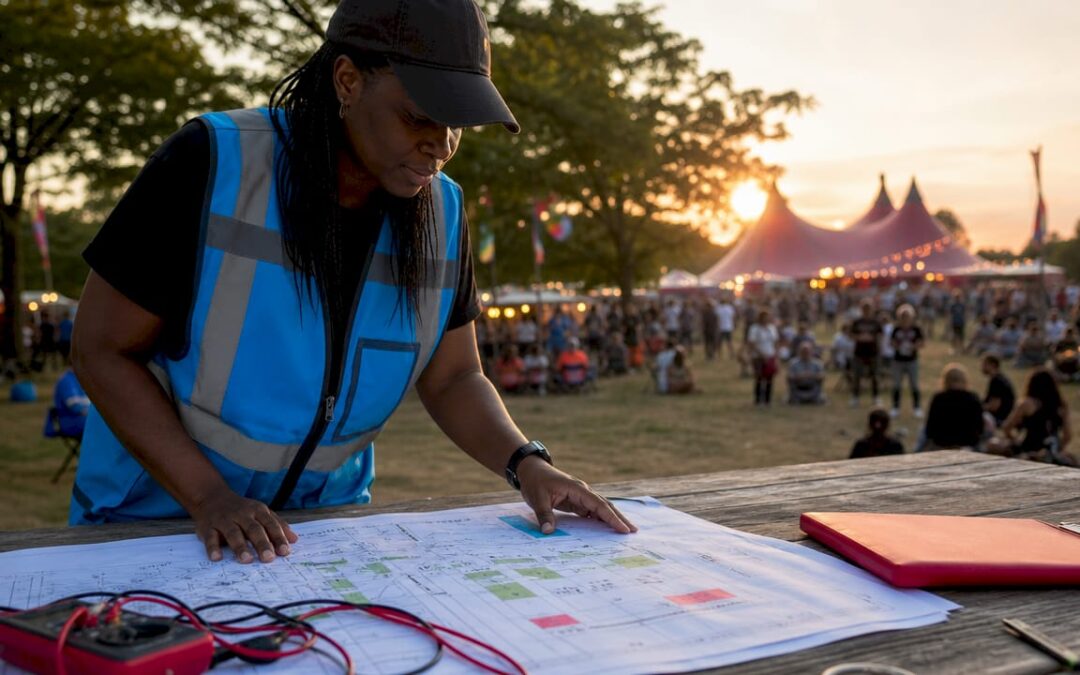
Outdoor festival power setup refers to the complete process of planning, installing, and managing a safe electrical supply system for open-air events. Getting it wrong carries real consequences. Standard 15-amp residential outlets deliver only around 1,800 watts continuously, far short of the 5,000–12,000 watts a professional production demands. A proper outdoor power setup covers load calculation, generator sizing, distribution panels, IP-rated cabling, and RCD protection. Miss any one of these elements and you risk tripped breakers, damaged equipment, or a safety incident that shuts down your event entirely.
How to calculate power requirements for outdoor festivals
Accurate load calculation is the foundation of every outdoor festival power setup. The process starts with listing every piece of electrical equipment on site: PA systems, stage lighting rigs, LED walls, vendor stalls, catering units, and production offices. Each item has a wattage rating. Add them all together to get your total running load.
Running load is not the same as peak demand. Motors in refrigeration units, air conditioning, and some lighting dimmers draw two to three times their rated wattage for a fraction of a second on start-up. These motor-start surge currents must be factored in, or your generator will trip the moment a vendor switches on a chest freezer.
Once you have your total running load, apply the standard safety margin. Event planners must add a 20–25% safety margin to generator capacity to avoid overheating and tripped breakers. In practice, a 30,000W load requires a 37,500W generator capacity. That buffer also gives you headroom if a late addition to the programme brings extra equipment on site.
Common load categories and typical draws:
- Small PA system (up to 500 attendees): 3,000–5,000W
- Mid-scale stage lighting rig: 4,000–8,000W
- LED video wall (per square metre): 150–300W
- Catering trailer: 3,000–6,000W
- Production office and comms: 1,000–2,000W
DIY festival power setups fail around 15% of the time due to poor planning, particularly ignoring motor-start surge currents and confusing standby generator ratings with prime ratings. Standby ratings apply to emergency use only. Prime ratings reflect continuous operation, which is what every festival requires.
Pro Tip: Always request prime-rated generator specifications from your hire supplier, not standby ratings. The difference in usable capacity can be significant, and mixing them up is one of the most common causes of on-site power failure.
How should you position and size festival generators?
Generator sizing goes beyond matching your calculated load. Generators must run at no more than 80% of their rated capacity continuously. Running a unit at full load accelerates wear, raises operating temperature, and increases the risk of shutdown during peak demand.
Positioning matters as much as sizing. Generators must be placed 75–100 feet from the stage and front-of-house position to prevent acoustic bleed into the mix. A diesel generator running at load produces 70–85 decibels at one metre. At 30 feet from an open-air stage, that noise becomes audible to the audience and bleeds into microphones.
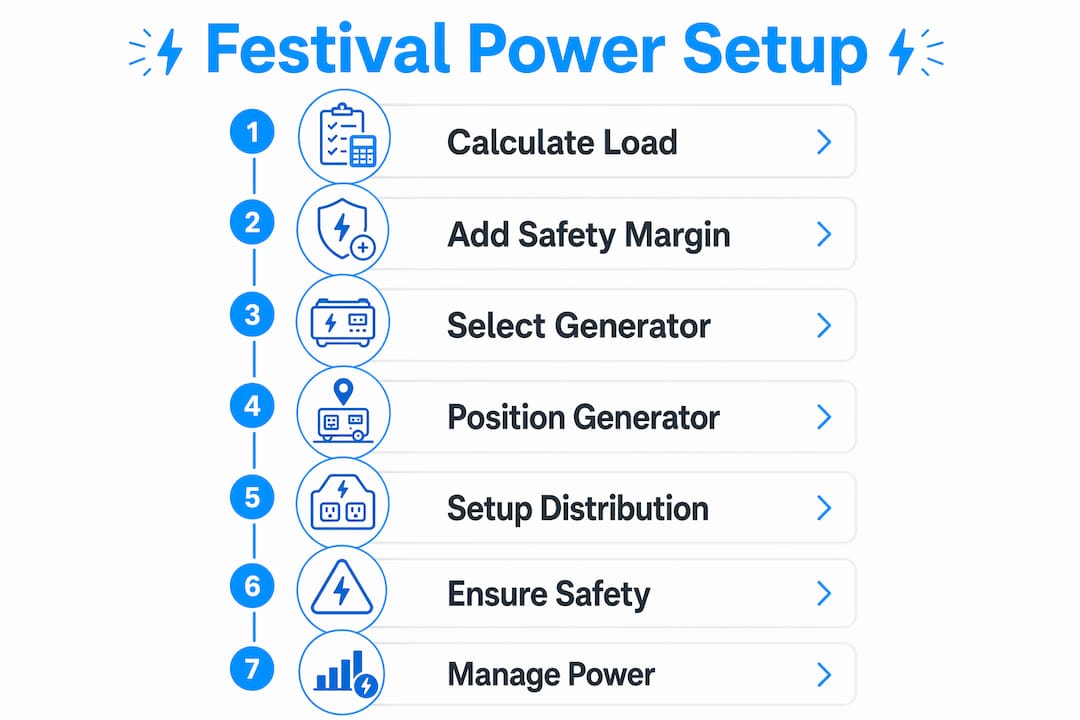
For generator selection, follow these steps:
- Calculate your prime-rated load including all surge allowances and the 20–25% safety margin.
- Choose an inverter generator for any circuit supplying sensitive audio or lighting control equipment. Inverter generators provide a clean sine wave output, reducing electrical noise and protecting devices.
- Position the primary generator upwind and downwind of the audience area to disperse exhaust fumes safely.
- Install a backup generator within 50 feet of the primary unit. Manual transfer switches allow backup units online in under two minutes, limiting the impact of any primary failure.
- Plan fuel logistics for multi-day events. A 20kVA generator running at 60% load consumes roughly 4–6 litres of diesel per hour.
Pro Tip: For outdoor cinema party power setups and smaller festival stages, a single inverter generator in the 6–10kVA range often covers audio, projection, and ambient lighting cleanly, without the noise and fuel demands of a larger diesel unit.
What are the best practices for power distribution and safety?
Power distribution is where most organisers make expensive mistakes. A distribution panel, commonly called a distro, takes the generator output and splits it into multiple protected circuits. Each circuit feeds a specific zone: stage, front-of-house, catering, lighting, and so on. This separation means a fault in the catering area cannot kill the stage power.
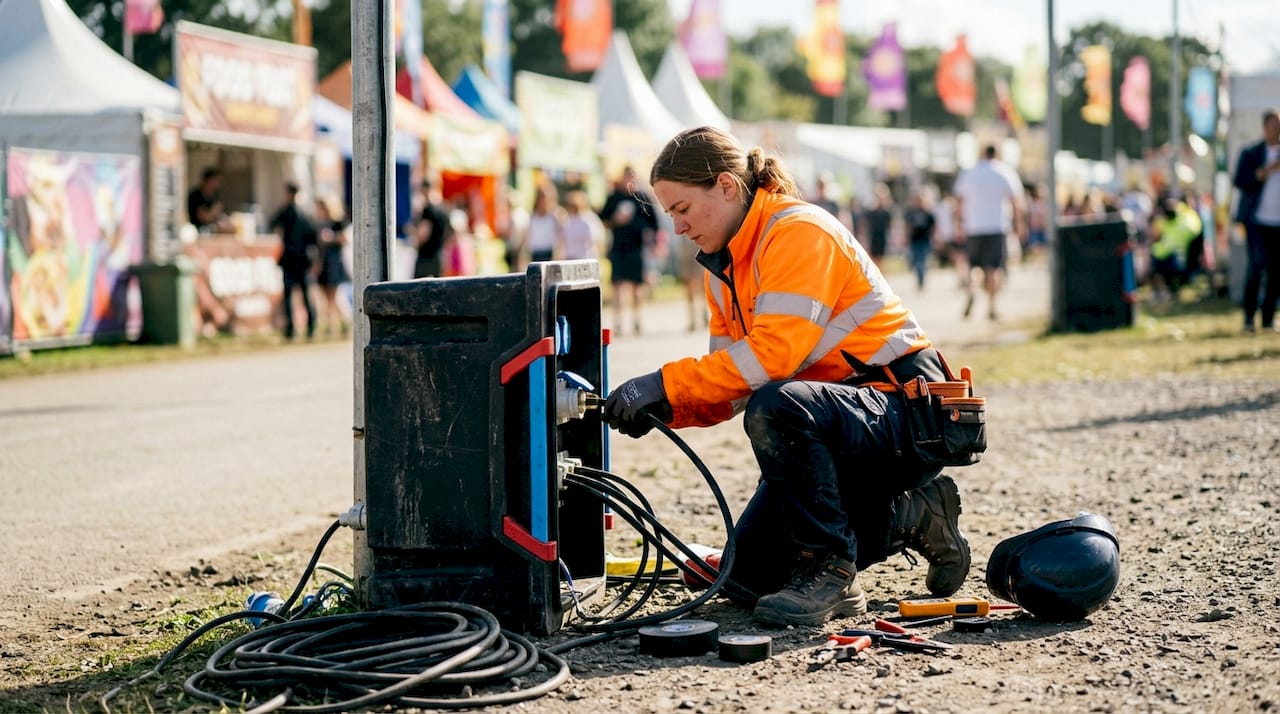
UK and international standards require all temporary outdoor electrical circuits to have minimum 30mA RCD protection and use industrial-grade, IP-rated cabling. The maximum permitted voltage drop is 5% of nominal supply voltage. Long cable runs reduce voltage, which causes equipment to draw more current, run hot, and potentially fail. Keep cable runs as short as practical, and size cables correctly for the load and distance.
| Distribution approach | Risk level | Recommended use |
|---|---|---|
| Feeder cables from generator to distro panels | Low | All professional festival setups |
| Extension cords daisy-chained between zones | High | Never acceptable for event use |
| Single distro serving entire site | Medium | Small events under 5kVA only |
| Zone distros with individual RCD protection | Low | Standard for mid to large festivals |
Daisy-chaining multiple extension cords leads to voltage drops, ground loops, and fire hazards. The correct approach uses feeder cables running directly from the generator to distribution units positioned in each zone. From those distros, shorter, correctly rated cables serve individual equipment.
Pro Tip: Label every circuit breaker on every distro before the event. During a live show, a tripped breaker in an unlabelled panel costs minutes of stage blackout while someone traces the fault. Colour-coded cable ties and a printed site plan solve this instantly.
All IP-rated cabling for outdoor use must be rated IP44 as a minimum, with IP65 preferred for ground-level runs in wet conditions. Never use domestic extension leads outdoors at events.
How does poor power management affect audio-visual quality?
Electrical noise is the invisible enemy of live event production. It enters audio circuits as a 50Hz hum or high-frequency buzz, audible through PA speakers and in-ear monitors. The source is almost always shared grounding between audio and lighting circuits, or dirty power from a non-inverter generator.
Isolation of audio and lighting circuits prevents electrical noise, a frequent problem that reduces sound quality at festivals. The solution is to feed audio and lighting from separate generator outputs or separate distro circuits with individual earth paths. This single step eliminates the majority of ground-loop hum complaints.
Key practices for audio-visual power separation:
- Dedicate a separate circuit to the mixing desk, amplifier racks, and stage boxes. Never share this circuit with dimmers or moving lights.
- Use an inverter generator or a power conditioner for all audio equipment. Dirty power from standard generators damages sensitive equipment and introduces noise into the signal chain.
- Consider wireless DMX transmitters for lighting control. They eliminate long DMX cable runs, which can pick up interference from power cables running in parallel.
- Keep audio and power cables separated by at least 300mm where they must run in the same direction, and cross them at 90 degrees where they intersect.
For lighting control systems specifically, voltage fluctuations cause flickering, unexpected colour shifts, and controller resets. A stable, isolated supply is not optional for professional results.
| Equipment type | Recommended supply | Isolation required |
|---|---|---|
| PA amplifiers and mixing desk | Inverter generator or conditioned circuit | Yes, dedicated earth |
| Moving lights and dimmers | Separate distro circuit | Yes, isolated from audio |
| LED video walls | Stable generator output | Recommended |
| Catering and general power | Standard generator output | No |
Key takeaways
A reliable outdoor festival power setup requires accurate load calculation with a 20–25% safety margin, prime-rated generators, IP-rated distribution, 30mA RCD protection on every circuit, and full electrical isolation between audio and lighting supplies.
| Point | Details |
|---|---|
| Apply the safety margin | Add 20–25% to your total calculated load before sizing any generator. |
| Use prime ratings only | Always specify prime-rated generator capacity, not standby, for continuous event use. |
| Protect every circuit with RCDs | UK standards require 30mA RCD protection on all temporary outdoor electrical circuits. |
| Separate audio and lighting supplies | Shared circuits cause ground-loop hum; dedicated feeds eliminate the problem. |
| Never daisy-chain extension cords | Use feeder cables to zone distros to maintain voltage stability and prevent fire hazards. |
What I have learned from years of festival power planning
After working across dozens of outdoor events in Sussex and beyond, the single biggest mistake I see is treating power as an afterthought. Organisers finalise the stage, the artists, and the catering, then ask about generators two weeks before the event. By that point, the site layout is fixed, and the cable runs are twice as long as they need to be.
The second mistake is underestimating the value of a dedicated power manager on site. A dedicated power manager role is critical for monitoring fuel, load distribution, and generator health, particularly overnight at multi-day festivals. Without one, a generator running low on fuel at 2 AM becomes a crisis rather than a routine refuel.
The pre-event site survey is where the real work happens. A CAD layout of the site, showing generator positions, cable routes, distro locations, and load zones, prevents the majority of on-site problems. Production teams and electrical teams need to be in the same room during that planning stage. When they are not, you get audio cables running parallel to power feeds, generators positioned where they cannot be accessed for refuelling, and distros placed in areas that flood when it rains.
My honest advice: budget for professional electrical planning from the start. The cost of getting it right is a fraction of the cost of a generator failure mid-show, a damaged mixing desk, or a safety incident that ends the event early.
— Rob
Jakspartypower: festival power hire in Sussex
Jakspartypower has supported outdoor events across Sussex for over 40 years, combining electrical contracting expertise with a full range of hire equipment. Whether you need a compact 6kVA generator for a small outdoor cinema party power setup or a 60kVA package for a large festival stage, the hire range covers the full spectrum of outdoor party power requirements.

The team assists with electrical layouts, compliance checks, and on-site standby support, so your power infrastructure meets 2026 RCD and IP-rating standards from the outset. Browse the full generator hire range or view complete hire packages to find the right solution for your event.
FAQ
What size generator do I need for an outdoor festival?
Calculate your total running load, add 20–25% as a safety margin, then select a prime-rated generator at no more than 80% of its rated capacity. A 30,000W load requires at least a 37,500W prime-rated unit.
What does RCD protection mean for outdoor events?
An RCD (residual current device) cuts power within milliseconds if a fault is detected, protecting people from electric shock. UK standards require 30mA RCD protection on all temporary outdoor electrical circuits.
Why does my festival PA system hum through the speakers?
Electrical hum is almost always caused by a shared earth between audio and lighting circuits, or dirty power from a non-inverter generator. Isolating audio onto a dedicated circuit with its own earth path resolves the issue.
How far should a generator be from the stage?
Position generators at least 75–100 feet from the stage and front-of-house mixing position to prevent generator noise from bleeding into the sound system and audience area.
What is the difference between standby and prime generator ratings?
Standby ratings apply to emergency backup use only, typically a few hours per year. Prime ratings reflect continuous full-load operation, which is the correct specification for any festival or event application.