
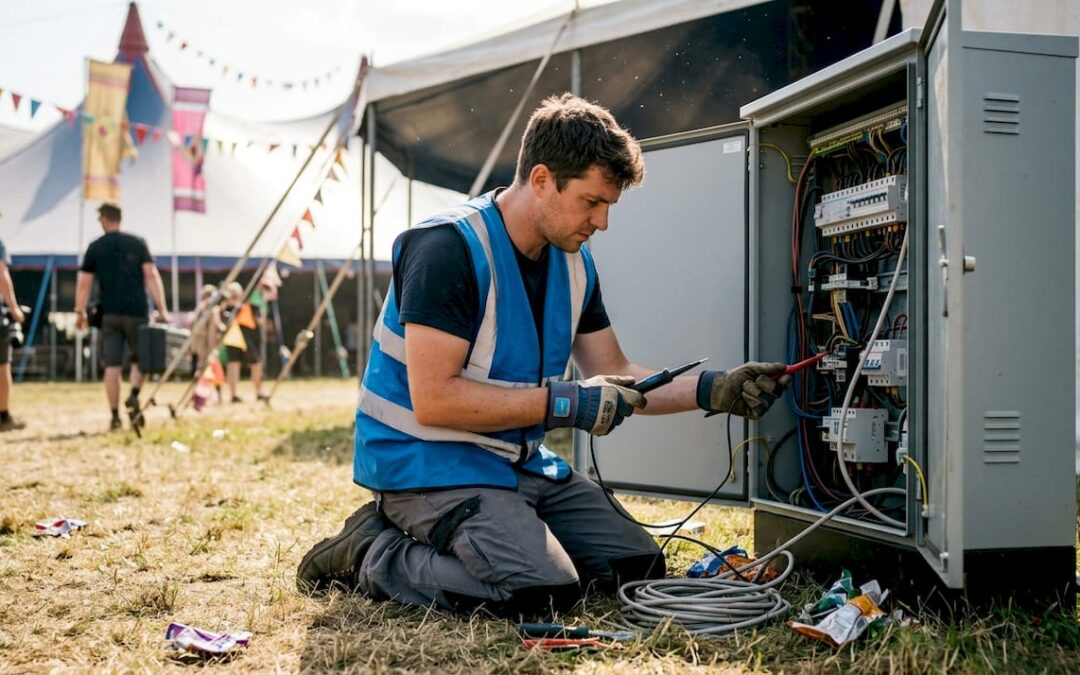
Distribution boards are devices that divide a single electrical supply into multiple protected circuits, and their role at large events is to keep every zone powered safely and independently. Without them, a single fault in the lighting rig could kill sound across the entire site. For event planners, understanding how electrical distribution works is not optional. It directly affects safety, compliance, and the smooth running of the show. Standards such as BS 7909:2023+A1:2024 and the Electricity at Work Regulations 1989 make this a legal matter, not just a technical one. Jakspartypower has spent over 40 years working in this space, and the lessons from that experience shape everything in this guide.
What role do distribution boards play at large events?
Distribution boards, known in the industry as “distros,” are the central nervous system of any large event’s electrical setup. They take a high-capacity incoming supply, whether from a generator or a mains connection, and split it into subsidiary circuits. Each circuit feeds a specific zone or piece of equipment, and each carries its own protection device.
The importance of distribution boards lies in fault isolation. Individual circuit breakers prevent a localised fault from triggering a total system failure. That means a tripped breaker at the bar area does not plunge the main stage into darkness. This separation is what keeps an event running when something goes wrong, and something always does.
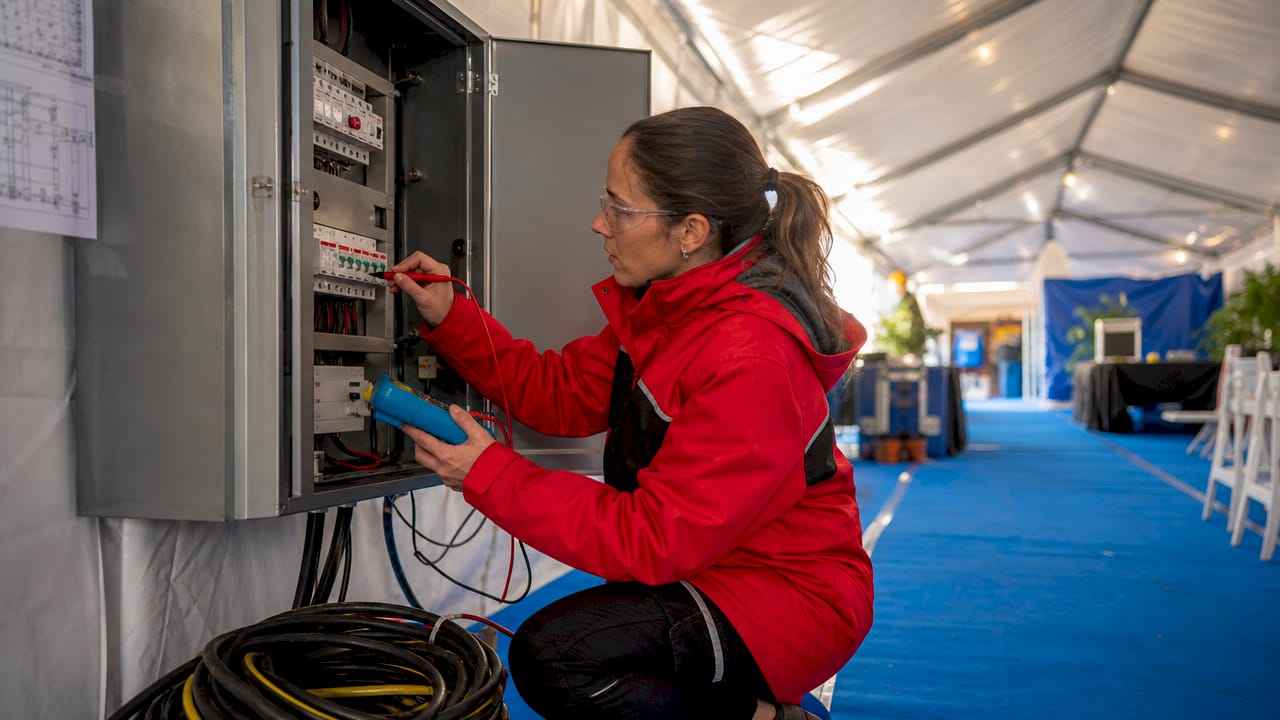
Distribution boards also protect sensitive equipment. Audio amplifiers, LED lighting controllers, and video walls are all vulnerable to voltage spikes and dirty power. A properly designed distro filters and separates these loads, reducing the risk of equipment damage and the costly downtime that follows.
What technical functions do distribution boards perform?
Circuit division and load management
A distribution board receives power at its incoming terminals and routes it through a series of outgoing ways. Each way is a separate circuit with its own rated breaker. At a large festival, a single main distro might feed a dozen sub-distros, each serving a different area of the site.
Load management is the discipline of balancing current draw across phases and circuits. Three-phase supplies, which are standard for events above a modest scale, allow loads to be spread across three 230V legs. Unbalanced phases cause inefficiency and can damage equipment, so a competent electrical designer will calculate and assign loads carefully before the event begins.
RCD protection and fault isolation
All outdoor event circuits must be protected by 30mA residual current devices (RCDs), tested before every event. An RCD detects the difference between current flowing out and current returning. If that difference exceeds 30 milliamps, it trips within milliseconds, cutting power before a person receives a lethal shock.
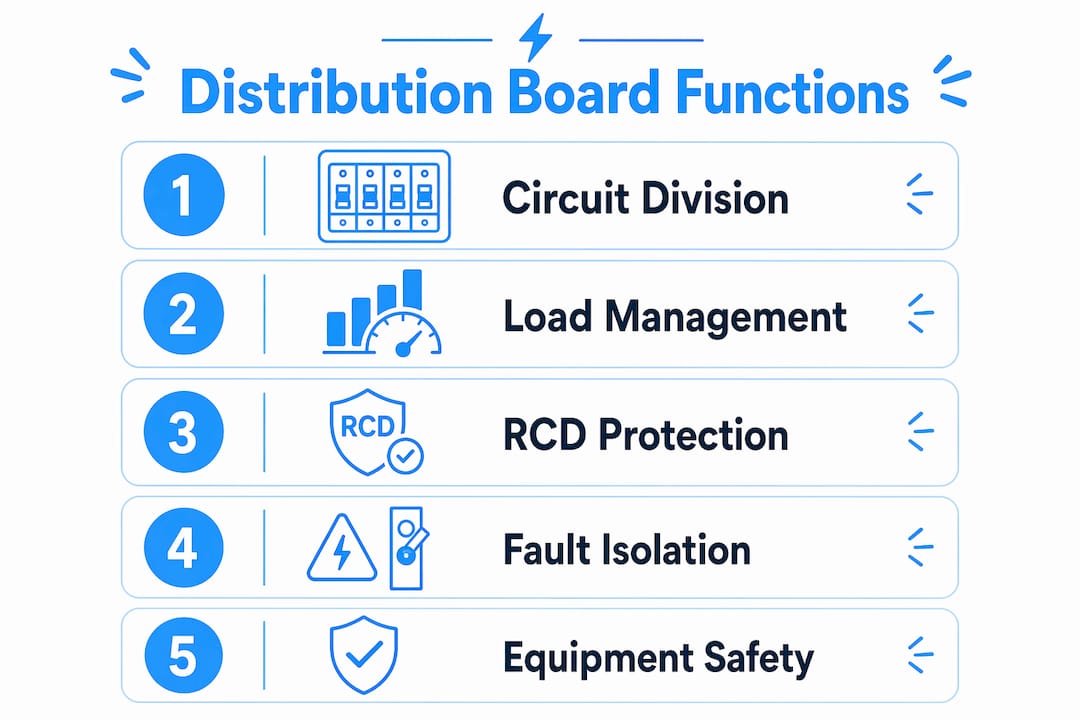
Critical circuits must be split so no single fault trips power to the whole event. This is not a recommendation. It is a requirement under the NADJ Power Planner guidance and consistent with BS 7909. A well-designed distro system uses separate RCDs for separate zones, so a fault in the catering area does not affect the stage.
Pro Tip: Always request a pre-event RCD test log from your electrical contractor. If they cannot produce one, the system has not been properly commissioned.
Single-phase versus three-phase configurations
Small events, such as private weddings or networking functions, often run on single-phase supplies at 230V. Larger events, including outdoor festivals and arena shows, require three-phase supplies at 400V. The distribution board configuration changes accordingly. Three-phase distros use a four-pole main switch and separate breakers for each phase, giving far greater capacity and flexibility.
How do UK regulations affect distribution board use at events?
BS 7909 and the duty to use competent persons
BS 7909:2023+A1:2024 is the UK code of practice for temporary electrical systems at entertainment events. It mandates that all such systems are designed, installed, verified, and signed off by competent persons. Formal handover records are not optional. They are a condition of compliance.
The Production Services Association (PSA) and the National Association of DJs (NADJ) both reference this standard in their guidance. Event planners who hire unqualified electricians or skip the sign-off process expose themselves to criminal liability under the Health and Safety at Work Act 1974.
Electricity at Work Regulations 1989
The Electricity at Work Regulations 1989 apply fully to temporary power installations. Treating a temporary setup as a “quick fix” outside normal compliance rules is a dangerous and legally indefensible position. Risk assessments, inspection records, and completion certificates are all required.
The key compliance duties for event planners include:
- Appointing a competent person to design and install the electrical system
- Obtaining a written scheme of work before installation begins
- Commissioning a formal inspection and test of all distribution boards and circuits
- Receiving a completion certificate before the event opens to the public
- Retaining all documentation for audit and insurance purposes
Voltage drop and RCD limits
BS 7909 sets limits on voltage drop across temporary systems. Excessive voltage drop causes equipment to underperform or fail. Distribution boards must be positioned close enough to their loads to keep cable runs within acceptable limits. This is one reason why large events use multiple sub-distros rather than running long cables from a single central board.
For event power risk management, the combination of RCD protection, correct cable sizing, and proper documentation forms the minimum acceptable standard.
What practical considerations matter when setting up distribution boards?
Zonal power distribution
The most effective approach to electrical distribution for large events is zoning. Each functional area of the site, such as the main stage, front of house (FOH), backstage, hospitality, and catering, receives its own dedicated distribution board. Zoned power management allows individual circuit control, prevents whole-site blackouts, and makes fault location far faster.
Zoning also simplifies load calculations. When each zone has its own distro, the electrical designer can calculate the peak demand for that zone independently and size the supply accordingly. This is far more accurate than estimating a single combined load for the entire site.
For outdoor festival setups, zoning is standard practice. The same principle applies to large indoor events, where different rooms or functions require separate, controllable power supplies.
IP ratings and outdoor equipment
All outdoor electrical equipment must carry an appropriate IP rating to prevent moisture ingress. Distribution boards used outdoors require a minimum of IP44, which protects against splashing water from any direction. Equipment used in exposed locations, such as fields or open-air stages, should carry IP65 or higher.
IP ratings are not a formality. A distribution board that ingresses water during a rain shower can cause a ground fault, trip the RCD, and cut power to an entire zone mid-show.
Cable management and overheating
- Fully uncoil all extension cables and feeder cables before connecting them. Coiled cables act as inductors and generate heat. A 32A cable left coiled can overheat at a fraction of its rated load.
- Use the correct cable cross-section for the load and run length. Undersized cables cause voltage drop and overheating. Your electrical contractor should specify cable sizes in the scheme of work.
- Protect all cables crossing pedestrian or vehicle routes. Cable ramps and conduit prevent physical damage and reduce trip hazards.
- Label every circuit at the distribution board. Clear labelling makes fault finding faster and reduces the risk of accidental disconnection during the event.
- Keep cable connections off the ground where possible. Raised connections reduce the risk of water ingress at connectors.
Pro Tip: Hire cables from a specialist supplier who tests and certifies them before each use. Uncertified cables are one of the most common causes of electrical failures at events.
What types of distribution boards are used at different event scales?
Small and portable units
Final distribution units are compact, portable boards that sit at the end of a distribution chain. They typically offer 16A or 32A sockets in single-phase configuration. These units suit small events, weddings, and hospitality areas where loads are modest. A wedding reception might use two or three of these units to power lighting, a PA system, and catering equipment.
16A splitters and similar accessories extend the reach of these units without requiring additional distro boards. They are a practical solution for areas where only a few circuits are needed.
Medium-capacity three-phase distros
For events with significant lighting rigs, multiple sound systems, or large catering operations, 63 amp three-phase distribution boards provide the capacity and flexibility required. These units accept a three-phase input and distribute it across multiple outgoing ways, each with individual protection.
125 amp three-phase units step up again for larger stages and main power distribution points. At this scale, the distro becomes a sub-main board, feeding smaller distros further down the chain.
Intake Switch Units for large-scale events
Very large distribution boards exceeding 500A are classified as Intake Switch Units under BS 7909. These are metal-enclosed, frame-mounted units that require crane or forklift movement. They connect directly to generator outputs or mains supplies and provide primary circuit protection for the entire site.
Intake Switch Units handle multiple inputs simultaneously, such as two or three generators running in parallel. They are the top of the distribution hierarchy at major festivals and arena events.
Separated distros for audio, lighting, and video
Production teams use separate distro boxes for audio, lighting, and video systems. Electrical isolation between these systems prevents ground-loop interference in audio, reduces hum, and stops a fault in one system from cascading into another. This separation is standard practice at professional events and should be specified in the scheme of work.
Key takeaways
Distribution boards are the foundation of safe event power. Without correctly specified, installed, and certified distros, no large event can meet its legal obligations or protect its audience.
| Point | Details |
|---|---|
| Fault isolation is the core function | Individual circuit breakers and RCDs stop a localised fault from shutting down the whole event. |
| BS 7909 compliance is mandatory | All temporary systems must be designed, installed, and signed off by a competent person with formal documentation. |
| Zoning prevents site-wide failures | Separate distros for each event zone allow independent control and faster fault finding. |
| IP ratings protect outdoor equipment | Outdoor distribution boards need at least IP44; exposed locations require IP65 or higher. |
| Generator sizing must account for surges | Size generator capacity at double the peak load to handle motor starts and harmonic distortion. |
What I have learned from 40 years of event power
The single biggest mistake I see event planners make is treating the electrical system as an afterthought. They finalise the stage layout, the catering plan, and the entertainment schedule, and then ask about power in the final week. By that point, the options are limited and the costs are higher.
The second mistake is underestimating complexity. A wedding with a marquee, a band, catering, and decorative lighting can easily require a three-phase supply, two or three sub-distros, and a generator sized at double the apparent load. Planners who assume a single 32A socket will cover it are setting themselves up for a very bad evening.
What actually works is early collaboration with a qualified electrical contractor. Bring them in at the design stage, share your site plan and equipment list, and let them produce a proper scheme of work. The role of electrical contractors at events goes well beyond plugging things in. They are responsible for a system that, if it fails, can injure people or end your event.
Compliance is not a box-ticking exercise. The documentation required under BS 7909 and the Electricity at Work Regulations 1989 exists because temporary electrical systems kill people when they are done badly. The planners who treat safety as a genuine priority, rather than a legal formality, are the ones whose events run without incident.
— Rob
How Jakspartypower supports your event power needs
Jakspartypower has supplied distribution boards, generators, and cabling to events across Sussex for over 40 years. Whether you are planning a wedding in a marquee or a large outdoor festival, the team can specify and supply the right distro configuration for your load requirements.

From portable final distribution units to three-phase boards and full generator hire, Jakspartypower provides equipment that meets BS 7909 requirements and arrives tested and certified. The standby service means a qualified engineer is on site throughout your event, ready to respond if anything needs attention. For planners who want a single point of contact for all event power needs, the benefits of hiring event generators through a specialist supplier are considerable. Get in touch with Jakspartypower to discuss your event’s requirements.
FAQ
What is a distribution board in an event context?
A distribution board is a device that splits a single electrical supply into multiple protected circuits, each serving a different zone or piece of equipment at an event. It contains circuit breakers and RCDs to isolate faults and protect both people and equipment.
Are distribution boards legally required at large events?
BS 7909:2023+A1:2024 and the Electricity at Work Regulations 1989 require all temporary electrical systems at entertainment events to be designed, installed, and certified by a competent person. Distribution boards are a core component of any compliant temporary power system.
What RCD rating is required for outdoor event circuits?
All outdoor event circuits must be protected by 30mA RCDs, which must be tested before every event. This requirement appears in NADJ Power Planner guidance and is consistent with BS 7909.
How do I size a generator to work with my distribution boards?
Generator capacity should be at least double the peak load to accommodate power factor losses, harmonic distortion, and motor start surges. Your electrical contractor should calculate the total connected load and apply this sizing rule in the scheme of work.
Can I use the same distribution board for audio and lighting?
Separating audio, lighting, and video onto dedicated distro boards is strongly recommended. Shared supplies introduce ground-loop interference into audio systems and mean a fault in one system can affect all others. Electrical isolation between sub-systems is standard practice at professional events.