

Any generator-hire agreement worth signing must specify the equipment by make, model, serial number and kVA rating; fix precise delivery and collection windows; define SLA response times for breakdown; state exactly when risk passes; and name a Senior Person Responsible (SPR) under BS 7909. Get those six things in writing before you sign anything else.
Non-negotiables before you sign:
- Full equipment specification including ancillary kit (distribution boards, cabling, fuel tanks)
- Delivery, commissioning and collection windows with named responsibility for delays
- Breakdown SLA with defined response times and liquidated damages for missed windows
- Pass-of-risk clause triggered by a signed BS 7909 completion certificate
- Proof of public liability and employer’s liability insurance sighted before delivery
- Named SPR with listed competencies
For UK venue operators who want a vetted partner rather than a procurement exercise, Jakspartypower (Jaks Party Power Limited) covers all of the above as standard, backed by decades of electrical contracting experience in Sussex.
Table of Contents
- What are the essential contract clauses for generator hire?
- How do you negotiate liability, indemnities and pass-of-risk?
- What site safety and placement rules belong in the contract?
- What SLA terms should you demand from a generator supplier?
- How are generator hire prices and payment terms usually structured?
- Procurement checklist and sample contract clauses
- Jakspartypower: generator hire with contracts built in
- Key takeaways
- What venue operators often get wrong about generator contracts
- Useful sources and further reading
- FAQ
What are the essential contract clauses for generator hire?
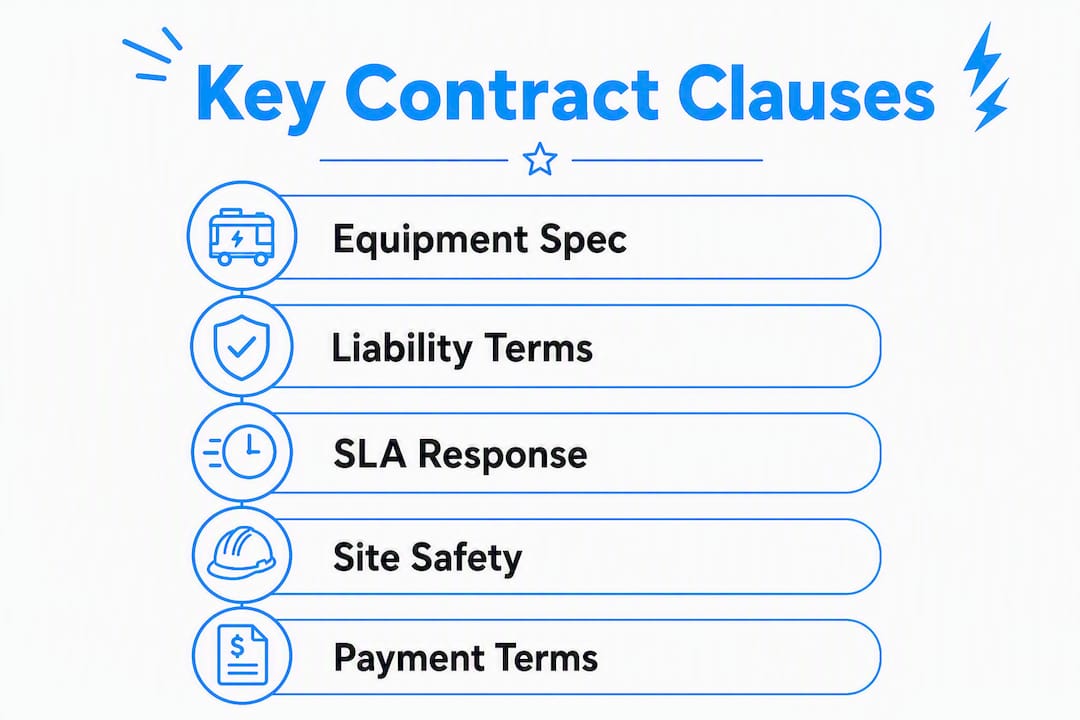
Equipment hire agreements must define the equipment clearly, allocate responsibility precisely, and leave no grey area around insurance or safety documentation. Here is what every generator service contract must contain.
- Equipment definition: make, model, serial number, kVA rating, and all ancillary kit (distribution boards, cabling, RCD protection, fuel tanks). Vague descriptions like “60 kVA diesel generator” are not sufficient.
- Hire period: exact delivery date and time, commissioning window, demobilisation start and collection deadline. State who pays for late collection or early return.
- Scope of supply: confirm in writing whether delivery, installation, earthing, testing, fuel supply and refuelling are included or excluded. Silence on any of these creates disputes.
- Maintenance and SLA: routine checks, breakdown response times, on-site standby scope, escalation procedure, and penalties for missed SLA windows.
- Pass-of-risk: the moment liability for loss or damage transfers from supplier to hirer must be tied to a physical handover event, not a calendar date.
- Insurance: minimum public liability, employer’s liability and motor/fuel cover; certificates must be sighted before the generator leaves the supplier’s yard.
- Termination and extension: notice periods, cancellation fees scaled to proximity of the event date, and written extension terms for prolonged events.
- Force majeure and liability caps: reasonable caps tied to contract value, carve-outs for wilful misconduct, and clarity on third-party delays.
- Environmental compliance: fuel disposal method, noise limits, emissions standards, and any local authority permit requirements.
Pro Tip: Ask the supplier to attach the equipment serial numbers and kVA ratings as a numbered schedule to the contract. If the unit delivered does not match the schedule, you have a clear contractual remedy without any argument about what was agreed.
How do you negotiate liability, indemnities and pass-of-risk?
Supplier-drafted contracts routinely favour the supplier on risk. Venue operators must push back on three specific areas.
- Liability cap: start from a cap equal to the total contract value. Suppliers will often accept a modest multiple (1.5x–2x) for consequential losses tied to their negligence. Resist any clause that removes the cap entirely for third-party claims.
- Indemnities: ask the supplier to indemnify you for their own negligence and wilful misconduct. Resist open-ended indemnities that expose the venue to third-party claims without a defined ceiling.
- Pass-of-risk language: require physical handover wording. Risk should transfer only when the SPR signs a completion certificate per BS 7909, not on delivery of the unit to site. A generator sitting unconnected in a car park is still the supplier’s risk.
- Insurance warranty: require a contractual warranty that cover remains in force for the full hire period, not just at the point of signing.
- SLA trade-off: a tighter response window (on-site within one hour rather than four) is worth a modest fee increase. Defined response times and remedies reduce on-the-day disputes far more than a theoretical uptime percentage ever will.
Pro Tip: Never accept a clause that makes the venue responsible for third-party losses arising from the supplier’s equipment failure. If the supplier resists removing it, ask them to cap the indemnity at their insured limit and confirm that limit in writing.
What site safety and placement rules belong in the contract?
HSE guidance is clear: generator placement and refuelling are core safety issues, not operational afterthoughts. The contract must address both.
- Placement: generators must be segregated from public areas, adequately ventilated, clearly signed with danger notices, and accessible to emergency services. Fenced or boarded enclosures are required where public proximity is unavoidable.
- Earthing and protection: BS 7909 requires earthing configuration (TN-S or IT) and RCD protection to be documented on a single-line diagram and tested before energisation. Require this documentation as a contract deliverable.
- Refuelling: state who supplies fuel, who is responsible for refuelling, bunded storage requirements, and waste fuel disposal. Refuelling routes and logistics must appear in the RAMS, not be left as an on-the-day decision.
- Permits: require the supplier to cooperate with local authority permit applications, connection agreements and permit-to-work processes. Parallel connection to public supply requires written agreement from the electricity supplier.
- SPR appointment: the contract must name the SPR, list their competencies and certificates, and confirm their presence on site during energisation and public access. Local authorities often require SPR details before issuing event licences.
- Safety documentation: RAMS, PAT records, test results and a completion certificate must be delivered before public access is permitted.
Pro Tip: A professional site survey comparing total kVA demand against available supply should happen before the contract is finalised, not after. Permanent venue power frequently lacks capacity or correct RCD protection for large event loads.
What SLA terms should you demand from a generator supplier?
Unclear role allocation is the most common cause of on-the-day failures. Naming the SPR in the contract and tying SLA remedies to defined response windows removes most of that ambiguity.
| Response band | Trigger | Remedy |
|---|---|---|
| On-site within 1 hour | Complete power loss | Replacement unit or liquidated damages |
| On-site within 2–4 hours | Partial failure or fault | Credit against hire fee |
| Next business day | Non-critical fault | Written resolution plan |
Beyond the table, the contract should also specify:
- Staffing levels for on-site standby: who is present, what they are authorised to fix, and when they escalate to a senior engineer.
- Fuel top-up intervals and monitoring frequency during the event.
- A 24/7 helpline number with a guaranteed call-back window (typically 15–30 minutes).
- Mean time to repair (MTTR) target and a guaranteed spares provision for critical components.
How are generator hire prices and payment terms usually structured?
Pricing in generator rental agreements typically has five components. Know each one before you negotiate.
- Base hire fee: the daily or event rate for the generator and ancillary kit.
- Delivery and collection charges: often quoted separately; confirm whether these are fixed or distance-dependent.
- Fuel: charged on consumption (metered), pre-filled flat rate, or replenishment at market rate. Require fuel consumption records and receipts regardless of the method.
- Operator and standby staff rates: day rates and overnight rates should be capped in the contract; require written authorisation before any overtime is incurred.
- Deposit and payment milestones: a typical structure is 25–50% on booking, balance 14–28 days before the event. State the refund schedule for cancellations at each milestone and the interest rate on late payments.
For extension and delay costs, require a written day-rate cap and an advance-notice mechanism (usually 48 hours) before any extension charges apply. Verbal agreements on the day are unenforceable and expensive.
Procurement checklist and sample contract clauses
Use this checklist at the point of procurement, then attach the completed documents as contract annexes.
Procurement checklist:
- Equipment schedule confirmed (make, model, serial number, kVA, ancillary kit)
- Delivery, commissioning and collection windows agreed in writing
- Earthing configuration and single-line diagram requested
- SLA response times, remedies and liquidated damages inserted
- Insurance certificates (public liability, employer’s liability) sighted
- SPR named with competencies listed
- RAMS, PAT records and completion certificate required pre-energisation
- Permits and local authority approvals confirmed
- Fuel billing method, bunding and disposal method stated
- Termination, extension and force majeure clauses reviewed
Sample clauses (copy and adapt):
- Equipment specification: “The Supplier shall deliver the equipment specified in Schedule 1 (make, model, serial number, kVA rating and ancillary kit) to the Site by [date/time]. Any substitution requires the Hirer’s prior written consent.”
- Pass-of-risk: “Operational responsibility and risk of loss or damage shall transfer to the Hirer only upon execution of a BS 7909 completion certificate signed by the Supplier’s SPR and the Hirer’s authorised representative.”
- SLA and liquidated damages: “In the event of complete power loss, the Supplier shall attend site within one hour of notification. Failure to attend within this window entitles the Hirer to liquidated damages of [£X] per hour until attendance, up to a maximum of [£Y].”
- Insurance: “The Supplier warrants that public liability cover of not less than £[X]m and employer’s liability cover of not less than £[X]m shall remain in force for the full hire period. Certificates shall be provided no later than [X] days before delivery.”
- Force majeure: “Neither party shall be liable for delay or failure caused by events beyond reasonable control, provided the affected party notifies the other within 24 hours of the triggering event and takes reasonable steps to mitigate.”
Attach insurance certificates, PAT records and the completion certificate as numbered annexes referenced in the main contract body.
Jakspartypower: generator hire with contracts built in
Venue operators who want the contract elements above delivered as standard, not negotiated clause by clause, will find Jakspartypower a practical fit. The team brings 40+ years of electrical contracting experience to every booking, covering generator hire, distribution boards, cabling, fuel management and on-site standby support across Sussex.

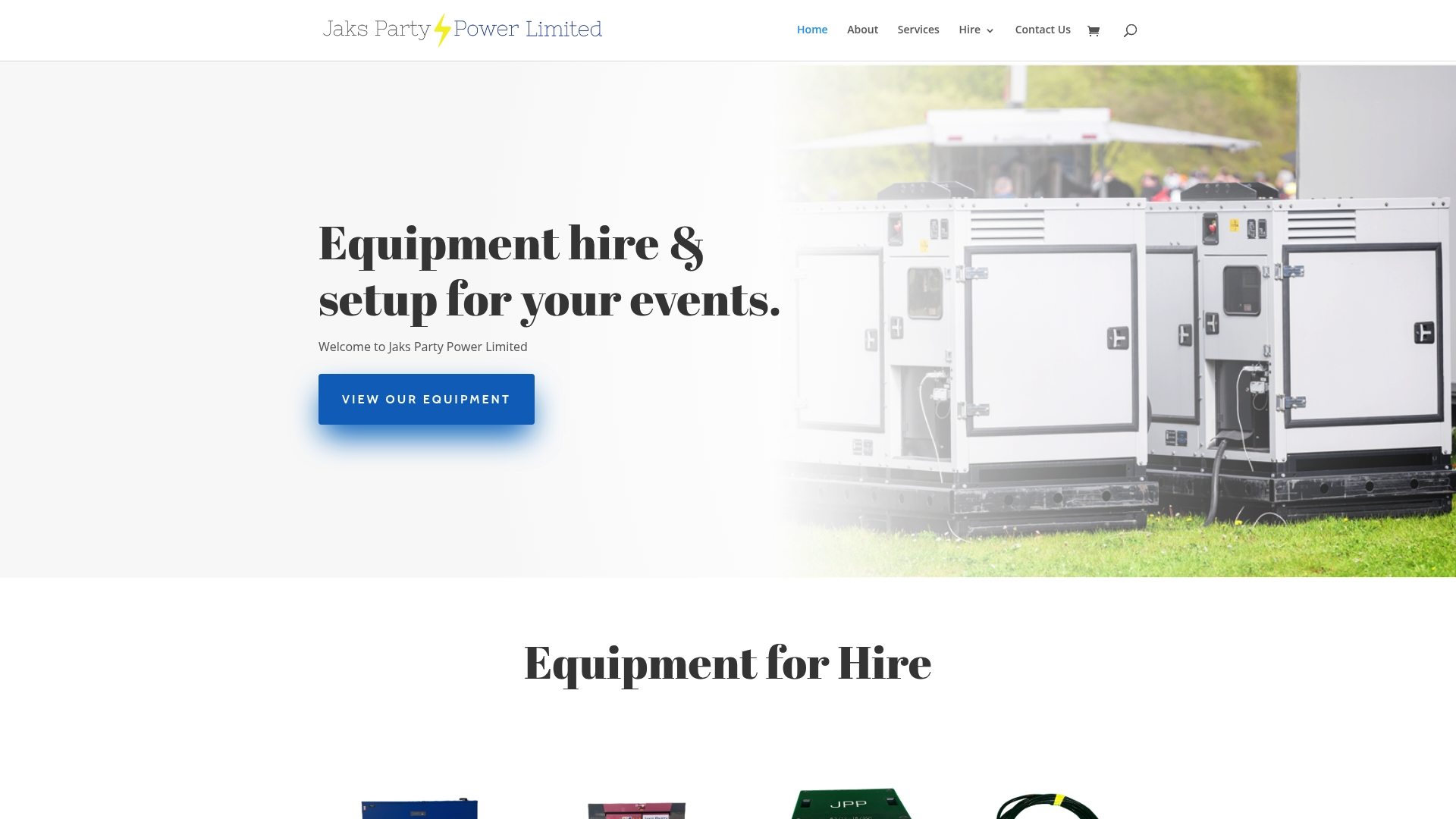
Every hire includes cooperation on SPR appointment, BS 7909 completion certificates, RAMS and insurance documentation before the event goes live. The standby service means a qualified engineer is present during the event, not just on call, which is the difference between a one-hour SLA and a one-minute response. For larger or corporate bookings, the corporate hire process guide walks through exactly what documentation to expect and when.
Get a quote or check availability for your event date at jakspartypower.com.
Key takeaways
A generator hire contract that specifies equipment, fixes SLA response windows, names the SPR, and requires a BS 7909 completion certificate before public access removes the majority of on-the-day disputes before they start.
| Point | Details |
|---|---|
| Equipment specification | Require make, model, serial number and kVA rating in a signed schedule before delivery. |
| SLA response windows | Demand prompt on-site attendance for complete power loss, with financial remedies for missed windows. |
| Pass-of-risk and handover | Risk transfers only on a signed BS 7909 completion certificate, not on delivery to site. |
| Insurance sighted upfront | Require public liability and employer’s liability certificates before the generator leaves the supplier’s yard. |
| Jakspartypower | Covers SPR appointment, completion certificates, RAMS and standby engineers as standard for Sussex events. |
What venue operators often get wrong about generator contracts
Most operators focus on price and delivery time, then discover the gaps when something goes wrong at 7 PM on a Saturday. The clauses that actually protect you are the ones nobody reads until they need them: the pass-of-risk trigger, the liquidated damages figure, and the SPR appointment. A contract that says “generator to be delivered by 10 AM” but says nothing about who is responsible if it arrives unconnected and untested is not a contract at all.
The BS 7909 completion certificate point is the one I see ignored most often. A test report is not the same thing. A test report tells you the installation passed a check; a completion certificate transfers operational responsibility from the supplier to the event team. Without it, you are in a grey area that no amount of goodwill resolves quickly during a live event.
The other underestimated clause is the SLA response window. Suppliers will offer “best endeavours” language if you let them. Push for a defined hour count and a financial remedy. A supplier who is confident in their response capability will accept it. One who hedges on that point is telling you something useful.
Useful sources and further reading
- BS 7909:2023 — BSI Knowledge: the code of practice for temporary electrical systems at events
- Electrical safety at events — HSE: HSE guidance on placement, earthing and refuelling
- GS50 — Electrical safety at places of entertainment (HSE): covers parallel supply connections and permit requirements
- Equipment hire agreement for UK businesses — Sprintlaw: clause-level guidance on hire agreements
- Equipment hire agreement checklist — LexisNexis: legal review checklist for indemnities and liability caps
- Event equipment hire checklist — Jakspartypower: printable procurement checklist for event organisers
- Event power supplier briefing guide — Jakspartypower: briefing template for preparing tender or quote requests
FAQ
What must a generator hire contract include?
At minimum: equipment specification (make, model, serial number, kVA), delivery and collection windows, SLA response times with remedies, pass-of-risk clause, insurance certificates, and a named SPR under BS 7909.
When does risk transfer from supplier to hirer?
Risk should transfer only when the SPR signs a BS 7909 completion certificate confirming the installation is safe and tested, not simply on delivery of the unit to site.
What insurance should a generator supplier carry?
Public liability and employer’s liability as a minimum; motor and fuel cover where applicable. Require certificates to be provided before delivery, with a contractual warranty that cover remains in force for the full hire period.
Who is the Senior Person Responsible (SPR)?
The SPR is a named, electrically competent individual appointed under BS 7909 to oversee design, installation and testing of temporary electrical systems. Many local authorities require SPR details before issuing an event licence.
How should fuel billing be handled in a generator rental agreement?
Define the billing method in the contract: consumption-metered, pre-filled flat rate, or market-rate replenishment. Require fuel consumption records and receipts, and cap any overtime or extension fuel charges with an advance-notice mechanism.