
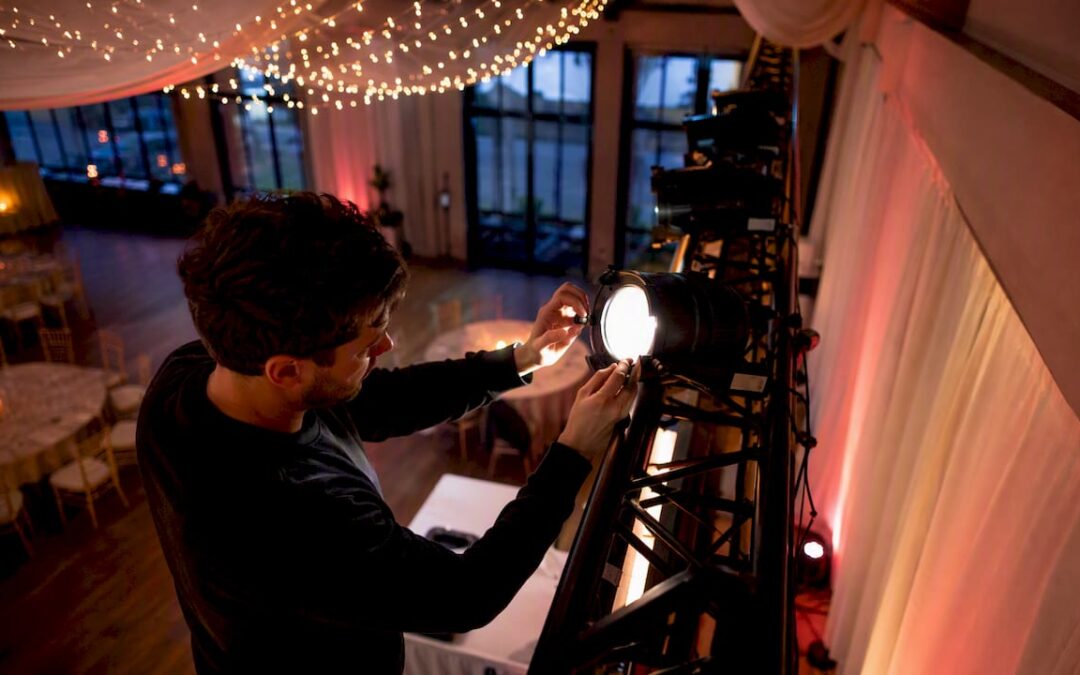
A well-planned private event lighting effects setup combines three layers: ambient light for mood, accent fixtures for focal points, and task lighting for safety and function. Get those three working together, add the right effects for your dancefloor or stage, and run a power and safety check before load-in. That is the whole framework. The fastest next step is a site visit to confirm your rigging points, mains capacity, and whether you need a generator.
Arrange these before anything else:
- Draw a zone plan: entrance, dining, top table or stage, dancefloor, pathways, and any outdoor areas
- Calculate total wattage and confirm your power source (mains circuit or hired generator)
- Specify IP-rated fixtures for any outdoor or marquee zones
- Book a site visit with your supplier or electrician to verify rigging points and power distribution
Key takeaways
A successful private event lighting effects setup starts with a layered zone plan, a documented power calculation, and a full test under real conditions before guests arrive.
| Point | Details |
|---|---|
| Layer your lighting | Use ambient, accent, and task lighting in every zone — never rely on a single source. |
| Calculate load before hire | Total all fixture wattages, convert to amps, and distribute across separate circuits for lighting and audio. |
| IP ratings matter outdoors | Use IP65 as the minimum for open-air UK events; IP44 for covered marquee areas. |
| Test under real conditions | Run a full scene test at the actual event time, with décor in place and the photographer present. |
| Jakspartypower for full delivery | Site surveys, lighting and generator hire, distribution boards, and on-site standby in Sussex. |
Table of Contents
- What does your event lighting actually need to do?
- Which fixtures should you use for a private event?
- How do you control the lights?
- Power planning and UK safety requirements
- What changes for outdoor events?
- A practical load-in and testing timeline
- Common private event lighting mistakes and how to fix them
- What 40 years of event power work actually teaches you
- Jakspartypower: site surveys, lighting hire, and standby support in Sussex
- Sources
- FAQ
What does your event lighting actually need to do?
Before you choose a single fixture, write down what each zone of the venue needs to achieve. Lighting that looks stunning in a showroom can flatten a room or blind guests if it is not matched to the space and the event’s programme.
The four objectives to plan against are:
- Ambience: the baseline mood. Warm colour temperatures (around 2,700–3,000K) suit dinners and weddings; cooler whites work for corporate receptions.
- Focal or accent lighting: draws the eye to the top table, a floral centrepiece, a cake, or a stage. Spotlights and gobos do this well.
- Task and visibility: guests need to read menus, find exits, and move safely. This is not optional; it is a safety requirement.
- Photographic and video needs: cameras need enough ambient light to avoid grainy shots. Flash-heavy photography in a dark room produces flat, unflattering results. Discuss the lighting plan with your photographer before finalising it.
Zone planning on a site visit
Walk the venue with a floor plan and mark each zone. A useful shorthand:
- Entrance: welcoming, warm, not blinding
- Dining area: soft, even ambient with accent on tables and centrepieces
- Top table or stage: brighter focal lighting, controllable for speeches
- Dancefloor: dynamic effects, lower ambient surround
- Pathways and exits: consistent, unobstructed task lighting at all times
Eventbrite’s indoor lighting guidance makes a point worth taking seriously: natural light shifts through the day, so a venue that looks well-lit at 3 PM may be very dark by 7 PM. Always test under the conditions you will actually use.
Pro Tip: Ask your photographer for their minimum ambient light requirement and test your full lighting scene in the venue at the time of day the event runs. Décor colours, tablecloths, and ceiling height all change how fixtures perform.
Which fixtures should you use for a private event?
The three-layer lighting approach (ambient, accent, task) is the practical starting point. Within that structure, these are the fixtures that appear most often at private events in the UK, and what each one actually does.
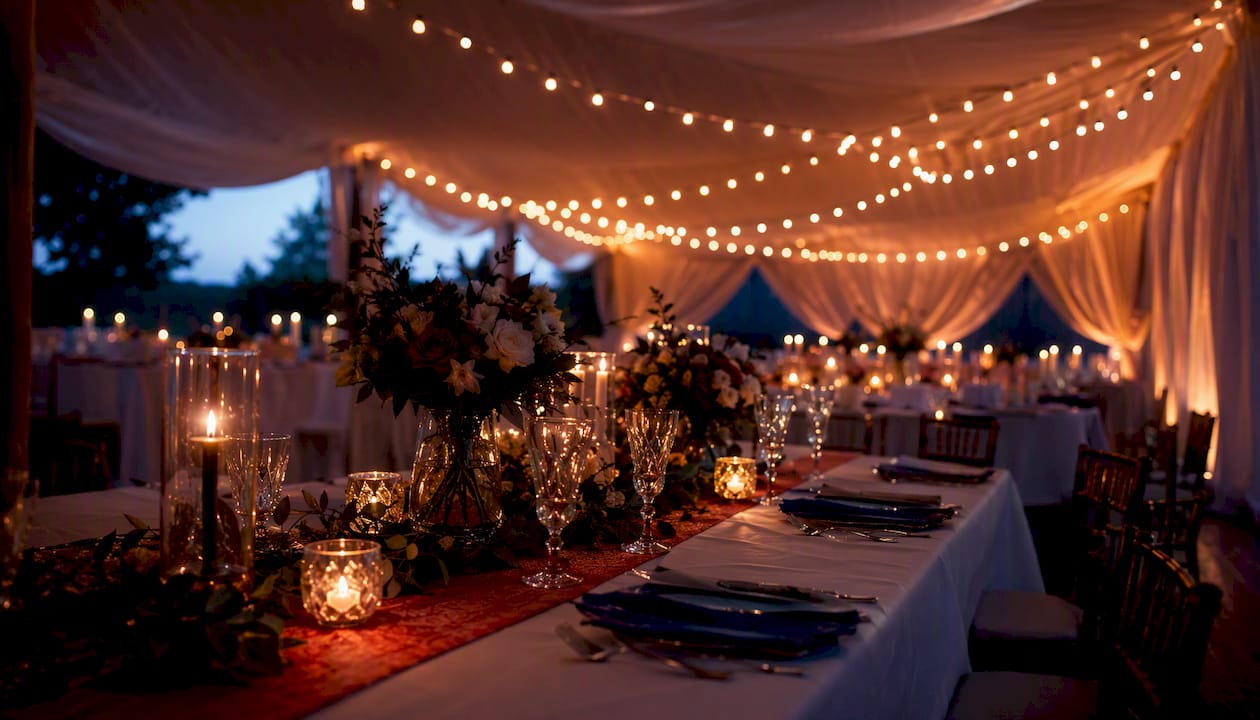
- Festoon and fairy lights: warm, low-wattage, easy to string across ceilings or outdoor canopies. Excellent for ambient fill in marquees and garden parties. Linkable festoon strings (such as 10m linkable festoon runs) let you cover large spans without running separate power drops everywhere.
- Uplighters: floor-standing LED cans that wash walls in colour. They transform a plain venue wall in minutes and are the single most cost-effective way to change a room’s mood. Linkable box uplighters can be daisy-chained to reduce cable runs.
- LED washes: broader coverage than uplighters, useful for stage or dining area fills. Colour-mixing (RGBW) versions let you shift from warm white for dinner to a deeper tone for dancing.
- Spotlights and gobos: a gobo is a metal or glass template placed inside a spotlight to project a pattern or monogram onto a wall or floor. Popular for weddings and branded events. Requires accurate focusing, so allow time during load-in.
- Moving heads: motorised fixtures that pan, tilt, and change colour. Effective on a dancefloor; overkill for a quiet dinner. They draw more power than static fixtures and need DMX control.
- Strobes: create a classic dancefloor effect but carry a genuine safety risk for guests with photosensitive epilepsy. Always display a warning notice and keep flash rates below the threshold recommended by the Purple Guide.
- Festoon chandeliers and candle/table lamps: decorative and photogenic. Low output, so they supplement rather than replace functional lighting.
Fixture matchups for common event types
| Event type | Recommended fixtures | Notes |
|---|---|---|
| Wedding dinner | Warm uplighters, festoon ceiling, candle/table lamps | 2,700–3,000K; dim for speeches |
| Cocktail reception | Festoon canopy, accent uplights, gobo monogram | Keep ambient bright enough for mingling |
| Dancefloor set | Moving heads, LED wash surround, low ambient | Separate circuit from audio; DMX control |
| Outdoor garden party | IP65-rated festoon, IP65 uplighters, pathway stakes | Check IP rating before hire |
| Marquee wedding | Three-layer: festoon ambient + uplighters + spot focal | Generator likely needed; confirm load |
Safety note on strobes, lasers, and high-power followspots: these require specialist operation and a risk assessment. Lasers in particular are subject to separate safety regulations. Do not operate them without a qualified technician present.
How do you control the lights?
Lighting control ranges from a simple app on your phone to a full DMX desk with pre-programmed cue stacks. The right level depends on your event’s complexity.
- Pre-set wireless controllers: most battery-powered LED uplighters come with a remote or app. Fine for static colour scenes at a dinner or reception where you want one look all night.
- DMX desks: a DMX 512 desk sends digital signals to compatible fixtures, giving you individual channel control over colour, intensity, and movement. Standard for any event with moving heads or complex scene changes. For a deeper look at how these systems work, lighting control systems for events covers the options in detail.
- Smartphone apps: some wireless DMX bridges let you run basic scenes from a phone. Practical for small events; unreliable for large shows where Wi-Fi congestion is a risk.
- Timecode and sound sync: moving heads and strobes can be triggered by music beat or a timecode track. Impressive when it works; it needs rehearsal time and a technician to manage it live.
DIY presets vs professional programming
| Criterion | DIY presets | Professional programming |
|---|---|---|
| Event complexity | Simple: one or two scenes | Multiple zones, cue-to-cue changes |
| Music synchronisation | Not possible | Full timecode or live operator |
| Setup time required | 30–60 minutes | Half day to full day |
| Risk of mid-show failure | Low (static scenes) | Low (operator present) |
| Suitable for | Dinners, receptions | Dancefloor shows, weddings with production |
Count your DMX channels before load-in: a single moving head can use 16 or more channels. Label every fixture and patch it to the desk before the venue fills with guests. Run every scene in full dark conditions, not in daylight, so you see exactly what guests will see.
Power planning and UK safety requirements
Getting the power right is not optional. HSE guidance on temporary electrical installations is clear: lighting installations must be selected, installed, and maintained to prevent injury. That starts with a documented load calculation.
What to calculate
- Total wattage of all fixtures across all zones
- Amps per circuit (watts ÷ 230V for single-phase UK supply)
- Whether any fixtures require three-phase or BS EN 60309 industrial sockets rather than standard 13A BS 1363 outlets
- Separate circuits for lighting and audio (GS50 requires this)
For a practical walkthrough of converting watts to amps and sizing circuits, event lighting power consumption explained is worth reading before you brief a supplier.
UK safety checklist for temporary lighting
- Fit a main isolator accessible to staff at all times
- Use RCDs on lighting circuits, but note that dimmers can cause nuisance tripping; consult GS50 and your equipment manufacturer before combining them
- Protect all cables with rubber ramps or cable covers where guests or vehicles cross them
- Never suspend a fixture on its power cable alone; every flown unit needs an independent load-bearing secondary support
- Use correct plug types: BS EN 60309 (CEE) connectors for higher-draw circuits, not domestic 13A adaptors
- Earth all metalwork in temporary structures
- Keep distribution boards locked and labelled
The Purple Guide and HSE GS50 are the two documents every event electrician in the UK works from. If your supplier cannot reference both, find a different supplier.
Pro Tip: For any connection to mains, three-phase supply, or alteration to a venue’s fixed installation, hire a competent electrician. A supplier standby service means a qualified person is on site if a fault develops mid-show, which is exactly when you need one.
What changes for outdoor events?
UK weather makes outdoor lighting a different discipline. Household fixtures are not safe outdoors; you need IP-rated equipment.
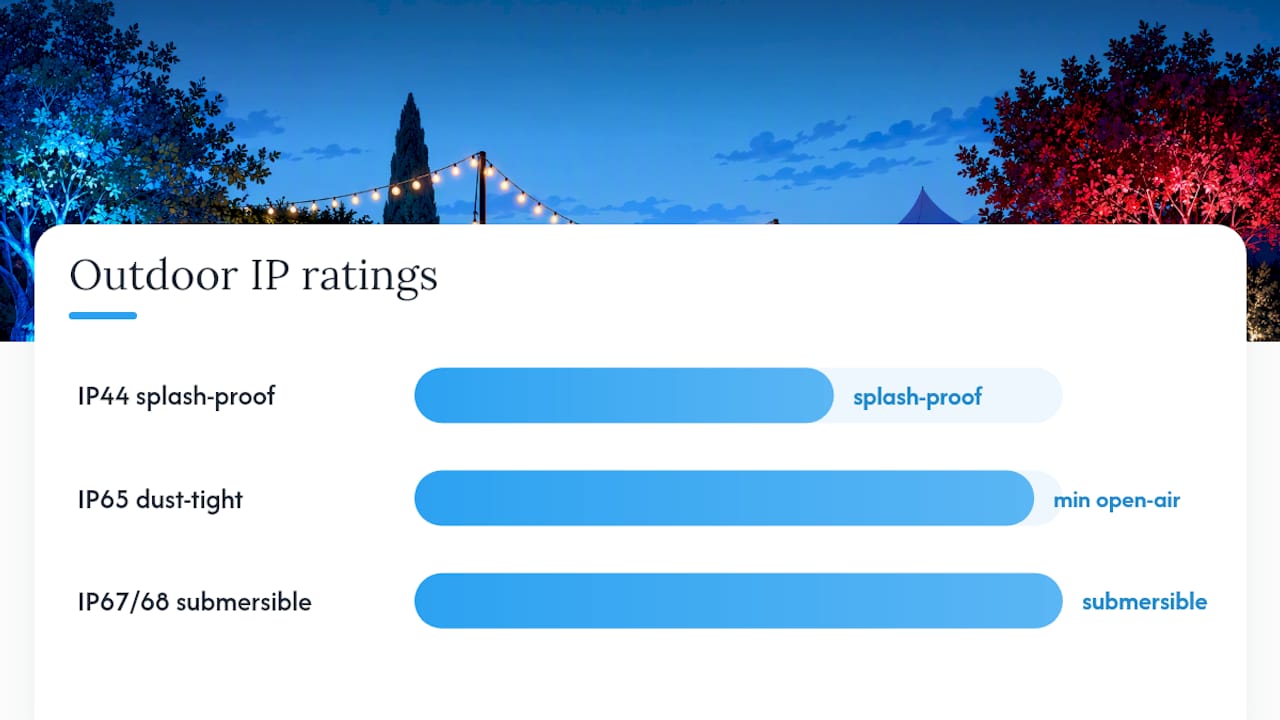
- IP44: splash-proof. Suitable for covered outdoor areas (marquees with sides).
- IP65: dust-tight and jet-proof. The minimum for open-air use in UK conditions.
- IP67/IP68: submersible. Needed for ground-level fixtures in wet grass or near water features.
HSE guidance on outdoor support structures requires that any structure supporting lighting must be fit for purpose, account for wind loading, and include secondary safety measures such as safety chains. An exclusion zone proportional to tower height is recommended where appropriate. Never allow guests near ballast areas or winch points.
For generator planning outdoors, factor in the total draw from lighting, AV, and catering combined, then allow meaningful spare capacity above that figure for start-up surges. Generator hire options sized for private events are available from Jakspartypower. Store fuel safely, away from heat sources, and ensure exhaust fumes cannot enter any enclosed space.
Outdoor cable runs need proper management: use armoured cable where possible, route above head height or through ground-level cable protectors, and check every connection is weatherproof before guests arrive. Concept Events’ outdoor lighting guide reinforces that power planning must include all draws, not just lighting.
Always fit secondary safety chains to any flown outdoor fixture. Lock off access to winches and ballast areas.
A practical load-in and testing timeline
1–2 days before the event
- Rig all overhead fixtures and run primary cable routes
- Connect distribution boards and label every circuit
- Power up and check each fixture individually
- Confirm rigging points are secure and secondary safety fixings are in place
Day before (or morning of, for same-day load-in)
- Run a full test at full load with all systems on simultaneously
- Check colour temperatures match the intended mood in the actual venue light conditions
- Walk every pathway and exit under event lighting to confirm visibility
- Confirm emergency lighting and exit routes are unobstructed and clearly visible
Event day
- Final scene run-through with the DJ or band present
- Check spare bulbs, fuses, cable ramps, zip ties, and gaffer tape are accessible
- Brief any staff on the location of the main isolator
- Confirm the photographer has seen and approved the lighting scenes
Equipment and consumables to have on site:
- Spare lamps for every fixture type in use
- Spare fuses (correct ratings)
- Cable ramps and rubber covers
- Gaffer tape and zip ties
- Extension leads rated for outdoor use if needed
- Torch for working in dark conditions
Local authority guidance, including the Buckinghamshire event safety guide, notes that venues used after dark must provide both normal and emergency lighting for all public access and escape routes. Check this applies to your venue before the event.
Common private event lighting mistakes and how to fix them
- Single light source: one overhead fitting leaves a flat, shadowless room. Fix: add uplighters around the perimeter and a focal spot on the top table or stage.
- Wrong colour temperature: cool white (5,000K+) in a warm, intimate setting looks clinical. Fix: specify 2,700–3,000K for dinners and weddings; reserve cool whites for corporate or contemporary themes.
- Underpowered circuits: plugging too many fixtures into a single domestic ring main trips the breaker mid-event. Fix: calculate total load before load-in and distribute across dedicated circuits. Refer to event electrical distribution options for guidance on splitting loads correctly.
- Poor rigging: fixtures hung on their power cables, or balanced on chairs and tables, are a safety hazard. Fix: use proper clamps, stands, or truss sections with secondary safety wires on every flown unit.
- Overuse of strobes and lasers without assessment: these effects need a risk assessment and a warning notice. Fix: limit strobe use to the dancefloor, display a notice at the entrance, and never operate lasers without a qualified technician.
- No contingency: a single failed fixture or tripped breaker can kill the atmosphere. Fix: carry spares, know where the isolator is, and consider a standby electrician for larger events.
On budget allocation: spend on power and safety first. A correctly sized distribution board and a competent electrician cost far less than a failed show or an insurance claim. Decorative extras like gobos and moving heads are worth adding once the fundamentals are solid.
What 40 years of event power work actually teaches you
The events where lighting fails are almost never the ones with the most ambitious designs. They are the ones where someone skipped the site visit, assumed the venue’s mains could handle the full load, or hired fixtures without checking IP ratings against the forecast.
The most useful thing a supplier can do is visit the site before the event, not on the day. A proper site survey identifies rigging points, confirms the mains supply or generator requirement, and flags problems while there is still time to solve them. On-site testing under real conditions, with the actual décor in place and the photographer present, catches colour temperature mismatches and shadow problems that no amount of planning on paper will reveal.
When clients ask whether they need a standby electrician, the honest answer is: if anything is flying overhead, if you are drawing from three-phase, or if the event runs past midnight with a full dancefloor, yes. The cost of a standby is trivial against the cost of a show that stops because no one on site can safely reset a distribution board.
Choosing a supplier comes down to three things: can they show you a load calculation, do they carry proof of PAT testing and public liability insurance, and will they have a qualified person on site if something goes wrong? If the answer to any of those is no, keep looking.
Jakspartypower: site surveys, lighting hire, and standby support in Sussex
Forty years of electrical contracting experience, applied specifically to events, is what Jakspartypower brings to a private event lighting setup. The practical difference: a team that calculates your load correctly, specifies the right distribution, and stays on site if anything needs attention during the show.
Services relevant to this article include site surveys and venue assessments, lighting hire (uplighters, festoon, and distribution), generator hire sized to your total event load, distribution boards, and a standby service with a qualified electrician present throughout. Every hire comes with equipment that has been PAT tested and is compliant with UK safety standards.
To request a quote or book a site survey, contact Jakspartypower with your guest numbers, venue plan, and a brief note on the mood you want to create. The team will confirm power requirements, rigging options, and what equipment fits your event. Get in touch via the Jakspartypower homepage to start the conversation.
Sources
- Electrical safety – HSE
- Marquee Lighting: Create Atmosphere for UK Events Lighting Guide & Hire (2026)
- The Purple Guide to Health, Safety and Welfare at Music and Other Events
FAQ
What lighting fixtures work best for a private wedding?
Warm uplighters (2,700–3,000K), festoon ceiling strings, and a gobo spotlight on the top table cover most wedding lighting needs. Add moving heads to the dancefloor if the budget allows.
How do I calculate how much power my event lighting needs?
Add the wattage of every fixture, then divide by 230 to get amps per circuit. Keep lighting on a separate circuit from audio, as required by HSE guidance note GS50.
Do I need a professional electrician for private event lighting?
For any connection to mains supply, three-phase power, or alteration to a venue’s fixed installation, yes. A competent electrician is also strongly advisable when flying equipment overhead or running a generator.
What IP rating do outdoor event lights need in the UK?
IP65 is the practical minimum for open-air use in UK conditions. IP44 is acceptable in covered marquee areas with sides fitted; IP67 or higher for ground-level fixtures in wet grass.
Can Jakspartypower supply lighting and power for a private event in Sussex?
Yes. Jakspartypower provides lighting hire, generator hire, distribution boards, and an on-site standby service for private events across Sussex. Contact them with your guest numbers and venue details to receive a quote.