
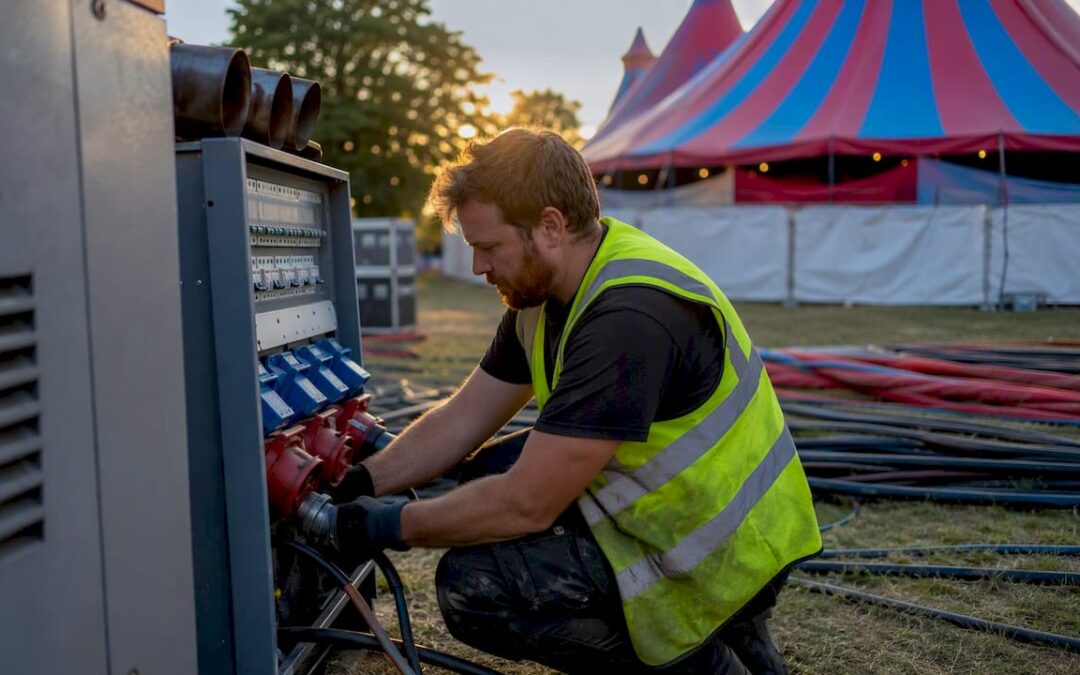
Standby electrical contractors give event organisers a competent person on site who can prevent power failures from becoming show-stopping disasters, cut fault response from hours to minutes, and hand over the legal paperwork that proves your event met BS 7909 safety requirements. That last part catches most organisers out. A generator running smoothly is not the same as a documented, compliant installation.
- Compliance backbone: BS 7909 requires a named Senior Person Responsible (SPR) to sign off temporary electrical systems before they’re energised.
- Real-world benchmark: generators are typically sized at 125–150% of calculated load, and standby crews are the ones watching that margin all night.
- Local example: Jaks Party Power Limited runs a dedicated standby service in Sussex built around exactly this monitoring and documentation model.
Production managers, festival organisers and venue dutyholders benefit most, because they’re the ones legally and financially exposed when a temporary electrical system fails without a competent person managing it.
Key takeaways
Standby electrical contractors reduce downtime, provide the legally required competent person under BS 7909, and hand over documented proof that your event’s power was safe to energise.
| Point | Details |
|---|---|
| Safety and uptime | On-site monitoring catches faults before they cascade into show-stopping failures. |
| BS 7909 compliance | Appointing a Senior Person Responsible is a requirement, not an optional extra. |
| Demand the handover document | Always insist on a Completion Certificate and Schedule of Test Results at energisation. |
| Contract clauses matter | Lock in response time SLAs, energisation authority and record-keeping obligations in writing. |
| Jaks Party Power’s approach | Bundles standby cover, equipment and completion paperwork into one Sussex-based service. |
Table of Contents
- Key benefits of hiring a standby electrician for your event
- What is the Senior Person Responsible and why does the handover document matter?
- What does a standby electrical contractor actually do on-site?
- How much does standby electrical cover cost, and how fast can they respond?
- What should you ask before hiring, and what belongs in the contract?
- Real examples of standby cover preventing event failures
- A practitioner’s perspective: why experienced contractors recommend standby cover
- How Jaks Party Power’s standby service supports your event
- Sources
- FAQ
Key benefits of hiring a standby electrician for your event
Break it down by what actually keeps you up the night before an event, and the value of standby cover gets a lot more concrete.
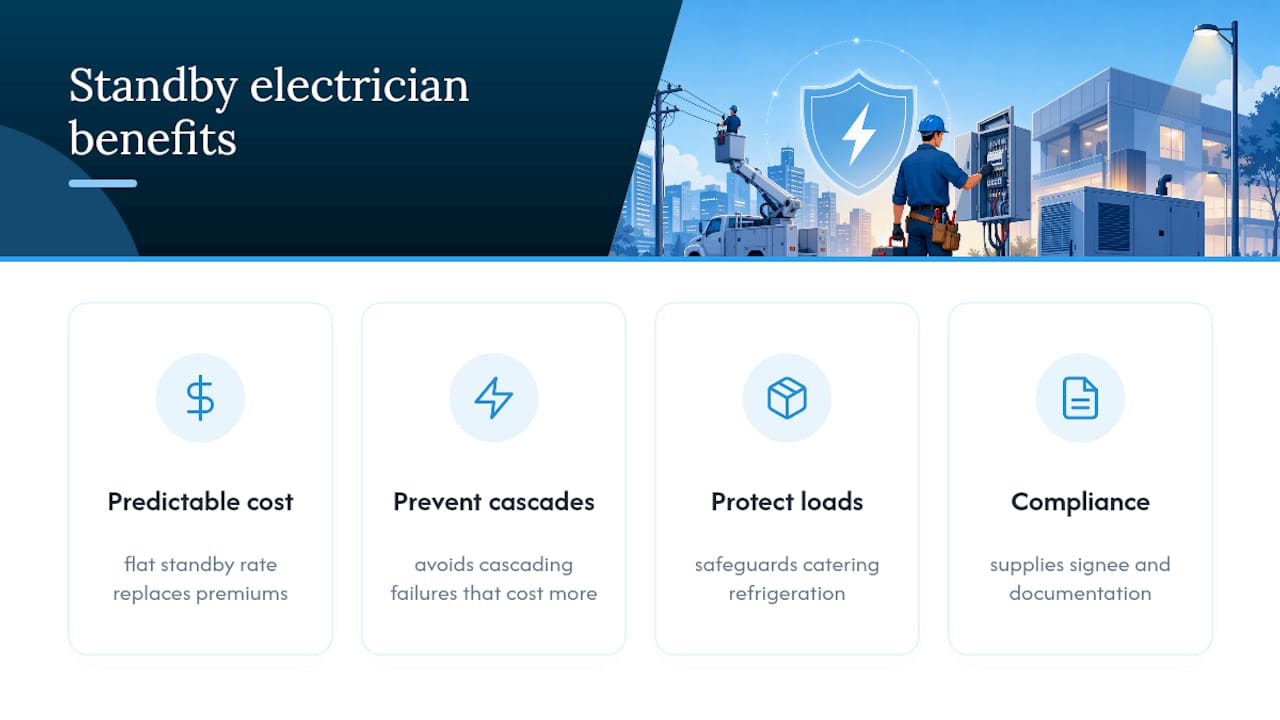
Safety comes first, and it’s not abstract. A competent electrician on standby actively enforces protective measures throughout the event, not just at setup. That means checking GFCI protection, verifying bonding, and routing cables so nobody trips over a 400-amp feed on the way to the bar. Temporary power lacks the fixed conduit and permanent earthing of a building installation, so the distribution design has to be deliberate rather than assumed.
Uptime improves because someone is already there. An on-call electrician forty minutes away means forty minutes of dead stage lighting or a silent PA system. A standby technician walking the distribution route every hour catches a loose connector or an overheating cable before it trips a breaker mid-performance.
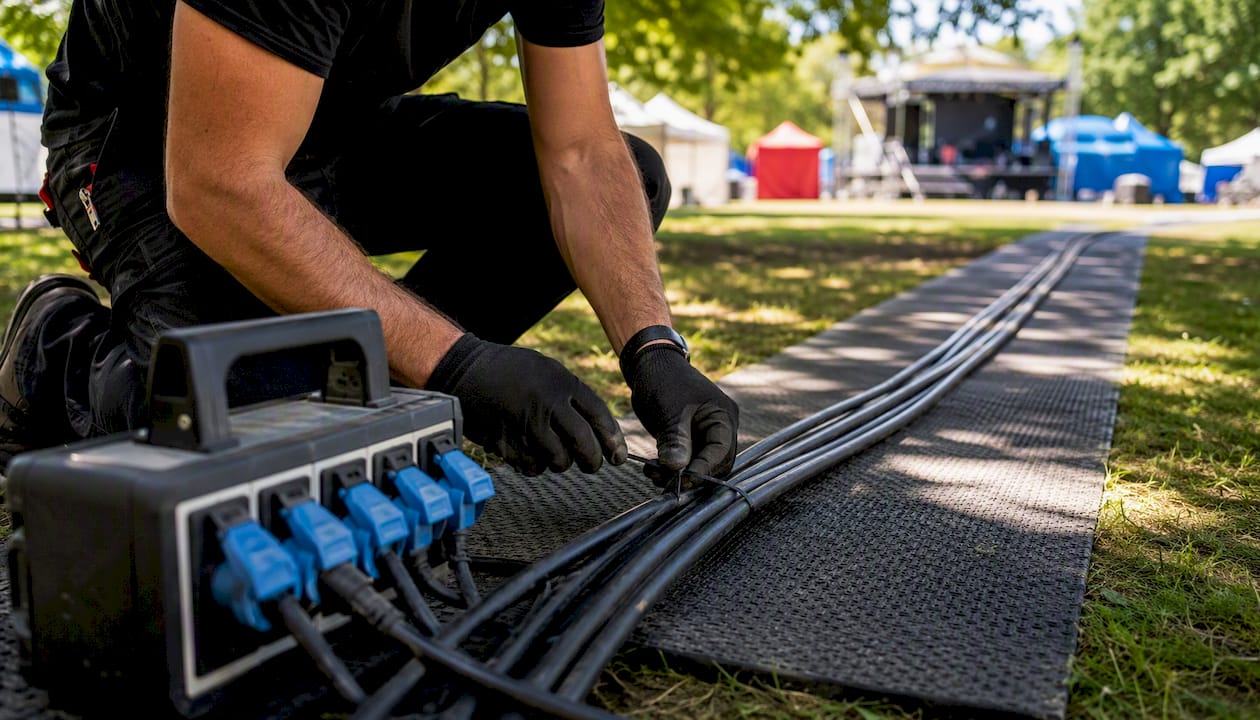
Compliance stops being a guess. The contractor supplies the person who takes professional responsibility for the installation, along with the documentation that proves it. This isn’t paperwork for its own sake. It’s the evidence you’d need if an incident occurred and someone asked who signed off the system.
Costs become predictable. A flat standby rate replaces the premium call-out fees that come from ringing an electrician at 11pm on a Saturday. It also protects perishable and vendor-critical loads, catering refrigeration, medical equipment, payment terminals, from cascading failures that cost far more than the standby fee itself.
Accountability sits in one place. With a single electrical lead on site, there’s no finger-pointing between the lighting vendor, the venue’s in-house electrician and the generator supplier when something trips. One person owns the fault, the fix, and the log entry.
Pro Tip: Ask any prospective standby contractor to show you a completed shift log from a previous event, not just a sample template. A real log tells you how they actually document faults, timings and actions, which is the habit that protects you later.
What is the Senior Person Responsible and why does the handover document matter?
BS 7909 is the primary code of practice for temporary electrical systems at events, and it centres everything on one appointment: the Senior Person Responsible, sometimes called the Responsible Person. This individual must be competent in both BS 7671 and BS 7909, and they personally sign off the pre-energisation checks before anything gets switched on.
The formal handover document, often called a Confirmation of Electrical Completion, is where most organisers get caught out. It’s the piece of paper that transfers professional obligation from the contractor to you as the client, confirming the system has been inspected, tested and is safe to energise. Skip it, and you have no evidence the installation was ever properly accepted.
A standby contractor should hand you:
- A signed Completion Certificate for the temporary installation.
- A Schedule of Test Results covering insulation resistance, earth continuity and RCD trip times.
- Inspection and energisation logs showing who checked what, and when.
Industry guidance repeatedly flags the handover document as the most commonly missed step in event electrical planning, leaving organisers without proof the system was ever formally accepted. That’s not a paperwork technicality. Without it, you’re the one holding the risk if an incident happens after the fact.
Pro Tip: At load-in, ask to see the Completion Certificate before you sign anything else. If the contractor can’t produce it on the spot, that’s your answer about how seriously they treat BS 7909 obligations.
What does a standby electrical contractor actually do on-site?
The value of standby cover shows up in the routine, not just the crisis. Here’s the typical sequence:
- Pre-energisation checks: the Responsible Person inspects the installation, confirms labelling, and signs the energisation authority before power flows.
- Live monitoring: regular panel and generator readings, fuel level checks, cable protection rounds, and alarm monitoring, all logged on a running shift record.
- Fault response: isolate the affected circuit, secure the area, and either perform a controlled shutdown or switch to backup supply, escalating to event control if the fix isn’t immediate.
- Distribution and generator management: load balancing across phases, managing transfer switches, and running scheduled refuelling windows without interrupting supply.
Beyond the technical tasks, communication protocols matter just as much. The standby team needs clear lines to venue electricians, equipment vendors and event control, so a fault gets reported once and resolved fast, not relayed through three people first. A festival temporary power plan that maps every load, source and accountable handoff point is the operational backbone that makes this monitoring possible rather than reactive guesswork.
- Assign a power coordinator and utility runners for larger sites; it’s a cheap way to cut confusion on event day.
- Keep shift logs visible to event control, not locked away with the electrical team.
How much does standby electrical cover cost, and how fast can they respond?
Pricing usually follows one of three models: a flat day rate for standby cover, a call-out fee plus hourly or half-day minimums, or a retainer for multi-day events and festivals. None of these is inherently cheaper. It depends on your event’s shape.
Several factors move the price:
- Complexity of the installation and how many SPRs the event legally requires.
- Equipment supplied alongside standby, such as distribution boards or generators, versus contractor-only cover.
- Travel distance, overnight work and holiday premiums.
- Insurance and qualification levels the event demands, particularly for large public gatherings.
An on-site standby team responds in minutes because they’re already walking the site. On-call technicians, by contrast, carry travel time on top of diagnosis, which is precisely the gap that turns a five-minute fix into a forty-minute blackout. Insist on a written response time in your service agreement, not a verbal assurance.
As a rough budgeting rule, bundling equipment hire with standby cover (generators and distribution supplied by the same contractor providing the standby technician) tends to work out more cost-effective than sourcing each separately, because you’re not paying two call-out premiums for one fault.
What should you ask before hiring, and what belongs in the contract?
Treat the hiring conversation like due diligence, not a quote request. Ask to see:
- Evidence of competence, qualifications and BS 7671/BS 7909 experience.
- A sample Completion Certificate and PEC record from a previous job.
- Insurance limits and public liability evidence in writing.
Then make sure the contract itself locks in the obligations, not just the price:
- Scope of standby cover, including hours and named personnel.
- Energisation authority, stating who signs off before power flows.
- Record-keeping obligations, covering shift logs and test schedules.
- Response time SLAs and named escalation contacts.
- Fuel and refuelling responsibilities, plus method statements and RAMS.
- Indemnities and cancellation terms.
Watch for red flags: a contractor who won’t supply PEC or Completion paperwork, vague answers about who holds energisation authority, or no mention of shift logs at all. Any of these should end the conversation.
Pro Tip: Copy the six contract clauses above straight into your procurement template. Tender responses that dodge specifics on any of them are telling you something.
Real examples of standby cover preventing event failures
A festival main stage running an LED wall off a shared generator feed is a classic cascade-trip scenario. A standby technician monitoring load in real time catches the early warning signs, a marginal voltage sag, a slightly hot connector, and performs a controlled transfer before the whole rig drops mid-set.
A conference relying on registration and payment terminals faced a supply sag partway through morning check-in. Standby intervention, backed by UPS protection on the critical circuits, kept card readers and badge printers running while the fault was traced and isolated elsewhere on site.
A wedding reception lost power to a catering fridge unit two hours before service. Rapid response from an on-site electrician isolated the fault and restored supply before stock spoiled, avoiding a scrambled menu change in front of 150 guests.
The pattern across all three is the same: it’s never the failure itself that costs money or reputation. It’s the gap between the fault occurring and someone competent reaching it.
A practitioner’s perspective: why experienced contractors recommend standby cover
Most electrical failures at events aren’t dramatic. They’re a loose connector, a slightly overloaded circuit, a generator running warmer than it should. The value of a standby team isn’t in solving disasters. It’s in the boring discipline of walking the same distribution route every hour and writing down what you find, even when nothing’s wrong.
What gets underestimated is the single point of accountability. When something trips at 2am and there’s one electrical lead who owns the fault, the fix and the shift log, decisions happen fast. When responsibility is split across three vendors and a venue in-house team, the first twenty minutes get burned on working out whose problem it is.
Event control should treat the standby lead as part of the command structure, not an external supplier to be summoned when things go wrong. Give them a direct line to the person making show-stop decisions, and build fifteen minutes into the post-event debrief specifically for the electrical log. That’s where you learn whether next year’s generator needs to be a size bigger, or whether a particular cable run keeps overheating for a reason nobody’s addressed.
How Jaks Party Power’s standby service supports your event
Alongside generators, lighting and distribution boards, Jaks Party Power Limited’s standby service gives you everything covered above under one roof rather than three separate suppliers. That’s the practical difference: no chasing a generator company, a distribution contractor and an electrician separately when something needs sorting at 9pm.

The service includes a designated Senior Person Responsible, full Completion Certificate and test schedule paperwork, on-site monitoring, and a planned refuelling schedule so generators don’t run dry mid-event. Jaks Party Power brings over 40 years of combined electrical contracting experience to that documentation, which matters when you’re relying on it as evidence your event met its safety obligations.
If you’re planning an event in Sussex and want standby cover built into your power plan from the start, request a quote for the standby service and ask about lead times for your event date, particularly if you’re booking during peak summer months when standby crews get committed early.
Sources
- A laymans guide to electrical safety at events
- Festival temporary power plan: an electrical handoff guide | WENOTIFT
- Event power distribution guide
- Event power needs: vendor checklist
- Exhibition & event electrical | Temporary installations BS | Elec-Mate
FAQ
What Does a Standby Electrical Contractor Actually Do?
They monitor live distribution and generator systems throughout an event, respond to faults immediately, and hold the professional responsibility for pre-energisation checks under BS 7909.
Is a Senior Person Responsible Legally Required at Every Event?
BS 7909 requires organisers to appoint a Senior Person Responsible for temporary electrical systems, so any event using generators or temporary distribution needs one named and competent.
What Is the Handover Document, and Why Does It Matter?
It’s the Confirmation of Electrical Completion, the paperwork proving the installation was inspected, tested and accepted as safe; without it, you have no evidence the system met safety requirements.
How Quickly Can a Standby Electrician Respond to a Fault?
An on-site standby team typically responds in minutes because they’re already on location, compared to on-call technicians who add travel time before diagnosis even begins.
Does Jaks Party Power Provide Standby Cover With Documentation Included?
Yes, Jaks Party Power Limited’s standby service includes a Senior Person Responsible, Completion Certificate paperwork and on-site monitoring as part of its standard offering.