
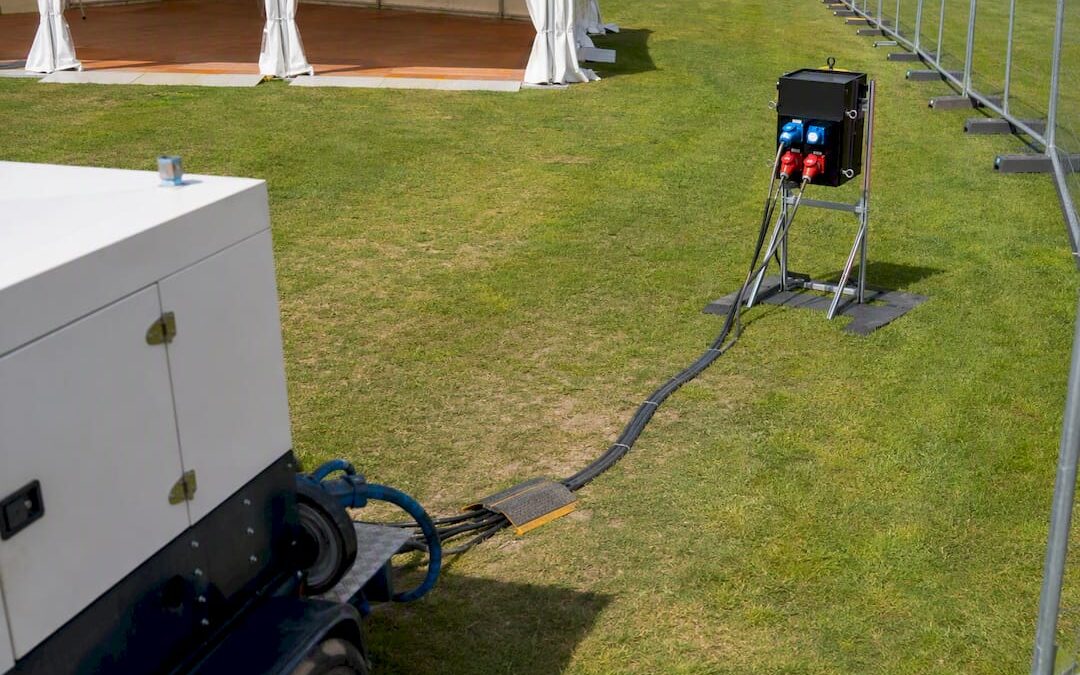
A permanent temporary power setup is a hired electrical installation, built from generators, distribution and cabling, that runs for the length of an event and is removed once the event ends. It sits between two extremes: a mains-only permanent connection and a single generator dropped on site with no planning. Organisers choose it whenever a venue’s fixed supply can’t handle the load, or when there’s no fixed supply at all, such as a marquee wedding, an outdoor festival or a temporary market. A proper setup follows BS 7909 for the electrical design and testing, BS 7671 for wiring safety, and HSE event guidance for site risk. Jakspartypower has built these systems across Sussex for over 40 years.
A typical hired package includes:
- One or more generators sized to the event’s actual load
- Distribution boards splitting power into manageable, protected circuits
- Armoured or industrial cabling routed and protected from foot traffic
- A standby operator on site for the duration of the event
Key Takeaways
A permanent temporary power setup applies BS 7909 design discipline and documented testing to a hired, repeatable event power system rather than a one-off improvised rig.
| Point | Details |
|---|---|
| Definition | It’s a hired, event-length power system, generators, distribution, cabling and standby, built to the same rigour as a permanent installation. |
| Sizing method | Use a circuit-by-circuit load schedule, not a rough total, and keep voltage drop within 5% of nominal supply. |
| Required standards | BS 7909 covers the temporary installation itself; BS 7671 governs wiring safety; HSE guidance covers site risk and public protection. |
| Reliability practice | Standby generators need periodic load-bank testing, since low utilisation can hide performance faults that no-load starts miss. |
| Supplier to use | Jakspartypower supplies generators, distribution, cabling and standby cover as one documented package across Sussex, backed by over 40 years of contracting experience. |
Table of Contents
- What does a temporary power system for events actually include?
- How do you size a generator and plan the load correctly?
- Which UK standards and safety rules apply to temporary power?
- What causes most on-site power failures, and how do you avoid them?
- How do you keep temporary power reliable throughout an event?
- What should you get in writing from a temporary power supplier?
- How is a permanent temporary power setup different from other installations?
- When do organisers choose a permanent temporary power setup over the alternatives?
- What makes installation different for a permanent temporary setup?
- How often should a permanent temporary power setup be inspected?
- What safety risks are specific to permanent temporary power setups?
- Why experience and documented process matter more than kit
- Ready to plan your event’s power properly?
- Sources
- FAQ
What does a temporary power system for events actually include?
Every hired setup is built from the same core building blocks, even if the scale changes wildly between a 50-guest marquee wedding and a 20,000-person festival.
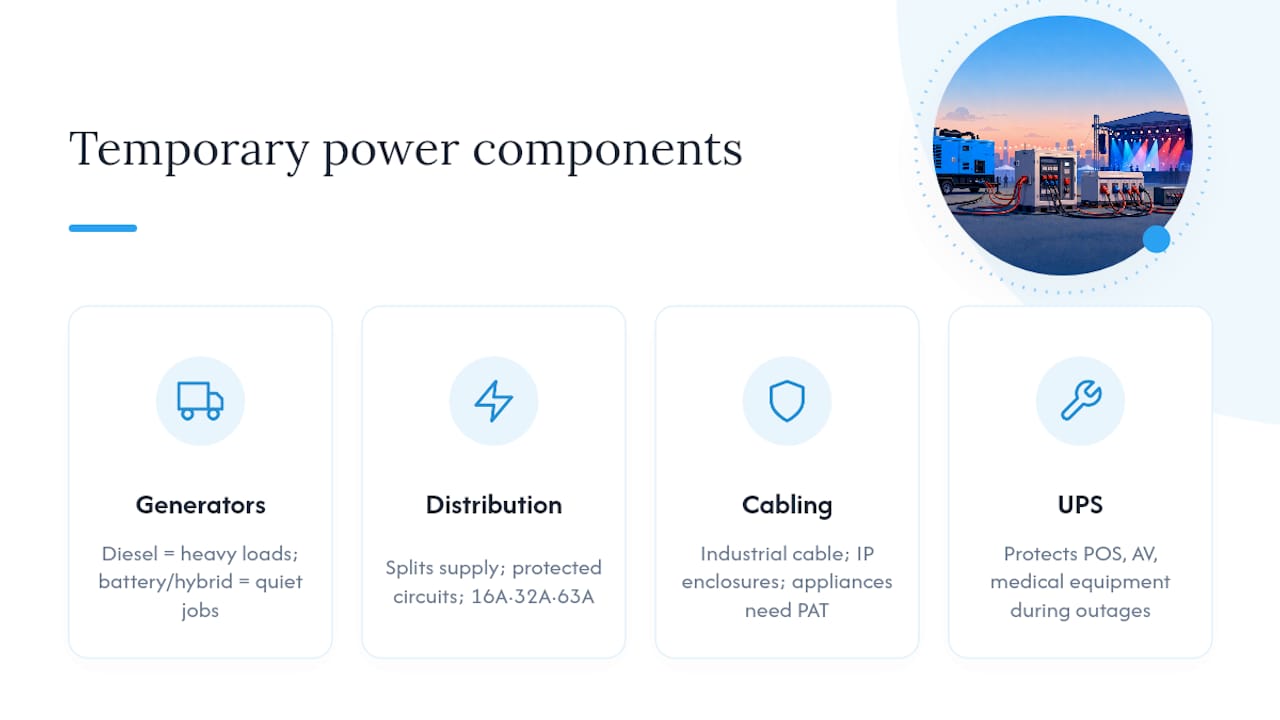
Generators fall into two broad camps. Diesel sets remain the default for anything drawing serious continuous load, from marquee catering rigs to stage production, because they’re predictable and easy to refuel mid-event. Battery and hybrid units suit smaller, noise-sensitive jobs, quiet wedding receptions, or applications where a generator running all night would annoy neighbours or breach a venue’s noise licence.
From the generator, power runs through a portable distribution board, which splits the single incoming supply into individually protected circuits, usually terminating in 16A, 32A or 63A connectors depending on what’s plugged in. Cabling should be industrial grade, run through IP-rated enclosures where it crosses walkways or sits outdoors, and any appliance connected on site needs current PAT testing records.
For anything sensitive, till systems, AV desks, medical equipment, ask your supplier about a UPS. A momentary generator changeover or fuel top-up can otherwise wipe a POS system mid-transaction.
Pro Tip: Ask your supplier who is physically on site during the event, not just on call. A standby operator who can respond to a tripped RCD in minutes is worth more than a generator with a bigger badge on the side.
Fuel logistics and refuelling schedules should be part of the hire agreement from the outset, not an afterthought discussed on the morning of the event.
How do you size a generator and plan the load correctly?
Guessing a generator size from a rough headcount is how events end up with brownouts during the first course. The right method is a circuit-by-circuit load schedule: list every piece of equipment, its running wattage, and whether it draws a heavy surge on start-up (catering equipment and motors are the usual culprits).
- List every circuit and its connected equipment, noting running load and peak/inrush load separately.
- Add a margin for motor starts and power factor losses, rather than simply summing nameplate wattages.
- Apply rule-of-thumb sizing as a sanity check, then confirm the final figure against your supplier’s own commissioning data.
- Map which circuits must stay live through any changeover and which can be shed temporarily.
- Request the single-line diagram and commissioning paperwork before the event, not after.
Voltage drop is the detail most organisers never think to ask about. Temporary installations must keep voltage drop within 5% of the nominal supply, and long cable runs across a large site push conductors closer to that limit. Sub-distribution boards positioned nearer the load reduce cable length and keep drop within tolerance, rather than running one enormous cable from a single generator across an entire field.
A circuit-by-circuit load schedule also tells your supplier which circuits need selective RCD protection, so a fault on the catering trailer doesn’t take down the stage lighting. This is where a competent contractor earns their fee: matching protection devices to the actual load pattern, not fitting one blanket RCD and hoping.
Which UK standards and safety rules apply to temporary power?
Three references govern almost everything a competent supplier does on site, and knowing them by name helps you ask the right questions during procurement.
BS 7909 governs temporary electrical installations for entertainment and events. It requires the whole job, design, installation, inspection, testing and maintenance, to be carried out by a competent person, backed by a written scheme of work and a completion certificate.
BS 7671 is the wiring regulations underpinning any UK electrical installation, temporary or fixed. For event supplies, the parts that matter most are voltage drop limits and RCD protection on socket outlets, particularly anything up to 32A that the public or crew might plug into directly.
HSE’s own event guidance focuses on the practical side: risk-assessing generator siting, planning cable routes, and protecting temporary installations from public access and bad weather.
A written scheme of work isn’t paperwork for its own sake. It’s the document that proves someone competent actually thought through your site’s specific risks, rather than applying a generic template.
Before signing off any hire, ask for:
- The single-line diagram showing how power flows from generator to final circuit
- An Electrical Installation Certificate (EIC)
- Inspection and test records covering RCDs and insulation resistance
What causes most on-site power failures, and how do you avoid them?
Earthing arrangement is the first thing to establish, and it’s the one most organisers never ask about. Generator-fed sites typically use TT earthing, sometimes TN-S or IT depending on how the supply is configured, and outdoor sites usually favour TT with RCD protection on all socket outlets. Whichever system your supplier chooses, get it documented, not assumed.
Beyond earthing, most temporary power failures trace back to a small handful of avoidable mistakes:
- Domestic extension leads daisy-chained together, which causes heat buildup and raises fire risk far more than most organisers realise
- Cable drums left partially wound, which also generates heat under sustained load
- RCDs mismatched to the circuit they’re protecting, so one fault trips everything
- Distribution boards left unsecured or exposed to rain without an IP-rated enclosure
Pro Tip: Walk the site the night before doors open and physically check every distribution board is locked, elevated off wet ground, and clearly labelled. It takes ten minutes and catches problems no amount of paperwork will.
Separating critical circuits, stage power, medical equipment, catering, from general-purpose sockets means one fault doesn’t cascade into a full site blackout. Your distribution board layout should make that separation obvious at a glance, not something only the installer understands.
How do you keep temporary power reliable throughout an event?
Reliability comes down to three things: fuel, people and testing, and organisers who skip any one of them are the ones who end up with a dark stage at 9pm.
A refuelling plan should specify tank capacity, expected consumption per hour, and where fuel is stored on site, safely, away from crowds and ignition sources. Standby operators are the second pillar. A standby electrician on site, with an agreed response time written into the contract, is the difference between a five-minute fix and a stalled event.
The part organisers consistently overlook is testing standby plant that barely runs. A generator kept in reserve for occasional standby duty can suffer performance degradation from low utilisation, and a quick no-load start doesn’t reveal that. Structured load-bank testing, staged progressively up to rated capacity, exposes alternator instability, voltage regulation faults and cooling problems that only show up under real demand.
Before hiring, insist on seeing:
- Recent load-bank test results for any standby unit, not just a service log
- Battery condition checks and fuel quality records
- Commissioning results from the last comparable job
What should you get in writing from a temporary power supplier?
Treat the paperwork stage as non-negotiable, because it’s the only record you’ll have if something goes wrong mid-event.
- Request the written scheme of work, single-line diagram, EIC and full commissioning paperwork before deposit or contract sign-off.
- Ask directly about generator noise levels, refuelling schedule, changeover testing and standby operator hours.
- Get insurance cover, operator response times, and confirmed generator load capacity written into the contract, not agreed verbally.
- At handover, confirm circuits are labelled, test records are handed over physically, and someone briefs your event manager on shutdown procedure.
A supplier who can’t produce this paperwork on request usually can’t produce it at all.
How is a permanent temporary power setup different from other installations?
A permanent temporary power setup sits deliberately between two other categories, and understanding the distinction saves organisers from asking a supplier for the wrong thing.
A purely temporary installation is built, used once, and stripped out, typically for a single wedding, festival or one-off corporate event. A permanent installation is the fixed mains supply wired into a building, inspected periodically, and left in place indefinitely. The permanent temporary setup borrows from both: it’s assembled and dismantled like a temporary rig, but it’s engineered, documented and tested to the same rigour as a permanent one, because it’s often repeated on the same site, season after season, or because the venue itself has no reliable fixed supply to fall back on.
Venues that host events regularly, wedding barns, showgrounds, outdoor function spaces, are the clearest example. Rather than reinventing the electrical plan for every booking, the venue and its supplier agree a standard configuration: generator position, distribution layout, cable routes, all designed once under BS 7909 and reused with minor adjustments for each event. It behaves like a permanent installation in terms of planning discipline, while remaining physically temporary and removable between bookings.
This matters commercially too. A venue that commissions a proper single-line diagram and written scheme of work once, rather than starting from scratch for every hire, saves time and reduces the chance of a rushed, poorly documented setup on a busy event weekend.
When do organisers choose a permanent temporary power setup over the alternatives?
The clearest case is a venue with no adequate fixed electrical supply that hosts events on a recurring basis. A converted barn, a showground, or a rural estate running weddings every weekend through summer can’t justify a full permanent mains upgrade for occasional peak loads, but it also can’t afford to treat every event as a one-off improvisation.
Festivals and multi-day outdoor events on the same site each year fall into the same pattern. Rather than redesigning power distribution annually, organisers who return to the same field or park often keep the same generator positions, distribution zoning and cable routes, refined slightly each year based on what worked.
Large weddings and marquee events at venues without three-phase mains access are another common scenario, particularly where catering, lighting and a band or DJ rig all draw simultaneously and the existing single-phase supply simply can’t cope. Corporate events held at exhibition halls or unconventional venues, warehouses, historic buildings, outdoor sites, follow the same logic: the building wasn’t designed for the load, so a documented, repeatable temporary system fills the gap.
What unites all these scenarios is repetition and scale. A single 30-guest garden party rarely needs this level of formality. A venue running the same type of event every fortnight benefits enormously from treating its “temporary” power as a standing, well-documented system rather than reinventing it each time.
What makes installation different for a permanent temporary setup?
The installation process starts the same way any temporary job should, with a site survey and a circuit-by-circuit load schedule, but the design work goes further because the system is expected to be reused.
Cable routes get planned with an eye to repeatability: fixed anchor points, consistent routing away from vehicle access and public paths, and distribution board positions chosen to suit the venue’s layout rather than one specific event’s stage plan as explained in this complete guide to temporary event setups. Earthing arrangement, usually TT for generator-fed outdoor sites, gets documented once and referenced for every subsequent booking rather than reassessed from scratch.
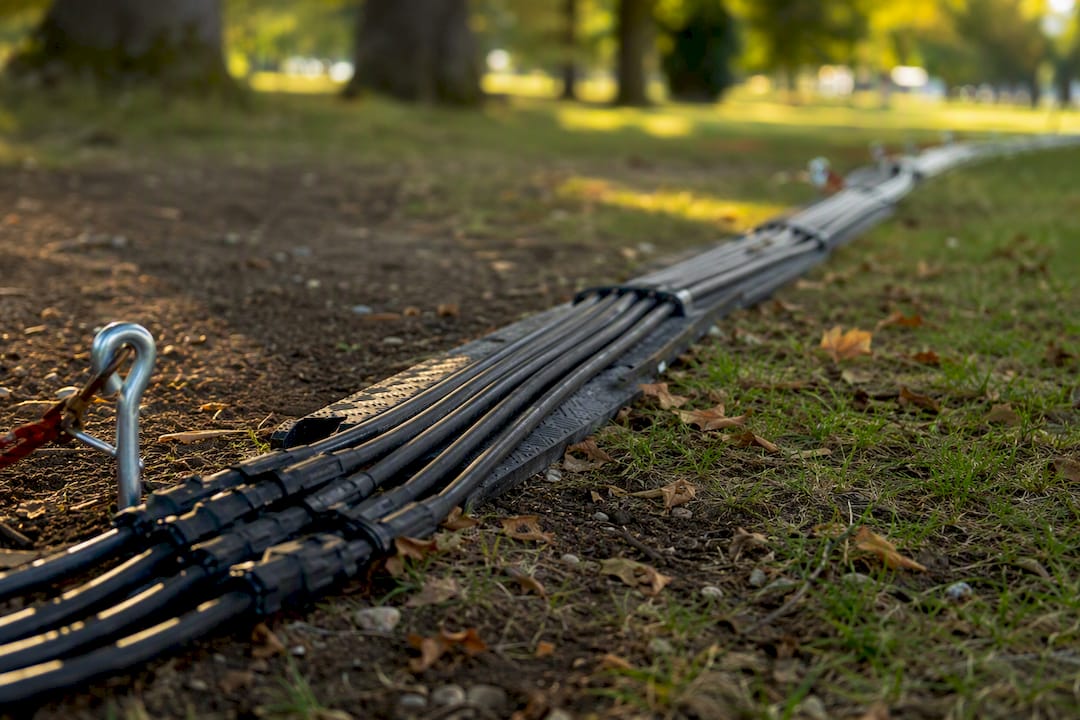
Because the setup recurs, suppliers often build in additional headroom during initial sizing, anticipating that future events at the same venue may draw more than the first booking. This avoids a venue outgrowing its supply after a season and needing a full redesign.
The single-line diagram and written scheme of work become living documents rather than one-off paperwork. They get updated when equipment changes, when a new stage position is added, or when the venue’s typical load profile shifts. Commissioning tests, insulation resistance, RCD trip times, earth loop impedance, still need repeating for each actual event installation, even where the underlying design stays consistent, because cabling and connections are physically reassembled every time.
Handover briefings matter more here too. Venue staff, not just the event’s own team, need to understand the standard configuration so they can brief future hirers or flag issues between bookings.
How often should a permanent temporary power setup be inspected?
Because these systems get assembled and dismantled repeatedly, inspection can’t follow a fixed installation’s typical five-year cycle. Every physical build, even the fiftieth event on the same site, needs its own inspection and test before it goes live.
That means insulation resistance testing, RCD trip time verification, and earth loop impedance checks each time cabling and distribution boards are reconnected, regardless of how many times the same configuration has run before. Reusing a proven layout doesn’t exempt the connections themselves from fresh verification.
Standby generators kept at a venue for recurring use need a different rhythm again. Structured load-bank testing, staged up to rated capacity, should sit in the maintenance schedule as a periodic check rather than a one-off at purchase, precisely because standby units that run rarely are the ones most likely to hide developing faults. A venue running events fortnightly through summer and going quiet over winter is exactly the profile where this matters.
Cabling and connectors used repeatedly also wear faster than a single-use temporary rig’s equipment. Connector housings crack, cable insulation degrades from repeated coiling and uncoiling, and distribution board enclosures take more cumulative weather exposure. A sensible schedule includes a visual inspection before every event, a full electrical test at each installation, and a documented periodic review of the equipment itself, not just the connections, every few months during an active season.
Keeping test records from every single build gives a venue and its supplier a running history, useful evidence if a fault ever needs tracing back to a specific date or reassembly.
What safety risks are specific to permanent temporary power setups?
The main risk with any recurring temporary system is complacency. Crews who’ve built the same configuration a dozen times can start skipping steps that would never be skipped on a genuinely one-off job, assuming last time’s test results still apply.
Documentation drift is the practical version of that risk. If a venue’s single-line diagram doesn’t get updated when a stage moves or a new catering unit gets added, the next event’s team may work from an outdated plan, potentially undersizing protection or missing a circuit that now carries more load than originally designed.
Because the physical kit gets repeatedly transported, connected and disconnected, connectors and cable ends see more mechanical stress than a fixed installation ever would. Regular visual checks before each build catch cracked housings or damaged pins before they become a live fault on site.
Public access control needs the same discipline every time, even on the venue’s hundredth event. Distribution boards need to stay secured and elevated, cable runs need protection from foot and vehicle traffic, and generator enclosures need siting that keeps guests and crew away from exhaust and refuelling points, exactly as HSE guidance sets out for any temporary event supply, permanent-temporary or otherwise.
Finally, because standby capacity at these venues often gets treated as a known quantity after a few successful events, it’s worth revisiting the load schedule whenever the venue’s typical booking changes, a bigger act, an extra food vendor, more lighting, rather than assuming the original sizing still has headroom to spare.
Why experience and documented process matter more than kit
Generators and distribution boards are largely commodity equipment. What separates a reliable event power setup from a risky one is the process behind it: proper load scheduling, a written scheme of work, and someone competent standing behind the commissioning paperwork.
Jakspartypower’s approach comes from over 40 years of electrical contracting, not just event hire, which shapes how equipment gets selected and tested before it ever reaches a site. A standby operator on the ground and documented commissioning aren’t add-ons; they’re what actually prevents the failures this article has walked through, mismatched RCDs, undersized cable, standby plant that hasn’t been load tested in months.
— Rob
Ready to plan your event’s power properly?
Sorting generators, distribution, cabling and standby cover separately, from different suppliers, is how gaps creep into an event’s electrical plan. Jakspartypower handles the whole package as one job: generators sized to your actual load, distribution boards zoned correctly, cabling routed and protected, and a standby operator on site for the duration, all backed by proper commissioning paperwork.

If you’re planning a wedding, festival, or a venue that hosts events regularly, the sensible next step is a site survey. It’s the only way to size a system accurately rather than guessing from a floor plan. Browse generator options to get a sense of scale, or head straight to Jakspartypower to request a quote or book a site visit across Sussex.
Sources
- Electrical safety – HSE
- NADJ – Power Planner
- The hidden risk in standby power systems: How low utilisation can lead to performance degradation and generator failure | EM Magazine
FAQ
What is a permanent temporary power setup?
It’s a hired electrical installation, generators, distribution boards, cabling and standby cover, built and tested to BS 7909 standards but assembled and removed for each event, often reused repeatedly at the same venue.
How is it different from a purely temporary setup?
A purely temporary setup is designed for a single one-off event, while a permanent temporary setup is engineered for repeated use at a recurring venue, with documentation updated and reused rather than rebuilt from scratch each time.
What standards apply to temporary event power?
BS 7909 governs the design, installation and testing of temporary entertainment power by a competent person, BS 7671 sets wiring safety rules including voltage drop and RCD protection, and HSE guidance covers site risk assessment and public safety.
How often does a permanent temporary setup need testing?
Every physical installation needs a fresh inspection and test, insulation resistance, RCD trip times, earth loop impedance, regardless of how many times the same configuration has run before, since cabling and connections are reassembled each time.
Why does standby generator testing matter so much?
Standby generators used only occasionally can develop hidden performance faults that a simple no-load start won’t reveal, which is why staged load-bank testing up to rated capacity is worth insisting on.
Who provides these setups for events in Sussex?
Jakspartypower supplies generators, distribution boards, cabling and standby operators as a single documented package for events across Sussex, drawing on over 40 years of electrical contracting experience.